• Quick note - the problem with Youtube videos not embedding on the forum appears to have been fixed, thanks to ZiprHead. If you do still see problems let me know.

Moderated Steel structures cannot globally collapse due to gravity alone

Too complicated. Try this. You, or rather your right foot (or left, your choice), shall kick a mass on the ground ... e.g. a foot ball. So you kick ... and the football was not a foot ball full of air ... but cement. What happens? Any ideas?

The ball catches up with the goalposts and glides serenely thru them. I have special explosives in my boot.
 
If you're going to set up a ridiculously stupid analogy couldn't you have at least said cement vs cement in an attempt to make it ever so slightly more relevant?

You really tried to hit a ball full of cement? Don't blame me! Blame NIST and Bazant. Your foot (and leg) is supposed to be rigid.
 
You really tried to hit a ball full of cement? Don't blame me! Blame NIST and Bazant. Your foot (and leg) is supposed to be rigid.

Actually, no; firstly cement is a dry powder. I would expect an engineer to know the difference between cement, mortar, and concrete. Alternatively you might mean an air-set cement, however this would technically be a neat grout.

Turning to the specifics of your analogy, in engineering terms there are a number of pin and hinge joints all of which would have to be analysed against the forces arising from the collision/kick in order to arrive at a conclusion on their failure.

More importantly, however, an engineer would want to examine the relative strengths of the two different materials (viz, bone and concrete).

[sigh] ....... ruddy amateurs ......
 
Heiwa, would you be so kind as to comment on this following post?

Sigh... once again, for the truthers. And I'd love to see this question answered for a change.

How can such a floor...


... stop something like this...


:confused:
 
whoa whoa WHOA, hold up! Heiwa's an engineer?!?! Holy monkey! :jaw-dropp


Judy Wood?

Heiwa is this guy, Andres Bjorkman. He makes Judy Who Would? look like a Nobel Prize winner.

Anders%20Bjorkman%20220%20JPG80.jpg
 
Heiwa is this guy, Andres Bjorkman. He makes Judy Who Would? look like a Nobel Prize winner.

http://patriotsquestion911.com/Photos/Anders%20Bjorkman%20220%20JPG80.jpg


Yeahh I would say that Judy Wood is more qualified to talk about building collapses than Mr. Bjorkman...strictly based on the education backgrounds. I was under the initial impression that Heiwa was an ME or perhaps even a CE. Nevertheless I find it hard to believe that any engineer, of any field, sane or not, would compare a football(or pizza boxes or cars) with the WTC Towers. Just...........baffling.

Heiwa, what do your colleauges say about your research?
 
Last edited:
Actually, no; firstly cement is a dry powder. I would expect an engineer to know the difference between cement, mortar, and concrete. Alternatively you might mean an air-set cement, however this would technically be a neat grout.

Turning to the specifics of your analogy, in engineering terms there are a number of pin and hinge joints all of which would have to be analysed against the forces arising from the collision/kick in order to arrive at a conclusion on their failure.

More importantly, however, an engineer would want to examine the relative strengths of the two different materials (viz, bone and concrete).

[sigh] ....... ruddy amateurs ......

Who has suggested otherwise? Ever tried to kick a bag of cement? The paper bag is quite strong, you know. You don't have to wet the cement to get hurt.

Re pin and hinge joints you are just kicking an open door. But try when the door is closed!
 
whoa whoa WHOA, hold up! Heiwa's an engineer?!?! Holy monkey! :jaw-dropp


Judy Wood?

A long while back I quizzed Heiwa on the actual, real-world, out-on-the-sea engineering projects he had worked on. The only thing he came up with was a lifeboat davit welding project for a Mediterranean ferry.

I strongly suspect he is not an engineer at all.

Knowledge of the issues surrounding scaling is pretty much general knowledge really, for any person with a scientific background. Heiwa either lacks this or is simply pulling legs here.
 
A long while back I quizzed Heiwa on the actual, real-world, out-on-the-sea engineering projects he had worked on. The only thing he came up with was a lifeboat davit welding project for a Mediterranean ferry.

I strongly suspect he is not an engineer at all.

Knowledge of the issues surrounding scaling is pretty much general knowledge really, for any person with a scientific background. Heiwa either lacks this or is simply pulling legs here.

I agree. He specifically claims to be a naval architect and marine engineer. But consider the following:

1. Pour 30 000 tons of water (plenty of PE) on WTC1 and WTC1 deflects the water and the PE ends up in the gutters of NYC. Agree? Water is not very rigid!

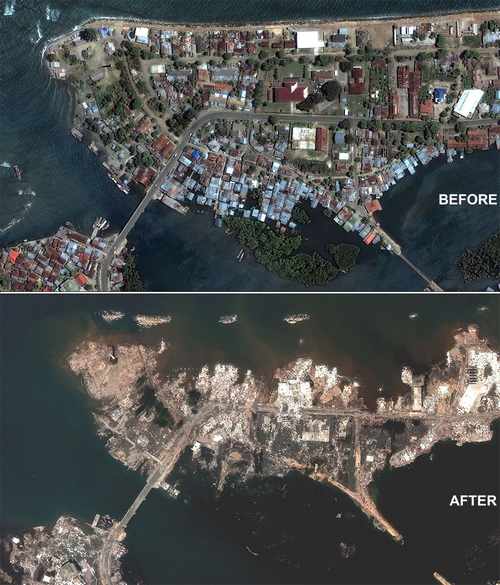
A thirty thousand ton mass of water dropped on either of the twin towers would completely destroy them.

A large mass of water plus a dash of acceleration makes for an incredibly destructive combination. This is the very first thing an engineering student would learn as he begins his specialization in marine engineering.

Every hear of a "tsunami", Hiewa?
before_after_tsunami_2004_500.jpg
 
No, I just say that local failures (eg due local heating, weakining of a part, bolt or weld failures) in a steel structure do not produce global collapse of the complete structure (at free fall acceleration). Local failures only produce load transfers and higher stressed and maybe deformed, adjacent parts and further destruction is arrested. It is called redundancy. *snip*

OK, let's say that. So one failure does not cause global collapse. Now, a second failure occurs. Load tranfers to the remaing structire. Now, a third failure occurs. Load transfers to the remaining structure. Etc....

Are you claiming that there will never come a point where the structure fails globally?

Hans
 
Heiwa claims that if you remove a column in a building it will stand up, because the adjacent columns are not very highly stressed, compared to their ultimate capacity, which is true.

However if the beams were simple corbel details then there is no way to get the load to the adjacent columns and you would get a local collapse of the bays either side of the columns.

If the joints were sound and able to take the rotation, then they would act like a catenary and transfer the load to the adjacent floors. The horizontal force causes a horizontal movement as well as a vertical load transfer.

The performance therefore depends on as much how the floors are designed and detailed, as how the columns are designed and detailed.

Even though you're already 12 posts in, if no one else has welcomed you to the forum yet: "Welcome!" :D.

And now to your point: Yes, even we non-engineer and non-architect folks here have figured out what you have said, just nowhere near the same level of detail. Thanks to the various engineers and architect trained posters who've helped us understand this; another such as you is always welcome here. But anyway, yes, it's true: So much depends on specific aspects of how a building was constructed that sweeping conclusions about failure behavior such as what Heiwa makes are unsupportable. It really doesn't help that his analogies are also getting sillier with each post.

Heiwa might be able to gain some headway if his thesis about how steel reacts in a collapse didn't contradict already established principles of steel failure, but unfortunately, this doesn't seem to bother him.

Anyway, thanks for participating. Chalk this up as yet another person who sees through the silliness.
 
OK, let's say that. So one failure does not cause global collapse. Now, a second failure occurs. Load tranfers to the remaing structire. Now, a third failure occurs. Load transfers to the remaining structure. Etc....

Are you claiming that there will never come a point where the structure fails globally?

Hans

Yes. You are just describing how to carry out structural damage analysis; you identify the first structural failure (e.g. due to fire or overload) and do a static structural analysis to see if there will be a second failure that further modifies the structural arrangement and the loads applied. Then you redo the static analysis with that case to identify the third failure, etc, etc. You establish a path of failures.

NIST never did that for WTC7. Evidence for that is that NIST agrees in the final 'final' report - see fig. 3-15 - that the structure above floor 16 is in 100% free fall for 2.25 seconds. The beauty with a structure in free fall is that gravity does not impose and loads at all on the structure! All gravity induced stresses and deformations in the structure becomes zero (0 !!) and no failures can take place anywhere.

Strangely enough NIST suggest the opposite and show three, four pictures to this effect, incl. parts flying around but the pictures are simply faked!!

The WTC7 structure was very simple - vertical columns carrying primary loads transmitted to them by horizontal (floor) beams carrying secondary loads.

A failure of a beam anywhere for any reason (fire!) will just cause the secondary load on it to drop down on the beam below ... and that's it. Further failures are arrested. The loads in the columns do not change at all.

A failure of a column for any reason (buckling due fire suggested by NIST) will just cause the primary load carried by it to be transferred to adjacent columns via the beams. Sudden simultaneous collapse of all columns resulting in free fall of structure above is not possible.

It is all explained at http://heiwaco.tripod.com/nist7.htm .

Heiwa
 
A photo of Professor Heiwa from archives:

 
Last edited:

Back
Top Bottom