• Security incident: ISF was recently accessed by intruders. Please change your password, and change it anywhere else you used it. Read more

Moderated Steel structures cannot globally collapse due to gravity alone

???? G destroys H and H destroys G, while J is looking on. How can H/G then destroy J????

Your use of the word "destroys" is highly misleading here, as it suggests G and H cease to exist. "Fragments" would be a more appropriate word, indicating that the mass of G and H is still present and able to fall on floor J.

And remember the Björkman axiom:

"If you want your calculations to support a specific conclusion, it's simpler to just state the conclusion and forget about doing the calculations."

Sorry, was that Björkman's Second Axiom?

Dave
 
You really have to read the BLGB paper - part C crushing part A (both of uniform density 0.25) and in the process producing part B (rubble with density 1.0 of what was previously the top of part A while part C is undamaged). Evidently part B is not joining parts A and C. It is a cushion of rubble that is 4 times more dense than both parts A and C and accelerating!

It is like compressing three lemons A, B and C in line! Force is applied on A and C and only B is compressed ... and accelerated. If you can do that in the real world of lemons, you'll win a prize.

ok, is there a difference between a force being applied from above (pushing down on the lemons) and a force pulling down from below (gravity). I cant figure out if there is.

But, imagine for a second, three lemons stacked up on a solid surface. Then apply wire to the top lemon at its base, all around its base, and thread the wires through holes in the solid serfice so they can be pulled from underneath.

Now, assuming the wires can be attached so they dont rip through the top lemon, pull on all the wires. I think the top lemon would squash the lower lemons.

You cannot attach the wires to the top of the top lemon and pull down on it because that would be the same as pushing from the top.

excue me if this is garbage. Just thinking out loud.
 
Now if I drop 13 floors on one floor, the one floor is subject to be more damaged than the 13 floors, correct?

How do you do that? One at a time or all 13 in one go - how? Pls describe the steel structure that shall globally collapse by dropping floors on it and I will explain.
 
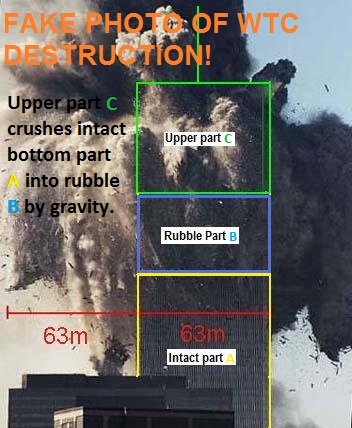
Solely gravity collapsze? Look at WTC 1! WTC 2 is same.

WTC.jpg


According NIST the upper part C is supposed to drop on and apply kinetic energy on lower part A that A cannot absorb due to lack of strain energy (strength), so that A is collapsing during 10-15 seconds!

According Bazant & Co the upper part C is supposed to drop and to one-way crush down lower part A into a compressed, compacted rubble layer part B(azant) that destroys A also during 10-15 seconds.

But gravity cannot produce this fountain of debris we see throwing debris in all directions!

Actually, a small top part of any structure cannot destroy the lower strcutural part due to a small drop and gravity. The small top part would remain up top ... arrested by the lower structure.

What you see is just simple, top down, controlled demolition of the tower!
How can you be completely wrong on everything?

Gravity collapse of each WTC had the energy of over 130 TONS of TNT energy to do all the things you say gravity can't do; but gravity did do.

Edited by Gaspode: 
Edited for civility - moderated thread.


Everyone can do the work using physics to see the energy of the gravity collapse had 130 TONS of TNT; like 130 2,000 pound bombs hitting each WTC tower. The fact is Energy is equal to the mass, times gravity, times the height.

E=mgh. Heiwa is proved wrong by physics.
 
Last edited by a moderator:
How do you do that? One at a time or all 13 in one go - how? Pls describe the steel structure that shall globally collapse by dropping floors on it and I will explain.

All 13 drop. Let's compare the structure design to WTC's 1&2. The drop is 2 floors of distance and the 13 floor section is not aligned with the single floor. At first contact, which receives more damage?
 
All 13 drop. Let's compare the structure design to WTC's 1&2. The drop is 2 floors of distance and the 13 floor section is not aligned with the single floor. At first contact, which receives more damage?

Pls describe the steel structure that shall globally collapse by dropping floors on it and I will explain.
 
Pls describe the steel structure that shall globally collapse by dropping floors on it and I will explain.

The steel structure is designed as a duplicate of the WTC's 1&2.

Now which receives more damage at initial contact; The 13 floors dropping? Or the floor the 13 are dropping on to?
 
The steel structure is designed as a duplicate of the WTC's 1&2.

Now which receives more damage at initial contact; The 13 floors dropping? Or the floor the 13 are dropping on to?

OK, your steel structure is a duplicate of WTC 1&2. Good.

Now the question; Upper part C composed of 13 floors (+ connecting structure) drops on lower part A composed of 97 floors (+ connecting structure). Which recieves more damage?

In my view the bottom floor + proximate structure of C = 1/13th of C may be damaged together with the top floor + proximate structure of A = 1/97th of A are damaged. Reason being that these local elements are similar in all respects. In absolute terms possible damages C and A are equal. In proportionate terms damages to C are 97/13 times greater.

In reality C may just bounce on A and there would be no real damages.

Anyway, in no case C can cause a global collapse of A.
 
OK, your steel structure is a duplicate of WTC 1&2. Good.

Now the question; Upper part C composed of 13 floors (+ connecting structure) drops on lower part A composed of 97 floors (+ connecting structure). Which recieves more damage?

In my view the bottom floor + proximate structure of C = 1/13th of C may be damaged together with the top floor + proximate structure of A = 1/97th of A are damaged. Reason being that these local elements are similar in all respects. In absolute terms possible damages C and A are equal. In proportionate terms damages to C are 97/13 times greater.

In reality C may just bounce on A and there would be no real damages.

Anyway, in no case C can cause a global collapse of A.

No Heiwa, you did not answer what I was asking. What happens to the floor that the 13 drop onto at initial contact?

There is momentum from the 13 floor block striking the stationary floor below, so at this specific moment which section receives more damage? The single floor being struck or the 13 floor section striking the single floor?
 
AA. No Heiwa, you did not answer what I was asking. What happens to the floor that the 13 drop onto at initial contact?

BB. There is momentum from the 13 floor block striking the stationary floor below, so at this specific moment which section receives more damage? The single floor being struck or the 13 floor section striking the single floor?

AA. At initial contact the bottom floor of the 13 moving floors impacts the floor you are interested in. BANG!

BB. ?? No, only the bottom floor of the 13 moving floors impacts the stationary floor. The stationary floor is, let's assume, similar to the bottom floor of the 13 moving floors, so weaker elements of both floors are damaged by stronger elements of both floors. The 12 other mowing floors above have not impacted anything.

The info in BB is one reason why steel structures cannot globally collapse due to gravity alone.
 

ISF - Join now!

Every member here is approved by hand. No bots, no spam, just people who care about evidence and honest debate.

Membership is free!

Create your free account

Back
Top Bottom