
I'd wouldn't be surprised if running and slow walking turned out to be almost completely different activities mechanically; perhaps as much different as walking versus standing. I'm not prepared to address running.It helps enormously if you're running, because the bounce allows you to recover energy that would otherwise be lost with each "landing".
I don't see why (asuming that we're not hanging on to the bar of the treadmill). If anything, I'd think it would be the other way around. I'm very aware of the amount of muscle activity involved in maintaining balance, because that's something I work on. Stand on one foot, see how high you can count, watch what your feet and lower legs are doing -- a lot of micro-correction going on there; maintaining balance is really a matter of recovering from small losses of balance. For an extra challenge, try it with your eyes closed. When I first started that regimen, I got sore feet out of the deal. On the track, you are free to adjust the pace if necessary to recover from a small loss of balance, whereas on the treadmill, any necessary recovery has to be done at the treadmill's pace (or else).I note that you were talking about a slow walk though. In that case I would guess that a lot more muscle energy is needed for stabilization and shock absorption on the track than on the treadmill.
Again, I don't see why. The treadmill's got what, half an inch of rubber? If that -- and pretty solid rubber, too. I'll bet there's at least as much on the track, and with some amount of air spaces between the particles. You can definitely feel the springyness of it.I don't think a rubberized track will give you anywhere near the cushioning you get on a typical treadmill.

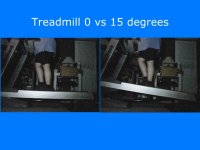
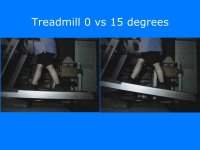


 I love basic physics stuff.


