Merged Thread to Discuss The Excellent Analysis of Jones latest paper

You provided a link but instead of informing readers that you made a mistake ...

It was a reply to Peter May. Peter May is an informed and competent man on the subject matter of EDS readings. He needs not be informed what the content of my link means. It's self-evident

The readers I write this for (Ivan Kminek, Sunstealer, ...) likewise are intelligent, well-informed and critical folks. They understand what Peter May wrote, and will have no difficulty what my linking to Harrit's answers means.


I apologize if any ill-informed and less intelligent readers fail to grasp the obvious.
 
Strange, I see no acknowledgement of your "mistaken assumption" in that earlier post?

But, I do see you ignoring your erroneous oft repeated assumption about the aluminum sample holder while using that link to pursue a different tack.

MM

Tell you what:

Why don't you ask me a couple of yes/no-questions about that, and see how that works out?
 
Strange, I see no acknowledgement of your "mistaken assumption" in that earlier post?

But, I do see you ignoring your erroneous oft repeated assumption about the aluminum sample holder while using that link to pursue a different tack.

MM


Orig. posted by Mr. Oystein.
(ETA: Two minor questions open in my mind:
a) Why doesn't the Al-map show Al everywhere outside of the chip? -> Perhaps the equipment, running in standard configuration, is smart enough to filter out most of the signal that's not from specimens - but obviously it records some of such signal - it's clearly there in the raw data, not very obtrusive, and available to be picked.


I am truly staggered and amazed by some of the comments of 911 truthers on this thread.
It’s perfectly plain to my mind, that Mr. Oystein asked the questions in the same spirit of all those who truly seek the truth, regardless of who that truth might serve. It would do you well to remember this.
Well done Oystein et al, keep up the good work.


It is very important to understand the nature of what we see, not what we want to see.
 
Last edited:
Peter, and Sunstealer, and The Almond,

you know I am playing around with simulation software to get a feel for what the spectra presented by Harrit et al. could mean quantitatively.

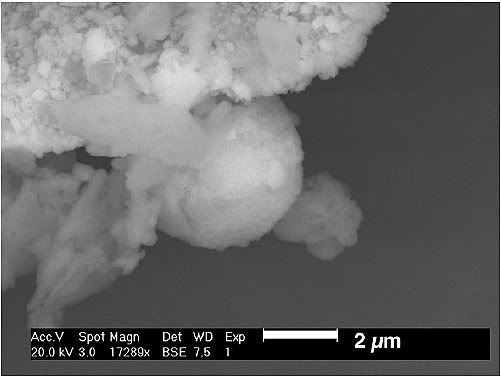
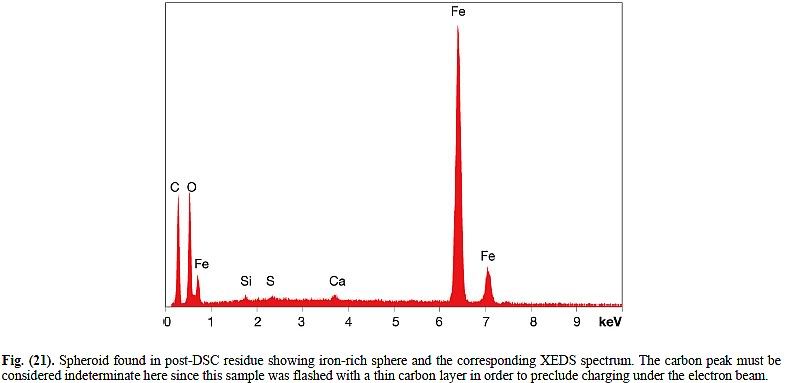
There is one thing I frequently encounter that puzzles me, and that is the rerlative hights of the L-alpha and K-alpha peaks of Fe: In most simualtions I run, the L-alpha has somewhere between 25 and 35% of the height of the K-alpha. In some of Jones's and Farrer's spectra, it's much lower. For example in Fig 21:

ActiveThermiticMaterial_Fig21_1.jpg

ActiveThermiticMaterial_Fig21_2.jpg


It's only like 11% there. I can't replicate that in my simulations.

I use the free DTSA-II program. In all my sims, I either model the stuff as a "homogeneous bulk" or as a "sphere on a homogeneous substrate", where the substrate is "None", i.e. vacuum. (When I try to play with substrate, i.e. a hematite pigment on epoxy, the substrate dominates in ways that make me thing it's not helpful)

I find that the L:K ratio for Fe depends on sphere diameter: The smaller the sphere, the larger the L-alpha.
For example, simulating the above as a large 100 micron sphere (which gives almost the same result as bulk), with a molar Fe:O ratio close to 2:3 and an appropriate amount of C, gets me an L:K ratio of 25%:

Fig21_100micronSphere_Sim3_20keV_zpsae49514e.png


versus a Fe3O4 mix and an appropriate amount of C as a 5 micron sphere - L:K is 38%:

Fig21_5micronSphere_Fe3O4C10_20keV_zpse6997376.png


What's making Jones's sphere - which looks more like a fuzzy snowball to me - have such a low L-alpha peak? Could it perhaps be that the surface isn't smooth and polished?
 
Last edited:
Oystein: I have indeed no idea why L-alpha peak of Fe is so low in Fig. 21.

But is it true that your simulations and their comparison with Fig. 21 indicate in this particular sphere the presence of Fe2O3 or Fe3O4 or something in between?

Then, the claim of Harrit et al that "substantial elemental iron must be present" is highly questionable (again).

Btw, I have just noticed this sentence in Bentham paper: "This result (shown in Fig. 17, I.K.) was repeated in other iron-rich spheroids in the post-DSC sample as well as in spots in the residue which did not form into spheres."

This should mean that some "spots" (probably remains of gray layers?) were not transformed into microspheres. As I already pointed out, one such partially transformed gray layer is visible in Fig. 20, in the upper-right image in its lower-left corner.
In fact, even Harrit et al seem to say/admit by this sentence that microspheres were formed from gray layers. At least I think so:cool:
 
Last edited:
I have thought about the DSC results once more, and specifically that one chip which was determined to have released 7.5 kJ/g of specific energy. You know, the old argument that thermite alone cannot release more than 3.96 kJ/g, and there is some inert mass on that chip (the gray layer), so there has to be some substance that releases significantly more than 7.5 kJ/g. Harrit et al. correctly suggest that the organic matrix must be "energetic", and of course it is.

Yesterday and the day before that, I took some time to consider the following details:

1. Where does the oxygen for the organic combustion come from? Either from air - in that case, this material would not exhibit all the great properties of "nanothermitic materials", for it would depend on ambient oxygen and could only burn its surface; both limit burn rate and achievable temperature. Or the organic contains its own oxidizer.

1.1 Combustion in air:
Tabulated values of specific energy for non-halogeneous flammable polymers range from 15 to 42 kJ/g. The max is for PP and PE. Most are in the 20-30 kJ/g range. The more energetic the polymer, the less you need to boost the chip from the <4 kJ/g to 7.5 kJ/g, i.e. the higher the thermite content could be.
The maximum, 42 kJ/g, is for polymers which only contain C and H, no O, and which burn to completion, releasing CO2 and water. For example Polypropylene has the sum formula (C3H6)n. No O means practically it fully unoxidized, ot´r caries no "dead load" in its structure.

1.2 Polymer with embedded oxidizer
Much more difficult to find tabulated values, but one can envelop the maximum achievable specific energy:
Again, consider the most highly energetic polymer, PP, which is (C3H6)n. To fully oxidize it and release all its energy, you need 0 oxygen atoms for each propylene group:
C3H6 + 4.5 O2 -> c CO2 + 3 H2O
So any oxidizing agent that you could mix with PP to make it "thermitic" would have to have 9 O-atoms per P-group - plus whatever else that agent is made of. C3H6 has a molecular weight of 42, 9 O-atoms weigh 144, so 1 g of PP your mix would have to include > 144/42 g of oxidizer, for a combined weight of 186/42 g. These >186/42 g would still release no more than about 42 kJ - the specific energy of the composite (PP + oxidizer) is thus < (42 / (186/42)) kJ/g, or < 9.5 kJ/g.
This value is heuristically an upper limit to the energy density of any "thermitic" polymer composite.

2. All the EDS-spectra of bulk red layers and their residues presented by Harrit et al, Basile and Millette clearly suggest that there is always at least as much Si in them as Al, and often more. So for this 7.5 kJ/g chip from the DSC experiment, we may assume that it, too, had at least Si=Al by mass.

3. Fig. 16 suggests that the Si is oxidized as SiO2. This will be my only assumption for which I don't already have Harrit's agreement or more solid data, but I think it is reasonable.

4. Numbers 2. and 3. together mean that for each Al-atom, I have one SiO2 molecule. For each 2 elemental Al-atoms, I need 1 Fe2O3 molecule for a thermite reaction, and those come with 2 SiO2 molecules. It can thus be easily computed from atomic weights that for each mass unit of ideal, stoichiometric thermite, our chip will have 0.541 mass units of inert SiO2 in the red layer.

5. The gray layer consists mostly of iron oxide, density 5.2 kg/L, which Harrit et al. consider to be inert. I agree that it is inert in the sense that it doesn't burn. In reality, this layer also contains hydroxyls which are released as H2O as the chip is heated, and that is mildly exotherm. But I will ignore thatm the contribution towards the 7.5 kJ/g is probably not great.
The red layer is assumed to consist of organic matrix, Al and silica, all of which have a much lower density, plus some iron oxide in the thermite. So the density of the red layer is considerably lower than that of the grey layer. Harrit et al. describe the layers as having about the same thickness, by order of magnitude, so usually the gray layer would have a larger mass than the red layer due to its higher density. On the other hand, the chip that released the most energy probably had the least amount of gray mass, so I will assume that both layers have the same mass. I will also do some calculations that ignore the gray layer (mass=0)


So, with all of those assumptions and limiting cases explained, I created a spreadsheet to figure out the maximum amount of thermite thermite and minimum amount of organic matrix to enable the chip to reach 7.5 kJ/g, for a variety of cases:
- With and without gray layer = red layer by mass
- Thermite with ideal (3.96 kJ/g) and realistic (3.0 kJ/g) energy density
- Polymers with 42 (PP in air), 30, 20.4 (epoxy) and 9.5 (PP with ideal oxidizer)


And got the following conclusions:


1. It's not practically possible that the chip was boosted by a "thermitic polymer" to its 7.5 kJ/g - the organic matrix must have burned on air
2. The organic matrix must have provided at least 10 times as much energy as the maximum possible amount of thermite
3. That chip therefore cannot have been thermitic in any sensible meaning of the word


Full discussion and math: 7.5 kJ/g disproves thermitic material

(Prediction: That blog post will not go viral on any social network! :D)
 
1.1 Combustion in air:
Tabulated values of specific energy for non-halogeneous flammable polymers range from 15 to 42 kJ/g. The max is for PP and PE. Most are in the 20-30 kJ/g range.

Polypropylene and polyethylene are everywhere in modern office buildings. This is one of Dr. Quintiere's reasons for believing that the fuel load in office fires is greatly underestimated.

1.2 Polymer with embedded oxidizer
Much more difficult to find tabulated values, but one can envelop the maximum achievable specific energy:
Again, consider the most highly energetic polymer, PP, which is (C3H6)n. To fully oxidize it and release all its energy, you need 0 9 oxygen atoms for each propylene group:
C3H6 + 4.5 O2 -> c CO2 + 3 H2O

Fixed typo.:)

1. It's not practically possible that the chip was boosted by a "thermitic polymer" to its 7.5 kJ/g - the organic matrix must have burned on air
2. The organic matrix must have provided at least 10 times as much energy as the maximum possible amount of thermite
3. That chip therefore cannot have been thermitic in any sensible meaning of the word

One of the reasons Harrit's paper is self-refuting. A half-competent chemist would never run his DSC test under air in the first place, and if this result were submitted to a competent chemist or referee, he would point out that it's thermodynamically impossible, without even knowing Harrit's procedure.
 
Polypropylene and polyethylene are everywhere in modern office buildings. This is one of Dr. Quintiere's reasons for believing that the fuel load in office fires is greatly underestimated.


Fixed typo.:)


One of the reasons Harrit's paper is self-refuting. A half-competent chemist would never run his DSC test under air in the first place, and if this result were submitted to a competent chemist or referee, he would point out that it's thermodynamically impossible, without even knowing Harrit's procedure.

Is that one of the reasons he disagreed with some of the recommendations of the committee?
 
Is that one of the reasons he disagreed with some of the recommendations of the committee?

I'm pretty sure it is. Dr. Quintiere has been on a mission to upgrade fire protection in office buildings, and IMNSHO he has a good case. Offices once mostly had furniture made of metal or wood, which burns slowly, yielding about 4 kcal/g; and carpets made of wool or perhaps something like rayon, which also burn slowly at about 4 kcal/g.

As Oystein has pointed out, plastics burn with much more energy. They first liquify, then erupt into horrific fires. That acrylic or polypropylene rug you may be sitting on is a real bundle of energy!
 
Oystein: Harrit et al. describe the layers as having about the same thickness, by order of magnitude, so usually the gray layer would have a larger mass than the red layer due to its higher density. On the other hand, the chip that released the most energy probably had the least amount of gray mass, so I will assume that both layers have the same mass.

When you begin with distortions and by making silly assumptions you can pretty much get whatever result you want. Your claim that Harrit et al say the layers have "about the same thickness" is very deceptive, since they actually say that both layers vary from 10 to 100 microns. They explain the variation of output with different ratios of red to gray layer mass but you make the assumption of the same mass, apparently unaware of the contradiction.

The explanation for output beyond std thermite is so simple even a kid could understand, the thermitic ingredients are mixed with an organic material that will obviously vastly increase output, especially when ignited in air. As you say yourself:
Most are in the 20-30 kJ/g range. The more energetic the polymer, the less you need to boost the chip from the <4 kJ/g to 7.5 kJ/g, i.e. the higher the thermite content could be.

It really is that simple. But you try to make things complicated:
That chip therefore cannot have been thermitic in any sensible meaning of the word

The organic matrix is not the reason why Harrit et al call the chips "thermitic material", the reason is the aluminum+ironoxide embedded within the matrix, that ignites and leaves reduced iron according to them. If you want to prove them wrong then publish a paper that refutes their result of reduced iron.

You know, the old argument that thermite alone cannot release more than 3.96 kJ/g..

Prediction: That blog post will not go viral on any social network!

Your prediction is probably correct, but you never know, certain forums keep repeating "old arguments" no matter what.:o But you really should not worry about the latest gossip at some forums, if you think you really nailed them on this one, go publish. Prediction: You won´t.:rolleyes:
 
The organic matrix is not the reason why Harrit et al call the chips "thermitic material", the reason is the aluminum+ironoxide embedded within the matrix, that ignites and leaves reduced iron according to them. If you want to prove them wrong then publish a paper that refutes their result of reduced iron.

I just figured I'd quote this so anyone that has you on ignore can get a good laugh too. :rolleyes:
 
The organic matrix is not the reason why Harrit et al call the chips "thermitic material", the reason is the aluminum+ironoxide embedded within the matrix, that ignites and leaves reduced iron according to them. If you want to prove them wrong then publish a paper that refutes their result of reduced iron.

:

@jtl, please can you tell me why the iron oxide embedded within the organic matrix is traceable yet the aluminium is not.

Can you also tell me if there is any traces of aluminuim left after DSC, if there are no traces please tell me where the aluminium goes.
 
When you begin with distortions and by making silly assumptions you can pretty much get whatever result you want. Your claim that Harrit et al say the layers have "about the same thickness" is very deceptive, since they actually say that both layers vary from 10 to 100 microns. They explain the variation of output with different ratios of red to gray layer mass but you make the assumption of the same mass, apparently unaware of the contradiction.

The explanation for output beyond std thermite is so simple even a kid could understand, the thermitic ingredients are mixed with an organic material that will obviously vastly increase output, especially when ignited in air. As you say yourself:

It really is that simple. But you try to make things complicated:


The organic matrix is not the reason why Harrit et al call the chips "thermitic material", the reason is the aluminum+ironoxide embedded within the matrix, that ignites and leaves reduced iron according to them. If you want to prove them wrong then publish a paper that refutes their result of reduced iron.


Your prediction is probably correct, but you never know, certain forums keep repeating "old arguments" no matter what.:o But you really should not worry about the latest gossip at some forums, if you think you really nailed them on this one, go publish. Prediction: You won´t.:rolleyes:

I respond to this, because you do one valuable and sensible thing there: You question the validity of my assumptions, specifically of the assumed mass ratio red:gray layer.

Now first of all, I must point out that the deceptive one here is you: You complain that 'Your claim that Harrit et al say the layers have "about the same thickness" is very deceptive' - but I don't claim that! I do not say that Harrit et al say the layers have "about the same thickness", I say they have "about the same thickness, by order of magnitude". Your deception lies in leaving out the hilited bit. My claim is correct, and YOU even present the evidence for why my claim is correct: "they actually say that both layers vary from 10 to 100 microns". This can be parsed as
- The red layer varies from 10 to 100 microns
- The gray layer varies from 10 to 100 microns
The "10 to 100 microns" is a metric for the order of magnitude of the thickness of either layer - and they are the same!


Now you say that my assumption that both layers have the same mass is "silly". What do you base this judgement on? Do you have a better, less silly assumption? Please give me a better assumption to work with - lower or upper bounds perhaps?
The problem is, that I have to make assumptions in the first place. The problem is not of my making - blame Jeff Farrer for it, because it was Farrer who failed completely to characterize the four specimens before wasting them in the DSC.


But, again, it's fair and valuable to question assumptions. It is certainly possible that the gray layer had less mass than the red layer, on that particular specimen.

Let me try to justify my assumption, or perhaps find reasons to adjust it!


We know that the gray layer was at least 10 microns thick and the red layer at most 100 microns. So a reasonable lower limit for the volume ratio of gray:red layer is 1:10.

To get from this to a mass ratio, we have to estimate the densities of both the gray and the red layer.
For the gray layer, that's pretty straightforward: It is known to be mostly iron oxides, and all the common iron oxides have densities of 5.2 kg/L or more.
For the red layer, it's a bit more complicated, as it is a composite material with (at least) 4 constituents. These are, in the model we are discussing here: Hematite, Al, silica and organic polymer. An upper limit for an envelope can be derived from the mix in my article with the highest thermite-content under ideal conditions (no gray layer at all, perfect energy yield of thermite, best available polymer). This mix, which is found in the last line of the first table in my blog post, is
Substance|wt-%=kg|density kg/L|volume L
Fe 2 O 3 |44.46%|5.242|0.08482
Al|15.06%|2.7|0.05577
SiO 2 |28.23%|2.648|0.10663
Polymer|12.25%|0.959|0.12769
SUM, red layer|100% = 1 kg| 2.667 kg/L |0.37490 L
The density of polymer is for the polymer with the highest energy density expressed in kJ/L, which is PE-HD; it has a slightly lower specific energy than PP; and this case represents ideal, i.e. practically impossible conditions. So I take the liberty to round down: Density of the red layer is <= 2.6 kg/L

With those number, we can calculate the minimum ratio of gray:red layer as
(10x5.2):(100x2.6) = 52:260 = 0.144:1

The problem now is of course that we arrived at this result of "gray layer has at least 14.4% the mass of the red layer" from a contradictory premise of "gray layer is 0%". With gray layer 14.4%, the maximum possible mass of thermite drops, with it the density of the red layer, and with that the minimum mass percentage of the gray layer increases!

Now I can use my spreadsheet, with a few formulas added on, to figure out the actual minimum mass of the gray layer such that premise and result don't contradict. This number is dependent on the actual energy yield of the thermite, and the yield of the organic matrix. At the ideal 3.96 kJ/g for thermite and 42 kJ/g for the polymer, it turns out that the gray layer has to have at least 21.09% of the mass of the red layer, at which point the red layer has a density of 2.466 kg/L, and the polymer releases 3 times as much energy as the thermite.

Now here is a table for varios values of specific energies of the two agents:
Thermite kJ/g|Polymer kJ/g|gray layer mass|yield Thermite:Polymer
3.96|42|20.09%|1:3.04
3.96|30|24.26%|1:3.58
3.96|20.4|30.52|1:5.08
3.96|9,5|impossible|impossible
3.00|42|21.67|1:4.45
3.00|30|25.04|1:5.25
3.00|20.4|31.51|1:7,45
3.00|9,5|impossible|impossible
So we see: The gray layer cannot have less than 20.1 % of the mass of the red layer, AND the organic matrix cannot contribute less than 3x as much energy as the hypothetical thermite.

It is not possible, in any case, that the organic matrix is itself thermitic, as long as
- the gray layer has at least 10% of the volume of the red layer, as Harrit et al. imply
- the red layer contains as many mols of silica as Al, as Harrit et al's data imply
 
Oystein: "about the same thickness, by order of magnitude". Your deception lies in leaving out the hilited bit.

For crying out loud, do you ever read your own gibberish before you post it?
When someone says object X is 10 times as large as object Y, this person is not at all saying they are "about the same" size, just the OPPOSITE.

I don´t know if you did this because of your ignorance, or in an attempt to deceive, but these mistakes or silly assumptions you make are the reason why I am quite sure that you cannot ever publish any of your latest "research", as I said earlier:
But you really should not worry about the latest gossip at some forums, if you think you really nailed them on this one, go publish. Prediction: You won´t.
 
Last edited:
For crying out loud, do you ever read your own gibberish before you post it?
When someone says object X is 10 times as large as object Y, this person is not at all saying they are "about the same" size, just the OPPOSITE.

I don´t know if you did this because of your ignorance, or in an attempt to deceive, but these mistakes or silly assumptions you make are the reason why I am quite sure that you cannot ever publish any of your latest "research", as I said earlier:

Next time when you cry out loud about Oystein, don't forget he said by order of magnitude.
 
When someone says object X is 10 times as large as object Y...

Who is saying that which object X is ten times as large as which object Y?

And did you read the rest of my post? Which proves that, when the gray layer is at least 10% the volume of the red layer, it has to have at least 20% of its mass, and then at least 75% of the energy must be provided by an organic matrix burning with ambient air to reach 7.5 kJ/g?
 
Oystein: Who is saying that which object X is ten times as large as which object Y?

Bottom line my dear, Harrit et al NEVER said the layers are "about the same", like you tried to say. Both Harrit and you imply that the ratio of gray-red varies by up to 10:1, you even repeat that in your very next sentence:
And did you read the rest of my post? Which proves that, when the gray layer is at least 10% the volume of the red layer, it has to have at least 20% of its mass, and then at least 75% of the energy must be provided by an organic matrix burning with ambient air to reach 7.5 kJ/g?

You keep making silly assumptions, even if you have a gray layer that is 10% the thickness of the red layer, that does not mean this gray layer covers the whole area of the red layer, it could be just a tiny gray layer covering 10% of the area, cutting down your assumption of mass by a factor of 10.

There is no point arguing about the 7.5kj/g as there is nothing peculiar about this energy given organic matrix and air ignition. And there is also no point arguing about whether the proposed embedded nanothermite provided 25% of the energy or some other number. As long as a thermite reaction provides some of the energy, the hypothesis of a "thermitic material" is valid.
 
Last edited:

ISF - Join now!

Every member here is approved by hand. No bots, no spam, just people who care about evidence and honest debate.

Membership is free!

Create your free account

Back
Top Bottom