dflynn,
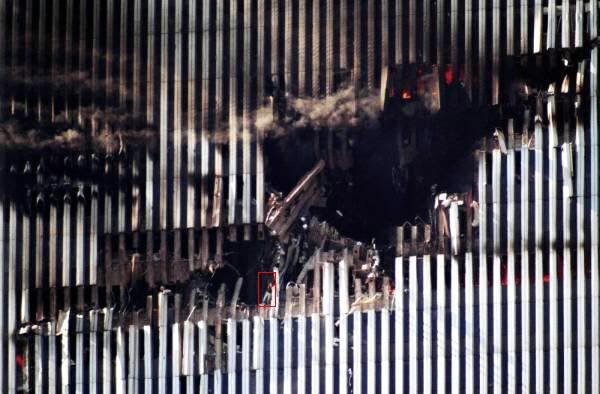
"The towers were built to withstand a jet impact" is a myth. An urban legend.
It is false.
Yeah, I know perfectly well that it gets repeated over & over. Famously by Frank DeMartini, the building manager in 2001.
As in
THIS VIDEO.
Mr. DeMartini was a
bona fide hero of 9/11, who gave his life that day trying to save others, while knowing the risks. And deserves all the respect in the world for those actions.
But he was a building manager. His job was to deal with the day to day running of an already constructed office complex. This means dealing with unions, project scheduling, & city hall. He didn't know diddly about Structural Engineering, as proven by his "pencil & screen netting" comment. I invite any one of you to show me some "structural" screen netting, loaded in high levels of compression. The answer is "the screen netting is unaffected by the pencil poke precisely because it is weak & flexible & in tension, not compression." Things that are weak & flexible & loaded in tension are singularly useless at holding up buildings.
Notice that the author of this video has "promoted" Mr. DeMartini to "Designer of the Twin Towers". Great. I guess John Skilling decided to hire a grammar school kid in 1963 to design the tallest building in the world, eh?
This is precisely the type of false, unverified, uncritical stories that underlie all of the truth movement's nonsense.
Listen to one of the real design engineers of the towers, Leslie Robertson, in an interview after 9/11/2001.
"We should not and can not design buildings and structures to resist the impact of these aircraft. Instead, we must concentrate our efforts on keeping aircraft away from our tall buildings, sports stadiums, symbolic buildings, atomic plants, and other potential targets"
Leslie Robertson, Structural Engineer, WTC
http://www.nae.edu/Publications/The...ecurity/ReflectionsontheWorldTradeCenter.aspx
Did you catch that? "We should not
and can not design buildings and structures to resist the impact of these aircraft."
So, what happened between 1964 & 2002? Did we lose the ability to design buildings to withstand aircraft impacts? No. The answer is, we never had it. And we still don't really have it today. (Engineers can make buildings much safer against this form of attack. They CAN NOT design any building - other than windowless 10-foot thick domes, like nuclear reactor containment domes - to withstand airplane impacts.
In order to come close, it takes supercomputers & FEA software, neither of which existed in 1964. They didn't have electronic calculators. They had slide rules. There is no way on earth to do that sort of a calculation with slide rules.
___
OK, the back-story behind "the towers were built to withstand jet impacts"...
What it would take to do this analysis:
Scientists & engineers are pretty damn clever. But there are serious limitations to the calculations that we could make about "real world" parts, prior to 1970s & '80s. That is, prior to the availability of Finite Element Analysis programs. The very first of these programs (NASTRAN) became available in the 1970s & 80s.
The memo that NIST is quoting was dated Feb 3, 1964, prepared by Malcom Levy, the head of planning & construction for the PANYNJ. So there is zero possibility that those software tools were used.
So, where did the myth originate? James Glanz's book "City in the Sky" has the story.
No one knows who started the calculation, but it was apparently carried out by some un-named engineers working for the PANYNJ, under the direction of Levy.
Here's an except from Glanz's book:
*****
"The first part of the calculation would have been quite simple. The towers had been designed to withstand the forces of windstorms with gusts of at least 120 miles an hour. Specifically, they were supposed to hold up against at Least forty-five pounds of lateral force on every square foot without shearing off and toppling. Each tower would be about 1,350 feet tall and 209 feet across on each face: 282,150 square feet. So if a wind sufficient to exert forty-five pounds per square foot of force was blowing directly against one of the faces. that would be about 13 million pounds. all told. And the tower should stand, with a standard safety margin of perhaps 30 to 40 percent to spare.
To figure out if the plane had a chance of tipping the tower over. Mal Levy’s engineers needed to estimate how much force the collision might produce. A Boeing 707 made a B-25 look like an insect in comparison. With a tip-to-tip wingspan of 131 feet and a fuel capacity of more than twenty thousand gallons. a fully loaded 707 can weigh 300,000 pounds on takeoff, and its cruising speed is about 600 miles per hour. The engineers knew that parts of the little B-25 flew all the way through the limestone-encased Empire State Building and out the other side. So it might have been reasonable to assume that the bigger. faster 707. after plowing into the much more compliant facade of a World Trade Center tower, would not come to a complete stop before it reached the opposite side of the floor, 209 feet away. It is a complicated problem to figure out precisely how hard the plane might push on the tower during a collision, but given the plane’s known weight. initial speed, and stopping distance, any freshman engineering student could come up with a rough estimate. The number turns out to be 17 million pounds, probably within the safety margin.
Levy’s engineers had discovered that not even a speeding 707 would shear off one of the towers."
*****
I believe that Glanz has this just slightly wrong. "Shearing" implies that the building slides off of its base. This is a silly, unrealistic failure mode. Structural engineers would recognize this. The proper failure mode would be "tipping", in which the building fractures at the highest stress point (i.e., right at ground level) and tips over. It is trivial to go from shear to moment calculations, and I believe that this slight variation from the one that Glanz describes is the calculation they would have done.
Notice that the wind shear load was 13 million pounds, and the calculated plane impact shear load was 17 million. And they concluded that this was "probably within the safety margin".
THIS is the level of accuracy that the "design for impact" analysis provided.
The second calculation imagined that a number of the beams on one side of the building, equivalent to the wingspan of the plane, were "surgically removed". As if you just took a Sawzall & cut them out. Absolutely no other damage to any part of the building. No fires, no damaged core columns, no damaged floors, etc.
The question asked: Would the building fall over under this condition.
They found out that it would not.
Clearly, neither one of these very unrealistic & very crude calculations comes anywhere CLOSE to a rigorous analysis upon which one could make the assertion that the building "was designed to withstand a jet impact".
____
So, how did the myth arise?
Intrigue, back-stabbing, bluff & bluster, and sloppy, self-serving interpretations of crude calculations.
Lawrence Wien, the "King" of Manhattan Real Estate was the owner of the Empire State Building (and a bunch of other commercial real estate properties in NYC). He, and several others were desperate to stop the WTC project. They didn't want the competition. Wien knew all about the plane that had hit his building (before he bought it). Wien had read the report on the fire damage & response of the ESB.
In Febuary 13, 1964, "... Wien called reporters to his office high above Forty-second Street, where the elegant silhouette of his most prized possession—the Empire State Building—was framed perfectly in his picture window. ... The twin towers, he claimed, would be dangerously unstable and prone to catastrophe, especially in a large fire or an explosion, when they could collapse."
The PANYNJ was not going to let Wien derail their project.
"What the real estate people did not know was that Levy already had his script prepared. Nor could they have known how far the Port Authority was willing to go to protect its project. On February 14, the day after Wien made his allegations. Lee Jaffe summoned reporters for a briefing at Port Authority headquarters. She distributed a three-page telegram sent that day from Richard Roth, one of the partners at Emery Roth & Sons, the New York architectural firm that had been assigned to work with Yamasaki on the trade center. Under the prestigious imprimatur of his firm, Roth had sent in an urgent rebuttal of Wien’s claims. The telegram “authoritatively refutes the false allegations of ‘real estate figures’ published in THE NEW YORK TIMES today,” Jaffe snarled in the memo she gave to one of those reporters. The telegram was impressive and detailed—pointing out, for example, that for the World Trade Center design.
THE STRUCTURAL ANALYSIS CARRIED OUT BY THE FIRM OF WORTHINGTON SKILLING, HELLE & JACKSON IS THE MOST COMPLETE AND DETAILED OF ANY EVER MADE FOR ANY BUILDING STRUCTURE. THE PRELIMINARY CALCULATIONS ALONE COVER 1,200 PAGES AND INVOLVE OVER 100 DETAILED DRAWINGS.
Point number three on the list of design features was this:
3. THE BUILDINGS HAVE BEEN INVESTIGATED AND FOUND TO BE SAFE IN AN ASSUMED COLLISION WITH A LARGE JET AIRLINER TRAVELING AT 600 MILES PER HOUR. ANALYSIS INDICATES
There was no elaboration on that assurance, but after a lengthy list of endorsements supposedly given by other architects and engineer, the telegram ended on this note:
11. THE TOWERS MAY BE SAID TO BE THE FIRST BUILDINGS OF THE 21ST CENTURY AND THE DESIGN CONCEPTS WHICH THEY EMBODY WILL BE INCORPORATED IN SOME MEASURE IN EVERY FUTURE HIGH RISE BUILDING EVER BUILT.
RICHARD ROTH
EMERY ROTH & SONS
Mal Levy, Lee Jaffe. and the Port Authority’s engineers had bested the great Lawrence Wien."
The newspaper reporters ran wild with the story.
And an urban myth was born.
That is the story behind the "design to withstand a jet impact".
A bunch of horse-pucky, fed to reporters, who were not competent enough, or skeptical enough, to do their homework.
___
You can read all about this episode
HERE. Do a search for "Levy", and read pages 131 thru about 139. It's a fascinating little vignette of the PANYNJ project managers bluffing a businessman and the press. And getting away with it.
BTW, Robertson apparently did some later studies (after the towers were built, IIRC). But nobody has ever been able to find those reports, and the limitations on computers & FEA software in the late 1970s imposes the same limitations on the conclusions of that study as well.
By the time the later studies came along, the myth was already well entrenched.
Anyone who says that "The towers were designed to withstand jet impacts" - and there are LOTS of people who do say this - is parroting an urban myth that they do not understand.
Tom