The towers were designed to survive a plane impact


You tried to claim that De Martini was something akin to a scheduling clerk and had no structural expertise. I corrected you on that:

Frank A. Demartini, on-site construction manager for the World Trade Center..... had first worked at World Trade Center when Leslie E. Robertson Associates hired him to assess damage from the truck bombing in 1993.

As for your other comments, maybe you need to make better comments.
 
dflynn,

"The towers were built to withstand a jet impact" is a myth. An urban legend.

It is false.

Yeah, I know perfectly well that it gets repeated over & over. Famously by Frank DeMartini, the building manager in 2001.

A

Tom

I think the whole "jet impact" quote was said because it is a far more "sexy" quote than "the towers were designed to withstand hurricane wind gusts" which was a far greater loading than that of a aircraft hitting it lost in the fog.
 
Just looking for a simple yes or no with thanks to 'were they specifically designed to survive an impact by a large jet plane'


No. Some back-of-the-notebook calculations were done to see whether the towers could withstand the force of a medium size plane going slowly. Based on a plane that hit the Empire State Building, it was assumed the pilot would be lost in fog and circling down very slowly, looking for landmarks.

The "modeling," if you could call it that, did not account for anything beyond the force of impact on the load-bearing parts of the building. It ignored fuel, fire, heat and a host of other things. There was no way to calculate such things over 40 years ago.
 
You tried to claim that De Martini was something akin to a scheduling clerk and had no structural expertise. I corrected you on that:


As for your other comments, maybe you need to make better comments.

"Frank De Martini had a passion for old cars, motorcycles, sailing and everything Italian. He also loved restoring Brooklyn brownstones, and was fascinated with the World Trade Center. Mr. De Martini, an architect, started working at the twin towers when he was hired to assess the damage from the 1993 bombing. He stayed on, becoming the construction manager, the man to see when you wanted to move a wall or rearrange the plumbing." http://www.legacy.com/Sept11/Story.aspx?PersonID=103328

The number 1 expert on the WTC structurally, Robertson. Aircraft impacts were 7 to 11 times greater in energy than designed for. That is significant.

Frank was the Construction manager of the World Trade Center after 1993, Frank is not a structual engineer, he is an architect.

Dr. Robertson is responsible for the structural design of the World Trade Center Towers, Mr De Martini was responsible for construction projects inside the WTC a manager you would use for your projects to move a wall or rearrange pluming. Mr De Martini was a hero who helped people escape from the WTC towers when terrorists attacked us.
 
Last edited:
The Titanic was designed to survive collisions.
 
et fuel burns at 800° to 1500°F, not hot enough to melt steel (2750°F). However, experts agree that for the towers to collapse, their steel frames didn't need to melt, they just had to lose some of their structural strength—and that required exposure to much less heat. "I have never seen melted steel in a building fire," says retired New York deputy fire chief Vincent Dunn, author of The Collapse Of Burning Buildings: A Guide To Fireground Safety. "But I've seen a lot of twisted, warped, bent and sagging steel. What happens is that the steel tries to expand at both ends, but when it can no longer expand, it sags and the surrounding concrete cracks."

So steel doesn't melt but just weakens or steel does melt?
 
So steel doesn't melt but just weakens or steel does melt?

OK, here is a quick 101 for laypeople on steel, temperature and strength:

The strength of any given steel* depends on its temperature. Generally, any increase results in a loss of strength. Steel is for example stronger at 68°F/20°C than it is at 70°F/21°C. The difference is just very very small, of course.

Metallurgists know how to look up how a given steel performs at what temperatures. So for example, at 500°C, it may have only 70% of the strength it has at 20°, or 65%, or 75%. (I am making these numbers up at this point - this is only illustration).
Or, to take a different viewpoint, a given steel may go under 50% of original strength at 800°C, or at 750°C, or 850°C (again, making up these numbers, just to give you the idea).

Iron melts (becomes liquid) at a bit over 1500°C, and so do many steels, but this temperature is irrlevant for the fire performance of structural steel that has to bear any load at all, as it will deform long before becoming liquid. Think of butter: Fresh out of the fridge it will resist a knife pretty well, at 86°F/30°C it becomes soft and hardly resists your knife anymore, but it doesn't melt until hmmm say 113°F/45°C. Think of structural steel as butter straight from the fridge, and steel involved in a building fire as butter in a warm kitchen. It doesn't melt, but it isn't able to carry much weight any longer.

To assess the arguments about steel and office fires, here is one last piece of information you need:
Office fires always generate temeratures above 250°C, frequently above 600°C, can reach 1000°C in some spots if the fire is large (as they were in the WTC), but is highly unlikely to reach 1500°C.
Conclusion: In any office fire, expect steel to lose strength significantly, but don't expect it to melt.

Because of this, structural steel gets covered with a layer of fireprotection - that is an insulation made of heat-resistant fibers. This fire protection delays the heat-up of the steel in case of fire. The aim is to prevent reaching a certain dangerous temperature for a specified time, for example 90 minutes or 2 hours. Such requirements are laid down in Building Codes which construction firms have to obey. The aim of this rating is to allow time for evacuation, and to give the steel a better chance of survival, as 90 or 120 minutes is a realistic time by which fires in a given location die out or get sufficiently under control by fire fighting efforts. In the Twin Towers, much of the fireproofing was removed by the plane impacts, so all bets of steel survival in fires were off.


* There are of course various kinds of steel, optimized for various purposes: Depending on its intended use, steel can be made more or less flexible, harder or softer, easier or harder to work with, more or less resistant to corrosion, having a higher or lower melting point, and of course more or less expensive, etc. This is achieved by mixing in other materials such as carbon, sulfur, or other metals such as molybdanium, nickel etc.

 
So steel doesn't melt but just weakens or steel does melt?
Go here.

http://www.mace.manchester.ac.uk/pr...HotRolledCarbonSteel/mechanicalProperties.htm

Figure 2.

StrengthReductionFactor43ASteel.gif


or here http://rustylopez.typepad.com/newcovenant/2007/03/history_is_made.html

or here http://www.keytometals.com/page.aspx?ID=CheckArticle&site=kts&LN=EN&NM=264

or here for reduction in modulus (stiffness) see fig 5 http://www.nrc-cnrc.gc.ca/eng/ibp/irc/bsi/87-fire-protection.html

or here http://www.corusconstruction.com/en...ctural_design/fire/steelwork_fire_resistance/

or here http://www.engineeringtoolbox.com/metal-temperature-strength-d_1353.html

Typically plain carbon steels lose half their strength at 593°C.
 
I don't see how office stuff would burn sufficiently hot. From the press reports, the claim is the steel softened due to the heat. That did not likely happen.
False. Steel's strength is destroyed by fire. Steel has to be protected from fire or it fails, and fails quickly, killing people and firemen.

Office fires can get hot enough to destroy the strength of steel quickly. This is why steel is encased in fire proofing materials to insulate it from fire. On 911 the insulation was knocked off with impacts equal to large bombs, kinetic energy impacts of 1300 and 2000 pounds of TNT.

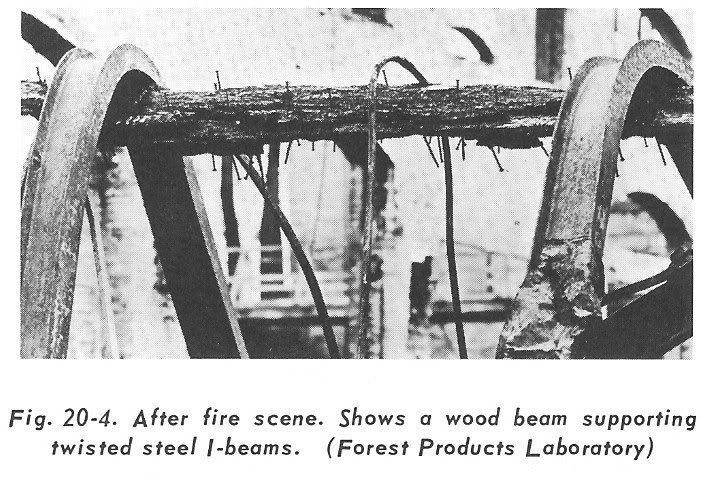
Here is steel exposed to fire.
woodbeambentsteel-full.jpg
 
False. Steel's strength is destroyed by fire. Steel has to be protected from fire or it fails, and fails quickly, killing people and firemen.

Office fires can get hot enough to destroy the strength of steel quickly. This is why steel is encased in fire proofing materials to insulate it from fire. On 911 the insulation was knocked off with impacts equal to large bombs, kinetic energy impacts of 1300 and 2000 pounds of TNT.

Here is steel exposed to fire.
[qimg]http://i286.photobucket.com/albums/ll116/tjkb/woodbeambentsteel-full.jpg[/qimg]

I work on a lot of machines in warehouses with spray on fire insulation on the ceiling/roof trusses. Some of these places, the operators are far less than careful and the masts are too high, they knock it off in clumps.
 
I work on a lot of machines in warehouses with spray on fire insulation on the ceiling/roof trusses. Some of these places, the operators are far less than careful and the masts are too high, they knock it off in clumps.
Hey.........."All the way up" is "all the way up". Do you know how sore your neck gets when you have to look up all the time?


:boxedin:
 
I work on a lot of machines in warehouses with spray on fire insulation on the ceiling/roof trusses. Some of these places, the operators are far less than careful and the masts are too high, they knock it off in clumps.


Yes, speaking as someone who used to pull cable through ceilings for a living, I can attest to the fact that spray on fireproofing is ridiculously (and unfortunately) easy to remove. It doesn't surprise me in the slightest that the sorts of stresses the towers were subjected to when the jets struck (and the resulting explosions) would be more than enough to jar loose significant amounts of fireproofing.
 
And lastly, modeling was simply not as rigorous in the 60's as it can be nowadays.
I think the young'uns have no idea exactly how pathetic computers were 40 years ago, when KILObytes measured RAM. Very few kilobytes. When the towers were built most of the calculations were done by hand with the help of a slide rule. Without limiting the data set, they'd still be designing them.

As it was, the designers did a damned fine job, which is supported by the towers' survival for many years, despite getting hit by jets much bigger and going much faster than they were designed for. If anything, they OVER-engineered. Which is always a good thing: Give a number, but design for twice that.

Didn't Scottie say something like that on TNG, except in reverse, explaining why his quotes were always shorter than what it really took? How to be an industrial hero: Take your worst case scenario and double the time and money. I'm not heroic, as I try to be realistic quoting the trades and don't take into account near enough bumps in my own time. :o
 
Didn't Scottie say something like that on TNG, except in reverse, explaining why his quotes were always shorter than what it really took?


Scotty talks about that sort of thing in the TNG episode "Relics" when he's busy bothering Geordi, but he's referencing an earlier quote from Star Trek III:

James T. Kirk: How much refit time before we can take her out again?
Montgomery Scott: Eight weeks, Sir, [Kirk opens his mouth] but ya don't have eight weeks, so I'll do it for ya in two.
James T. Kirk: Mr.Scott. Have you always multiplied your repair estimates by a factor of four?
Montgomery Scott: Certainly, Sir. How else can I keep my reputation as a miracle worker?
James T. Kirk: [over the intercom] Your reputation is secure, Scotty.


Thank you for your interest in finding out more about Trek. I'm a big fan too. It is always good to meet a fellow starship traveler. If you need any more info, I'd be glad to provide it.
Live long and prosper,
JG
I have to go kill myself now. Bye-bye.

The previous paragrapgh is a truncated, slightly reworded excerpt from The Mystery Science Theater 3000 Amazing Colossal Episode Guide (Bantam Books 1996). Thank you for your interest in finding out more about MST3K. I'm a big fan too. It is always good to meet a fellow "Mistie". If you need any more info, I'd be glad to provide it.
Hi-keeba!
JG
I'm not going to kill myself now, but the thought does cross my mind from time to time. Night-night.
 
Actually, I'm a fan of Svengoolie, nee: Son of Svengoolie, whom some of the MST3K guys watched back in the day. They act as if it's original, but the lineage goes back at least as far as Ghoulardi, who Ernie Anderson created when I was a kid in Cleveland. Around the same time I moved to Chicago a Cleveland DJ, Jerry G Bishop, did, too. He, er, adapted the Ghoulardi character for local tastes. (IIRC, he had Anderson's permission because he was off to Hollywood to be ABC's main announcer, as in, "On The Love Boat tonight...")

Anyway, SoS took over some years ago, back when those guys were coming up. Some bits are similar. OTOH, I recognize some SoS drop-ins from Jerry G's shows in Cleveland and Chicago. I rather like decades of continuity like that.
 
Well, I don't normally wade into these debates on this topic but jet fuel does not burn at a temperature sufficient to melt steel, at least the kind they built the Twin Towers with.

I don't see how office stuff would burn sufficiently hot. From the press reports, the claim is the steel softened due to the heat. That did not likely happen.

Déjà vu is the experience of feeling sure that one has already witnessed or experienced a current situation.

Dave
 
For Ergo since he will miss it and datamine the wrong stuff.

"Frank De Martini had a passion for old cars, motorcycles, sailing and everything Italian. He also loved restoring Brooklyn brownstones, and was fascinated with the World Trade Center. Mr. De Martini, an architect, started working at the twin towers when he was hired to assess the damage from the 1993 bombing. He stayed on, becoming the construction manager, the man to see when you wanted to move a wall or rearrange the plumbing." http://www.legacy.com/Sept11/Story.aspx?PersonID=103328

So like normal reading for comprehension has reared up and bit ergo in the ass again.

poor ergo... Try to not step ONTO your dick or INTO a pile o' fail.
 

ISF - Join now!

Every member here is approved by hand. No bots, no spam, just people who care about evidence and honest debate.

Membership is free!

Create your free account

Back
Top Bottom