The towers were designed to survive a plane impact

dflynn

New Blood
Joined
Mar 18, 2011
Messages
2
Hi, I frequent other forums which have conspiracy sections and this pops up a lot, that the towers were designed to survive a plane impact.

A cursory search online points more to the fact they designed the building and somewhere along the line someone said hey this is really tall what if a plane hits it, so they had a chat about the possibility around a coffee and talked themselves into believing it would survive.

This is a far cry from being specifically designed to survive and all the considerations to materials , supports, fire prefention etc, that would entail.

I am sure this has been brought up a lot so apologies, the amount of threads upon searching was unreal.

Just looking for a simple yes or no with thanks to 'were they specifically designed to survive an impact by a large jet plane'

merci
 
they did survive. long enough to get the vast majority of the personnel out.
 
I guess you missed it but there is a link at the top of each page to search the forum which makes it easy to find threads and posts were topics were previously discussed.
 
Hi, I frequent other forums which have conspiracy sections and this pops up a lot, that the towers were designed to survive a plane impact.

A cursory search online points more to the fact they designed the building and somewhere along the line someone said hey this is really tall what if a plane hits it, so they had a chat about the possibility around a coffee and talked themselves into believing it would survive.

This is a far cry from being specifically designed to survive and all the considerations to materials , supports, fire prefention etc, that would entail.

I am sure this has been brought up a lot so apologies, the amount of threads upon searching was unreal.

Just looking for a simple yes or no with thanks to 'were they specifically designed to survive an impact by a large jet plane'

merci
Welcome to the forums!

Yes. It was assumed the plane (a 707) would be lost in the fog or low on fuel and looking to land at one of the local airports. They assume it would be going slow based on that. They also didn't consider fuel load and the fires that such an accident would cause.

They also determined the collapse mechanism. According to Les Robertson, the guy who designed them, they fell as they theorized they would.

Like Thunder said they did survive the impacts. Many people credit the engineering for saving lives in that respect. On the other hand, many believe the design and placement of the stairwells was one of the main causes of loss of life above the impact zone.
 
Thunder is right. The bottom line is that one of the designers is on record as saying that the example they were thinking of was a 707, low on fuel, and lost in the fog on landing approach, therefore flying slowly. Not a 757/767 with a pretty decent fuel load going in excess of 400 knots.

Furthermore, fuel loads were not taken into consideration. The subsequent fires were initially thought to be small, limited, and controllable enough by the sprinkler systems to allow for further firefighting to take place.

And lastly, modeling was simply not as rigorous in the 60's as it can be nowadays. Computerization has allowed for very good advances in structural modeling, and issues that were not easily considered in decades past can now be studied in simulation. But the point is that the design didn't have the benefit of this computerization back then.

In spite of that, the towers stood long enough for a substantial evacuation to take place. Many of the people who were trapped were on floors above the impact/fire zones, and if there was some escape route for them, it's definitely plausible that they would've had time to evacuate too. That, in fact, is the topic of one of the subreports of the famous NIST report: "Occupant Behavior" and "Egress".

Do a forum search for the terms "Robinson" (that's Leslie Robinson, the chief structural engineer during the constructoin of the towers), "low fuel" and "707", and you'll come up with the relevant threads.
 
Hi, I frequent other forums which have conspiracy sections and this pops up a lot, that the towers were designed to survive a plane impact.

A cursory search online points more to the fact they designed the building and somewhere along the line someone said hey this is really tall what if a plane hits it, so they had a chat about the possibility around a coffee and talked themselves into believing it would survive.

This is a far cry from being specifically designed to survive and all the considerations to materials , supports, fire prefention etc, that would entail.

I am sure this has been brought up a lot so apologies, the amount of threads upon searching was unreal.

Just looking for a simple yes or no with thanks to 'were they specifically designed to survive an impact by a large jet plane'

merci

Robertson designed them to survive an impact at 180 mph, low on fuel, lost in the fog trying to land. This is the most likely accident to plan for.

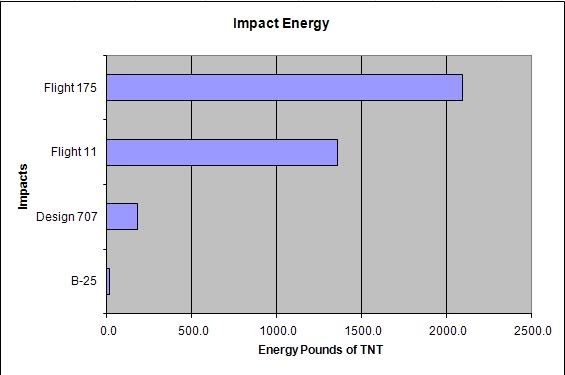
The impact at 180 mph is equal to about 187 pounds of TNT.

Impacts on 911 were at 470mph and 590mph, equal in kinetic energy to 1300 and 2093 pounds of TNT.
7 and 11 times greater than the design.!!!

A study after 911 confirms an impact of 200mph would not damage the WTC towers significantly.

There was a white paper, a marketing tool for the WTC, which said 600 mph. The white paper was not from engineers, it was a marketing tool; no engineering. Robertson did the numbers, it was 180 mph, that number was confirmed after 911.
 
Welcome to the forums!

Yes. It was assumed the plane ...

Thanks a lot, so it was assumed they would survive the impact but not that they would not subsequently collapse .

Usually I see they were designed to survive ie not fall ie explosive demolition.

Lenbrazil point taken, yes it was very rude of me to first post a question before looking through all the threads.
 
If the recent earthquake in Japan is any indication, you can design for the things that you can anticipate, but there's no way to account for every conceivable combination of events that takes place at a given moment. As much as I hate to use that as an example it is a case in point that is applicable to the twin towers.

In the earthquake situation, the powerplant was designed for a 7.0 on the Richter scale, the reactors were designed to shut down, while backup coolers were designed to keep them stable. The tsunami along with a series of problems have led to a catastrophe that is still unfolding as we speak. Much like the WTC were designed with the idea that a plane may severely cripple the structure; they did not account for the deficiencies that such an impact would have on fire suppression. They can bring it up that the air collisions were considered as part of the equation, they wouldn't be necessarily wrong, but "first time in history" seems to be their catch all criteria rather than design anyway so I don't see their point in citing it particuarly when designing for the aircraft impact did not guarantee in of itself that the towers would have survived the combination of things that came together.
 
Last edited:
And lastly, modeling was simply not as rigorous in the 60's as it can be nowadays. Computerization has allowed for very good advances in structural modeling, and issues that were not easily considered in decades past can now be studied in simulation. But the point is that the design didn't have the benefit of this computerization back then.

This point is worth emphasising. If I recall correctly, Leslie Robertson claimed to have carried out three pages' worth of longhand calculations to analyse whether the buildings would collapse as a result of an airliner hitting them (although these three pages have not been found). Three pages of manual calculations could be carried out in a fraction of a second by a spreadsheet application on an average powered computer these days, whereas NIST's calculations required long run times on high specification workstations. And yet truthers prefer to accept the result of the former as more rigorous than the latter, despite the fact that the opposite is clearly true. A classic case of confirmation bias.

Dave
 
http://community.seattletimes.nwsource.com/archive/?date=19930227&slug=1687698

"We looked at every possible thing we could think of that could happen to the buildings, even to the extent of an airplane hitting the side," said John Skilling, head structural engineer....

Skilling, based in Seattle, is among the world's top structural engineers. He is responsible for much of Seattle's downtown skyline and for several of the world's tallest structures, including the Trade Center.

Concerned because of a case where an airplane hit the Empire State Building, Skilling's people did an analysis that showed the towers would withstand the impact of a Boeing 707...

Skilling - a recognized expert in tall buildings - doesn't think a single 200-pound car bomb would topple or do major structural damage to a Trade Center tower. The supporting columns are closely spaced and even if several were disabled, the others would carry the load.


http://911research.wtc7.net/wtc/analysis/design.html

Frank A. Demartini, on-site construction manager for the World Trade Center, spoke of the resilience of the towers in an interview recorded on January 25, 2001:

The building was designed to have a fully loaded 707 crash into it. That was the largest plane at the time. I believe that the building probably could sustain multiple impacts of jetliners because this structure is like the mosquito netting on your screen door -- this intense grid -- and the jet plane is just a pencil puncturing that screen netting. It really does nothing to the screen netting.

Demartini, who had an office on the 88th floor of the North Tower, has been missing since the 9/11/01 attack, having remained in the North Tower to assist in the evacuation. Demartini had first worked at World Trade Center when Leslie E. Robertson Associates hired him to assess damage from the truck bombing in 1993.
 
The chief structural engineer is the prime source; Physics Required

Leslie E. Robertson, The lead structural engineer reflects on the rise and fall of the World Trade Center towers, spring 2002 wrote: "It appears that about 25,000 people safely exited the buildings, almost all of them from below the impact floors; almost everyone above the impact floors perished, either from the impact and fire or from the subsequent collapse. The structures of the buildings were heroic in some ways but less so in others. The buildings survived the impact of the Boeing 767 aircraft, an impact very much greater than had been contemplated in our design (a slow-flying Boeing 707 lost in the fog and seeking a landing field). Therefore, the robustness of the towers was exemplary. At the same time, the fires raging in the inner reaches of the buildings undermined their strength. In time, the unimaginable happened . . . wounded by the impact of the aircraft and bleeding from the fires, both of the towers of the World Trade Center collapsed."
http://www.nae.edu/Publications/Bri...ecurity/ReflectionsontheWorldTradeCenter.aspx
http://www.nae.edu/Publications/Bridge/EngineeringandHomelandSecurity.aspx
Chief of the structural design for the WTC, makes all the cherry picking, quote mining truthers, outright knowledge free failures.

wtckcrobertson.jpg


Energy911.jpg

911 truth can't do physics, they have no clue what kinetic energy is, or why 10 times more kinetic energy is significant.
Which part of "low on fuel" does 911 truth have a problem with?
 
Last edited:

Please keep in mind that good ole Ergo here doesn't know the difference between
into vs onto
essentially vs actually
a debris field the "size of the moon" and center of mass
about
exponentially
and thinks that a buildings footprint includes buildings across the street and even the ROOF of an adjacent building.

So it is fully understandable that he only datamines but doesn't read for comprehension.

P.s. Hey ergo.... about explosions... you know the caracas tower fire (where you really stepped ONTO your dick, and INTO a pile of fail) it had multiple reported explosions. Did the NWO cause those? Have you figured out why it remained standing yet?
 
Nothing other than poking a hole in the screen netting.
That comment by Frank A. Demartini must rank as one of the all time poor analogies:
The building was designed to have a fully loaded 707 crash into it. That was the largest plane at the time. I believe that the building probably could sustain multiple impacts of jetliners because this structure is like the mosquito netting on your screen door -- this intense grid -- and the jet plane is just a pencil puncturing that screen netting. It really does nothing to the screen netting.
It would certainly have returned to haunt him except, sadly, he appears to have been one of the victims of 9/11.

As for the "pencil puncturing" we know that the full silhouette - fuselage and wings - cut through the outer walls of both Twin Towers. Something that I as a structural engineer would not have predicted before 9/11 even tho' it is easy to understand in hindsight. :o
 
Well, I don't normally wade into these debates on this topic but jet fuel does not burn at a temperature sufficient to melt steel, at least the kind they built the Twin Towers with.
 
Well, I don't normally wade into these debates on this topic but jet fuel does not burn at a temperature sufficient to melt steel, at least the kind they built the Twin Towers with.

I'm glad I can be the first person to thank you for taking the time to ask this question. This is so smart. I have never thought of this one. And it's just obvious. Like I've been saying, common sense is so much better than reading.

Come on all you JREF smarty-pants. Just because you've an engineer and have built all those big buildings doesn't mean a little come sense can't put you in your place! What's the answer to this one?
 
Last edited:
Don't normally wade in...? I wonder if you've ever even seen the ocean! I'll stipulate that burning jet fuel won't melt steel...do you think steel has to be in a liquid state before it loses its ability to bear loads? Were there other contents burning in the towers that could burn hotter and longer than jet fuel? This is Twin Towers 101 stuff, dude.
 
Don't normally wade in...? I wonder if you've ever even seen the ocean! I'll stipulate that burning jet fuel won't melt steel...do you think steel has to be in a liquid state before it loses its ability to bear loads? Were there other contents burning in the towers that could burn hotter and longer than jet fuel? This is Twin Towers 101 stuff, dude.
I don't see how office stuff would burn sufficiently hot. From the press reports, the claim is the steel softened due to the heat. That did not likely happen.
 
I don't see how office stuff would burn sufficiently hot. From the press reports, the claim is the steel softened due to the heat. That did not likely happen.

Absolutely. The likelihood that a fire could soften steel is ridiculous.
I've never heard such a silly thing.
 

ISF - Join now!

Every member here is approved by hand. No bots, no spam, just people who care about evidence and honest debate.

Membership is free!

Create your free account

Back
Top Bottom