Vixen
Penultimate Amazing

"Crew Buried Cargo" claims Ruotsalainen in full page Sunday Supplement Spread
Harri Ruotsalainen, a former employee of the Helsinki Rescue Department and the Finnish Defense Forces and retired fire engineer, says he saw something in Tallinn in November 1994. He believes it has been classified by Sweden as a state secret for 75 years. A couple of months after the accident he was shown a ‘decisive clue’ which he says was not mentioned in the JAIC report.
He believes the JAIC’s desire to ‘immerse the core issue in endless detail (the falling off of the bow visor and consequent flooding of the car deck) which continues over 200 pages with numerous specifications of the nuts, bolts and locks, to be an example of ‘classical disinformation’.
Ruotsalainen finds the final route map of the Estonia ‘strange’.
He says he went to Tallinn in November 1994 on an internship and as an advisor.
He says there were eyewitnesses who mentioned the sounds of trucks from the car deck yet there is no mention of this in the JAIC report.
He also claims there were no Russians present but later a Russian tried to discuss the topic with him.
Summary
Harri Ruotsalainen, a former employee of the Helsinki Rescue Department and the Finnish Defense Forces and retired fire engineer, says he saw something in Tallinn in November 1994. He believes it has been classified by Sweden as a state secret for 75 years. A couple of months after the accident he was shown a ‘decisive clue’ which he says was not mentioned in the JAIC report.
He believes the JAIC’s desire to ‘immerse the core issue in endless detail (the falling off of the bow visor and consequent flooding of the car deck) which continues over 200 pages with numerous specifications of the nuts, bolts and locks, to be an example of ‘classical disinformation’.
Ruotsalainen finds the final route map of the Estonia ‘strange’.
He says he went to Tallinn in November 1994 on an internship and as an advisor.
TS“That's when I came across this diagonal sonar tape,” Ruotsalainen says.
“- After a while, the men of the maritime service company Alfons Håkans came, and my local counterpart at the Rescue Board, the Estonian Rescue Service, was Igor Volke . A couple of other men supported a long strip of paper on a roll, and they asked me what these echoes might be.
- It had echoes in two queues, square echoes, and from the trip I saw, there were quite a lot of them. - I thought it was a cargo that came out, Ruotsalainen says and sighs.
- Later, it started to think specifically that because the order was so good, that cargo could not come out through the bow. After that, it would have collided with a ship quite soon, which would have thrown the cargo down. So those products, or cargo, were dropped from the stern.”
He says there were eyewitnesses who mentioned the sounds of trucks from the car deck yet there is no mention of this in the JAIC report.
According to Ruotsalainen, the result of the oblique sonar was seen at the same time by six other people, some of whom were Norwegian. Later, he has not seen the tape or heard anyone else talk about it.
- I assume that the Swedes took all the material for themselves.”
He also claims there were no Russians present but later a Russian tried to discuss the topic with him.
ibid“The key to the mystery, according to Ruotsalainen, is not in the wreck of Estonia, which most of the scientists and divers describe. Above all, you should explore the location perhaps 500 meters away.
According to the theory, it would have embedded secret cargo in the sounding data, which by no means could end up in the hands of the authorities waiting at the ship's terminal port in Stockholm.”
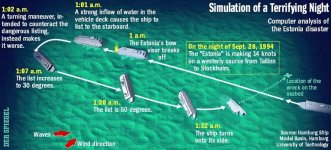
Once the cargo had been submerged in the sea, Estonia began to sink and made the last loop, surprisingly long, drawn on some maps, according to Ruotsalainen.
Summary
Theses
Ruotsalainen's theory
This is how Harri Ruotsalainen drew his own conclusions about Estonia's sinking.
According to him, the oblique sonar tape displayed in Tallinn had square echoes in two neat queues. What else could they be than the cargo that came out?
Ruotsalainen concluded that the cargo must have been lowered into the sea from the stern of the ship. From the bow gate, the containers would have ended up under the ship and giggled upside down.
He asks , among other things: what happened to the captain of the ship and who commanded the ship at crucial moments? Why, in the event of a maritime distress, did the ship move further north than normal in the depression? Why has the sinking been shown to have taken place so that the ship was still driving far ahead and turning left in a loop, returning to the same point it had passed moments earlier, and in the end a little over?
It is at the intersection of the routes , about 500 meters from the wreck of Estonia, that the research groups think the Swedish groups should look for any cargo that may be missing from the ship.
He suspects that the person who commanded Estonia was ordered to sink the ship on top of the cargo dumped at sea. The intention would have been to cover up a secret cargo that was possibly Soviet military products en route to Sweden and beyond.