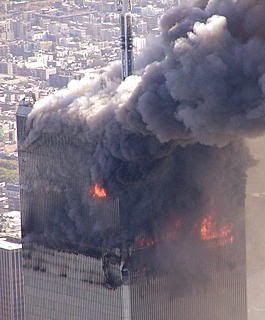
The jet fuel was mostly gone in the massive fireballs outside the buildings; my high school chemistry taught how an emanation of black smoke means it's a cool, oxygen-hungry fire.
There is no rule that says “black smoke = oxygen starved fire”. Sure, in some cases (such as a wood fire) this may be the case. But in the World Trade Center there was far more than wood burning. We had plastic products (computers), paper, carpet, desks, jet fuel and other items you would expect to see in an office building, all burning. The equation that you present us (black smoke = oxygen hungry fire) is highly simplistic and fails to take into account what might actually be burning in the towers.
Take for example this quote from a Health and Saftey paper.
http://www.hse.gov.uk/research/hsl_pdf/2004/hsl0414.pdf
“Large fires involving plastics produce copious quantities of black smoke, such smoke is likely to be more toxic than smoke from a fire involving wood, and would render escape and fire fighting very difficult.”
Furthermore,
An experienced Fire Investigator John J Lentini tells us that smoke color means absolutely nothing.
http://www.atslab.com/fire/PDF/IndicatorsOfTrouble.pdf
“While it is true that flammable liquids produce black smoke, so does any petroleum-based product. The color of the initial flame and smoke might have been important in the 1940s and 1950s when our furniture was made of cotton and wood, but most furniture today is made of nylon, polyester, and polyurethane. Even wood fires, deprived of oxygen, will produce black smoke. According to NFPA 921, Paragraph 3.6:
“Smoke color is not necessarily an indicator of what is burning. While wood smoke from a well ventilated or fuel controlled wood fire is light colored or gray, the same fuel under low-oxygen conditions, or ventilation-controlled conditions in a post-flashover fire can be quite dark or black. Black smoke can also be produced by the burning of other materials including most plastics or ignitable liquids.”
Light smoke may indicate that there are no petroleum products burning. Black smoke indicates nothing meaningful.”
So there you have it, smoke color means nothing. In fact, the heat of the fire itself can also determine the smoke color.
http://www.slate.com/id/2145891/
“The type of fuel and how hot it's burning. I
n general, a hotter fire will convert more fuel into elemental carbon, which forms into tiny particles that absorb light and appear in the sky as black smoke.”
Again, there is no scientic law that “black smoke = oxygen starved fire”. This also applies to “lots of smoke = oxygen starved fire”.
If you've already looked at all the "twoofer" evidence... How do you explain Chief Palmer, at the 78th floor, saying that they would be able to knock out the fire with two lines?
What you have failed to do here is distinguish between the fires on the 78th floor, and the fires in the rest of the building.
Our heroic firefighter, Orio J Palmer, was undoubtedly correct in saying that there were only two isolated pockets of fire on the 78th floor. This acutally fits with the NIST WTC Fire Recreation report. As we can see, there are only two isolated pockets of fire.
External Image
http://www.911myths.com/assets/images/db_images/db_Floor781.jpg
But now let's look at some other floors. Such as the 82nd and 83rd floors of Tower 2 (the tower Palmer was in).
External Image
http://www.911myths.com/assets/images/db_images/db_Floor821.jpg
External Image
http://www.911myths.com/assets/images/db_images/db_Floor831.jpg
You have implied that all the fires could have been taken down with two lines and were therefore not as large as we are lead to believe. That would be taking Mr Palmer's quote out of context. He said it would take two lines to knock down the pockets of fire on the 78th floor. As we can see, much more would have been needed for the higher floors of the impact zone.
To assume that the bulk of the fires were located on the lowest section of the impact point is just ignorant.



 ).