structural engineer charles pegelow

The point that I was attempting to make was that a civil engineer has no business passing himself off as a structural engineer.

Even further than that, a Professional Engineer has a responsibility to his profession and to the public to confine his work to his area of expertise. In states with non-discipline-specific "PE" licenses (such as VA), I could use my PE to seal electrical plans, mechanical plans, drainage plans, etc...IF I was unethical. However, I have no practical experience (following college) that would prepare me to do such a thing, no matter how eminently qualified I might consider myself. My question to Mr. Pegelow would be, if he takes the responsibility and obligation of his profession seriously, what exactly in his professional background does he think entitles him to engage in a forensic analysis of a high-rise steel structure collapse, appealing to his status as an engineer to garner credibility among the public?

He is not a member of ASCE or AISC as far as I can tell, and there is a giveaway in his resume
CODES: Use of following national and industry codes: ASIC, API RP 2A, ANSI 58.1 (AISC), UBC, DNV, ASME Div. VIII vessel.

OK, API RP 2A is Recommended Practice for Planning, Designing and Constructing Fixed Offshore Platforms, DNV is offshore codes by Det Norske Veritas, ASME Div VIII vessels are pressure vessels, such as one might find in the oil and petrochemical industry. UBC is Uniform Building Code, hasn't been updated since 1997 but still in use by jurisdictions, mainly California.
ASIC I am assuming is a mistake - AISC - unless he is very proud of his running shoes.
ANSI A-58.1 has not been called that since 1982. It is the Minimum Design Loads for Buildings and Other Structures that became ANSI/ASCE 7-88 and is now up to ASCE/SEI 7-05.
(To be generous, perhaps he put (AISC) in parentheses as his referring source because the ASD manual which is still used but has not been updated since 1989 (and essentially is, as AISC admits, a 1961 standard) has a reference to ANSI A-58.1-1982 in the specifications (along with many other out-of-date standards). But LRFD corrected that in its second edition, and the thirteenth edition of the Steel Construction Manual did away with the separate ASD and LRFD manuals altogether.)
At any rate, he is referring to an obsolete standard that is over 20 years old - which begs the question, again, just what are his qualifications to analyze the WTC collapse (given that he apparently is not even current in his field)?
 
Because even if you believe the steel could have "weakened" the fire would have had to be a blazing hot one lasting many hours. Just look at the Madrid or Venezuela fires.

Sorry I'm late to the party. I brought this:

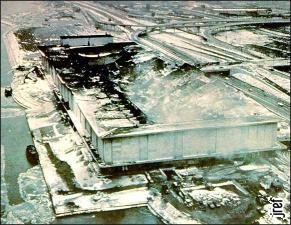
McCormick Place Exhibition Center, Chicago, IL, 16 January, 1967:
619745b6665e9fe5c.jpg


McCormick Place, the world's largest exposition hall, officially opened November 18, 1960. The 40-million dollar building on Chicago's lakefront was a tremendous commercial success.

On January 16, 1967, with the National Housewares Manufacturers' Association exhibit about to open, the great building was destroyed by fire. The resulting Mayor's Committee to Investigate McCormick Place Fire recommended a number of revisions to the Chicago Municipal Code. Work on the new McCormick Place was begun in May, 1968, using the lower level of the old building. (Source)

Six-year-old McCormick Place was thoroughly damaged in a fire that started during the National Housewares Manufacturers Association 46th Semi-Annual Exhibit. One security guard was killed.

A janitor noticed smoke coming from the back of a booth about 2:05 a.m. Within 5 minutes the entire booth was involved and the fire department called at 2:11 a.m. The fire department responded rapidly, entering the building and ordering a second alarm at 2:16 a.m. Nine alarms were struck, bringing 500 persons and 94 pieces of fire equipment. Initial attempts to fight the fire were frustrated by an almost immediate failure of the water supply. By 2:53 a.m. firefighters were able to establish a relay from hydrants 1/4 mile away and the first fire boat arrived, but by then the whole building was involved in the fire and the roof had started collapsing. The fire was struck out at 9:46 a.m. with only parts of the lower level and the theater undamaged.

A number of factors contributed to the catastrophe. Most of these would have been sufficient by themselves to cause great destruction. (Source)

McCormick Place is a warehouse-type building that housed a large exhibition hall. It had a long-span roof supported by web trusses. When a fire broke out in an exhibition with many flammable displays it rapidly spread, and a portion of the roof collapsed within 30 minutes.http://www.911research.wtc7.net/wtc/analysis/compare/mccormick.html

(Bolding mine)

Even 911research cites McCormick Place. What's funny is how they qualify it: "a portion of the roof". Look at the photo right on their website and tell me if that's only a "portion" of the roof.

More from their site:

The first fact that should be noted in regard to any such comparison is that the McCormick Place incident was not a total building collapse -- it was only a roof collapse.
Duh. The perimeter was concrete. It was wider than it was tall; there was many orders of magnitude less GPE stored in the structure. It still shows how a building with a large portion of structural steel is susceptible to fire damage.

Furthermore, the comparisons of the roof trusses of McCormick Place to the floor trusses of the Twin Towers is limited by the following facts:

  • The floor trusses were insulated, unlike the roof trusses.
  • The floor trusses spanned at most 60 feet, apparently much shorter than the roof trusses.
  • The floor trusses had to support the floor loads of the concrete slabs and office furniture, whereas the roof trusses only had to support snow loading.
They are gracious enough to debunk themselves. Thanks!
 
Last edited:
Whatever his other qualifications this guy might or might not have, he doesn't know the most basic principles of fire science.

Comments on Some of NIST's FAQs

by Charles Pegelow

...

9. If thick black smoke is characteristic of an oxygen-starved, lower temperature, less intense fire, why was thick black smoke exiting the WTC towers when the fires inside were supposed to be extremely hot?

Where is the smoke in all these videos and photographs of the towers on fire? Answer: Outside the building.
Where did the smoke come from? Answer: Inside the building, from the fire floors.
How much smoke is there? Answer: A lot.
Was the building airtight? Answer: No, it had large holes in it (in addition to normal ventilation).
So, when large amounts of smoke vent out of the fire floors, what else can we conclude? Answer: An equivalent volume of fresh air was entering the fire floors.

From this alone, we know for certain that the fire as a whole was not oxygen-starved, though it was clearly (as are almost all fires) oxygen-limited.

Open flames produce direct, radiant, and infrared heat.

Class, repeat after me: conduction, convection, and radiation. Those are the three ways heat moves.

This is the most basic fact of fire science. Fire engineers know this from day one. The same way Christians know Father, Son, and Holy Ghost; the way eight-year-old boys know Triassic, Jurassic, and Cretaceous; the way realtors know location, location, and location; fire engineers know conduction, convection, and radiation.

So what's this "direct, radiant, and infrared" nonsense? Infrared is a specific frequency range of radiant heat, and in most fires it's most of the radiant heat (making "radiant" and "infrared" mean almost the same thing in that context). "Direct" presumably refers to conduction. That leaves out convection, which is indirect heat transfer by fluid flow of heated gases (and liquids). Convection is enormously important in the mechanisms of fire propagation and the behavior of building fires.

Omitting convection is a really dumbass thing for a supposed expert to do.

Both radiant and infrared heat are blocked by smoke...

Dead wrong. When smoke is created by combustion it's hot, and in a confined or partially-confined fire it stays hot. Its movement therefore is a form of convective heat transfer. Furthermore, hot smoke radiates radiant (infrared, same thing) heat to any cooler surroundings very efficiently. In a normal room fire, an increasingly hot smoke layer accumulates from the ceiling downward until the thermal radiation from the smoke becomes sufficient to suddenly and rapidly ignite all the exposed fuel in the room, a well-known phenomenon called flashover. Yes, the smoke is that hot. It doesn't block heat, it moves heat.

11. Why do some photographs show a yellow stream of molten metal pouring down the side of WTC2 that NIST claims was aluminum from the crashed plane although aluminum burns with a white glow?

Because burning is not the same as melting. An engineer doesn't know this?

Warning: the remainder of this post conjectures, based on my knowledge of how heat, smoke, and fire behave, especially in large structure fires, scenarios of what some of the 9/11 victims might likely have experienced. This is not pleasant material. Despite the passage of five+ years, tears were running down my face as I typed it. If you had friends or loved ones in the towers, you don't need to read this. You shouldn't read it. Really. Go away. Now. I can handle Mr. Fires-Weren't-Very-Hot "Engineer" by myself.

10. Why were people seen in the gaps left by the plane impacts if the heat from the fires behind them was so excessive?

Because, you miserable excuse for a human being, they were "lucky" enough to find gaps where the inrushing fresh air (remember how smoke pouring out = outside air coming in somewhere else?) kept some of the smoke and convected heat from the fire at bay. And there they stayed, while the radiant heat from the "oxygen starved" "not very hot" fires behind them scorched their bodies until many of them jumped to their deaths rather than stand it for one moment more.

What alternatives do you think those people had? Do you think they were there at the gaps to enjoy the view? When you look at that burning tower, with dense hot (fast-rising = hot) smoke venting from every aperture near the top, many floors above where the visible flames are, what do you imagine is going on inside? I'll tell you. With the exception of a few zones left clear by random accidents of airflow, those upper floors were solid cubes of opaque, toxic, searing hot smoke, smoke hot enough to set fire to whatever combustibles it touched. Most of that fire would burn invisibly, slowly, sheathed in the opaque smoke, adding yet more heat and smoke to the inferno. Any survivors not in intact stairwells or at windows would be trapped in a few relatively closed-off spaces, repreived for only a matter of minutes by a few centimeters of drywall, in pitch darkness because even if the power were on, the smoke layer at the ceiling is so opaque that the ceiling lights couldn't shine through.

"Oxygen starved?" Only in the sense that just about every fire (except for e.g. an oxy-acetylene torch or a rocket engine) is oxygen-limited: the overall rate of combusion was limited by the available oxygen. Without working sprinklers (broken water pipes) in a building full of paper with holes and interior damage that made it effectively a gigantic chimney, much of the interior was quickly aflame, smoldering, or above ignition temperature, making oxygen influx the limiting factor in how rapidly any given portion burned.

Do you know what happens when you have a fire in a box in which the oxygen inflow is reduced below the rate the burning fuel would normally use it? There's a technical term for this: it's called a stove. You might have heard of them. If you've ever used one, you might already be aware that the interior of a stove can get much hotter than the same fuel burning in an open fireplace, because more of the heat is contained. The bigger the box, the more efficient that containment of heat becomes, and the hotter the interior can get.

At the time of the collapses, those fires had plenty of fuel left, plenty of oxygen flow (though not an unlimited amount), and were getting hotter by the second. Had the frame stayed standing, burn-through at the top floors and widespread window breakage would have eventually occurred, increasing the ventilation and accelerating the flames. At that point, there would likely have been explosions as pockets of accumulated superheated smoke containing flammable gases were suddenly exposed to fresh air. Only with that increased ventilation would the interior temperature begin decreasing again.

Fewer lives would have been lost (especially firefighters and police) if the buildings had not collapsed, but the event would have been hardly less traumatic. Few on the upper floors would have survived. The collapses meant that we didn't really have to think much about how most of the victims actually perished, which is a small blessing.

Respectfully,
Myriad

 
I have come to the conclusion that if there were no flames visable from the exterior of the towers. Despite all the smoke billowing from the towers themselves. Troofers would declare there was no fire at all. :jaw-dropp
No need to look surprised! That's exactly what they do with WTC7: show them the videos and pics of heavy smoke and they say "but we can't see any flames".
 
No fair. I printed out the Pegelow crap at work, read it on the train, got a reply ready, and then I find that you've all covered it already and in comprehensive detail!

:(
 
Myriad

Well said.

I don't think these cospiracy fantacists have the first idea about fires in buildings. I suspect they think the fires act like a bonfire in the open air, whatever the size. They just do not appreciate the containing effect on the heat. I also think that they don't understand the shear quantity of heat involved from even a "small" domestic fire, let alone what happened in the WTC buildings.

Dave
 
Do you know what happens when you have a fire in a box in which the oxygen inflow is reduced below the rate the burning fuel would normally use it? There's a technical term for this: it's called a stove. You might have heard of them. If you've ever used one, you might already be aware that the interior of a stove can get much hotter than the same fuel burning in an open fireplace, because more of the heat is contained. The bigger the box, the more efficient that containment of heat becomes, and the hotter the interior can get.


Myriad

Good post. I was wondering if you had any links that explain the mechnisms of how a stove works. I always felt this was the most glaring flaw in the "fires weren't hot enough" argument, but I don't know enough about it myself to speak on the issue, and couldn't find any good online sources that explained it all.

It's pretty obvious that things like stoves, forges and kilns can get hotter than the open air burning temperature of the fuel, otherwise how could we ever melt things like steel? But proving that is a bit harder.....
 
I think you guys buried him alive with facts.

He also seems to be allergic to facts as well. Poor guy.

:runaway
 
One day we'll meet a CTer who has actually researched the basics of his case AND knows how to argue effectively.....


...but I'm not holding my breath.
 
One day we'll meet a CTer who has actually researched the basics of his case AND knows how to argue effectively...
Someone who knows how to argue effectively has to be capable of rational thought, and if someone is capable of rational thought and has researched the basics, he won't be a CTer.

So please don't hold your breath.
 
Kam:

For your interest:

NIST Scientists and Engineers

TEAM LEADERS:

Dr. H.S. Lew – Senior Research Engineer.
PhD Civil Engineering, BS in Architectural Engineering. ASCE Fellow.
With NIST: Structural Engineering, Earthquake Engineering, Building and Fire Research.
http://www2.bfrl.nist.gov/profiles/profiles.asp?lastname=Lew
(his full profile)

Richard W. Bukowski – Senior Research Engineer.
BSc Electrical Engineering.
With NIST: Co-ordinator of Building and Fire Research Lab.
http://www2.bfrl.nist.gov/profiles/profiles.asp?lastname=bukowski
(his full profile)

Dr. Fahim H. Sadek
PhD Mechanical Engineering SMU
With NIST: Research Structural Engineer
http://www2.bfrl.nist.gov/profiles/profiles.asp?lastname=sadek
(his full profile)

Dr. Frank W. Gayle
PhD Metallurgy MIT, MSc Materials Science, BSc Civil Engineering.
http://wtc.nist.gov/pi/wtc_profiles.asp?lastname=gayle
(his full profile)

Dr. David D. Evans
PhD in Engineering (Fire protection)


Dr. William Grosshandler
PhD Mechanical Engineering UC Berkley
With NIST: Head of Building and Fire Research
http://www2.bfrl.nist.gov/profiles/profiles.asp?lastname=grosshandler
(his full profile)

Dr. Richard G. Gann
PhD Physical Chemistry MIT
With NIST: Senior Research Scientist – Integrated Performance Assessment
http://www2.bfrl.nist.gov/profiles/profiles.asp?lastname=gann
(his full profile)

Dr. John L. Gross
PhD Structural Engineering, BSc/MSc Civil Engineering Cornell
With NIST: Research Engineer – Materials and Construction Research Division
http://www2.bfrl.nist.gov/profiles/profiles.asp?lastname=gross
(his full profile)

Dr. Therese P. McAllister
PhD Structural Engineering John Hopkins
With NIST: Senior Structural Engineer.
http://www2.bfrl.nist.gov/profiles/profiles.asp?lastname=mcallister
(her full profile)

Jason D. Averill
MSc Structural Engineering (working on PhD) John Hopkins
With NIST: Research Engineer
http://www2.bfrl.nist.gov/profiles/profiles.asp?lastname=averill
(his full profile)

J. Randall Lawson
BA, BSc Industrial Education, AA Computer Science and Math
With NIST: General Physical Scientist
http://www2.bfrl.nist.gov/profiles/profiles.asp?lastname=lawson
(his full profile)

Those are just the team leaders, so tell me again why I should believe Pegalow and Jones over these people?

TAM:)
 
guys guys guys!

you have posted so much information even I am struggling to embrace it all!
There is no way (starting at gravy's response last page) he will respond to this, I will start a new thread with it or suggest someone does. You have gone overload on so many facts hahaha, its like stirring up a hornets nest.

Do a gravy/almond v kameelyun thread.....he is so wrong, but he wont absord the twenty comments posted since full of facts.
 
Good post. I was wondering if you had any links that explain the mechnisms of how a stove works. I always felt this was the most glaring flaw in the "fires weren't hot enough" argument, but I don't know enough about it myself to speak on the issue, and couldn't find any good online sources that explained it all.

It's pretty obvious that things like stoves, forges and kilns can get hotter than the open air burning temperature of the fuel, otherwise how could we ever melt things like steel? But proving that is a bit harder.....

Good question. I haven't found a good link for that yet. I think the problem might be that you need a model that focuses on a few key phenomena, but models built for practical purposes get very technical as there are many other variables and many nonlinear effects involved. For instance, a practical model of the performance of a wood stove has to include the equations of convective and radiative heat transfer from the outside surface of the stove -- after all, that's what it's for, to warm up its surroundings. What we need for this case is a model that disregards some effects (such as direct heat loss through the container -- negligible anyhow when the container is a ten-storey rubble pile) but is correct in others to show that, in principle, contained fires can and do build up heat and explain the basic reasons why. I think I'm going to have to write one, and present it here for review.

Let me point out that not all mechanisms that can be used in stoves, forges, boilers, etc. have analogues in accidental fires. Some do: effects similar to those of forced air in a forge can also occur in a structure fire due to chimney effects. (If I post a fire-in-a-box math model, I hope I can persuade someone with good video software to reciprocate by doing estimates of the velocity of the smoke from the tower fires.) But you can also blow pure oxygen into your forge, or use a heat exchanger to pre-heat the fuel and air from the exhaust gases. (In theory, with a perfectly efficient heat exchanger and lots of insulation, a normal fire could be driven arbitrarily hot, at least until some important component melted down.) Modern steelmaking is especially nifty; the same exothermic oxidation reactions that remove the impurities when air and then oxygen are blown into the melt also accomplish the necessary final stages of heating, obviating the need to melt it with an extremely hot fire.

BTW, none of this is meant to suggest that the 9/11 fires were abnormally hot for large high-rise fires. From a fire engineering point of view, the most abnormal aspect of the tower fires wasn't the jet fuel, it was that the sprinklers weren't working due to severed water lines. All high-rise buildings would be fire deathtraps without sprinker systems.

I've seen no convincing evidence that iron or steel was melted in the 9/11 fires before or after collapse. Re-labeling an ordinary thermogram "molten iron hot spots" doesn't do it for me, unless Prof. Jones can show me his patent for a spectrophotometer that can identify specific chemical species underneath meters of rubble.

Respectfully,
Myriad
 
guys guys guys!

you have posted so much information even I am struggling to embrace it all!
There is no way (starting at gravy's response last page) he will respond to this, I will start a new thread with it or suggest someone does. You have gone overload on so many facts hahaha, its like stirring up a hornets nest.

Do a gravy/almond v kameelyun thread.....he is so wrong, but he wont absord the twenty comments posted since full of facts.
hellaeon, why do you hate Gravy and Almond? ;)

IMO, it's not important that kameelyun respond, but I hope he reads and tries to understand what we've written.
 
Another fine post above, Myriad. It's as if you're saying to kameelyun, "Keep reading...you're getting warmer...."

BTW, the NIST report concluded that even if the sprinklers had been fully functional, they did not have the capacity to contain massive simultaneous fires on multiple floors in the towers.
 

ISF - Join now!

Every member here is approved by hand. No bots, no spam, just people who care about evidence and honest debate.

Membership is free!

Create your free account

Back
Top Bottom