Skeptoid Podcast: Cell phones and airlines

Update: I've taken the data. I need to scan it and get it up here.

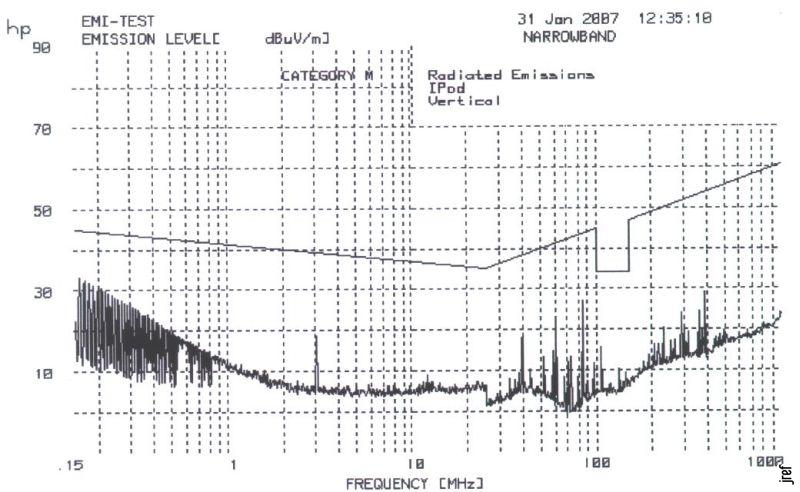
Summary: It emits alot more than I thought it would, but nothing over the DO-160D RF Radiated Emissions with radio notch.

If I have the time tonite, I'll scan it in and post it.
 
Ok, here it is.
Test Conditions:
iPod nano, playing Pink Floyd's Division Bell. Screen active, but light was off. Headphones supported above via a wooden strut that I had laying about the lab, we tried to arrange the headphones as much like they would be on your head, but since we don't have a Buster, we had to improvise.

Test Results (narrowband only):
549045c27ee663e81.jpg


Like I said, there was a lot more content than I thought there would be, but nothing extraordinary.
 
No. Not without a major attempt on your part. There isn't anything in this frequency range, with this iPod that I can say would be "a threat" to a commercial aircraft.

Of course, I STILL would follow any and all FAA regs that you're told to do. And even some that you're not told to do.
 
So, let's get down to brass tacks.
How do we build something that looks like a cellphone or a laptop, will pass security checks, but does radiate enough noise to jam avionics?

Because if we don't, somebody will, because there's a big demand from the terrorist market and godsdammit, I thought we were capitalists here?

(And if it makes cellphones explode, so much the better. Put me down for two.)
 
The answer to soapy Sam's question is
Build an cell phone that works as a cell phone, however at a certain time it will switch itself on and send out a powerful EM (radio) pulse or three. Any electronics nearby gets knocked out. May drain the batteries but who cares?

If it works then delete one aircraft with passengers. Cause unknown. Do it often enough they will be forced to ground all aircraft until they can work out the cause. Very hard.

If it does not work then you do not lose anything. Just rebuild and try again.

Even if it works you do not have to lose a volunteer. Just give it to your worst enemy as a 'peace offering' just before they depart on a plane flight.

Cost - a few hundred dollars per phone.
 
So many freedoms are lost when one decides to go on an airplane. How dangerous do people think airplanes would be if guns were allowed on, cigarettes were lit, and cellphones activate and everyones talking to sweet ol' grandma at the same time? Would it still be safer than driving? I always thought airplane travel was pretty safe, even if all those things would be added in the situation. Wouldn't someone who wanted to take down the plane and/or hi-jack the plane do it illegally, or by some low-tech way no one thought of? So are these rules really doing much help?

I mean, these laws and rules just seem to limit average joes who wouldn't want to do bad things. If guns were allowed and people tried to hijack the plane with guns with the possibility of gun owners on the plane wouldn't that be scary for them? Or maybe since cellphones and cigarettes are such big threats someone could say; "Oh yeah, I'll turn my cellphone on....WHILE SMOKING!" Wouldn't that be scary now. Maybe that will be the new way people will hijack planes since they can't do it with box cutters anymore.

Do cellphones really do bad things? How long have they been around, and how many people have died or been injured due to them on being activated on airplanes? Does it really make sense, that numerous planes travel daily yet I hardly hear of airplane crashes. And I've personally never heard of one going down due to cellphones. I'm not saying it hasn't happened, I'm just saying I never heard of it happening.

I also apologize for making this about freedom and terrorism, but I think when one is speaking about airplane rules and possible myths. Then freedom must be included. We should try to give ourselves as much freedom as possible. Even though it could lead to some of the worst things ever imagined.

And I'm pretty sure some airlines would not change the rules, and some could if the FAA stepped aside on this. And then customers could choose which airline appeals to them the most. The one with no guns but yes smoking+cell phones, or the one with guns and cellphones allowed but not smoking, or the one with all allowed,etc. If this is a Myth, then is it okay for the FAA impose? Or should it be up to the airlines and the customers?
 
Last edited:
"The FAA is not alone in its prohibition of in-flight cell phone use. The Federal Communications Commission has a ban of its own, although it has nothing to do with safety. The FCC says signals emitted by phones in the air have the potential to engage multiple cell towers and thereby cause interference with calls on the ground. There is no scientific proof behind the FCC dictate, however; the agency never commissioned a study that conclusively proved its hypothesis." (from a 2002 article from Cable World)

I doubt the FCC is going to perform studies, since the reasoning for not having allowing cell phone users in airplanes is based on the design of the cellular phone network.

The cell network is designed around a set of users all residing in a simple plane (not airplane, the geometric kind). At a given location, an individual user's transmission decreases with the square of the distance from the cell tower. For the simple case of analog cells, this means that after a certain distance, frequencies can be reused. For digital cellular it means that a given slot or coding only interfers with the cell towers that are near that user.

Essentially, each cell tower is able to handle a certain number of users transmitting near it. This includes the users using that tower directly, plus the signal that is "visible" from users using neighboring cells.

This all breaks down when people on airplanes start using their cellphones. Typical cell separation in non-dense area is about 10 miles. It can be much higher in dense urban areas. A user that is several miles up will have a signal visible to a larger number of towers. Another way of thinking of it, is that a single user on the phone on an airplane interferes with the network the same way that perhaps a hundred would on the ground. A cellular network designed to handle 10,000 users in a given area could be completely unavailable with just 100 users in an airplane above.

Aside from all of this, people on airplanes are unlikely to find cell phone usage to be a very pleasant experience. The networks were designed to handle terrestrial users travelling at speeds under 100MPH. Users outside of these parameters are unlikely to maintain connections for long periods of times without dropouts and dropped calls.

I suspect there are two unrelated issues here. One is the fear and such coming from the airlines over possible safety issues. The other is the FCC (and the cell companies) trying to make sure that their networks aren't overwhelmed by a small number of users in the air.

If the cell companies were somehow required to provide service to air users, they would probably come up with a way to detect this, and charge significantly more for the service.

Dave

 
Last edited:
So, let's get down to brass tacks.
How do we build something that looks like a cellphone or a laptop, will pass security checks, but does radiate enough noise to jam avionics?

I doubt you could. People tend to forget that commercial avionics are well hardened against this kind of attack. This is probably why Grant chose a 1960's-era radio direction finder for his Mythbusters "test".
 
I doubt you could. People tend to forget that commercial avionics are well hardened against this kind of attack. This is probably why Grant chose a 1960's-era radio direction finder for his Mythbusters "test".

I bet I could do it. But then again, that's my field of work.
 
I became skeptical of Brian's podcast after I heard M. Granger Morgan on the Scientific America Podcast talk about the POSSIBLE risks that may be associated with electronic use on airlines. For anyone interested, the podcast is SCIENCE TALK and the episode is the week starting 3/08/06. Granger is the head of the department of engineering and public policy at Carnegie Melon and he is the third speaker in that podcast episode. I am now up in the air about this one
 

ISF - Join now!

Every member here is approved by hand. No bots, no spam, just people who care about evidence and honest debate.

Membership is free!

Create your free account

Back
Top Bottom