
You are using an out of date browser. It may not display this or other websites correctly.
You should upgrade or use an alternative browser.
You should upgrade or use an alternative browser.
Simple Challenge For Bigfoot Supporters
- Thread starter desertyeti
- Start date
- Status
- Not open for further replies.
Skeptical Greg
Agave Wine Connoisseur

...... let me post a gorilla foot with dermal ridges that look just like the "desication ridges" on tube's test cast:

http://www.bigfootforums.com/index.php?showtopic=14781&hl=gorilla+feet
............
Actually they don't .. ( look like the desication ridges in Tube's test cast )
Besides, where are the flexion creases in bigfoot prints...
With that midtarsal break and all, we should be seeing some...
Oh, and where are two prints from the same trackway that show identical dermals ?
tube
Muse

- Joined
- Aug 1, 2005
- Messages
- 917
OK, footprints again. I was surprised to see how much variation there can be in tracks made by the same foot. This is a track made by my own foot:

And this is another track made by the same foot:

I think in the second track we are seeing some supination, possibly as a result of me striding out with a compliant gait. I'll have to pay more careful attention next time to see what kind of tracks a regular gait makes versus tracks made with a compliant gait.
And this is another track made by the same foot:
I think in the second track we are seeing some supination, possibly as a result of me striding out with a compliant gait. I'll have to pay more careful attention next time to see what kind of tracks a regular gait makes versus tracks made with a compliant gait.
kitakaze
Resident DJ/NSA Supermole

Oh, you know, that depends on how I feel like interpreting the word to suit my beliefs. Right now I'd say you're more of a super lady linker.I just noticed I'm a Master Poster and you'e only a Graduate Poster, k. Does that mean I'm a masterdebater?
SweatyYeti
Master Poster

- Joined
- Dec 1, 2006
- Messages
- 2,919
kitakaze wrote:
As for #3...a bad memory....
How could Joyce's poor memory of certain details change the most basic fact of their sighting....that they thought they saw a Bigfoot?
Some details...
1) Her daughter shouted out "What the f--- was that?!"
Did her daughter actually say..."What is that...a bear?"...and years later Joyce recalled it so very differently?
I seriously doubt it.
2) They watched it walk away through a cow pasture.
Were they actually watching a bear walk upright through a cow pasture, and only later she misremembered it and thought they were watching a Bigfoot?
What is it that you're saying exactly, kitakaze,with regards to Joyce possibly remembering details incorrectly?
Can you give some examples of details being distorted...which would make the difference between them seeing a bear, and a Bigfoot?
1) Joyce really saw bigfoot- improbable due to a lack of supporting evidence for such a creature.
2) Joyce lied- far more probable. If she willfully invented the story there are any number of reasons to do so, not all of them necessarily malicious.
3) Joyce's memory of the event is faulty and the true details of the event differ from her account. Definitely possible. That's all we can say with out a proper investigation of the claim having been conducted 24 years ago.
4) Joyce's memory of the event is psychologically manufactured for whatever reason and the event never took place. Unless we should starting including various psychotherapies for every claimant to check for such mental constructs it's no better or worse than 2 or 3.
As for #3...a bad memory....
How could Joyce's poor memory of certain details change the most basic fact of their sighting....that they thought they saw a Bigfoot?
Some details...
1) Her daughter shouted out "What the f--- was that?!"
Did her daughter actually say..."What is that...a bear?"...and years later Joyce recalled it so very differently?
I seriously doubt it.
2) They watched it walk away through a cow pasture.
Were they actually watching a bear walk upright through a cow pasture, and only later she misremembered it and thought they were watching a Bigfoot?
What is it that you're saying exactly, kitakaze,with regards to Joyce possibly remembering details incorrectly?
Can you give some examples of details being distorted...which would make the difference between them seeing a bear, and a Bigfoot?
SweatyYeti
Master Poster
- Joined
- Dec 1, 2006
- Messages
- 2,919
kitakaze wrote:
What exactly does that mean? Joyce was a nutcase??
When faced with very few likely explanations to explain a Bigfoot sighting report....one can always fall back on..."they're nuts".
This is the direct OPPOSITE of analysis....which narrows down different possible explanations, so that the chances of some being true are decreased, while others are increased...thereby bringing a picture into "sharper focus".
Skeptics like to "analyse" a Bigfoot sighting by saying....."it could be anything"....thereby making the picture as fuzzy as possible.
Let's see....."psychologically manufactured".....4) Joyce's memory of the event is psychologically manufactured for whatever reason and the event never took place. Unless we should starting including various psychotherapies for every claimant to check for such mental constructs it's no better or worse than 2 or 3.
What exactly does that mean? Joyce was a nutcase??
When faced with very few likely explanations to explain a Bigfoot sighting report....one can always fall back on..."they're nuts".
This is the direct OPPOSITE of analysis....which narrows down different possible explanations, so that the chances of some being true are decreased, while others are increased...thereby bringing a picture into "sharper focus".
Skeptics like to "analyse" a Bigfoot sighting by saying....."it could be anything"....thereby making the picture as fuzzy as possible.
Last edited:
kitakaze
Resident DJ/NSA Supermole
Sweaty, the more that you try to push this Joyce business as being supportive evidence for bigfoot the more you clearly illustrate the profound extent of your own failure to recognize just how much you delude yourself into trying to justify your silly, unfounded beliefs. You've done NOTHING to bring any objectivity to the matter of Joyce's report.
If you want to make any effort to appear sincere in looking into the matter then might I suggest you stop patheticall dodging the issues I raised in posts #852, #897, and #915. You've already admitted with bemusing self-directed sarcasm that you've made no attempt to take the most basic step of seeking to confirm the incident with the second reported witness. Maybe you could answer some basic points raised instead of cycling through 14 year old girl, Katherine Hepburn, and The Cable Guy personality disorder displays.
If you want to make any effort to appear sincere in looking into the matter then might I suggest you stop patheticall dodging the issues I raised in posts #852, #897, and #915. You've already admitted with bemusing self-directed sarcasm that you've made no attempt to take the most basic step of seeking to confirm the incident with the second reported witness. Maybe you could answer some basic points raised instead of cycling through 14 year old girl, Katherine Hepburn, and The Cable Guy personality disorder displays.
Yes, Sweaty, bad memory. Like the kind you displayed when you weren't even able to accurately recount the most basic elements of her report when first trotting it out as BF evidence that 'isn't paltry'. Of course you haven't even confirmed that there was a 'their sighting' so you're just making yourself look all the more pathetic. Not to mention that in her submitted report she never used the word 'bigfoot'.kitakaze wrote:
As for #3...a bad memory....
How could Joyce's poor memory of certain details change the most basic fact of their sighting....that they thought they saw a Bigfoot?
Yes, we've seen how good you are with those. #852, #897, #915.Some details...
mm hmm... Tell us what her daughter said, Sweaty. In any event, 'what the f--- is that?!' does not equate 'OMG, a bigfoot!' or 'holy *****, a bear!'. That is what I call asparagus reasoning. Maybe we should sort out your mental failings before we get on with any possible occurrences with Joyce.Her daughter shouted out "What the f--- was that?!"
Did her daughter actually say..."What is that...a bear?"...and years later Joyce recalled it so very differently?
I seriously doubt it.
Asparagus reasoning is that bear is only one contingent yet the only alternative that you are proposing as possible to something seen and just plain ignorance is that you can't even account for how much our memory can alter what we experience. Before you embarrass yourself further why don't you just try addressing basic points and questions on the matter or realize that your anecdote is very paltry evidence and drop it.2) They watched it walk away through a cow pasture.
Were they actually watching a bear walk upright through a cow pasture, and only later she misremembered it and thought they were watching a Bigfoot?
What is it that you're saying exactly, kitakaze,with regards to Joyce possibly remembering details incorrectly?
Can you give some examples of details being distorted...which would make the difference between them seeing a bear, and a Bigfoot?
Last edited:
kitakaze
Resident DJ/NSA Supermole
I just realized that you are making a positive contribution so by all means, Sweaty, please continue to illustrate by example how to engage in the complete opposite of critical thinking. If you're more interested in sasquatch evidence maybe you can give dermal claimers a hand by addressing my new sig.kitakaze wrote:
Let's see....."psychologically manufactured".....
What exactly does that mean? Joyce was a nutcase??
When faced with very few likely explanations to explain a Bigfoot sighting report....one can always fall back on..."they're nuts".
This is the direct OPPOSITE of analysis....which narrows down different possible explanations, so that the chances of some being true are decreased, while others are increased...thereby bringing a picture into "sharper focus".
Skeptics like to "analyse" a Bigfoot sighting by saying....."it could be anything"....thereby making the picture as fuzzy as possible.
SweatyYeti
Master Poster
- Joined
- Dec 1, 2006
- Messages
- 2,919
kitakaze wrote:
Still not convinced she was refering to Bigfoot in her report? Joyce said to me in our conversation...refering to Bigfoot....."OH Yeah...THEY'RE REAL!"
NOTHING, in this case, says a LOT. Neither you, kitakaze-o-so-klueless nor RayG are able to answer simple questions concerning her report.
And the two of you confirm that with every single one of your posts.
What exactly do you mean by "I haven't confirmed there was a sighting"?Of course you haven't even confirmed that there was a 'their sighting' so you're just making yourself look all the more pathetic.
From Joyce's report:Not to mention that in her submitted report she never used the word 'bigfoot'.
Hey...kitakazeohsoklueless...what name are " large (7 feet at least), hairy man-like creatures" commonly refered to by in reports filed on Bigfoot database websites, like Bfro. Any idea?...we saw a large (7 feet at least), hairy man-like creature.
Still not convinced she was refering to Bigfoot in her report? Joyce said to me in our conversation...refering to Bigfoot....."OH Yeah...THEY'RE REAL!"
Yoooooowzaaaa....kaze.....you got it....NO ATTEMPT to talk to her daughter....and none scheduled any time soon.You've already admitted with bemusing self-directed sarcasm that you've made no attempt to take the most basic step of seeking to confirm the incident with the second reported witness.
And you have done absolutely NOTHING to answer the 4 questions I just asked you in my posts from last night.You've done NOTHING to bring any objectivity to the matter of Joyce's report.
NOTHING, in this case, says a LOT. Neither you, kitakaze-o-so-klueless nor RayG are able to answer simple questions concerning her report.
And the two of you confirm that with every single one of your posts.
Last edited:
Correa Neto
Philosopher

- Joined
- Aug 4, 2003
- Messages
- 8,548
You doubt he has ever been exposed to bigfoot lore?His argument's about the same as Daegling's. I doubt he's looked at the evidence.
Yes, it was. But why should I think Meldrum´s conclusions are correct while Ciochon´s are not?Experts can be wrong, right? That wasn't an appeal to authority, was it
Meat is not a major part of their diet, LAL...Chimpanzees were thought to be vegetarians until they were observed hunting and sharing the kill. Meat is eaten with relish.
Heck, even deer are know to eat meat sometimes.There's no quicker way than protein to supply the estimated 5000 calories a day it would take to sustain an animal of that size.
http://scotlandonsunday.scotsman.com/scotland.cfm?id=870952003
*must resist not making some true scotman comment*
I fail to see how all of this provides any backing to bigfeet as real creatures.
Sheer baseless speculation.And even if Giganto was a specialized bamboo eater, there's no reason a similar species couldn't have split off that wasn't.
The avaliable evidence indicates there was no bigfoot-like primate coehxisting with modern humans anywhere...And no evidence they didn't.
Check the map you posted. Look at the size of that distribution area! See how many different climates, vegetations, geomorphologies, human population densities, land uses, etc. it encompasses. And not a single specimen, recent or ancient?Their habitat was conducive to fossilization. If Sasquatches utilized the same habitat, we might have fossils of them too.
Why not?Then spread to the early settlers, who were grabbing their land and gradually exterminating them and their traditions.
Or current USA lore does not includes a number of elements from Native American cultures?
Same happened here in Brazil (and elsewhere in the world), our natives were nearly exterminated by colonists, slavers, disease, etc. And we have a lot of elements from their culture incorporated in ours.
I´m sure you can figure out some reasons by yourself, but here´s a couple:Why not reports of these mythical creatures eating bamboo?
-Myths are not static, they change with time, elements are added or removed;
-There are no actual template for sasquatch and bigfoot myths;
And I am accused of twisting words...Did H. sapiens get folk tales from H. erectus?
How can you know if someone is "mythlike" or not?The first person account I heard while waiting for my oil change in Waynesville was absolutely not mythlike.The witness was a trucker. He and his partner saw one cross the road near Snoqualmie, Washington. I don't know if they said WTF or not, but that was all there was to it. The partner told him to keep quiet about it, or they're "lock us up".
You don't have to be "mythlike" (whatever this actually means) to have the image of bigfeet stored at some corner of your mind, ready to be used...
Read Campbell, LAL. Dawkin´s writings on memes can also be very insightfull.
Hehehehe."myth (mth)
n.
1.
a. A traditional, typically ancient story dealing with supernatural beings, ancestors, or heroes that serves as a fundamental type in the worldview of a people, as by explaining aspects of the natural world or delineating the psychology, customs, or ideals of society: the myth of Eros and Psyche; a creation myth.
b. Such stories considered as a group: the realm of myth.
2. A popular belief or story that has become associated with a person, institution, or occurrence, especially one considered to illustrate a cultural ideal: a star whose fame turned her into a myth; the pioneer myth of suburbia.
3. A fiction or half-truth, especially one that forms part of an ideology.
4. A fictitious story, person, or thing: "German artillery superiority on the Western Front was a myth" Leon Wolff."
http://www.thefreedictionary.com/myth
Even this dictionary entry is appliable to bigfoot´s case. Let me live to my reputation of word twister and adapt the quote:
1.
a. A traditional, typically ancient story dealing with supernatural beings, ancestors, or heroes that serves as a fundamental type in the worldview of a people, as by explaining aspects of the natural world or delineating the psychology, customs, or ideals of society: the myths of sasquatch and wendigo; a creation myth.
2. A popular belief or story that has become associated with a person, institution, or occurrence, especially one considered to illustrate a cultural ideal: There are gentle giant apes in the forests of North America.
3. A fiction or half-truth, especially one that forms part of an ideology: Skeptics refuse to admit bigfeet roam in the forests of North America undiscovered by science because their closed minds..
4. A fictitious story, person, or thing: "Bigfeet are real creatures."
Read Campbell, LAL.
So what?Orangutans can walk quite well bipedally, but they usually don't.
"Wildmen" are bipedal.
The template does not has to match perfectly the mythical creature based on it. Remember, its a myth, and myths change with time, bits are added, removed and changed with time.
Again, is is really that far-fetched to imagine that tales of wildmen will naturally appear in jungles inhabited by apes and monkeys?
I will assume there´s little or no "cultural contamination" on the text (despite the frequent use of the term "planes of existence", a common esoteric/new age babble).
It provides a prime example of how dangerous interpretation of myths outside their original contex can be. Most of the tales talk about a spiritual being (frequently some sort of messenger between realms), described as a hairy tall man. There are also a number of differences between the myths presented (behavior, role, appearance, etc.).
When one says the myths are about a real giant hominid living (currently or not) in North America, one is making an interpretation outside their original context. The interpreter is using his/hers own cultural background and bias.
Note also that the "bigfeet travelling between planes of existence" lines can be used by Beckjord to support his "theories". It would be his cultural background and personal bias producing an interpretation.
In these myths, some will see an unknown giant bipedal primate, some others a shapeshifter that travels through universes, and yet some others a spiritual entity.
Whose interpretation is the correct? It depends not only on the beholder, but also on exactly what and how the beholder is watching. Depending on this, all of them may be right, all of them may be wrong! Welcome to the world of mythology.
Bottomline:
Myths do not provide a reliable backing for the existence of bigfeet or any other crypto.
Or the finger from an ape...BTW, Peter Byrne, in Sasquatch Odyssey, said Osmond Hill examined the finger and said it was not human.
Of course, it could have been bear.
Or someone is not telling the story exactly as it happened.
Skeptical Greg
Agave Wine Connoisseur
Only in the Western world.. Not in their habitat ..Gorillas were a myth until they were "dicovered".
Lets see.. Human, bear or Bigfoot.. No other possibilities .. Certainly no possibility that Hill was mistaken .BTW, Peter Byrne, in Sasquatch Odyssey, said Osmond Hill examined the finger and said it was not human.
Of course, it could have been bear.
There are some well papered scientists who attribute a well defined elk lay to your imaginary beast . 'Can't imagine how that happens ..
Correa Neto
Philosopher
- Joined
- Aug 4, 2003
- Messages
- 8,548
That was the link I needed. Thanks.I was, again, referring to the area that may have the largest population.
[qimg]http://penn.freeservers.com/bigfootmaps/bfsightingNAT6.gif[/qimg]
http://penn.freeservers.com/bigfootmaps/
I'll post a precipitation map when I find one.
Checking eastern reports, I noticed they tnd to be few and far between, even though those big pins make them look numerous.
D/Lded the database and will dump it in to a GIS and do some gridding whenever I have some spare time.
Using Google Earth, I could already see that there seems to be at least a place in Eastern USA that has a sighting density similar to western "hot spots". Gridding will confirm this or not and allow some other checks.
Aniway, if the database is a good portrait of sighting distributions in North America, I think bigfeet´s habitat has a better match with USA´s borders than with precipitation. Maybe their distribution is controlled by a cultural factor weak or absent in Canada and Mexico...
Yes, I can not stop you from using sweeping generalizations and similar tactics. But using it will not be of much help.I'm not at all frustrated, even with your attempts to tell me what I can and cannot say.
So, anyone followed it?Byrne suggested someone should follow up. I don't know if anyone did. It evidently got as far as Osmond Hill.
If someone followed it, why there´s no news about it?
Why Byrne himself did not followed it?
I can´t see why after having such important evidence in his hands he would just let it go...
Maybe because its not that important...
desertyeti
Muse

- Joined
- Jul 10, 2006
- Messages
- 835
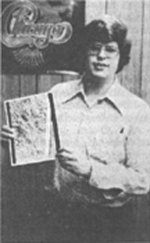
So...since LAL is still (incorrectly) claiming that I'm wrong about the source of the 3-toed track cast. Let me again state that I originally said that the same cast is displayed in a photo in John Green's book.
It is.
It is in the hands of Stan Gordon who sits in front of a "Chicago" poster.
The image I posted is clearer and in color, but it is a cast of the same track from the same incident.
I don't have the page number as I'm at work, but no doubt a dedicated BF-fan can easily find said photo.
Now, being as all this is completely irrelevant to the discussion at hand (namely how do so-called BF experts distinguish real from forged tracks), I'll leave it at that.
Carry on my wayward sons (and daughters).
It is.
It is in the hands of Stan Gordon who sits in front of a "Chicago" poster.
The image I posted is clearer and in color, but it is a cast of the same track from the same incident.
I don't have the page number as I'm at work, but no doubt a dedicated BF-fan can easily find said photo.
Now, being as all this is completely irrelevant to the discussion at hand (namely how do so-called BF experts distinguish real from forged tracks), I'll leave it at that.
Carry on my wayward sons (and daughters).
Last edited:
LAL
Illuminator

- Joined
- May 19, 2005
- Messages
- 3,255
Meat is not a major part of their diet, LAL...
It's a regular part of their diet:
http://www.americanscientist.org/template/AssetDetail/assetid/24543?fulltext=true
The point is, they were thought to be vegetarians until observation proved otherwise.
They've even added humans to the diet:
http://www.igorilla.com/gorilla/animal/2004/monkeys-attack0human-babies.html
I fail to see how all of this provides any backing to bigfeet as real creatures.
Protein would go a long way toward providing the estimated 5000 calories a day they would need. From reports, fish, frogs, deer and even wild hogs (nocturnal, by the way) are part of their diet. One hair analysis grouped them with humans, gorillas and chimpanzees. Two out of three of those hunt for meat.
Did you see the report from Crater Lake's chief naturalist? A retired wildlife biologist had an encounter near Skookum Meadow. I can probably dig up a few more. Wildlife biologists have seen them.
I don't have time today to go over stuff we've gone over several times before. We can agree to disagree.
However, I live in an area that has a strong tradition of story-telling. A friend of mine is a professional storyteller whose great-grandfather brought the Jack tales from England. There are no myths about hairy giants in these stories (Jack and the Beanstalk would be the closest, and that's not close).
I'm near the Eastern Band of the Cherokee as well. A Cherokee aquaintance referred me to a book on Cherokee belief when asked about tradition on this. The only thing he could provide was information on a modern sighting near Big Cove. Another Cherokee thought saquatches were a western thing; the Cherokee have the Boogers, which are a spirit being kind of thing.
There seems to be little in the way of Bigfoot mythology here but there are credible sightings, especially in the western Piedmont.
Did you see my post on the error in the box? Meldrum does not support the idea of an opposed thumb in his book. I'll read Campbell if you'll read Meldrum.
I've read Dawkins on memes. I wasnt impressed.
LAL
Illuminator
- Joined
- May 19, 2005
- Messages
- 3,255
So...since LAL is still (incorrectly) claiming that I'm wrong about the source of the 3-toed track cast. Let me again state that I originally said that the same cast is displayed in a photo in John Green's book.
That's not what you originally said.
It is.
It is in the hands of Stan Gordon who sits in front of a "Chicago" poster.
The image I posted is clearer and in color, but it is a cast of the same track from the same incident.
Okay, so now its a cleaner, color version of the photo in Gordon's hand? I posted the photo of Gordon. He's standing, BTW.
Where did you get the cleaner, color version you posted?
I don't have the page number as I'm at work, but no doubt a dedicated BF-fan can easily find said photo.
It's on page 259.
I own books by Murphy, Green, Dahinden, Krantz, Byrne, Meldrum, Powell and even Coleman. Your version is in none of them.
Simple question: where did you get it?
Now, being as all this is completely irrelevant to the discussion at hand (namely how do so-called BF experts distinguish real from forged tracks), I'll leave it at that.
Carry on my wayward sons (and daughters).
I'm undoubtedly old enough to be your mother. I would appreciate it if you would drop the condescension and answer the question.
An "enhanced" photo that's supposed to show researchers take three-toed tracks (outside of Fouke) seriously is certainly relevant. Jeff Meldrum has said none of the three-toed prints hold up anatomically. Therefore they're what?
Stan Gordon fat? Look again:
Attachments
LAL
Illuminator
- Joined
- May 19, 2005
- Messages
- 3,255
Oh, you know, that depends on how I feel like interpreting the word to suit my beliefs. Right now I'd say you're more of a super lady linker.
Thank you, I think.
Science is finally getting around to this one, a mere 40 years later:

It helps to have a skull.
LAL
Illuminator
- Joined
- May 19, 2005
- Messages
- 3,255
"I've intended to write something of a tutorial relating to syndactyly (fused digits) and my thoughts on the possibility of there being 4 (or 3!) toed bigfeet (I think all such cases are hoaxes), but I don't see it happening any time soon. So for now, here is a shot of severe syndactyly in a mountain gorilla. Shown are toes 2-5 (big toe off to left) of the right foot of an adult male mountain gorilla. You can see that toes 3 (nail lifted) and 4 are fused to nearly the tip." -Apeman

http://www.bigfootforums.com/index.php?showtopic=14781&pid=355454&st=0&#entry355454
I can't "out" Apeman, but he really is an expert on apes.
http://www.bigfootforums.com/index.php?showtopic=14781&pid=355454&st=0&#entry355454
I can't "out" Apeman, but he really is an expert on apes.
LAL
Illuminator
- Joined
- May 19, 2005
- Messages
- 3,255
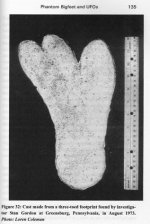
Well, I finally thought to check the Bords (so? I got the book in a package deal- it was cheap). This is their version and look where even they put it (looks like it was made with a spoon, actually). Their source is Loren Coleman. Are these supposed to be the same?
Attachments

Last edited:
Skeptical Greg
Agave Wine Connoisseur
"I've intended to write something of a tutorial relating to syndactyly (fused digits) and my thoughts on the possibility of there being 4 (or 3!) toed bigfeet (I think all such cases are hoaxes), but I don't see it happening any time soon. So for now, here is a shot of severe syndactyly in a mountain gorilla. Shown are toes 2-5 (big toe off to left) of the right foot of an adult male mountain gorilla. You can see that toes 3 (nail lifted) and 4 are fused to nearly the tip." -Apeman
[qimg]http://www.bigfootforums.com/uploads//post-958-1164469998_thumb.jpg[/qimg]
http://www.bigfootforums.com/index.php?showtopic=14781&pid=355454&st=0&#entry355454
I can't "out" Apeman, but he really is an expert on apes.
What is your point ? Who says a Bigfoot can't be 3 or four toed ?
An imaginary animal can have as many toes as you want ...
- Status
- Not open for further replies.