Anyway, he's a specialist, an expert. His opinion must have some importance, after all, specially because he's the "father" of the giant primate...
His argument's about the same as Daegling's. I doubt he's looked at the evidence.
Experts can be wrong, right? That wasn't an appeal to authority, was it

<snip>
Found them after you provided the info. Thanks.
Academic Google, I love you!
From Daegling & Grine, 1994
http://md1.csa.com/partners/viewrec...&recid=3703033&q=&uid=789847771&setcookie=yes
we have:
From Ciochon
et al., 1990,
http://www.pnas.org/cgi/content/abstract/87/20/8120
We have:
That's herbivorous, not omnivorous...
There is a discussion on how important was bamboo to their diet, but both papers agree they were herbivorous.
Strange Daegling didn't say that in his book after citing those papers, one of which he co-authored.
Chimpanzees were thought to be vegetarians until they were observed hunting and sharing the kill. Meat is eaten with relish.
There's no quicker way than protein to supply the estimated 5000 calories a day it would take to sustain an animal of that size. And even if Giganto was a specialized bamboo eater, there's no reason a similar species couldn't have split off that wasn't.
But still, there are no evidence they (or any other hominid) migrated and coexisted in North America with H. sapiens...
And no evidence they didn't.
Little detail that is missing:
There are remains of elephants (and their relatives) as well other animals with comparable distributions scattered all over Asia and North America. Got a similar backing for bigfoot?
Their habitat was conducive to fossilization. If Sasquatches utilized the same habitat, we might have fossils of them too.
Nope. Their fossils may be "all over China" only if their habitat included the whole China (what is probably quite unlikely).
I was being sarcastic. How about all over the region between Central China and Vietnam? Is anyone looking in northern China?
The apparent ancestor lived in India (not much left of them, either).
<snip>
Yes, are you beginning to understand why I consider unsatisfactory the position that their remains (fossil or not) should be found only at PNW (as well as the complimentary reasonings on why they are not found)?
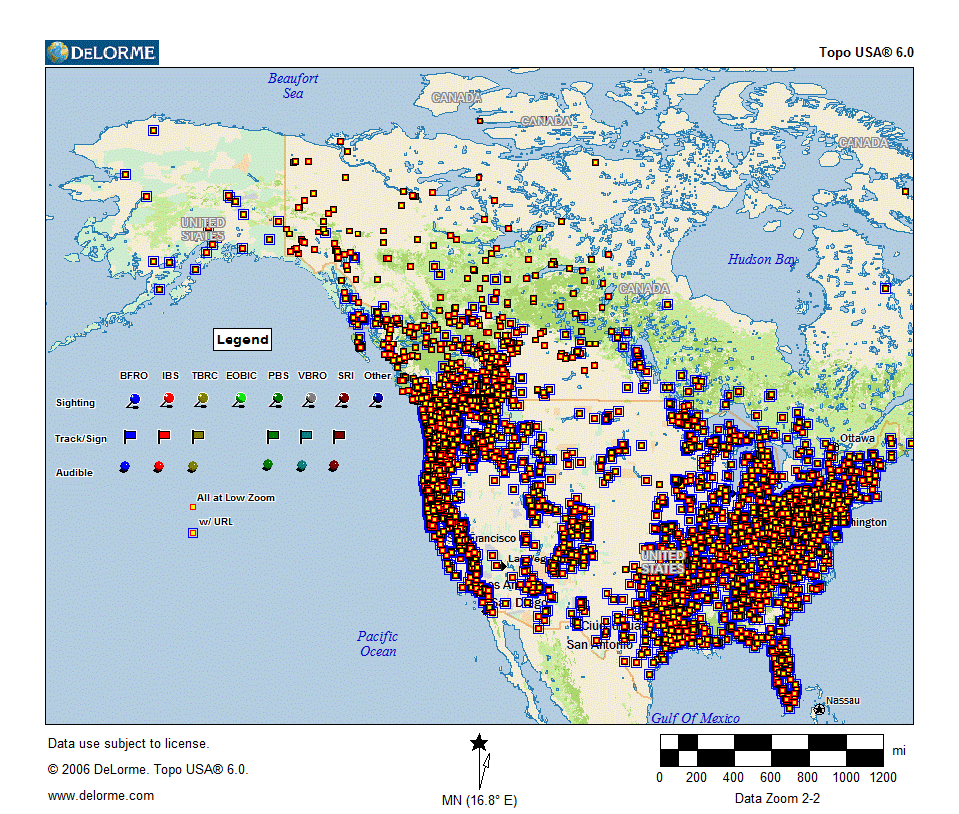
That's the most likely area. An investigator on another list posted this morning he visits the area between Mt. St. Helens yearly. Ironically, that's the very area I posted this picture off:
This is Mt. Hood + Adams:
And Adams + Rainier.:
http://unrnet.seismo.unr.edu/Aerials/part4.html
This is some prime habitat. It stretches south, too, past Mt. Shasta in California.
He said he carries with him enough technology to make most scientists foam at the mouth. He said if anyone thinks he, or others, are out for a buck they might want to see what he's spent to make that "buck".
Yes, I never denied that here are possible templates in the fossil record for Asiatic "jungle wildmen". Perhaps you have missed this post:
http://www.internationalskeptics.com/forums/showpost.php?p=2235688&postcount=380
What I say is that the fossil record provides no backing for
bigfoot. I think its possible -but highly unlikely for the reasons I already exposed several times- that sasquatch myth started in Asia with Gigantopithecus and was later brought to North America by the antecessors of current Native Americans.
Then spread to the early settlers, who were grabbing their land and gradually exterminating them and their traditions.
This myth was then incorporated to modern bigfoot lore. Or, why not "modern bigfoot myth"?
Why not reports of these mythical creatures eating bamboo?
Modern H. Sapiens cohexisted with H. erectus there. ...
Did
H. sapiens get folk tales from
H. erectus?
The most likely candidate to be the template for an Asiatic "jungle wild men" and perhaps sasquatch (if the myth was brought from Asia) would be H. erectus.
Of course there several types of "asiatic wildmen". We don't seem to have many myths of the Orang Pendak in NA.
The native "myths" about the Ebu Gogo may actually have been about the Ebu Gogo (
Homo floriensis).
Krantnz thought the Almasty were modern human Paleolithic hunters. The Russian scientists leaned toward Neandertals. They're much more recent.
However, both ideas above are nothing but speculation.
Yep.
The first person account I heard while waiting for my oil change in Waynesville was absolutely not mythlike.The witness was a trucker. He and his partner saw one cross the road near Snoqualmie, Washington. I don't know if they said WTF or not, but that was all there was to it. The partner told him to keep quiet about it, or they're "lock us up".
"myth (mth)
n.
1.
a. A traditional, typically ancient story dealing with supernatural beings, ancestors, or heroes that serves as a fundamental type in the worldview of a people, as by explaining aspects of the natural world or delineating the psychology, customs, or ideals of society: the myth of Eros and Psyche; a creation myth.
b. Such stories considered as a group: the realm of myth.
2. A popular belief or story that has become associated with a person, institution, or occurrence, especially one considered to illustrate a cultural ideal: a star whose fame turned her into a myth; the pioneer myth of suburbia.
3. A fiction or half-truth, especially one that forms part of an ideology.
4. A fictitious story, person, or thing: "German artillery superiority on the Western Front was a myth" Leon Wolff."
http://www.thefreedictionary.com/myth
Frankly, at an area where there are (or were untill some centuries ago) orang-utangs, is there any real reason for a fossil template as a source for myths on "jungle wildmen"?
Orangutans can walk quite well bipedally, but they usually don't.
"Wildmen" are bipedal.
Gorillas were a myth until they were "dicovered".
Are there any real needs for forest wildmen myths everywhere to have unknown or extinct hominid species as template?
Nope.
See Gayle Highpine's paper for a NA POV:
http://web.ncf.ca/bz050/HomePage.bfna.html
BTW, Peter Byrne, in
Sasquatch Odyssey, said Osmond Hill examined the finger and said it was not human.
Of course, it could have been bear.