• Quick note - the problem with Youtube videos not embedding on the forum appears to have been fixed, thanks to ZiprHead. If you do still see problems let me know.

Simple Challenge For Bigfoot Supporters

Status
Not open for further replies.
In LAL's quoted post above mentioning Whitehall and it's population she originally said 'check to the west' as opposed to the edit of 'check what's around the town'.

I changed it after noticing the area to the east isn't necessarily farmland. Google Earth isn't all that detailed and I'm not used to it. I'm not sure just how the Adirondacks run and Google is timing out on me. I'll check Topo.

This report mentions a tree farm.

"ENVIRONMENT: I've mapped the area by natural community 'cover types'. Essentially, the forested areas are Beech-maple mesic forests with scattered occurrences of the Hemlock-northern hardwood forest community, particularly on western and northern slopes. Lesser occurrences of the Pitch pine-oak-heath rocky summit community are found near ridge and hill tops dominated by rock outcroppings.

http://www.bfro.net/GDB/show_report.asp?id=9723

From my friend's photos, I know the area they were in was remote and wild as anything around here................just smaller. They not only heard wood-knocking, it was in response to theirs.
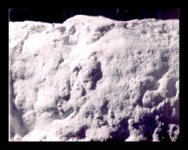
 
Tube has neglected to mention something really important. Jimmy Chilcutt doesn't rely on dermal ridges alone. The "characteristics" have to be there before he can say it's "primate". I've already posted an example from the Elkins Creek cast. It's the bifurcations, short ridges, ending ridges and closures shown in area "A" in the report:

http://www.bigfootencounters.com/sbs/elkins.html

Regarding OM, this is the area he was referring to specifically in the Willow Creek Symposium presentation.
 

Attachments

  • Chilcutt- OM dermals.jpg
    Chilcutt- OM dermals.jpg
    60.2 KB · Views: 96
Regarding Wrinkle Foot, he was focusing on the scars. The edges of the ridges tuck under. He said this indicates a real animal. He said he couldn't say it was a sasquatch; he's never seen a sasquatch.......and, he said, he doesn't want to.

The dermal ridges aren't just along the edges. They're all over.

The top two photos are stills from WCS 2003.The diagrams and photo are from Chris Murphy's Meet the Sasquatch.
 

Attachments

  • Chilcutt- Wrinkle Foot.jpg
    Chilcutt- Wrinkle Foot.jpg
    52.3 KB · Views: 94
  • Chilcutt - Wrinkle Foot scar.jpg
    Chilcutt - Wrinkle Foot scar.jpg
    60.9 KB · Views: 82
  • Dermal ridge flow- Murphy.jpg
    Dermal ridge flow- Murphy.jpg
    66.9 KB · Views: 84
Would it be something to the effect of 'regardless of what's been shown to the contrary I believe what Meldrum and Chilcutt claim to be dermals are IMO dermals'?

No, it would be more about confidently naming a source that isn't the correct source, and insisting on it even after being shown it's incorrect. I suppose it's possible someone has removed the page from both editions, but I didn't see any cut marks. Did you bother to check him on it or did you just assume DY's correct?

Sweeping statements such as "Chilcutt's wrong" and "Meldrum's wrong" come to mind.

Well, I don't know how many times I can say it but I guess more than one cast from a successive trackway displaying matching 'dermal' patterns would reaaally go a long way to support such an assertion. Those are where?

I posted CA-20 off tube's website. Did you miss it? It right under CA-19.

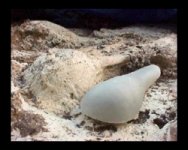
See a better angle of the "Skookum heel" below.

Of course someone claimed the mud caved in to create the look of an Achilles tendon. What appears to be the extended heel deduced by Krantz from the Bossburg prints and seen on the figure in the PGF, must be a trick of the mud too.;) The still is also from his presentation.
 

Attachments

  • Chilcutt - Heel angle.jpg
    Chilcutt - Heel angle.jpg
    58.9 KB · Views: 82
Last edited:
Tube has neglected to mention something really important. Jimmy Chilcutt doesn't rely on dermal ridges alone.
Is that so?
The "characteristics" have to be there before he can say it's "primate". I've already posted an example from the Elkins Creek cast. It's the bifurcations, short ridges, ending ridges and closures shown in area "A" in the report:
Is that an overly technical explantion for what diseccation ridges would naturally do or are we supposed to think they would remain completely separate like some kind of neat topographical map and not conform to fluid physics? Wait, let's check with Chilcutt-

Jimmy Chilcutt:
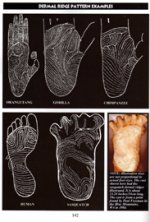
Not many people know this, but all monkeys have the same fingerprint pattern, which is an elongated whorl. Monkeys, no matter where you find them in the world, from India, Africa, South America, all monkeys have the same pattern - they're all unique and individual to each animal, but all have the same general pattern - elongated whorl. That's all they have. Humans have arches, loops, and whorls. Great apes - gorillas, orangutans, chimpanzees, and gibbons - they have loops and whorls.
Oh, OK. Where are these elongated whorls in these casts?

Oh, wait a tick:
Yeah, once I decided they could not have been faked I started looking at the texture and the ridge-flow pattern.
Uh huh... Wait, how did you determine that?
I found in all the sasquatch foot casts I examined that the ridges flow up and down the side of the foot...in humans the ridges flow across, and in primates that we know of they flow at an angle.
Really?
I've never seen a print where the ridges go up and down the side. And once I determined what this animal's print looked like, it was easy to examine the others and be able to tell a fake from a real one.
Never, huh?
 
Regarding OM, this is the area he was referring to specifically in the Willow Creek Symposium presentation.
Are the those the 'dermals' at the edge of that lunar landscape? That's wild that dermals would imprint themselves on the outside of all that muck. What's really wild is that bigfoot can apparently leave dermal detail without leaving gross morphological detail. Wow.
 
Last edited:
Regarding Wrinkle Foot, he was focusing on the scars. The edges of the ridges tuck under. He said this indicates a real animal. He said he couldn't say it was a sasquatch; he's never seen a sasquatch.......and, he said, he doesn't want to.
It's a good thing Chilcutt has such extensive experience working with casts that he can readily differentiate the tucked under edges from casting artifacts. What's that? No experience with casts? Hey, his testimony puts people in jail, so there!
 
No, it would be more about confidently naming a source that isn't the correct source, and insisting on it even after being shown it's incorrect. I suppose it's possible someone has removed the page from both editions, but I didn't see any cut marks. Did you bother to check him on it or did you just assume DY's correct?

Sweeping statements such as "Chilcutt's wrong" and "Meldrum's wrong" come to mind.
Maybe DY's trying to trick you with phantom three-toed pics. I can't say as I'm more interested with the obvious poo level of dermal claims.
I posted CA-20 off tube's website. Did you miss it? It right under CA-19.
OMG, you posted evidence of two casts from a successive trackway displaying matching ridge flow patterns!? No, you didn't? You just posted CA-20? For a second there you would have thought there was a chance all Tube's demonstrations would have gone up in a puff of smoke and simple logic, but no.
 
IMO, I would say it differs in that Meldrum, Krantz, etc were not presenting their findings personally here and then directly accused. Realistically, I see know reason given the subsequent investigations of their claims why Noll, Meldrum, or maybe Chilcutt should avoid a dialogue with those who are informed and skeptical of their findings.

They shouldn't and I'm sure they don't. I have yet to see Jimmy post on a message board, but since tube knows him personally, maybe he could persuade him to join in here. I would dearly love to see his replies to tube's posts.

I'm sure he could explain better than I can why ridges taking a 45° turn rules out pouring problems.
 
Is that so?Is that an overly technical explantion for what diseccation ridges would naturally do or are we supposed to think they would remain completely separate like some kind of neat topographical map and not conform to fluid physics?

No, that's about what actual dermal ridges do.

Oh, OK. Where are these elongated whorls in these casts?

Why elongated whorls? Thy're not monkeys.

See Wrinkle Foot.

Oh, wait a tick:Uh huh... Wait, how did you determine that? Really? Never, huh?

He has a thousand primate prints in his data base. He's a forensic fingerprint expert. He may have seen a few human prints too.

If you're trying to imply the longitudinal ridges might have been put there by a human foot, remember they're twice the width of human dermal ridges.
 
It's a good thing Chilcutt has such extensive experience working with casts that he can readily differentiate the tucked under edges from casting artifacts. What's that? No experience with casts? Hey, his testimony puts people in jail, so there!

Tube has no experience in fingerprinting, but you believe everything he says?

Jimmy seemed open to learning more about casting. That's more than I can say for some of his critics.

He did not think that could be easily faked. There were several such scars showing on those casts (there are two Wrinkle Foots, left and right). Do you have any experience with scars? He spent three days examining Meldrum's collection. This wasn't any cursory look in a drawer.
 
I think for anyone even after the most casual examination to continue to assert that these features are dermal ridges is to display such total lack of objectivity that whatever credibility may have been had is irrevocably gone. Not to mention the forhead slapping stupidity of not in one instance someone being able to address the question of more than one cast of a successive trackway displaying matching dermal features.

That been addressed several times. Read Meldrum.
It's not supposed to be funny but it really is.

What's funny to me is that sceptics don't seem to notice the lack of continuity in the "Crowlely lines". And where are the characteristics Chilcutt uses to make his determinations? Ridges alone aren't enough.
 
Tube has no experience in fingerprinting, but you believe everything he says?

Jimmy seemed open to learning more about casting. That's more than I can say for some of his critics.

He did not think that could be easily faked. There were several such scars showing on those casts (there are two Wrinkle Foots, left and right). Do you have any experience with scars? He spent three days examining Meldrum's collection. This wasn't any cursory look in a drawer.

What is the "that" that he did not think could be easily faked?
 
They shouldn't and I'm sure they don't.
I think it would be maybe arrogant to expect them to come here and explain it to us simps but considering that here is where many of there key findings are shown to be incorrect you'd think it not out of the question.
I have yet to see Jimmy post on a message board, but since tube knows him personally, maybe he could persuade him to join in here. I would dearly love to see his replies to tube's posts.
Yes, he's very quiet. I wonder how currently confident he is in his original findings. I wonder if he's ever said to anyone that he needs to re-evaluate them before making his own publishing concerning them.
I'm sure he could explain better than I can why ridges taking a 45° turn rules out pouring problems.
So, you've got me staring at my hands and unable to find where any of my own dermals make 45 degree turns. The closest thing I can think of is separate ridges joining together but I admit I'm at a loss.
 
Does anyone else find it kind of sad that it has taken almost 40 YEARS for this piece of evidence to be critically and publicly discussed?

I cold answer this question another way. It is not sad; it is to be expected. It didn't take long after reports of Bigfoot hit the post-1950 American media, that skepticism took root. It just didn't seem right that after hundreds of years of exploration, exploitation and habitation of our forests - we would have a unknown species of gigantic bipedal apes living right there with us. Something smelled really rotten about the Bigfoot claims right from the get go.

Almost immediately, thinking folks didn't pay much attention to Bigfoot stuff. They weren't missin anything because no animal or carcass has ever been found... back then or up to now.

It's not sad that the dermal thingy has taken 40 years to be critically discussed. Shoot, we've only had the internet since Al Gore invented it. Besides that, all of the other smart folks like Matt Crowley already done had other better things to do with their time than to fuss about that silly Bigfoot thing.
 
No, that's about what actual dermal ridges do.
I'd have thought you were very familiar with bifurcations. Are we to believe that bifurcations (the ridges seeming to fork), short ridges, ending ridges, and closures could not occur without primate dermals? I guess that's a great big sweat pore there too, right?
Why elongated whorls? Thy're not monkeys.
You're missing the point. These's casts don't have dessication ridges which out of some crazy fluke exactly mimic what only primate dermals do. There are NO features on any of the casts that could only be created by primate feet. Incidentally, the question may seem silly to you but how do you know they're not monkies?
See Wrinkle Foot.
We can see it very well here and I'm sorry but IMO it's ridiculous that you or anyone thinks those are dermals.
He has a thousand primate prints in his data base. He's a forensic fingerprint expert. He may have seen a few human prints too.
You're again totally missing the point. By what criteria that hasn't already been showed to be flawed is he ruling out fakes? Thousands of prints and NEVER seen anything like those on the outsides of bigfoot prints. You're painting yourself in the corner right along with him.
If you're trying to imply the longitudinal ridges might have been put there by a human foot, remember they're twice the width of human dermal ridges.
Yeah, what?:boggled: Where do get that? Anyway it's hard to forget they're almost twice the width of ANY primate dermals.
 
Tube has no experience in fingerprinting, but you believe everything he says?
I make my decision from what is painfully obvious but I can't help notice the irony of you asking about believing everything someone says. Maybe you could indulge in some speculation as to why none of these 'dermal' prints look anything like the the textures of human feet that have never worn shoes and live in mountainous areas.
 
Status
Not open for further replies.

Back
Top Bottom