• Quick note - the problem with Youtube videos not embedding on the forum appears to have been fixed, thanks to ZiprHead. If you do still see problems let me know.

Simple Challenge For Bigfoot Supporters

Status
Not open for further replies.
What should I retract?
That LAL doesn't agree that the cast in Green's book is the same as the color photo I posted? Sorry. It is.

If I may refresh your memory, what you said was this:

It's from Pennsylvania in the 1970's
John Green's got a photo of it in his bible "Apes Among Us."
There's plenty more like it in the books from other sources, but most of the BF "researchers" who want to appear at least a wee bit legitimate try to ignore these oddballs even though the circumstances of their discovery and associated "sightings" seem just as legitimate as those of the 5-toed "normal" variety (ie., nothing a serious field biologist would put too much stock into). Krantz mentioned this and then proceeded to continue with his "analysis" of 5- and 4- and 6-toed tracks, while ignoring 3-toed tracks. Very blatant bias, and by no stretch of the imagination "scientific." "

Now you're saying this

thum_10506459d54845a353.jpg


which does not appear in the book, is the same as the cast below (1978 edition, pg 320)? This is the only photo of a 3-toed cast (without someone holding it) I can find in The Apes Among Us and it's from Los Angeles County, not Pennsylvania.
 

Attachments

  • 3-toed cast- LA.jpg
    3-toed cast- LA.jpg
    72.3 KB · Views: 45
Last edited:
Why can't you just open your heart to the teachings of Meldrum?:D

One thing I'll say for Dr. Meldrum- he doesn't do a lot of debating online, but when he does he debates like a gentleman and doesn't try to flame the opposition.
 
"But lets be very clear about this - if you took this sample to have it analyzed, it would not come back with a reading that says it is Volcanic Ash. Volcanic Ash breaks down very fast - in as little as 2 years if it is exposed to the elements, I was told even faster by a Volcanologist currently working on Mt. Saint Helens for the USGS, if Ash is on the side of a hill, or a Mountain side. I will get into the actual properties of the soil at a later date, as I am waiting for some other very specific information about this soil. I am trying to dot all of my i's and crossing all my t's.

Ok for the pictures. I did exactly what Matt Crowley discusses. My results..I do have Dermal Ridges and Flexion Creases. While the dermals are very faint they are there. The dermals on a human female are much smaller and more difficult to recover than that of a human male. These casts are of my feet - and I am (I guarantee you) a human female.

Measurement of the track prior to casting:

These numbers remained unchanged in the finished cast - there was no expanision.. I can not account for this. I expected to see some expansion - but I had none.

I was unable to duplicate Matt's work. I did exactly as I was instructed, and I could not do it. I have the feeling it may have everything to do with the casting agent. But, something we need to consider is this. Matt's work for the most part was in Volcanic ash - and Im sure that ash moved much easier under the weight of the casting agent. This soil is not the same - at all. If you look at the full foot cast you will see a depression in the soil (in the arch area) - that is where the casting agent made first contact with the soil - and it abruptly stops. Another thing to consider - soil is not Volcanic Ash. There is a big difference between the two." -Melissa Hovey

http://txsasquatch.blogspot.com/search?q=volcanic+ash
 
Thom Powell, in his book The Locals does mention three-toed trackways, but there are no pictures. I've found nothing on 6-toes. There are several reports mentioning four toes, but, as Krantz suggested, the fifth toe might have been elevated and just not have left a print.

Again, DY, what is the source for the 3-toed photo? Are you sure it doesn't have something to do with Mike Dennett and the 15' penguin?
 
One thing I'll say for Dr. Meldrum- he doesn't do a lot of debating online, but when he does he debates like a gentleman and doesn't try to flame the opposition.
No he doesn't ... He just talks down to them in a very condescending manner ..

In this post, he talks to everyone who doesn't accept his mis-identification of an elk lay, in a condescending manner.

http://www.bigfootforums.com/index.php?s=&showtopic=14377&view=findpost&p=300698

Seriously, I would have to attribute that seeming change of opinion to a better appreciation of different audiences. During the initial examinations I was among colleagues sharing to varying degrees my understanding of ape and wildlife anatomy and sign, who could appreciate the significance of what we were looking at.
 
Last edited:
If I may refresh your memory, what you said was this:

It's from Pennsylvania in the 1970's
John Green's got a photo of it in his bible "Apes Among Us."
There's plenty more like it in the books from other sources, but most of the BF "researchers" who want to appear at least a wee bit legitimate try to ignore these oddballs even though the circumstances of their discovery and associated "sightings" seem just as legitimate as those of the 5-toed "normal" variety (ie., nothing a serious field biologist would put too much stock into). Krantz mentioned this and then proceeded to continue with his "analysis" of 5- and 4- and 6-toed tracks, while ignoring 3-toed tracks. Very blatant bias, and by no stretch of the imagination "scientific." "

Now you're saying this

[qimg]http://www.internationalskeptics.com/forums/imagehosting/thum_10506459d54845a353.jpg[/qimg]

which does not appear in the book, is the same as the cast below (1978 edition, pg 320)? This is the only photo of a 3-toed cast (without someone holding it) I can find in The Apes Among Us and it's from Los Angeles County, not Pennsylvania.


Wrong again LAL!:D
Take a look at the photo of that track as it is discussed in the Pennsylvania section. It's there. I promise. The fat guy with the Chicago poster is associated with it as I recall.

Volcanic Ash breaks down very fast - in as little as 2 years if it is exposed to the elements, I was told even faster by a Volcanologist currently working on Mt. Saint Helens for the USGS, if Ash is on the side of a hill, or a Mountain side. I will get into the actual properties of the soil at a later date, as I am waiting for some other very specific information about this soil. I am trying to dot all of my i's and crossing all my t's.

Completely untrue. Volcanic ash (bentonitic clay) sits at the surface until it either is carried away, or is burried. That's how we have 100s of millions of years old ash beds. I tell you this as a geologist. The roads in Bluff Creek were cosntructed by scraping away (grading) the topsoil and exposing the underlying ash-rich soil. Simple. End of story.

So...back to how all those BF "experts" confidently identify tracks...
I say it's all b.s.
 
Last edited:
RayG wrote:
You'll figure it out eventually... there ARE no answers when it comes to bigfoot. It can be just about anything you want it to be. (wishful-thinking is a great help in this regard).
And someday you'll figure out how to answer simple questions!

How are the other PROBABLE explanations for Joyce's report and her phone call to me coming along?
You said you could think of some....can you post anything at all?
Or are you full of stinking hot air? :)
 
LAL's confused because I posted a color photo of a 3-toed track from Pennsylvania, which is also figured in John Green's book as a B&W photo. But she can't make the connection that photos come in both B&W and color, depending on the medium. Apparently for her, if it's not in a book, it ain't real!

Well, chalk me up as confused too, 'cause I don't see a b&w or color pic of that track in Apes Among Us either. Since you have posted a colored version, you must have had a source, yes?

RayG
 
And someday you'll figure out how to answer simple questions!

And you continue to cut me to the quick. If only your powers of observation were as sharp as your wit.

How are the other PROBABLE explanations for Joyce's report and her phone call to me coming along?
You want probabilities go see a mathematician. If you truly cannot think of any other possibilities then your mind isn't as open as you claim.

You said you could think of some....can you post anything at all?
Yes, I can, and without a great deal of effort. Read much? Try reading some books on the brain, perception, and memory. You shouldn't have any difficulty coming up with other possibilities once you exercise your brain instead of your mouth.

Or are you full of stinking hot air?
Aren't we all, or are you somehow special?

RayG
 
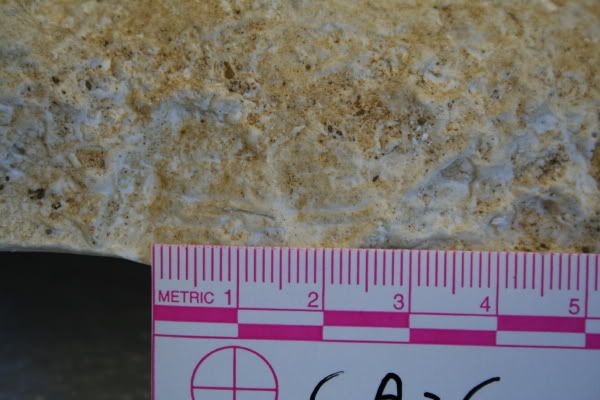
I was going through a bunch of photos I took in Dr. Meldrum's lab of some of his casts. I took so many that day I forgot about a couple of interesting shots. I haven't posted these on BFF or here before, so perhaps some of you might be interested. As you will see, more than just one cast from the Blue Creek Mountain - Onion Mountain trackway exhibit desiccation ridges.

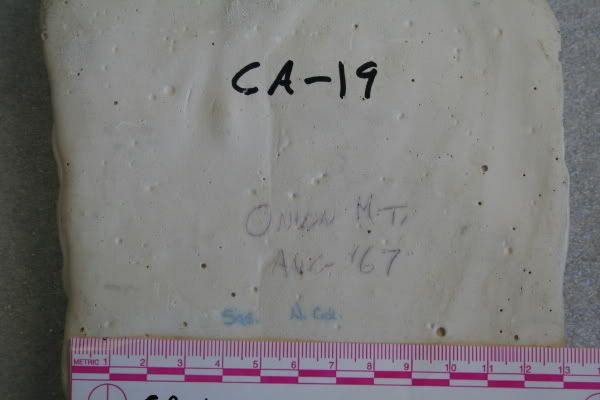
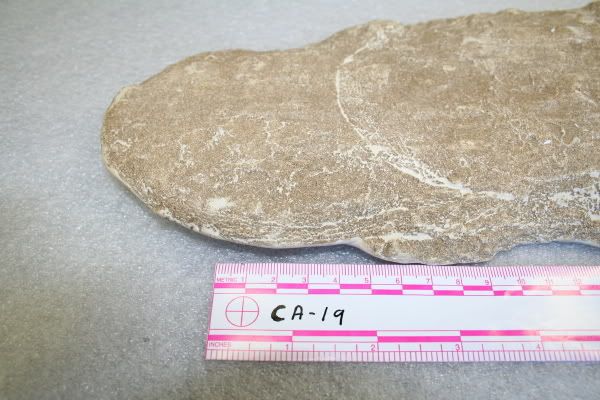
But first, lets look at the cast that Chilcutt claims exhibits "dermal ridges". This was labeled by Grover Krantz "CA-19" and "Onion Mountain". Jeff Meldrum claims it is the ORIGINAL cast, but this is disputed by John Green, who says that he "did not keep that one".

If Chilcutt examined the cast that Meldrum claims is the original, then why was he so adamant about claiming it came from "Blue Creek Mountain" when in CLEARLY says "Onion Mountain" on it???

"This ridge flow is consistent with the ridge flow of the 1967 Blue Creek Mountain Road casting and the 1984 Walla Walla, Table Spring casting."

http://home.clara.net/rfthomas/papers/elkins.html

As you can see, we are not off to such a wonderfully solid forensic start here... At the very root of this case we have two fundamental identification blunders. As the Bigfooters are fond of saying, "If this were a court of law"...

But lets look at some desiccation ridges for fun...

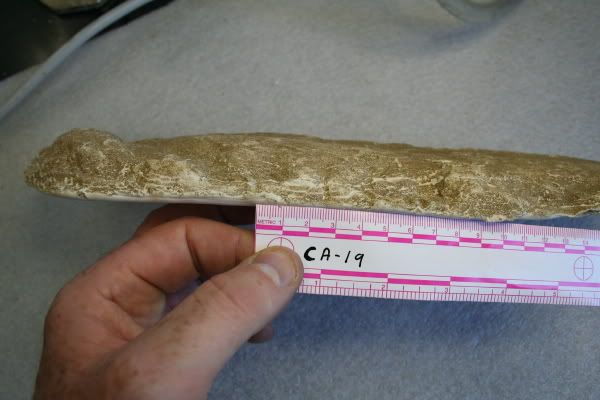
IMG_3428.jpg
 
This is a view of the LATERAL margin of CA-19, the side you DON'T see on Legend Meets Science, Loren Coleman's Bigfoot book, and Meldrum's new book. Hey, I wonder why....

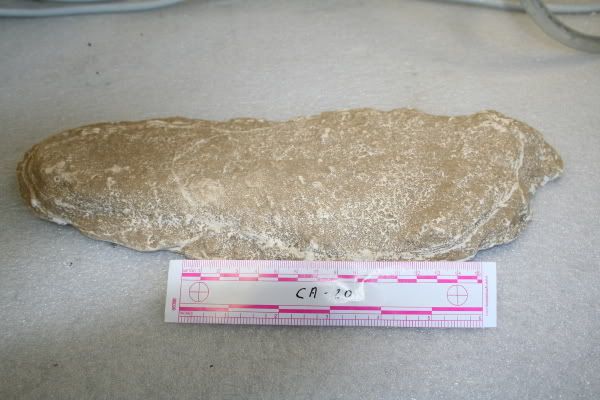
IMG_3474.jpg
 
Here is CA-20, another cast from the Blue Creek Mountain trackway. As you can see, there is essentially NO gross morphological detail in the cast, i.e. toes. If the track contained no gross morphological detail, it is unreasonable to expect it to contain fine detail.

But to anyone who knows what desiccation ridges look like it's a "slam dunk" as they say...

I knew immediately what I was looking at when I saw the cast. I'm genuinely sorry Chilcutt didn't understand what he was looking at.

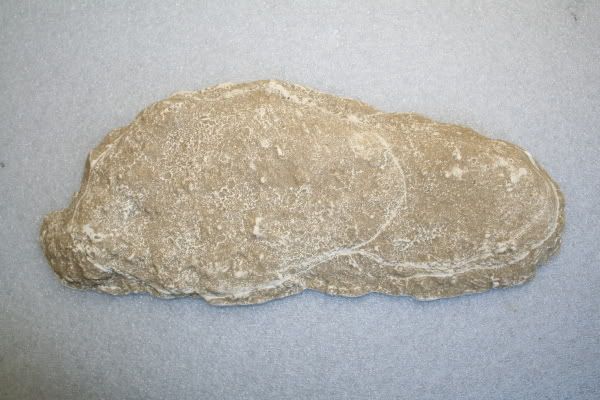
IMG_3385.jpg
 
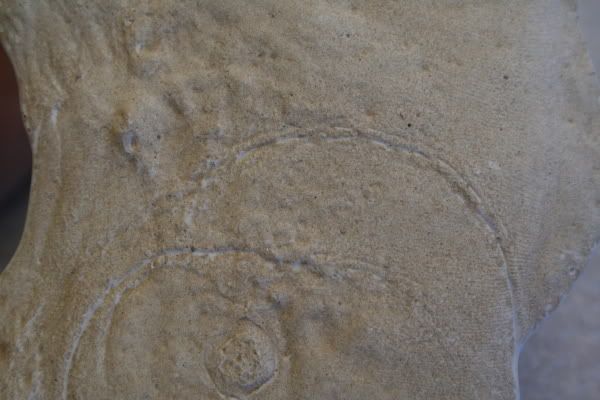
Here is a lateral view of CA-20. As you can see the major furrow loops around the "heel" and "toe" area of the cast.

Yes, Virginia, desiccation ridges have a "ridge flow pattern" too...

IMG_3395.jpg
 
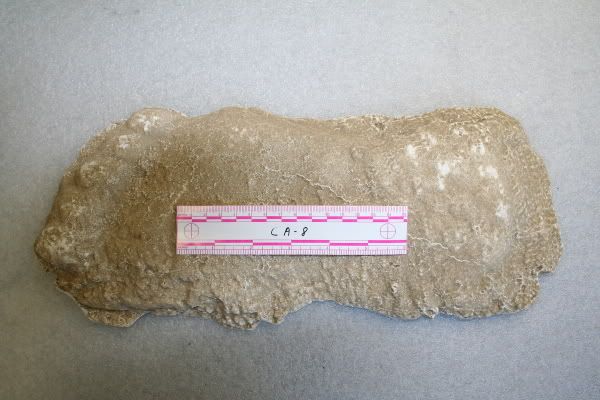
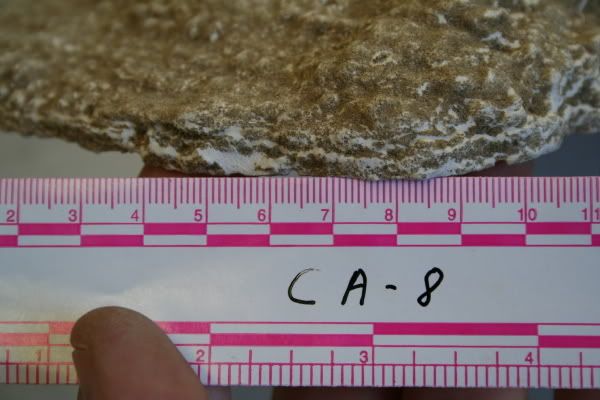
Here is an edge view of CA-8. It gets kind of familiar after a while, doesn't it...

IMG_3413.jpg
 
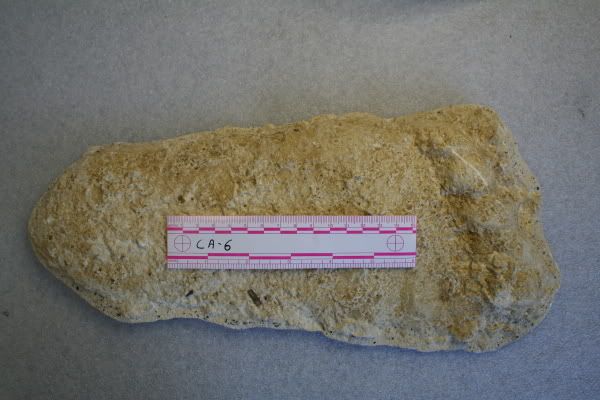
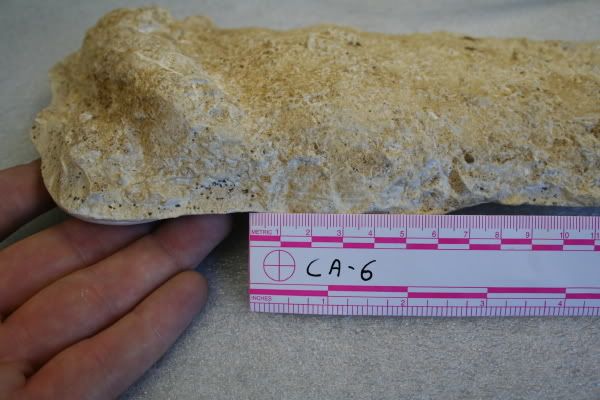
Desiccation ridges often, but not always, congregate around the periphery of casts. The four casts seen here are no exception.

I know that I will never convince Internet fanatics, and those who wish to augment their Bigfoot social status by attacking "debunkers" such as myself and Dr. Wroblewski. But I think that everyone else can see how obvious these textures are as desiccation ridges.

IMG_3422.jpg
 
I stopped posting on Bigfoot Forums when one individual had the audacity to imply that I had somehow engaged in fraud or gross negligence to obtain desiccation ridges on my own test casts.

I find this ironic, as test casts made in 1999, long before I even heard about "Bigfoot's dermal ridges", exhibit desiccation ridges were made by Jeff Meldrum himself...

This cast is quite interesting, actually, as you can see desiccation ridges superimposed on top of the test subject's own REAL dermal ridges. I hope the photo resolution comes through for everyone, as I can see it on my end.

IMG_3448.jpg
 
Status
Not open for further replies.

Back
Top Bottom