Sol88
Philosopher

- Joined
- Mar 23, 2009
- Messages
- 8,437
sounds to me that the re-invented the tearing instability
Unstable electric currents.

sounds to me that the re-invented the tearing instability

Posting more stuff you don't understand in an attempt to distract and divert from.your prior nonsense. Pathetic but typicsl.The dominate electric currents, electric fields, plasmoids and something about the attendant magnetic fields that arise from moving charged particles!

sounds to me that the re-invented the tearing instability

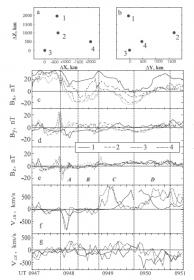

In addition to the solar coronal heating (30, 31), the omnipresence of plasmoids associated with magnetic reconnection, identified in this study, also has broad implications and consequences on particle acceleration in the solar/stellar coronae, accretion disks, and jets from compact objects (33, 34), and on filament formation in the Herschel maps of the Orion A giant molecular cloud (35). Moreover, the ubiquitous presence of dense plasmoids in the interstellar medium can also play an important role in pulsar scintillation (36). All the aforementioned astrophysical systems are associated with large Rm ( > 105) and thus could be characterized by the tearing-mediated turbulence identified in the present work.
Bostick wrote:[8]
Plasmoids appear to be plasma cylinders elongated in the direction of the magnetic field. Plasmoids possess a measurable magnetic moment, a measurable translational speed, a transverse electric field, and a measurable size. Plasmoids can interact with each other, seemingly by reflecting off one another. Their orbits can also be made to curve toward one another. Plasmoids can be made to spiral to a stop if projected into a gas at about 10−3 mm Hg pressure. Plasmoids can also be made to smash each other into fragments. There is some scant evidence to support the hypothesis that they undergo fission and possess spin.

Have you anything newer on plasmoids? Bosticks a bit long in the tooth now.
Nöh, first show how the observations of cluster.....
Quasi-periodic pulsations (QPPs; also known as quasi-periodic oscillations, i.e., QPOs)
Thus, the temporal variation of microwave emissions is closely related to the process of electron acceleration. Once the magnetic reconnection happens quasi-periodically, the electron acceleration will also be quasi-periodic and QPPs will be generated.
In the standard flare model, magnetic reconnection plays an important role in releasing energy from the coronal magnetic field, ejecting plasmoid and accelerating electrons.
Moreover, a 2.5-dimensional MHD simulation further validates that magnetic islands generated in the current sheet modulate magnetic reconnection into a quasi-periodic form.
Tearing modes are ubiquitous plasma instabilities whose final nonlinear stage involves the disruption of magnetic flux surfaces via the formation of magnetic islands
Effectively “short-circuit” confinement by allowing heat/particles to transit island region by rapidly flowing along field-lines, rather
than slowly diffusing across flux-surfaces.
LINKAll these results strongly support the scenario that quasi-periodic magnetic reconnection in the current sheet accelerates electrons quasi-periodically and then generates QPPs.
“ideal” tearing mode"
Tearing Mode Instability inIf we consider a “collapsing” current sheet, i.e. a thinning current sheet, whose aspect ratio...Secondary current sheets become tearing unstable and new plasmoids form

A clear understanding of plasmoid formation could thus lead to a more efficient method of creating and maintaining a plasma through transient Coaxial Helicity Injection. This method, originally developed at the University of Washington, could dispense with a solenoid entirely and would work like this:
1. Researchers first inject open magnetic field lines into the vessel from the bottom of the vacuum chamber. As researchers drive electric current along those magnetic lines, the lines snap closed and form the plasmoids, much like soap bubbles being blown out of a sheet of soapy film.
2. The many plasmoids would then merge to form one giant plasmoid that could fill the vacuum chamber.
3.The magnetic field within this giant plasmoid would induce a current in the plasma to keep the gas tightly in place. "In principle, CHI could fundamentally change how tokamaks are built in the future," says Raman.
Understanding how the magnetic lines in plasmoids snap closed could also help solar physicists decode the workings of the sun. Huge magnetic lines regularly loop off the surface of the star, bringing the sun's hot plasma with them. These lines sometimes snap together to form a plasmoid-like mass that can interfere with communications satellites when it collides with the magnetic field that surrounds the Earth.

Plasmoids and sheaths mean success or failure for solar eruptionsOur Sun experiences regular eruptions of material into space, but solar physicists still have difficulty in explaining why these dramatic events take place.

1. Researchers first inject open magnetic field lines into the vessel from the bottom of the vacuum chamber. As researchers drive electric current along those magnetic lines, the lines snap closed and form the plasmoids, much like soap bubbles being blown out of a sheet of soapy film.
LINKThe formation of the plasmoids is due to the motion of plasma in the lower atmosphere of the Sun. These motions bring magnetic fieldlines closer together to reconnect and build a new magnetic flux system (i.e. the plasmoid). Whether the plasmoids are 'failed' or 'successful' (i.e. they erupt into space) depends on the level of interaction between the new emerging field and the old, pre-existing magnetic field in the solar corona.
In plasma physics, it is well known that magnetic field lines are "frozen-in" to an infinitely conductive plasma. Since charged plasma particles are confined to circular orbits around magnetic field lines, this means that infinitely conductive plasmas will not diffuse across field lines and mix. Conversely, two distinct field lines will remain separate since they cannot penetrate the intervening plasma. In most cases, solar and magnetospheric plasmas can be described very accurately with such a theory since they are both very conductive. However, straightforward application of the theory would remove the possibility of ejected solar plasma penetrating the magnetosphere since the plasmas would not be allowed to mix. Nevertheless, based on observations and known technological disruptions, we know that they must mix, but how?
The answer resides in the fact that when plasmas carrying oppositely directed magnetic field lines are brought together, a strong current sheet is established, in the presence of which even a vanishingly small amount of resistivity in a small volume can become important, allowing plasma diffusion and, thus, magnetic reconnection to occur.
Not with me you haven't.
I'm specifically looking for an explanation as to why two differing plasma fields should not have a double layer boundary.
The lack of such a boundary is required for MHD models have any validity at all.
Astrophysicists are basically denying that double layers exist between differing plasmas by ignoring them.
Either circuit theory is wrong and there is no such thing as a double layer, or MHD reconnection is wrong.
One or the other.
Chose which theory to mock.
That's not how this works, Michael. You're the one that started the thread. You're the one making the claim that an entire field of expert researchers is wrong about a basic point. You're the one that needs to provide evidence that your assertions are correct, or at least reasonable.
You can't answer even this simple question, and it's transparently obvious why.
By default, the standard model of reconnection would be invalidated by the existence of a double layer.
I assumed you could figure that part out on your own.
Just answer the question and I'll shut up about EU forever.
Does a double layer exist at the boundary of two differing plasma regions or not?
You can completely rid me of all my EU beliefs if you can demonstrate that there is no such thing as a double layer.
Double layers create current sheets.
7
A Promising Multi-scale Idea to Combine Fluid and Kinetic
Models: Plasmoid Instability of Large-scale Current Sheets

Where are the double layers? michaelsuede was onto it.
Now mainstream have caught up kinetic circuit theory is valid. MHD was thw wrong model.
Oh well.
Yes, of course. Why would they not?
Ampres law and all!