Problems With Magnetic Reconnection

But an electric field will accelerate charged particles, electrons in particular (less mass) more better’r than null point mag fields snapping, stretching and reconnecting.

What exactly is your basis for this claim (other that you would prefer it to be so)? Magnet fields can accelerate charged particles every bit as efficiently as electrical fields. Basically, they are two sides of the same thing.

Hans
 
Tim Thompson is no longer active here, but his posts live on.

See my post Electric Currents and Magnetic Reconnection II (#763 on page 20) and the post by W.D. Clinger that follows immediately after.

....snip....

The idea that magnetic reconnection can be confused with "circuit reconnection" or "current reconnection" is ludicrous, and carries with it the necessary assumption that nearly all living plasma physicists are morons. It is a sign of enormous & quite frankly insulting arrogance.


ETA: My personal web site went down some time ago, so its images are no longer displayed. In the following extended quotation from my post recommended above by Tim Thompson, I have repaired that image by linking directly to Wikipedia.

Allow me to present what I believe to be a correct definition of magnetic field lines, followed by what I believe to be a (highly relevant) counterexample to the definition Tim Thompson offered above.

Definition. A magnetic field line of a magnetic field B is a differentiable one-parameter curve L(λ) such that dL/dλ=B(L(λ)).

In English, that says a magnetic field line is a curve that's parallel to the magnetic field. Equivalently, the magnetic field is tangent to the magnetic field line at every point on the magnetic field line.

Example. In cylindrical coordinates, consider a magnetic field B(r,θ,z)=(1/r,(θ+π/2),0). That's the magnetic field generated by a certain (unit-dependent) current running through an infinitely long and infinitely thin conducting rod at r=0. (Don't worry about the singularity at r=0, because it goes away for rods that aren't infinitely thin. For a real conducting rod bisected by the plane z=0, the formula shown remains a good approximation to the magnetic field in that plane provided r is small compared to the length of the rod but isn't too close to zero.)

The magnetic field lines of B(r,θ,z)=(1/r,(θ+π/2),0) form circles whose center is r=0. If I've done the math right, the magnetic field line at radius r and height z is L(λ)=(r,λ/r2, z).

For that particular magnetic field, the magnetic field lines do indeed have the property stated by Tim Thompson: the magnitude of the magnetic field is constant on the magnetic field line. To construct my counterexample B', I will subtract two translated copies of the field B from the sum of two translated copies of B. By linearity, B' will be the magnetic field generated by four conducting rods, each carrying exactly the same current.

A more complicated example. Translating the origin to a point p' gives us a different magnetic field Bp'(p)=B(p-p') whose magnetic field lines are translations of the magnetic field lines for B. Still using cylindrical coordinates, let
  1. p1=(1,0,0)
  2. p2=(1,π/2,0)
  3. p3=(1,π,0)
  4. p4=(1,3π/2,0)
Using Bi to abbreviate Bpi, define
B' = B4 - B3 + B2 - B1​
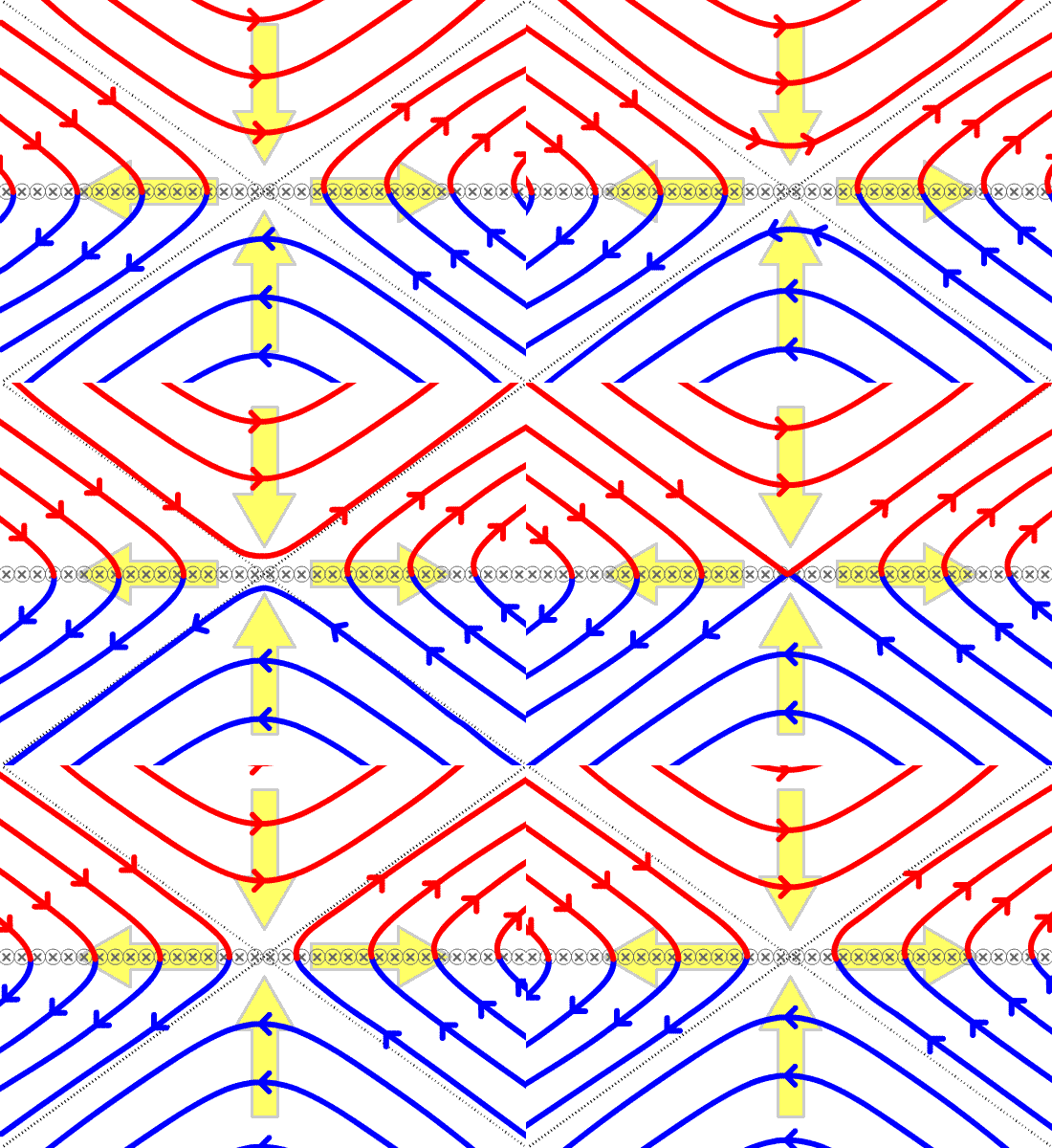
Near the origin, the magnetic field lines of B' look something like the red, blue, and red/blue lines of

Reconnection.gif


except the X-lines meet at right angles instead of being vertically squashed as in that Wikipedia image.

Consider the magnetic field lines that go through the origin. It turns out that there are two different magnetic field lines that go through that point. For one of those magnetic field lines, the magnitude of the magnetic field increases in the direction of π/4, while for the other field line the magnitude of the magnetic field decreases in the direction of -π/4. For both of those magnetic field lines, the magnitude of the magnetic field is zero at the origin.

Yet neither of those magnetic field lines ends at the origin, and the divergence is zero at the origin (as it is everywhere). I suspect that some of the EU crowd's misconceptions come from using an incorrect definition of magnetic field lines and from a shallow (and incorrect) notion of divergence.

 
Last edited:
Of course we have to be careful with moving images as shown above.

This is a simple cartoon of fieldlines merging, whcih is helpful in general and describes the large picture rather well, as observed many times by e.g. Cluster.

However, if the density of the field lines remains constant along the y-axis, then there is no reduction in the magnetic field strength, which we know happens when nearing the X-line. In the ion and electron diffusion regions it actually does not make sense to label field lines because they loose their identity. I should not say this because Sol is going to run with this, not understanding what is meant.
But at clear 2D reconnection, in the central X-line there is zero field, so no direction, naturally this changes when there is a guide field present.

NEVERTHELESS, considering "large scale" physics, i.e. outside of the ion diffusion region, a region that is a few ion inertial length thick and, depending on the situation up to a few tens of ion inertial lengths wide, the simple cartoon shows exactly what is happening, oppositely directed field being pressed together, reconnecting (i.e. changing the magnetic topology) and then the newly formed strongly bent field lines relax to a less bent state, thereby accelerating the attached plasma through the magnetic tension, and yes, there are some electric fields in play too. But looking at the actual data, from space missions, it is clear that the main accelerator is the magnetic field.

Classic double speak!

there are some electric fields in play too. Ok then, what do the electric fields do?

Charge separation was not mentioned, oversight?


It is clear that the main accelerator is the magnetic field
, ok then...can the magnetic field involved here change the kinetic energy of the plasma, tusenfem?
 
Last edited:
Nope, magnetic reconnection. The very type denied by your cult.


You've become irrelevant unfortunately jd116.

You were wrong about the diamagnetic cavity @67P, mag reconection, charge separation, electric fields, Field aligned currents....the list is endless.
 
Tim Thompson is no longer active here, but his posts live on.


ETA: My personal web site went down some time ago, so its images are no longer displayed. In the following extended quotation from my post recommended above by Tim Thompson, I have repaired that image by linking directly to Wikipedia.

The idea that magnetic reconnection can be confused with "circuit reconnection" or "current reconnection" is ludicrous, and carries with it the necessary assumption that nearly all living plasma physicists are morons. It is a sign of enormous & quite frankly insulting arrogance.

What part do the currents (flux tubes) play then?
 
See MM gave it a red hot crack.

Funnily enough, was proven correct!

Ahh, the ELECTRIC FIELDS!
 
The idea that magnetic reconnection can be confused with "circuit reconnection" or "current reconnection" is ludicrous, and carries with it the necessary assumption that nearly all living plasma physicists are morons. It is a sign of enormous & quite frankly insulting arrogance.

What part do the currents (flux tubes) play then?

But seriously, electric currents and electric fields are in play here. My electric field beats your magnetic field at adding kinetic energy to the plasma. :boggled:

So the electric currents and electric fields involved play no part because your irons are bigger the the ‘lectrons and their frozen in magnetic field lines can snap and join, so we can just sorta ignore them?
 
So the electric currents and electric fields involved play no part because your irons are bigger the the ‘lectrons and their frozen in magnetic field lines can snap and join, so we can just sorta ignore them?

What iron? this is mainly a hydrogen plasma!
For the rest, the sentence makes even less sense.
 
You've become irrelevant unfortunately jd116.

You were wrong about the diamagnetic cavity @67P, mag reconection, charge separation, electric fields, Field aligned currents....the list is endless.

No I wasn't wrong. It is you who is still batting zero. Fälthammar accepted magnetic reconnection. You won't find a plasma physicist on the planet that doesn't. A handful of unqualified mythologists aren't going to change anything.
 
No I wasn't wrong. It is you who is still batting zero. Fälthammar accepted magnetic reconnection. You won't find a plasma physicist on the planet that doesn't. A handful of unqualified mythologists aren't going to change anything.

Enter the Plasmoid

In 2007, Nuno Loureiro, then a postdoctoral researcher at PPPL and a participant of the DOE Center for Multiscale Plasma Dynamics at the University of Maryland, developed what might be the final piece of the map. It was a new theory that became known as the plasmoid instability
. It connects the Sweet-Parker and two-fluid models into a single theory. Later*work at PPPL has expanded on his initial idea.

Like Sweet-Parker, the plasmoid instability model starts with a stretched-out, thin sheet of electrical current with an accompanying magnetic field. Like the two-fluid model, it assumes the electrons and ions that flow along the magnetic field lines break away at different times.

What makes this model different is that it is based on the fact that the sheets of electrical current are extremely unstable. As the sheets stretch, they break and form new ones, each thinner than the original. As these sheets separate, chains of magnetic bubbles (plasmoids) form between them. While previous theories had described these bubbles, no one had provided a good explanation of how and why they form.

The theory proposes that as more bubbles form and sheets break up, the magnetic lines crash into each other and break. The lines disconnect from the ions first, then the electrons. The breaking feeds magnetic energy into the particles, heating them up and accelerating them. As time goes on, the whole process becomes faster and faster. It creates a runaway effect — fast reconnection.

Unlike Sweet-Parker, this model provides the "oomph" to give fast reconnection its speed. Unlike the two-fluid theory, it illustrates why and how the process starts after that initial sheet of strong electric current forms.

Modeling and experimental data have held the theory up — so far.

The dominate electric currents, electric fields, plasmoids and something about the attendant magnetic fields that arise from moving charged particles!
 
The dominate electric currents, electric fields, plasmoids and something about the attendant magnetic fields that arise from moving charged particles!

Errr, we already knew that reconnection creates plasmoids! And that there is a current sheet. There kind of has to be. You have anti-parallel magnetic fields. That is the same reason that there is a heliospheric current sheet. Ditto in the tail of comets, and in the magnetosphere.

I just don't think you understand what reconnection is. Your cult leaders have told you not to believe in it, even though we observe it, and you have to follow the party line, despite not knowing what the hell it is!

EDIT:

Best I do a drawing to explain 'anti-parallel' fields!

>>>>>>>>>>>>>>>>>
......................................
<<<<<<<<<<<<<<<<<

Where > & < are the fields and their direction of flow, and ... is the current sheet going into (or out of) the screen.
 
Last edited:
Errr, we already knew that reconnection creates plasmoids! And that there is a current sheet. There kind of has to be. You have anti-parallel magnetic fields. That is the same reason that there is a heliospheric current sheet. Ditto in the tail of comets, and in the magnetosphere.

I just don't think you understand what reconnection is. Your cult leaders have told you not to believe in it, even though we observe it, and you have to follow the party line, despite not knowing what the hell it is!

EDIT:

Best I do a drawing to explain 'anti-parallel' fields!

>>>>>>>>>>>>>>>>>
......................................
<<<<<<<<<<<<<<<<<

Where > & < are the fields and their direction of flow, and ... is the current sheet going into (or out of) the screen.


Oh, a double layer!
 
The dominate electric currents, electric fields, plasmoids and something about the attendant magnetic fields that arise from moving charged particles!

sounds to me that the re-invented the tearing instability
 

ISF - Join now!

Every member here is approved by hand. No bots, no spam, just people who care about evidence and honest debate.

Membership is free!

Create your free account

Back
Top Bottom