Merged Pearl Harbor: "Revisionists" vs. "Traditionalists"

One has to remember the purpose of the ship-carried DF equipment of the time: It was meant for homing in on a target, or a port. Actually, it had ways of distinguishing between opposite bearings, without triangulation (using an auxiliary antenna, for those with technical interest), but then you simply headed in the indicated direction, taking new bearings on the way, till you had visual contact.

Hans

Did they ever use that gear to home in on SOS broadcasts?
 
*) This might have some merit: In eastern culture there is a distinct tendency to report what you think your superiours want to hear, rather than what actually happened.

Comms were logged, an objective records of what was received when. (Not completely immune to tampering, of course, but not easily "edited" either.) This is the problem Capt. Safford had in proving the Winds activation message was sent. Luckily for him, 7001 was missing, so that, in his opinion, was "the one".
 
Did they ever use that gear to home in on SOS broadcasts?

I expect so, but again all you needed was to be able to steam in the approximately right direction, then refine your course on the way, with new bearings.

Hans
 
Comms were logged, an objective records of what was received when. (Not completely immune to tampering, of course, but not easily "edited" either.) This is the problem Capt. Safford had in proving the Winds activation message was sent. Luckily for him, 7001 was missing, so that, in his opinion, was "the one".

Well, I would expct so, from a competent fleet leadership. Just leaving the benefit of doubt. ;)

Hans
 
Have you ever seen a directional, turnable HF antenna? They exist; some radio hams use them, and some embassies still sport them. Imagine the skeleton of a 30 foot fish, made in thin metal pipes, and supported by stringers, and you have a good picture. Good lick with installing, not to mention operating, such a contraption on a sea-going vessel.
Hans

Hans,
Please read my posts and links.

Yes, I have seen directional turnable HF antennas

Radio Direction Finding. Shortly after the Army mine layer General Samuel M. Mills was converted to the cable laying ship Pequot she was equipped with a first generation radio direction finding (RDF) system or Radio Compass. This can be seen on the photo below (right) as the distinctive diamond shaped rotating antenna on top of the wheelhouse. It is not evident on the earlier photo to the left. This technology, which was first deployed by the Coast Guard in the early 1920s, enabled the ship’s radio operator to get a compass bearing fix on the source of a ship or shore radio transmission. Not only was this an aid to navigation, but it enabled ships to locate each other at sea and during the war determine friend from foe.

See picture 69


http://indicatorloops.com/usn_pequot_communications.htm
 
I expect so, but again all you needed was to be able to steam in the approximately right direction, then refine your course on the way, with new bearings.

Hans

True. I was just wondering if you knew of any cases where that happened. Someone sending an SOS might not know their position, just enough to know how to send a distress signal, so homing in would be the only way to find them.
 
Google Adcock aerial, loop aerial,fixed frame aerial and rotating frame aerial.
All of these are ship mounted and are not of the huge dimensions you posit.
The Adcock antenna was patented in 1919.
No. Present evidence for your claims.

I certainly did not assert that the liner had the same equipment as a warship.
What I did assert was that the technology was available and not only to the Canadians.
Which is an argument from ignorance, and is effectively useless for determining what the Cruise Liner did have. Not might have had. Did.

If you look at the link I posted you will see a more complete list.
I first quoted the list to show that the technology was available in the 40's.
The second time i quoted it was to refute the assertion that HF/DF need to be of gigantic proportions and couldn't be fitted to a ship.
I made no assertions other than the DF argument is not relevant to refuting bobtaftfan's argument.
Again, useless.
 
Last edited:
No. Present evidence for your claims.

Which is an argument from ignorance, and is effectively useless for determining what the Cruise Liner did have. Not might have had. Did.


If yAgain, useless.

Holy mackerel, and I am the one arguing from ignorance.

I am out of here.

Edited by jhunter1163: 
Edited for Rule 0.
 
Last edited by a moderator:
RDF can be used to triangulate the position of other ships who are transmitting radio signals.

It does not matter whether the source of the transmission is stationary or mobile.
That's correct, but not in the way you think. You can take bearings, sure, but without another simultaneous reading you can't tell where along the bearing the other ship is. You can't even be sure if it's moving or not.

You only require the ship to be transmitting.

Now whether or not the Japanese fleet was transmitting or not remains to be seen.
No it doesn't. People have repeatedly pointed out the Japanese say their ship was under strict radio silence. Bobby keeps ignoring it.

My point is if the Japanese were transmitting, then any ship in range with the most rudimentary RDF would be able to perform this triangulation.
They were not transmitting. They said and say so.

This triangulation can be done with only one receiver whether the transmitter or receiver were mobile or stationary.
False.

This is a fact as shown by the game tracking example I provided.
It does not matter whether you use VHF or HF, the principle remains the same.
Except for the fact that your example was only relevant to a small area, not thousands of square miles of ocean.

I disagree with bobtaftfan's assertion that this direction finding could have discerned the number of ships in the Japanese fleet as not all of the ships would have been transmitting and the resolution of the RDF is not sufficient to make this distinction anyway.

ETA: History
John Stone Stone patented the first direction finding system in 1902 (U.S. Patent 716,134). Alternate and improved direction finding systems were invented by Lee de Forest in 1904 (U.S. Patent 771,819), and by Italian engineers Ettore Bellini and Alessandro Tosi in 1909 (U.S. Patent 943,960). In 1919, British Army Officer Frank Adcock proposed an improved direction finding antenna design Adcock antenna (UK Patent 130,490).
http://en.wikipedia.org/wiki/Radio_direction_finder

Yes, we know, argument from ignorance. "It could've happened!" you bleat, over and over.
 
Hans,
Please read my posts and links.

Yes, I have seen directional turnable HF antennas

Radio Direction Finding. Shortly after the Army mine layer General Samuel M. Mills was converted to the cable laying ship Pequot she was equipped with a first generation radio direction finding (RDF) system or Radio Compass. This can be seen on the photo below (right) as the distinctive diamond shaped rotating antenna on top of the wheelhouse. It is not evident on the earlier photo to the left. This technology, which was first deployed by the Coast Guard in the early 1920s, enabled the ship’s radio operator to get a compass bearing fix on the source of a ship or shore radio transmission. Not only was this an aid to navigation, but it enabled ships to locate each other at sea and during the war determine friend from foe.

See picture 69


http://indicatorloops.com/usn_pequot_communications.htm

Yep, that's your typical early diamond-shaped loop DF antenna. Not very precise. The later photo shows the circular HF/DF "Huff-Duff" antenna, wich was somewhat better, not so much because of the antenna, but because the electronics had been improved. - Of course, the fact that is sits in the middle of a cluster of masta and what have you is not going to help the precision.

A civilian ship, in 1041, would have the diamond-shaped type, and might not even have specialized receiving equipment to go with it. Probably just hooked it up to their standard receiver and used the AGC meter to find the signal minimums.

Hans
 
Last edited:
Holy mackerel, and I am the one arguing from ignorance.

I am out of here.


Edited by LashL: 
Removed quote of moderated content.

That's right. Run away when asked for evidence you claim exists.

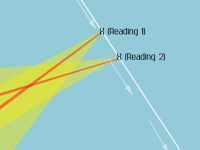
On the attached rough diagram, please identify the exact location and course of the ship or group whose transmissions are being detected by ship X. The yellow area represents the margin of error, as discussed several times. The red represents the apparent reading. Keep in mind that the yellow area covers thousands of square miles.

Neither you, nor Bobby will be willing to hazard a guess. If you like, I'll even allow you to ignore the margin of error. And, full disclosure, I even have the actual straight-line location/course plotted out in the Photoshop document, so this won't be a trick question where the answer is whatever you don't choose.
 

Attachments

  • DirectionFinding01.png
    DirectionFinding01.png
    14.4 KB · Views: 13
Last edited by a moderator:
Google Adcock aerial, loop aerial,fixed frame aerial and rotating frame aerial.
All of these are ship mounted and are not of the huge dimensions you posit.
The Adcock antenna was patented in 1919.


I certainly did not assert that the liner had the same equipment as a warship.
What I did assert was that the technology was available and not only to the Canadians.


If you look at the link I posted you will see a more complete list.
I first quoted the list to show that the technology was available in the 40's.
The second time i quoted it was to refute the assertion that HF/DF need to be of gigantic proportions and couldn't be fitted to a ship.
I made no assertions other than the DF argument is not relevant to refuting bobtaftfan's argument.
Yes, I know about different ways of doing DF. I didn't assert that all DF equipment was too big to be on a ship. My post was a response to your comment that beam antennas work for tracking radio-tagged game. They do. But the comment showed that you don't understand how radio works, or you would never have brought it up.
 
That's right. Run away when asked for evidence you claim exists.

On the attached rough diagram, please identify the exact location and course of the ship or group whose transmissions are being detected by ship X. The yellow area represents the margin of error, as discussed several times. The red represents the apparent reading. Keep in mind that the yellow area covers thousands of square miles.

Neither you, nor Bobby will be willing to hazard a guess. If you like, I'll even allow you to ignore the margin of error. And, full disclosure, I even have the actual straight-line location/course plotted out in the Photoshop document, so this won't be a trick question where the answer is whatever you don't choose.


Bearing in mind that the target is also moving between the two fixes.
 
This DF chatter is all a Red Herring anyway. There is no evidence to show that the fleet was transmitting at any time let alone constantly. Evidence points to an order to the fleet not to transmit.
 
RDF can be used to triangulate the position of other ships who are transmitting radio signals.

It does not matter whether the source of the transmission is stationary or mobile.

You only require the ship to be transmitting.

Now whether or not the Japanese fleet was transmitting or not remains to be seen.

My point is if the Japanese were transmitting, then any ship in range with the most rudimentary RDF would be able to perform this triangulation.


"Triangulation" means two receivers received the signal at the same time or one receiver moved around a stationary transmitter. This did not happen during the Japanese task force's transit.

This triangulation can be done with only one receiver whether the transmitter or receiver were mobile or stationary.

This is a fact as shown by the game tracking example I provided.


You have shown you understand the basics of DF but don't understand the difficulty of determining the position of a moving transmitter by a moving receiver with poor DF capability.

It does not matter whether you use VHF or HF, the principle remains the same.


No one is debating the principle, only the relative accuracy of bearings obtained by different sized antenna in relation to the wavelength. Lower frequencies require larger antennas to get the same bearing accuracy as higher frequencies. Is an accuracy of 2° just as good as an accuracy of 20° for accurately locating a moving ship 3000 nautical miles away over the time span of several days? Keep in mind that Grogan claimed his bearings matched the task force's track, not "hey, there is a Japanese task force operating somewhere in the North Pacific". He goes so far as to say they "stopped" on Dec 2.

But as I said before, it's all academic until we actually see the bearings Grogan claimed to take. All we have is "northwest" and "northwest by west" and claims not supported by these vague directions.
 
Yes, I know about different ways of doing DF. I didn't assert that all DF equipment was too big to be on a ship. My post was a response to your comment that beam antennas work for tracking radio-tagged game. They do. But the comment showed that you don't understand how radio works, or you would never have brought it up.

Firstly, let me apologise for my earlier sarcastic statement.

I was at work and being tried from all ends.

Secondly, the reason I brought up the animal tracking was to refute the idea that you cannot triangulate using only one transmitter and one receiver.

As far as my understanding of how a radio works, radiowaves travel radially from the source in straight lines, unless reflected by some medium.

So, triangulation is possible at any frequency.
Sure, a hand held HF tracking setup is far from practical.

As far as ship borne HF/DF sets were concerned they used either Adcock, loop, fixed frame or rotating frame antennas which are relatively compact.

I was not asserting that ships used HF yagi antennas, that was your interpretation of my game tracking statement.

When I studied at King Radio in Olathe Kansas, thay had a directional HF yagi antenna on the factory roof so I know the physical size of a HF yagi.

As far as the SS Lurline is concerned, this was a top of the range luxury liner. It is not unreasonable to expect a ship of this calibre to utilise a RDF seeing as they had been in use for some 20 years before the war.

The SS Lurline was christened on 12 July 1932.

The next issue regarding the SS Lurliner is the fact that this ship was not trying to intercept the source of transmission, just noting from which general direction the transmission came from.

Had they been trying to intercept they would have kept altering course to intercept and refining their heading with further triangulation.

It is gross speculation for Grogan to determine the source to have been the Japanese fleet. The source could have been a decoy or land based transmissions. ( I thought I made this clear in an earlier post).

So, whatever argument is used to refute this conspiracy theory, the intricacies of HF/DF is not going to cut the mustard.:)
 
"Triangulation" means two receivers received the signal at the same time or one receiver moved around a stationary transmitter. This did not happen during the Japanese task force's transit. .

Hence my statement about single transmitter, single receiver game triangulation.

The principle is the same regardless of the frequency.

This procedure works and if you wish to refute it, please provide evidence of the failures to perform.

By comparing relative bearing taken at various positions with a single receiver is triangulation.

Sure the accuracy is not fantastic, but by altering your course and comparing plots will bring you within visual range of your target.

ETA:
TRIANGULATION USING A RADIO BEACON ON EARTH

Earthquake triangulation uses the distance to something and figures out the exact location from that. Another kind of triangulation uses the direction to something to figure out location. Hikers can use radio waves to triangulate their location. A radio transmitter sends out waves from one location in all directions. A receiver will be loudest when the hiker is facing the transmitter. When the hiker knows the readings from two places, they can find the transmitter.
rad-direction.gif

hiker.gif

DS1's AutoNav system uses triangulation and the locations of asteroids in space to figure out its exact location.

http://www.qrg.northwestern.edu/projects/vss/docs/navigation/1-what-is-triangulation.html
 
Last edited:
Hence my statement about single transmitter, single receiver game triangulation.

The principle is the same regardless of the frequency.

This procedure works and if you wish to refute it, please provide evidence of the failures to perform.


No one is disputing it works, only the accuracy.

It's like you're from a different planet. Is everything on your planet black and white, completing lacking in any shade of gray?

By comparing relative bearing


I already corrected you about "relative bearings".

taken at various positions with a single receiver is triangulation.

If and only if the transmitter is stationary, as shown in the link you provided. Did you not notice the transmitter is stationary???


Sure the accuracy is not fantastic, but by altering your course and comparing plots will bring you within visual range of your target.


Finally! You finally admit accuracy can be variable!

To answer your challenge, please tell me exactly where the target is:

p1UyZ.png
 
Has anyone posted this before?
http://www.usnwc.edu/getattachment/...hing-the-Fox-Unaware---Japanese-Radio-Denial-

It's got some quite interesting stuff on the radio deception plan, and the whole radio silence bit. I didn't realise when the Japanese unwrapped their various comms kit from whatever various things they'd been stored in in order to ensure they were never used, some of it was not in a great state.

bobtaftfan also mentioned something earlier about repeat-backs and how Grogan knew they had to be the fleet because they were LHF (300 something kHz?). I will quote from the above, p113-114:

"
As the ships sailed north to the cold and foggy Kuriles, the Tokyo broadcast sent out a message from Commander, Carrier Divisions of the Combined Fleet to all carrier units, Commander, 1st Destroyer Squadron, and Commander, 3rd Battleship Division that beginning at midnight 19 November Tokyo time, fleet frequencies in the HF band would be on “Battle Control” status, while those in VLF would assume “Alert Control.” This order, Striking Force Operational Order 1, meant that the HF broadcast would carry operational traffic, while the VLF broadcast would transmit if the traffic volume became excessive. It did not order radio silence—the ships already had been ordered into HF silence, and they could not transmit on VLF frequencies.
"

Does that mean the ships could not actually transmit at the frequency Grogan was picking up? I'm not a comms expert, but that's what that implies to me.

ETA: This was the post where the frequency of the broadcasts is mentioned.
http://www.internationalskeptics.com/forums/showpost.php?p=8658113&postcount=227
 
Last edited:

ISF - Join now!

Every member here is approved by hand. No bots, no spam, just people who care about evidence and honest debate.

Membership is free!

Create your free account

Back
Top Bottom