Origins of Covid

Status
Not open for further replies.
I agree with this: Another Metzl Tweet:
This phylogenetic analysis of the #SARSCoV2 virus makes clear that @carlzimmer's @nytimes cover story re the #COVID19 preprints was misreported. It is simply not plausible that the Worobey & Pekar papers present "dispositive evidence" of market origins.

Louis R Nemzer, Associate Professor at Nova Southeastern University commented he also concluded Gao's paper ruled out the market spillover and he highlighted the same passages I quoted. I hesitated to post this because he thinks the NYT's biases were showing in their reporting.

Nemzer's reply to Metzl's Tweet
They had rush to finish it, because the other preprint by the head of China's CDC (Gao 2022) was about to say the market was NOT the source.
Gao's paper with the highlights is embedded in Nemzer's Tweet.
 
Last edited:
So Gao should have an opinion on the market being a spillover event but the Worobey group can't possibly address the Gao et al paper because they came out a day apart?

It's easy to focus on something pedantic and miss the bigger picture.

Worobey overstated the findings of their study. Nothing about being interpreted by anyone else.

More than a few Western researchers and experts have a confirmation bias toward finding a natural event, not a lab accident for the origin. I brought this up a couple posts upthread. The implications of a lab accident could have repercussions that affect the whole viral research field.

Gao has a clear motive to find an origin of the pandemic outside of Wuhan, outside of China. Why would he consider a possible spillover event at the market? That makes no sense.


None of these people except Gao are necessarily aware of their biases.


That's why the TopHap study is so important. It's also important to look at what these coronavirus researchers were doing before the pandemic. There is a lot of evidence to be found there.


You asked "Does the Worobey study address the findings in the Gao paper? Why not?"

I told you why the study does not address it.

Then you ask what did the group say?

So, you want me to track that down as well...

Worobey finds it interesting that both lineages were found in Huanan when I think they only knew of one being detected there.

Link


One complaint that comes up is that because all the swabbing seems to have been done in January, and in some cases mid-January, there is the obvious problem of destruction of a lot of evidence that could have taken place then. The market was apparently scrubbed to contain the outbreak. Clearly someone thought the Huanan market was a possible spillover zone all the way back then.
 
For what it is worth I don't find the Worobey et al paper to be anywhere near conclusive.

In fact, I think it has been massively overhyped.
 
Also, I am now confused about what some of the lab leakers believe.

It seems there have been some splits in Drastic.

Am I wrong or does Rosanna Segreto seem to be claiming that the TopHap analysis suggests that the lab from which Covid leaked was actually in the US???!??

Link
 
Am I wrong or does Rosanna Segreto seem to be claiming that the TopHap analysis suggests that the lab from which Covid leaked was actually in the US???!??

Link
That does appear to be what she is claiming, judging from her tweet's hand-written "USA" next to the nu1 and nu2 mutations in the TopHap paper's Figure 3. I see no support for that conclusion in the TopHap paper; indeed, Figure 7 of the TopHap paper and its discussion clearly indicate that Caraballo-Ortiz et al. (the authors of the TopHap paper) do not regard the nu1 and nu2 mutations as viable candidates for MRCA (most recent common ancestor).

Figure 5 (Spatiotemporal dynamics of 172,480 SARS-CoV-2 genomes (December 2019–2020)) of the Kumar et al. paper (which was the immediate context for Segreto's tweet, but she seems to be confused about that) shows genomes in Asia well before the appearance of genomes in Europe or North America.

I'm not sure why you think your interpretation of the paper is superior to the 2 PhDs' interpretation of the paper.

TWO PhDs!!!!

I guess 2 PhDs can't be wrong.
Let's not forget that Kumar et al. (8 PhDs) and Caraballo-Ortiz et al. (7 of the 8 from Kumar et al. plus one new co-author) published their findings in refereed journals. Latham and Wilson stated their opinions in a blog article.
 
That does appear to be what she is claiming, judging from her tweet's hand-written "USA" next to the nu1 and nu2 mutations in the TopHap paper's Figure 3. I see no support for that conclusion in the TopHap paper; indeed, Figure 7 of the TopHap paper and its discussion clearly indicate that Caraballo-Ortiz et al. (the authors of the TopHap paper) do not regard the nu1 and nu2 mutations as viable candidates for MRCA (most recent common ancestor).

Figure 5 (Spatiotemporal dynamics of 172,480 SARS-CoV-2 genomes (December 2019–2020)) of the Kumar et al. paper (which was the immediate context for Segreto's tweet, but she seems to be confused about that) shows genomes in Asia well before the appearance of genomes in Europe or North America.


Let's not forget that Kumar et al. (8 PhDs) and Caraballo-Ortiz et al. (7 of the 8 from Kumar et al. plus one new co-author) published their findings in refereed journals. Latham and Wilson stated their opinions in a blog article.

Certainly I find Latham and Wilson's discussions of various arguments to be difficult to take at face value. I would think their Mojiang Mine Serial Passage of RaTG13 theory to be even more obviously refuted than the Huanan spillover theory given the discovery of BANAL-52.

That said, I am sure that Kumar et al / Caraballo-Ortiz et al have viable claims for their analyses of the emergence of SARS-CoV2 or its progenitor.

The thing is, I have no way of judging that.

This appears to be one of the key points:

In all the three equally most parsimonious scenarios (A, B and C), the addition of mutation x pushes back the MRCA of SARS-CoV-2 by one mutation compared to the proCoV2 sequence of Kumar et al. (2021). In these cases, the number of differences between Wuhan-1 and the MRCA is four (Fig. 7). With a mutation rate range of 6.64 × 10−4 to 9.27 × 10−4 substitutions per site per year (Pekar et al., 2021), we can estimate that proCoV2 existed 7.7–10.8 weeks before the December 24, 2019 sampling date of Wuhan-1. This places the progenitor of SARS-CoV-2 to have evolved in mid-September to early-October 2019, many weeks earlier than the mid-November 2019 date proposed by Pekar et al. (2021). For their analysis, Pekar et al. (2021) used the rooting from scenario D in which the lineage containing α2–α3 and β1–β3 (PANGO B) is a sister group of the lineage containing α1 and ν1–ν2 (PANGO A) (Fig. 7d). As noted above, this scenario receives lower bootstrap support than the alternative in which PANGO B arose from the ancestor containing α1. In this sense, Pekar et al. (2021) have likely dated an event that occurred downstream of the MRCA.

Link

Pekar et. al (2001) appears to be an earlier paper (rather than the more recent pre-print that came out as the companion paper to Worobey et. al's paper that looked at the cases spreading from the Huanan market.) in which they argued that lineage A and lineage B were separate emergences and hence making it more likely that it was due to spillover rather than lab leak.

Presumably even if the spillover occurred back in mid-September or early-October, it still doesn't answer the question of whether or not it was spillover or lab leak, and doesn't even, in my humble opinion, rule out the market as the emergence site.

But this is just my opinion. I don't even have one PhD, let alone two.
 
You asked "Does the Worobey study address the findings in the Gao paper? Why not?"

I told you why the study does not address it.

Then you ask what did the group say?

So, you want me to track that down as well...
I was being sarcastic given you have been droning on about what Gao didn't say which to you has some special significance.

Seriously, it's time you stopped these pedantic distractions and actually deal with the issues. Worobey ignores the earliest cases and instead maps out the ones that essentially occurred after the super-spreading event at the market.

Worobey finds it interesting that both lineages were found in Huanan when I think they only knew of one being detected there.

Link
From that link:
As such, it was sampled within just 8 days of the very first SARS-CoV-2 sequence known to date, a lineage B virus sampled from a deliveryman at the Huanan market.
"[T]he very first SARS-CoV-2 sequence known to date," is exactly my point. So cases China knows about (they admitted to early on) but which they refuse to share the details about simply don't count in Worobey's "known to date".

That is not likely to get by the peer reviewers.


One complaint that comes up is that because all the swabbing seems to have been done in January, and in some cases mid-January, there is the obvious problem of destruction of a lot of evidence that could have taken place then. The market was apparently scrubbed to contain the outbreak. Clearly someone thought the Huanan market was a possible spillover zone all the way back then.
Or they were simply doing due diligence because there was a cluster of cases around the market. :rolleyes:
 
For what it is worth I don't find the Worobey et al paper to be anywhere near conclusive.

In fact, I think it has been massively overhyped.
Some of your posts reflect that and some don't. I find it confusing that your posts put so much weight on the Worobey paper if this is indeed your opinion of it.

Can we move on now to the TopHap research?
 
Also, I am now confused about what some of the lab leakers believe.

It seems there have been some splits in Drastic.

Am I wrong or does Rosanna Segreto seem to be claiming that the TopHap analysis suggests that the lab from which Covid leaked was actually in the US???!??

Link
I'll have to look into that.

As for what the lab origin proponents believe, I wasn't aware we were supposed to be moving in lock-step.
 
“Aha! Worobey says X in his paper!” X 10
*looks at paper again* “That doesn’t look accurate!”
“Why you always going on about Worobey?”
 
I've been going on about Worobey because their conclusions are not only overstated, they've been taken, falsely, by the news media and many others as some sort of smoking gun.

As for Gao said the market was a super-spreader event, yes he said that early on. You want his latest paper to negate that, it doesn't. End of pedantry.

Back to areas of substance. I'm looking into the claim the TopHap study implicates a beginning outside of Wuhan. I saw nothing of the kind in the further analysis of the MOA results using the TopHap methodology. Most of the TopHap paper is concerned with testing its reliability.

I need to look further
 
Also, I am now confused about what some of the lab leakers believe.

It seems there have been some splits in Drastic.

Am I wrong or does Rosanna Segreto seem to be claiming that the TopHap analysis suggests that the lab from which Covid leaked was actually in the US???!??

Link

I'm not seeing the "splits" you refer to. I did look at Segreto's Twitter and following leads came across this: BMJ Opinion piece: Waiting for the truth: is reluctance in accepting an early origin hypothesis for SARS-CoV-2 delaying our understanding of viral emergence?

The authors make a case for not ruling out very early circulation of SARS CoV2 in countries other than China. I don't think there's a case that is stronger than a leak from a lab in Wuhan for the main reason it doesn't explain China's reluctance to share data on the earliest cases and they've yet to release their coronavirus genome library.

But the point of leaving a very early origin in a country besides China on the table is a reasonable point.

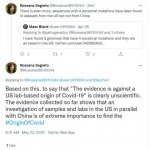
Whereas you think the virus came from the WIV (or the CCDC), derived from RaTG13 (or one of the Laos viruses), Segreto clearly thinks there is a stronger case for saying it came from the USA.

Link

Now, to be sure. She doesn't say, "It's from the US" but only says "to say that "The evidence is against a US lab-based origin of Covid-19" is clearly unscientific."
 

Attachments

  • Segreto born in the USA.jpg
    Segreto born in the USA.jpg
    39.9 KB · Views: 5
We had a problem early on in the WA State outbreak of COVID, because of a shortage of tests testing was restricted to cases of pneumonia in people with a known exposure to a positive case. It took an ED Dr taking things in his own hands to find out they were seeing fatalities from the Life Care nursing home in people with COVID.

It looks like there was significant bias in the Chinese recognition of cases to only those with a history of exposure to the market.

There are lots of details about that in this archived Twitter run down.
The first sign of (PCR and seroconversion) global spread is found in the end of November 2019 to about 01 December 2019. This is at least a week before the Huanan market environmental samples or case cluster. ...

Severe underreporting of cases, market-centered “retrospective case search”, and market-only standard of diagnosis formed the basis of the WHO 2019 dataset of “173 cases in December 2019, centered around the Huanan market”. Other cases were ignored and covered up.

Alina Chan reply:
A good find by @TheSeeker268: doctors in Wuhan said that unless pneumonia cases were linked to the Huanan market, they did not meet Wuhan Municipal Health Commission standards and were often not reported or counted.


It's a long exchange citing lots of data and is well worth reading.
 
Whereas you think the virus came from the WIV (or the CCDC), derived from RaTG13 (or one of the Laos viruses), Segreto clearly thinks there is a stronger case for saying it came from the USA.

Link

Now, to be sure. She doesn't say, "It's from the US" but only says "to say that "The evidence is against a US lab-based origin of Covid-19" is clearly unscientific."
Besides you are misstating my position the virus came directly from any of the distant viruses in Yunaan and Laos, I'm not sure why you are repeating what Segreto said given I commented on it already in post 3013 right above your post.
 
Besides you are misstating my position the virus came directly from any of the distant viruses in Yunaan and Laos, I'm not sure why you are repeating what Segreto said given I commented on it already in post 3013 right above your post.

Why am I repeating what Segreto said? Because what she says contradicts your interpretation of her...

Look again at her Tweet that specifically refers to a "US lab-based origin of Covid-19".

That is in contradiction to this, "The authors make a case for not ruling out very early circulation of SARS CoV2 in countries other than China. I don't think there's a case that is stronger than a leak from a lab in Wuhan for the main reason it doesn't explain China's reluctance to share data on the earliest cases and they've yet to release their coronavirus genome library."

No, not "very early circulation". She is explicitly saying "US-based lab origin".

Segreto is here arguing with Alina Chan (Alina believes it is a WIV origin, clearly, and Segreto thinks the US strains are shown to be the earliest according to the TopHap).

Also, interesting is that when I click on the link to that Twitter thread I find it is populated with people like Daoyu, Segreto and Charles Rixey.

You may want to look at their Twitter feeds. Lots of claims that monkeypox either came from a lab or is spreading due to ADE thanks to the Covid vaccines.

Daoyu

Charles Rixey on Monkeypox
 
Why am I repeating what Segreto said? Because what she says contradicts your interpretation of her...

Look again at her Tweet that specifically refers to a "US lab-based origin of Covid-19".

That is in contradiction to this, "The authors make a case for not ruling out very early circulation of SARS CoV2 in countries other than China. I don't think there's a case that is stronger than a leak from a lab in Wuhan for the main reason it doesn't explain China's reluctance to share data on the earliest cases and they've yet to release their coronavirus genome library."

No, not "very early circulation". She is explicitly saying "US-based lab origin".

Segreto is here arguing with Alina Chan (Alina believes it is a WIV origin, clearly, and Segreto thinks the US strains are shown to be the earliest according to the TopHap).

Also, interesting is that when I click on the link to that Twitter thread I find it is populated with people like Daoyu, Segreto and Charles Rixey.

You may want to look at their Twitter feeds. Lots of claims that monkeypox either came from a lab or is spreading due to ADE thanks to the Covid vaccines.

Daoyu
[snipped off-topic Monkey Pox citations. We have enough on this plate already without expanding it to an unrelated virus outbreak]
Funny you mention Daoyu. I was just about to cite that Twitter feed.

Here's a long feed with lots of evidence that not only did the pandemic start before the market cases, there's evidence the military games were indeed connected to spreading the virus to the EU and elsewhere.

We seem to be circling back to earlier on in the thread where you dismissed the spread via the military games.


Why should I buy into one person's claim the pandemic started in the US? I'm not sure what you expect me to take away from that? This is what I said about Segreto:
SG said:
I don't think there's a case that is stronger than a leak from a lab in Wuhan for the main reason it doesn't explain China's reluctance to share data on the earliest cases and they've yet to release their coronavirus genome library.
I also don't think she's right about the MOA/TopHap analysis showing the virus started outside of Wuhan. She might have circled what she thought was what the analysis showed, but the authors did not state that was their findings. One would think such a finding would be in their abstract or conclusion.

I've been waiting to see if they reply to Segreto. I'll post it here if they do.

Chan and Ridley build a thorough case for the Wuhan lab-leak hypothesis in their book, Viral, and their testimony to the Parliament in the UK that I cited earlier.

Here's Segreto's book review of Viral. She describes a lot of things about the book and other reviews of it. She essentially remains on the fence (her words) about the origin of the pandemic and didn't find Viral to be a game changer.


Back to what you seem to think is so important, she circled places in the phylogenetic tree from the MOA/TopHap work. That isn't exactly a detailed case for the virus starting outside Wuhan. Compare that to a number of very detailed accounts of evidence supporting the Wuhan lab-leak origin. I'm not impressed by Segretto's circles.

From the TopHap paper:
These trends are consistent with the clonal evolution without recombination of SARS-CoV-2 during the early stage of the pandemic. ...
IOW ready to go from the first cases. That's hard to explain using the spillover hypothesis. The ACE insertion site and the FC would be unlikely to have evolved in an animal species, especially one leaving no detectable traces. Adaptation in a lab, OTOH, explains how the virus came to be ready out of the box when it infected the true patient zero.
... In these cases, the number of differences between Wuhan-1 and the MRCA is four (Fig. 7). With a mutation rate range of 6.64 × 10−4 to 9.27 × 10−4 substitutions per site per year (Pekar et al., 2021), we can estimate that proCoV2 existed 7.7–10.8 weeks before the December 24, 2019 sampling date of Wuhan-1. This places the progenitor of SARS-CoV-2 to have evolved in mid-September to early-October 2019, many weeks earlier than the mid-November 2019 date proposed by Pekar et al. (2021). ...
The analysis rules out the market as the origin. It rules out 2 spillover events. Starting in Sept is consistent with the Chinese removal of their coronavirus databases from open access. It is consistent with early spread of the virus via the military games. And given how China sought to minimize the COVID problem during the winter olympics, it makes sense they mistakenly thought they had things under control in Oct 2019 so gave no warning to the incoming visitors to the military games.

When Segreto has an explanation for the secrecy China as invoked surrounding the earliest cases of COVID she might make her case stronger. I suspect she is misinterpreting the phylogenic tree roots.
 
protein sequences with 4-5 sequential positive charges

I looked up the sequences of some DNA binding proteins that fall into the class of leucine zippers. Because DNA carries a negative charge, one expects the protein to have some positively charged amino acid side chains. A portion of the sequence for Jun reads RRMR. That is three positive charges out of four amino acid residues (M is uncharged). A few residues away is a second sequence KCRKRK. That is four positive charges in a row, and 5 out of 6 (C is uncharged). Some of the residues of Fos are in a special kind of alpha-helix called a coiled-coil. In the one-letter code, K is lysine, and R is arginine.

I would point out that being close in sequence is not quite the same thing as being close in three dimensions. A typical alpha-helix makes one full revolution every 3.6 amino acids. One can consult a diagram of a helical wheel to see how the side-chains are dispersed in the standard alpha helix (although a coiled coil is slightly different). In a beta-sheet, each side chain points in an approximately opposite direction to the last one. I am not saying that the claim that 4 positive charges in a row is rare is incorrect, but I am saying that I am not convinced.
By accident I found another example, namely NPLLLKRRKKARALEAAA. KRRKK is five positively charged amino acids in a row. This is a portion of the sequence of the protein MAPKAPK2 and MAPKAPK3 has a nearly identical peptide sequence in this region. MAPKAPK2 stands for MAPK-activated protein kinases. These are signal transduction proteins, and I found these sequences and two more that have four positively charged residues in a row, in this paper Tanoue T et al., Nature Cell Biology 2(2):110-116 2000. PubMed
doi: 10.1038/35000065
EDT
My recollection is that this issue was raised because of a claim that having four positively charged amino acid residues in a row was impossible, or at the very least, never occurred in nature. K stands for lysine, and R stands for arginine; both amino acid residues have positively charged side chains. We can now be certain that having even four or five positively charged amino acid residues does occur in nature.
 
Last edited:
IMHO it was bad bungling by the Chinese Government in the early stages rather then some evil plot.
The Chinses Government secrecy is a exercise in CYA more then anything else.
 
Status
Not open for further replies.

ISF - Join now!

Every member here is approved by hand. No bots, no spam, just people who care about evidence and honest debate.

Membership is free!

Create your free account

Back
Top Bottom