The Great Zaganza
Maledictorian

- Joined
- Aug 14, 2016
- Messages
- 33,287
What I'm hearing is that the NWO put the AA sequence into humans in preparation for the plandemic.


What I'm hearing is that the NWO put the AA sequence into humans in preparation for the plandemic.
Abstract
Despite strong epidemiological links and the documented presence of SARS-CoV2 susceptible animals, the role of the Huanan Seafood Wholesale Market in the COVID 19 pandemic remains controversial. Using spatial analyses we show that the earliest known COVID-19 cases diagnosed in December 2019 were geographically distributed near to, and centered on, this market. This distribution cannot be explained by high densities of elderly people at greater risk of symptomatic COVID-19. This pattern was stronger in cases without, rather than with, identified epidemiological links to the Huanan market, consistent with SARS-CoV-2 community transmission starting in the surrounding area. By combining spatial and genomic data, we show that both the two early lineages of SARS-CoV-2 have a clear association with the Huanan market. We also report that live mammals, including raccoon dogs, were sold at the market in late 2019 and geospatial analyses within the market show that SARS-CoV-2-positive environmental samples were strongly associated with vendors selling live animals. Together, these analyses provide dispositive evidence for the emergence of SARS-CoV-2 via the live wildlife trade and identify the Huanan market as the unambiguous epicenter of the COVID-19 pandemic.
One sentence summary:
Geographical clustering of the earliest known COVID-19 cases and the proximity of positive environmental samples to live-animal vendors suggest that the Huanan Seafood Wholesale Market in Wuhan was the site of origin of the COVID-19 pandemic
"Some scientists" have always favored the natural event. All those working to keep the lab-leak hypothesis in play and not have it snuffed out before the evidence really rules it out are not likely to have changed their minds based on these reports.Preprints unlikely to end debate over how SARS-CoV-2 began the pandemic, but some scientists say lab-leak hypothesis has taken a “blow”

Re Worobey, the issue I've haven't gotten back to the thread on is his use of a faulty underlying premise that he was operating with very early virus cases.

No one is disputing the market cluster. But it's pretty telling that the head of the Chinese CDC believes the market was where a super-spreader event took place, not where the first cases occurred.
Nowhere in the paper does Worobey, et al recognize any cases earlier than Dec 2019.
Nothing in your post provides evidence for this assertion.
There are no known identifiable cases earlier than Dec 11 so he's using the available data, as he should. There were almost certainly un-diagnosed cases as far back as early Nov but unknown and un-diagnosed cases are of no value to a study like this one.
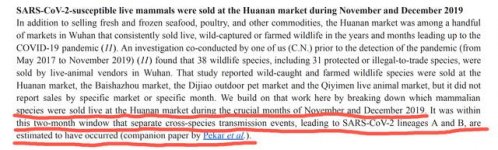
This is the conclusion in the Worobey paper I have an issue with:The Worobey et. al paper explicitly points out in a number of places that they cannot be sure exactly when the earliest cases were and that they explicitly deny the first known case was the first actual case. In fact, they suggest that for every known case there were probably at least 10 and maybe up to 70 cases of unknown infections.
They say that the Pekar et. al paper is the one that deals with the estimates of when the virus appeared in humans.
Collectively these results provide incontrovertible evidence that there was a clear conduit, via susceptible live mammals for the zoonotic emergence of SARS-CoV-2 at the Huanan market towards the end of 2019. ...
Together these analyses provide dispositive evidence for the emergence of SARS-CoV-2 via the live wildlife trade and identify the Huanan market as the unambiguous epicenter of the COVID-19 pandemic.
So Worobey admits more data is needed.Skeptics of the natural origin theory maintain the market cluster could merely be a superspreader event touched off when a person infected with a lab-escaped coronavirus visited it. But Worobey thinks further data could make that contention even less tenable. A more transparent analysis of the market’s genetic sampling data, in particular, might identify exactly which species of animals sold there carried the virus.
Gao would like to move patient zero out of China altogether. He asserts the patients in Italy predate the patients in Wuhan.In the new preprint, Gao and colleagues analyzed 1380 samples from 188 animals in the market and the environment, including sewer wells, the ground, feather removing machines, and “containers.” They found SARS-CoV-2 in 73 samples. But because all were from the environment, not the animals themselves, they assert that humans introduced the virus to the market. The authors call the market an “amplifier,” not the source, of SARS-CoV-2.
So A&B lineages differ by only 2 mutations yet they dismiss the possibility B descended from A?Garry had identified two different forms of SARS-CoV-2, differing by just two mutations, which he argued surfaced at different Wuhan markets in December 2019.
I'll get back to this.What I did not get from looking at the paper by Kumar, et, al was exactly what was being claimed, whether it was a "proto-SARS-CoV-2" or one that was already in humans.
I have no way of knowing whether Pekar et al or Kumar et al are more likely to be correct.
Indeed. I read through the Gao et.al. paper (CDCC) and did not find anything in it in which they “ruled out” Huanan market as a spillover location. The only thing that the paper did was confirmed that it was the site of an amplifying event, which had already been suspected. In fact the paper seems to me to be exactly what you would want in a science paper making use of available data and drawing reasonable conclusions without attendant wild speculation....
2) Environmental samples collected at the market are of human origin and did not come from animals sold there.
The aim of the Chinese CDC paper was to analyse the environmental samples (swabs from surfaces etc.) that they took in and around the Huanan market after Jan 1st, 2020 (Gao et al., 2022). They concluded that the market was only an amplifying event, in part because SARS-CoV-2-positive samples were associated with stalls belonging to multiple types of vendors, including those not selling animals (the Worobey preprint argues there is a correlation). More compelling, the CDC authors found that the samples collected from the market, which Pekar and Worobey claim are from infected animals, are admixed only with human genetic material and not with genetic material from raccoon dogs or other species potentially sold at the market. The only reasonable inference is that these positive samples did not derive from the faeces or urine or exhalations of a live non-human animal. Few results would better indicate that virus-positive market samples derive from infected humans as opposed to other species.
Indeed. I read through the Gao et.al. paper (CDCC) and did not find anything in it in which they “ruled out” Huanan market as a spillover location. The only thing that the paper did was confirmed that it was the site of an amplifying event, which had already been suspected. In fact the paper seems to me to be exactly what you would want in a science paper making use of available data and drawing reasonable conclusions without attendant wild speculation.
2) Environmental samples collected at the market are of human origin and did not come from animals sold there.
The aim of the Chinese CDC paper was to analyse the environmental samples (swabs from surfaces etc.) that they took in and around the Huanan market after Jan 1st, 2020 (Gao et al., 2022). They concluded that the market was only an amplifying event, in part because SARS-CoV-2-positive samples were associated with stalls belonging to multiple types of vendors, including those not selling animals (the Worobey preprint argues there is a correlation). More compelling, the CDC authors found that the samples collected from the market, which Pekar and Worobey claim are from infected animals, are admixed only with human genetic material and not with genetic material from raccoon dogs or other species potentially sold at the market. The only reasonable inference is that these positive samples did not derive from the faeces or urine or exhalations of a live non-human animal. Few results would better indicate that virus-positive market samples derive from infected humans as opposed to other species.
And I said Gao has had the position the market was a super-spreader event from the beginning.
Whatever's in the paper you've linked to is not the only place Gao has voiced his opinion.
So what indeed.So what? ....
So what indeed.
Any good scientist will not deal in absolutes. Even in this debate, there is no proof one way or the other which origin hypothesis is correct.
Does that say maybe animals from the market could have been a source of the contaminated sewage?All the four sewerage wells in the market tested positive. This suggested that either contaminated sewage may have played a role in the cluster of cases in the market or that the infected people in the market contaminated the sewage
These results suggested that SARS-CoV-2 might have been circulating in the market, especially the western zone, for a period of time in December 2019, leading to an extensive distribution of the virus within the market, which might have been facilitated by the crowded buyers and the contaminated environment.
That includes a lot of samples taken that include some before the market was purged of all animals.All the 457 animal samples tested negative for SARS-CoV-2 nucleic acid, suggesting that the animal infections with SARS-CoV-2 might be rare in the market.
Does that say the conclusion could be they represent a spillover event occurred at the market?Therefore, the SARS-CoV-2 sequences from environmental samples were highly similar to the clinical strains obtained during the early stage of the COVID-19 outbreak
We analyzed the correlation of SARS-CoV-2 and the abundance of other species. The abundance of Homo sapiens showed the correlation to SARS-CoV-2(Figure 4), which highly suggests the SARS-CoV-2 might have derived fromHomo sapiens in the HSM. No animals were concluded, implying that no animal host of SARS-CoV-2 can be deduced.
IOW Gao wants to see more investigating of older samples from different countries.Thus, the market might have acted as an amplifier due to the high number of visitors every day, causing many initially identified infection clusters in the early stage of the outbreak as indicated in the Report of WHO-convened global study of origins of SARS-CoV-2 (10). In addition, live SARS-CoV-2 viruses also existed in the environmental samples. However, no SARS-CoV-2 was detected in the animal samples from the market. Definitely, more work involving international coordination is needed to investigate the real origins of SARS-CoV-2(10), especially considering the SARS-CoV-2 positive results of samples collected in 2019 in retrospective studies of different countries (29, 30).
From your linkoes that say maybe animals from the market could have been a source of the contaminated sewage?
No, it says maybe the contaminated sewage played a role in the cluster of cases.
Further down:
Does that say a spillover event cannot be ruled out?
No.
That includes a lot of samples taken that include some before the market was purged of all animals.
More testing
No.
I'm not sure why you think your interpretation of the paper is superior to the 2 PhDs' interpretation of the paper.
What are you talking about?Absence of evidence =/= evidence of absence.
This is elementary logic and yet, your authors derived the latter from the former.

What are you talking about?
Did you lose track of the discussion?
You claim Gao didn't rule out a spillover event at the market. By your measure he didn't rule out a panspermia virus either.
BTW, the Gao paper was posted before the Worobey study wasn't it? Or do I have the dates wrong? Why would you expect Gao to comment one way or the other on a spillover event at the market?
Does the Worobey study address the findings in the Gao paper? Why not? It concludes the earliest viruses don't have remnants of animal viruses.
Does the Worobey study address the findings in the Gao paper? Why not? It concludes the earliest viruses don't have remnants of animal viruses.
He links to both papers in the next 2 Tweets.I'd love to see a respectful public dialogue between
@MichaelWorobey & Sudhir @kumar_lab re pandemic origins. If Kumar's phylogenetic analysis of #SARSCov2 evolution is correct, Worobey et al's case for "dispositive evidence" of a #COVID19 market origin cannot be defended.