Origins of Covid

Status
Not open for further replies.
Are you talking about Quay's Bayseian analysis?

I have skimmed through the paper and I cannot make head or tail of his argument. It just looks like he arbitrarily attaches probabilities to cherry-picked datapoints.
That is a better abstract of the paper than the abstract Quay wrote.

No, not that paper. Give me a few minutes and I'll edit the link in here.

No, not that paper. Give me a few minutes hours (I got busy with other things) and I'll edit the link in here.

This is the paper you say you didn't understand:
A Bayesian analysis concludes beyond a reasonable doubt that SARS-CoV-2 is not a natural zoonosis but instead is laboratory derived
If you recall, you dismissed Quay not based on the paper but on the fact you weren't impressed by his background.
angrysoba asked whether that was the paper your meant, you said it wasn't, and now it appears to have been the paper you meant.

That paper is rubbish, for the substantive reason stated above by angrysoba. If I remember correctly, I have given a more substantive review of that paper earlier in this thread, and will try to find that review if SkepticGinger continues to refer to it.
 
That is not what is being claimed, as far as I can see.

They claim it came from the same market as both lineages were present at the market.
So how is that evidence for a natural spillover? That doesn't make any sense.

It also doesn't address the problem those lineages might only differ because of sequencing error.

And it doesn't address the problem that the virus appeared out of the box adapted to humans. Replicating in an animal source wouldn't be expected to have produced 2 different variants both well adapted to human to human transmission and significant disease.
 
I don't think this is correct. There is no claim that the civets were infected in the markets.
Yeah there was.

No reservoir was found among the civet cats or the other suspected source animal. But there were bats sold in the same markets.

Civets had presumably been infected with SARS somewhere close to where the bats lived, in Yunnan.
If that had been the case then there would have been a reservoir in civets.


(infected civets also showed up in other areas such as Shenzhen - which is where, I believe, infected civets were originally discovered, and also in Hubei, the province in which Wuhan is. This is circumstantial evidence that there is a plausible route from the countryside to Wuhan).
No, I reviewed this stuff before I posted. If you have a different history of how SARS was spread to humans you'll need to cite some sources so I can see what you are talking about.

So nobody is looking for bats in the Huanan Market. It is irrelevant whether there were bats, live or otherwise there.

However, from what I gather Worobey et al do think that raccoon dogs were sold in the Huanan Market and they may have been infected somewhere on the wildlife trade route.
Right, he simply fills in the blanks where his hypothesis lacks evidence and acts as if that is all evidence supported.

I think you should either read the Twitter thread that I linked to above in which Worobey summarizes the findings of the writers of the article (there are 18 authors altogether with impressive credentials), or maybe go straight to the paper itself.

In fact, it is one of two papers out right now which make the case for spillover.

I admit that I have not yet read them myself, and they have not been peer-reviewed yet, but I lack the competence in this field to make any critical appraisal of them. I can only go on the word of others in the field.
You want me to read something you haven't even read yourself? :confused:

I listened to the news reports, NPR had a lot of details plus someone who was supposed to be critiquing the report who actually was more someone posting confirmation bias than rebuttal.

Look, my reply was very thorough. If all you have is telling me to read the Twitter feed, (like when you said I should read the book, Spillover) that's not going to cut it.

Critique or rebut my post with specifics or something more concrete than your 'feelings' about a source and I'll reply to that.

I said initially that Worobey had an hypothesis. Bloom said he couldn't fault the science but it wasn't conclusive or a smoking gun. Now Worobey has expanded on his hypothesis but has added very little in the way of new evidence.

I don't see that the needle moved any amount at all.
 
Last edited:
Here's one of the sources I reviewed on the origin of SARS 1:

Berkeley evo news: Tracking SARS back to its source; January 2006, updated July 2013
Scientists immediately suspected that it had jumped to humans from some other organism. In May of 2003, attention focused in on cat-like mammals called civets. Infected civets were discovered at a live animal market in southern China (where they are occasionally eaten). However, since further searches failed to turn up more tainted civets, scientists concluded that they were not the original source of SARS ...
They still knew or strongly suspected the 'spillover' originated in the proximal source, the civet cats.
... and continued their quest. Then in the fall of 2005, two teams of researchers independently discovered large reservoirs of a SARS-like virus in Chinese horseshoe bats. The bats now appear to be both culprit and victim in this mystery: they are the carriers of the SARS virus, but the virus is probably only passed to humans through intermediate hosts when bats are captured and brought to market.
So bats to intermediate host to humans all in the wet markets.

Viruses evolve rapidly and constantly, changing within a lineage and splitting off to form new lineages. As they evolve, they accumulate small changes in the sequences of their genomes. Based on these genetic differences, biologists can reconstruct the evolutionary relationships of different viral strains, building an evolutionary tree that reveals which strains evolved from which strains and in what order they evolved.

In this case, biologists collected samples of the SARS virus’s genetic material, RNA, from different sources: infected humans, infected civets, and different species of infected horseshoe bat. The RNA was then copied, sequenced, and used to build a phylogeny, or evolutionary tree.

The tree showed that civet and human SARS viruses are very similar to each other and, most importantly, that both are nested within a clade of bat viruses — so the ancestor of the civet and human strains seems to have been a bat virus! Based on this evidence, biologists have come up with a plausible path of transmission: infected bats and uninfected civets came into contact at a market, the virus was transmitted to civets and then multiplied and evolved in civets (or other animals) in the public market, until eventually the virus hopped to humans.

Notice Worobey has not found the clade that SARS 2 was nested within.
 
Last edited:
SG, thanks for the links regarding the question of how the civets became infected by SARS. I will have to look back into how I came to the conclusion that they were infected outside the markets because I cannot remember. It may have been that I read it in Spillover, or perhaps I heard it on a TWiV episode with the assumption being that the civets had been infected somewhere along the wildlife trade route, but not sure. But I also remember that infected civets (or at least those with antibodies against SARS) had turned up in multiple cities (including Shenzhen where, I believe the first civets were found, as opposed to Guangdong where the outbreak began, and in parts of Hubei), and people in Yunnan had tested positive for antibodies.

The article you posted is itself rather old, and it wasn't until 2017 that the virus was traced back to the particular bats in Yunnan province, so I am not sure if that work supersedes the article you posted.

Anyway, I will look into it.
 
Right, he simply fills in the blanks where his hypothesis lacks evidence and acts as if that is all evidence supported.

I don't think this is fair. He is not "simply filling in the blanks" where his hypothesis lacks evidence. There is photographic evidence of raccoon dogs in the market taken by Eddie Holmes who is one of the co-authors. In fact there are 18 scientists on the paper, so it is not as though it is a single person just making up crap.
 
This is a pretty interesting thread from Kristian Andersen on the two pre-prints laying out the case for the market being the epicentre of the pandemic.

Link

Well recommended!
 
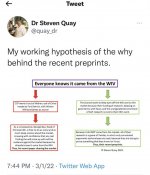
Dr Steven Quay has tweeted his reaction to the preprints (including a separate one that was done by the Chinese CDC under George Gao):
 

Attachments

  • Steven Quay Tweet.jpg
    Steven Quay Tweet.jpg
    59.4 KB · Views: 28
According to Vincent Racaniello, Michael Worobey says he will be on TWiV sometime soon. It will be interesting to see what he has to say. It is possible that he may go on with Robert Garry, or Kristian Andersen as well. Amy suggested having Daszak on as well to see what he makes of it.
 
SG, thanks for the links regarding the question of how the civets became infected by SARS. I will have to look back into how I came to the conclusion that they were infected outside the markets because I cannot remember. It may have been that I read it in Spillover, or perhaps I heard it on a TWiV episode with the assumption being that the civets had been infected somewhere along the wildlife trade route, but not sure. But I also remember that infected civets (or at least those with antibodies against SARS) had turned up in multiple cities (including Shenzhen where, I believe the first civets were found, as opposed to Guangdong where the outbreak began, and in parts of Hubei), and people in Yunnan had tested positive for antibodies.

The article you posted is itself rather old, and it wasn't until 2017 that the virus was traced back to the particular bats in Yunnan province, so I am not sure if that work supersedes the article you posted.

Anyway, I will look into it.
I believe you might be conflating when the specific bat virus was found to be the source of SARS 1 with the finding the Yunnan horseshoe bats harbored multiple SARS-like coronaviruses. I don't know without reviewing the papers either.

As for where else infected Civets showed up, I'd need to look into that as well. There was no other location for where SARS 1 jumped to people. That was all in Guangdong. It was a one-time jump from two different wet markets at about the same time. I followed all this very closely at the time because I was advising employers and teaching healthcare workers how to manage potential SARS patients.

Worobey's claim to have found new evidence or whatever the latest headline reads is simply not true. His evidence is a nice tap-dance (think Chicago) using no new information.

I still have the Spillover book. I'l review what it said about the SARS 1 origin.
 
I don't think this is fair. He is not "simply filling in the blanks" where his hypothesis lacks evidence. There is photographic evidence of raccoon dogs in the market taken by Eddie Holmes who is one of the co-authors. In fact there are 18 scientists on the paper, so it is not as though it is a single person just making up crap.

So there were raccoon dogs, so what? (That was a species also suspected of being the source of SARS 1 jump to people.)

I posted the list made before SARS 2 of animals sold at the wet markets in Wuhan. Raccoon Dogs are on the list as are civets also called Masked palm civet. Minks are also on the list. This is not new information. The article is from June 2021.

Nature, linked to recently but I might have also linked to it way back when pangolins were being discussed.

Table 1 from the article:Table 1 List of 38 species sold in Wuhan City markets between May 2017–Nov 2019, including the mean number of live individuals sold per month and price (mean ± SD; n = survey rounds).
 
Dr Steven Quay has tweeted his reaction to the preprints (including a separate one that was done by the Chinese CDC under George Gao):
A link instead of this screenshot would be nice. :(

I'll hunt down his Twitter Feed and get back to this later. I don't have it on speed dial.:rolleyes:


Edited to add: I appreciate it when you have these moments of actual discussion.
 
Last edited:
Michael Worobey appears on this episode of TWiV to explain why he says the market is the epicentre of the spillover.

Essentially, he argues that this was a repeat of SARS-1. Why was the trail not picked up on? Well, the animals were culled, the market was cleaned, some of the wildlife farms were disbanded, and one of the reasons it spread out so quickly to obscure the origins were because of asymptomatic spread which was not the case with SARS-1.


Admittedly he is not a very engaging speaker, to be honest, but that should not be surprising as it is clearly not part of his skill set. Probably best to listen on x1.25 or even x1.5.
 
I've listened to the first hour, I'll listen to the last 44 minutes later. So far it's exactly what I said, he's ignored the data that doesn't fit his hypothesis and filled in data where none existed.

Let me step back a minute here and talk about Worobey.

Worobey and the group he worked with in the 80s did research on the origin of HIV. He was accused of pushing his hypothesis while ignoring some data and filling in some holes without data. In the case of HIV, unfortunately there was an actual CT that HIV was the product of vaccine development. There was no evidence for that hypothesis and since the work showing the airline steward was not patient zero, more evidence has been found and all of it corroborated the origin coming from bushmeat in the Congo.

Epidemiological evidence surfaced of cases of 'wasting' among persons in rural African villages that occurred in the 50s IIRC. A road was built to harvest logs and along that road prostitution flourished. It allowed HIV which had been confined to a small area to spread far and wide. There was also a direct connection to Haiti. Eventually the virus spread among homosexuals who were having encounters with 100s of partners.

The first point being we have a lot of corroborating evidence about the origin of HIV not being from vaccine development. And we have corroboration where HIV initially spilled-over, it's not based on one group's phylogenic mapping.

And the second point being, Worobey would almost certainly like to relive his glory days when he was involved in tracking down the origin of HIV.

So let's look at the data he conveniently ignores and adds to make this all fit his COVID spillover hypothesis.

We have lineage A & B. Worobey says they are only a couple mutations difference between them. I believe it is only 3. He starts off saying A came first and was found in those people who had no connection to the seafood market. (He ignores previous conclusions the market was the site of a super-spreader event.) Then suddenly they find a single specimen of the A lineage among the seafood market patients and nothing about all the other patients with A not being connected to that market matter anymore.

From there he speculates using words like "it's possible" B came first and the cases not connected to the seafood market "probably" had connections to the other 4 wet markets in the area.

He makes excuses why no infected source animals were found even going so far as to erroneously claim that wild animals might have been caught "around Wuhan" when no such potential source animals were found anywhere near Wuhan.

He thinks the cases connected to the seafood market are too much of a coincidence while ignoring the extraordinary coincidence the initial outbreak happened close to 2 labs studying related viruses. He noted the distance to the WIV (hardly impossible if a single staff member or student spread the virus from one of the labs). But he fails to mention the location of the CCDC lab very close to the market and doesn't mention that lab moved locations still close to the market around the time of the outbreak.

Like the strawman that keeps being repeated bioengineered viruses have been ruled out as if the lab leak origin relies on that (it doesn't), he adds a new strawman claiming people who favor the lab origin claimed certain wild animals weren't for sale at the market. I don't know anyone making such a claim, maybe Worobey does.

And so far it looks like his whole hypothesis relies heavily on multiple spillover events hitting dead ends before one successful event got started in Wuhan. The problem with this is it completely ignores the need for the virus to become adapted to person to person spread in humans.

He mentions spreading occurred in asymptomatic persons to get to lineage A from lineage B.

Supposedly of the first 14 or so cases, ~half were connected to the seafood market, ~half weren't. Then suddenly the total cases in Dec they are looking at is 164 of which 156 were lineage B. Well d'uh, B was more successful in spreading as shown by its continued spread. It wasn't because B was the first lineage in the spillover.

He wasn't very clear how the first cases were in Nov, then they were in Dec??? And there were only a dozen or so and all of a sudden there were 164 cases? That's some pretty fast spreading for a virus that only jumped from animals infecting a dozen or so cases to reach in less than a month.

But if you are Worobey filling in the evidence holes, you explain it all by asymptomatic cases. OK, then, how many cases were there in Oct or Nov? His phylogenic mapping doesn't go back before Dec. Why is that? Lineage A was supposed to be earlier than B and was found in the earliest cases. What happened to that when a single case of A was found in the seafood market samples? So those early cases of A no longer count as earlier? They must have been later all connected to asymptomatic cases?

Again other than multiple dead-end starts, nowhere does Worobey address the biggest problem with his hypothesis, how/where did SARS CoV2 become so well adapted to humans? So far the other people in the podcast are not asking very hard hitting questions.


Worobey mentioned the 8 other genomes Shi did not put in the gene bank access. He asks Shi about it and she puts those genomes in the bank explaining they were less like SARS CoV2 than RaTG13. How do we know that? Shi is not likely going to post incriminating evidence online.

It so happens I am on that chapter in Viral, Chan and Ridley's book on the origin of SARS CoV2. I'll post about it when I finish the chapter.
 
I think the chapter on HIV in Spillover is quite good. It goes pretty deeply into the OPV theory of AIDS (which was that oral polio vaccine used a form of the simian version of AIDS which then led to the HIV and then AIDS) and also Worobey's involvement in initially accompanying W. D. Hamilton (a prominent proponent of the theory) to Congo to find blood samples in order to see if it contained SIV. Apparently Hamilton contracted malaria on the trip and later died, and the blood samples showed no SIV.

Regarding Worobey's theory here, the TWIV team don't really ask many questions because, as they say at the end, Worobey basically answers all the ones that they planned to ask, and they apparently had a lot that they wanted to ask.

Regarding the wild animals, I don't think Worobey thinks they came from near Wuhan, as far as I remember. They could have been farmed many miles away.

I also don't think he is arguing it spilled over in multiple markets. Just one.

How did it get adapted to humans? Well, presumably there is a survivorship bias. Lineage A was not as adaptive as B, and maybe there were others that fizzled out. We know it was adapting all the time as he even mentions another variant that completely took over.

And we can hardly say he is "ignoring" the proximity of the labs. It was the very proximity of the labs that got him and Jesse Bloom to write a letter to Science saying that the lab leak theory needs to be taken seriously.

Anyway, it will be interesting to see what the peer reviewers make of it.
 
.... Regarding the wild animals, I don't think Worobey thinks they came from near Wuhan, as far as I remember. They could have been farmed many miles away.
He gave a number of possibilities none proven, none supported by any evidence.

.... I also don't think he is arguing it spilled over in multiple markets. Just one.
He shifted his story. At first he said there was more than one event and he described the 4 nearby markets he hypothesized were the source of those infections not related to the seafood market. Later he shifted to saying instead because they found one case of lineage A at the seafood market all the lineage A cases not related to the market must have been (again no evidence) spread by asymptomatic cases. This is one of the things where he simply fit the data to his preconceived conclusion.

.... How did it get adapted to humans? Well, presumably there is a survivorship bias. Lineage A was not as adaptive as B, and maybe there were others that fizzled out. We know it was adapting all the time as he even mentions another variant that completely took over.
No, not what the evidence shows and it is not what needs to happen for adaptation to human spread. But think about what you are saying: A was first. Worobey fitting the data to his preconceived bias said he later believed B was first. IOW it entered the human population ready to rapidly spread.

He can't have it both ways, A first then B makes it less adapted though not by much. Or B first then it was already highly contagious, no adaptation needed.

That's not what happened with SARS 1 which simmered for about a month among people before becoming well adapted to human to human spread.

And HPAI H5N1 (flu) has yet to become adapted to human to human spread after a number of human cases and almost 20 years! The first human cases were in 1997 (IIRC) in Hong Kong CDC says 2003. At some point it was found the virus was only a couple mutations away from adapting to human spread.

Also he mentioned the furin cleavage site but did not explain when that fit into the picture other than it supposedly happened before the jump. How was that mutation naturally selected?

.... And we can hardly say he is "ignoring" the proximity of the labs. It was the very proximity of the labs that got him and Jesse Bloom to write a letter to Science saying that the lab leak theory needs to be taken seriously.
And after that he does his genetic mapping (which only goes back to Dec 10) and claims the epidemiological evidence corroborates that with the cluster of cases he maps around the seafood market. The CCDC lab near the market is not mentioned in the first hour anyway. I still have 44 minutes to go.
 
Last edited:
That's not what happened with SARS 1 which simmered for about a month among people before becoming well adapted to human to human spread.

And HPAI H5N1 (flu) has yet to become adapted to human to human spread after a number of human cases and almost 20 years!

These two objections taken together make no sense, do they?

If you are expressing incredulity that SARS-CoV2 apparently became adapted so quickly on the basis that it did so faster than SARS-1, then by your own argument you should also express incredulity that SARS-1 became human-to-human adapted in merely a month when *points at random flu* that one still hasn't after 20 years.
This is bizarre logic.

Neither one 'spilled over' ready to go with rapid human to human spreading.
 
This is bizarre logic.

Neither one 'spilled over' ready to go with rapid human to human spreading.

I think you have pointed out, very clearly, that different viruses require different time frames to become human-to-human transmissable.

In addition, do you know who the first person to get Covid was?
 
I think you have pointed out, very clearly, that different viruses require different time frames to become human-to-human transmissable.

In addition, do you know who the first person to get Covid was?

China is hiding that information. Worobey didn't know either.

It's a basic principle in biology that a virus jumping species has to adapt to the new species. But there are exceptions. For example COVID adapted quickly to deer and mink.

The thing is, if one sees a virus appear in humans that is ready to go, the lab is much more likely to be the source. It is not proof.

And there are a couple of suspicious mutations like the furin cleavage mutation which are hard to explain as some random natural mutation. That becomes quite a coincidence. Again, it is not proof.

And speaking of other animals, COVID has spread rapidly in deer and mink and yet no evidence of it circulating in other species in China has been found*.

Scientists have now found the coronavirus in 29 kinds of animals,
a list that has been steadily growing almost since the start of the pandemic and includes cats, dogs, ferrets, hamsters, tigers, mice, otters and hippos. In most cases, the animals have not been shown to transmit the virus back to humans.

But in at least two cases, it looks as if they can. Minks have spread the virus to people, and in a new Canadian study, scientists identified one person who tested positive after unspecified “close contact” with infected white-tailed deer.

This is more evidence the virus should have been found in other species in China yet it hasn't been. Worobey claims the Chinese tested irrelevant species in that 80,000 tested. But once again he fits the evidence to his preconceived conclusion.


*Evidence it has now been found in pets in China is after the fact. So far it has shown up in animals exposed to infected people, not the other way around.
 
Last edited:
Status
Not open for further replies.

ISF - Join now!

Every member here is approved by hand. No bots, no spam, just people who care about evidence and honest debate.

Membership is free!

Create your free account

Back
Top Bottom