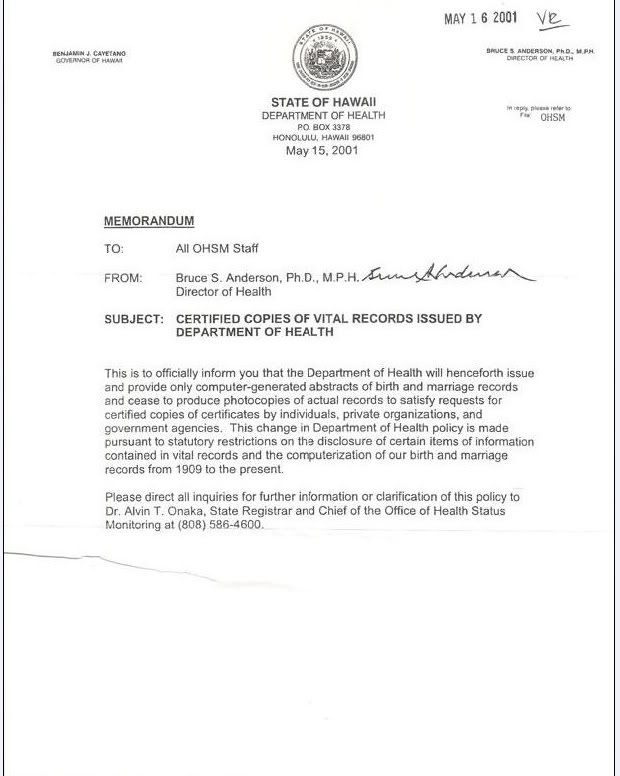
No. The fact is that the document was scanned as a PDF, and when opened in Illustrator there will be some vectorization as a result. No where did I ever propose that the image was manipulated in Illustrator. In fact that would be incredibly stupid, and only a complete goober would ever attempt to create a photo realistic fake document with Illustrator (or any vector program) as the end client.
Got it. Man, this is fun ! So the Illustrator stuff is entirely a red herring, I'll buy that.
So, the process is that the BC is copied, using a B/W scanner, onto official BC stock with a green crosshatched pattern. Then, this piece of paper (let's call it scan 1) is scanned on a color scanner to create the image posted (let's call it scan 2). Correct?
As to your anomalous gray scale 1, it is a photocopy scanned into a PDF. It is an artifact, just like the white pixelization. They are artifacts. If you didn't see white around the letters on a scanned pdf it would do more to signal a fake.
Well, it appears to me there still is a lot to be explained.
First, the overall appearance. If the above theory is correct, then the shading on the left side of the document should appear on the left side of the scan 1 and scan 2. Instead it appears in the middle of both scans, with clear crosshatching to the left. And, the top border, in the upper left corner of the B/C, the inset shadow, is sharp. There is no way that sharp edge would be created using a scanner and a curved piece of paper (the BC). In fact the whole BC appears as an inset, with sharp edges all the way around, on the crosshatching, that is impossible using the theory above.
So, that in itself is enought to show that the theory above cannot be correct.
Then there is the matter that, according to the TickerGuy in a video referenced, a color scanner will produce color artifacts around a scanned black character, and there are no color artifacts around the characters of scan 2, so this again demonstrates that the theory is not correct.
And there is still the matter of the 1 bit scanning for the 1064 and the grayscale scanning for the following 1, and the 1 bit scanning of the single letter in ukelele (shown in a previous post).
So, have you got explanations? Can you give a theory of how the posted document was created that accounts for the lack of color fringing around the type, and the differences in the scanned characters (some b/w, some grayscale)?
You got to admit, this is a fun puzzle.