This article is not without its problems as evidence that the C14 sample area was not a patch.
1. The biases of the author - He is promoting his own theory of why the C14 dating was in error so he has a bias to prove that Rogers' theory is wrong.
2. He references images but unfortunately the images in his report don't seem to be in the on-line version.
3. His claims about the similarity of the patch area to the rest of the shroud seem to rest on x-ray fluorescence reported by Rogers and Schwalbe in PHYSICS AND CHEMISTRY OF THE SHROUD OF TURIN A Summary of the 1978 Investigation. It is difficult to find exactly where in that report there is a detailed chemical analysis of every area of the shroud so that it is possible to compare the chemistry of the sample area with other areas of the shroud. Thibault Heimburger, a shroud authenticity supporter writing a response to Antonacci that appears at the back of the on-line version Antonacci's report:
As I read that Heimburger questions whether Antonacci's claim that similar concentrations of calcium, iron and strontium is fully supported by his evidence and he says even if it is, is that proof that the patch areas and the rest of the shroud were manufactured at roughly the same time and place.
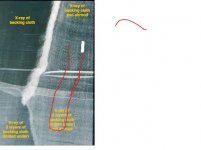
I thought Antonacci's best argument (beyond the chemical similarity argument which seems very good to me) might have been his argument that banding visible with transmitted light through the shroud is similar and continuous through the sample area from surrounding areas. Unfortunately the photograph that he offered as evidence of that was missing from the on-line report. However I did find a radiograph of the sample area that shows banding also. The radiograph is on page 42 of a paper by Schwable and Rogers
http://ac.els-cdn.com/S000326700185...t=1342108692_bde95a56874f5a398909f87420fe3777
[qimg]http://www.internationalskeptics.com/forums/imagehosting/5664fff134e0afb3.jpg[/qimg]
Notes on the above image: I made it by clipping a section of the radiograph in the Scwalbe/Rogers paper and placing it next to a diagram from the Benford/Marino paper. I resized the diagram a bit so it was in the same scale as the clipped portion of the radiograph.
The fact that the banding that passes through the sample area is continuous through the sample area and there is not signs of anything resembling a patch in the area of the sample looks like extremely strong evidence that the sample was taken from an area that had not been patched.
My only quibble with what looks like what might be categorical evidence to me is that the backing cloth was on the shroud when the image was made and perhaps the banding we are seeing was affected by banding on the backing cloth.