• Quick note - the problem with Youtube videos not embedding on the forum appears to have been fixed, thanks to ZiprHead. If you do still see problems let me know.

Michael Shermer vs. "alternative history" Hancock and Crandall

*Note that the domestication of crops comes BEFORE permanent settlements...?

Note the word "may".

It's possible that domestication came before permanent settlements. On the other hand we know of hunter-gatherers who lived in permanents settlements, so it's certainly not that case everywhere.

Here's a simple example:
https://en.wikipedia.org/wiki/Celilo_Falls
Celilo Falls (Wyam, meaning "echo of falling water" or "sound of water upon the rocks," in several native languages) was a tribal fishing area on the Columbia River, just east of the Cascade Mountains, on what is today the border between the U.S. states of Oregon and Washington. The name refers to a series of cascades and waterfalls on the river, as well as to the native settlements and trading villages that existed there in various configurations for 15,000 years. Celilo was the oldest continuously inhabited community on the North American continent until 1957, when the falls and nearby settlements were submerged by the construction of The Dalles Dam.[1]
 
ROTFLMAO

*Except for these huge stone monuments that appear on every continent... :/

You haven't presented any evidence that these monuments were built by the same people at the same time.
There is ample evidence they were built by separate cultures at different times through history.

When asked for the evidence you tell us it was all washed away and that the evidence that is available is for people who came along later and occupied already existing sites.

Show us some evidence that the same culture built these monuments at the same time in history.

Waffle about Egyptian Beer isn't evidence.
 
You haven't presented any evidence that these monuments were built by the same people at the same time.
There is ample evidence they were built by separate cultures at different times through history.

When asked for the evidence you tell us it was all washed away and that the evidence that is available is for people who came along later and occupied already existing sites.

Show us some evidence that the same culture built these monuments at the same time in history.

Waffle about Egyptian Beer isn't evidence.

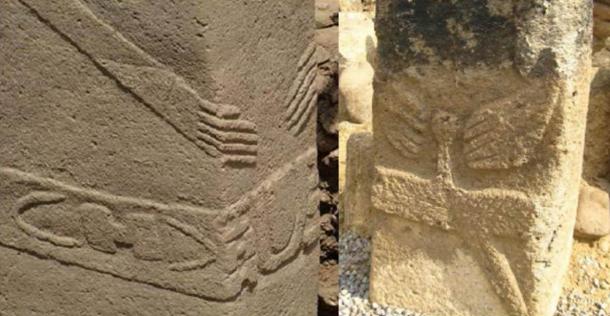
You mean stuff like the same hand carvings appearing at GT and on Easter Island?
 
You mean stuff like the same hand carvings appearing at GT and on Easter Island?

You really are desperate when you present this:
omphalos.jpg


As evidence of anything. People have hands, there are only so many ways to present the hands in a carving. There are only so many common ways that people place their hands. That they are carved like this in disconnected cultures doesn't tell us anything.
 
You really are desperate when you present this:
[qimg]http://www.ancient-origins.net/sites/default/files/styles/large/public/omphalos.jpg?itok=NyRPksV9[/qimg]

As evidence of anything. People have hands, there are only so many ways to present the hands in a carving. There are only so many common ways that people place their hands. That they are carved like this in disconnected cultures doesn't tell us anything.

"Look, that isn't a Nike Swoosh, it doesn't have Michael Jordan near it!"
 
I have just spent time studying pictures of Gobekli Tepe and the Easter Island Statues.

Apart from having hands carved in to their surface I see no similarity whatsoever.
How many ways are there to represent arms and hands on the surface of a rock monolith?

Apart from a similarity in the hand carvings I don't see any similarities in the sites at all apart from their being carved from rock.
 
Show us your best hand carvings that convinced you of the common origin of the stones.
 
It is evidence that directly contradicts the claim that there was ONLY weak beer that did NOT require very much grain.

The OTHER piece of evidence I posted, that you ALSO ignored states humankind was probably brewing some 100,000 years ago. So, by GT time, we were likely good at it.

But, you know...don't bother addressing evidence that you disagree with...keep your position safe...turn away from those ugly facts!

What evidence? An Egyptian beer recipe tells us nothing about beer at GT several thousand years previously.
 
I have just spent time studying pictures of Gobekli Tepe and the Easter Island Statues.

Apart from having hands carved in to their surface I see no similarity whatsoever.
How many ways are there to represent arms and hands on the surface of a rock monolith?

Apart from a similarity in the hand carvings I don't see any similarities in the sites at all apart from their being carved from rock.

They all seem to represent or worship fertility...their hands all hang down at a 45 degree angle toward their junk-spot. ETA II: The MAIN similarity I see is the way the fingers wrap around the corner at a 45 degree angle- pointing toward a square'ish or other object. They seem to be carrying or holding an object of some importance.

ETA:

This was my first thought to your first question:
 

Attachments

  • Unknown-14.jpeg
    Unknown-14.jpeg
    8.9 KB · Views: 51
Last edited:
What evidence? An Egyptian beer recipe tells us nothing about beer at GT several thousand years previously.

*CONTEXT*

I was responding to someone who just posted medieval recipes to claim there WAS NO old strong beer.

ETA: This Evidence- It shows both that our fermenting arts were well established, and that its necessities likely precursored settled establishments.

REPOST for EMPHASIS:

"But at some point the hunter-gatherers learned to maintain the buzz, a major breakthrough. “By the time we became distinctly human 100,000 years ago, we would have known where there were certain fruits we could collect to make fermented beverages,” McGovern says. “We would have been very deliberate about going at the right time of the year to collect grains, fruits and tubers and making them into beverages at the beginning of the human race.” (Alas, archaeologists are unlikely to find evidence of these preliminary hooches, fermented from things such as figs or baobab fruit, because their creators, in Africa, would have stored them in dried gourds and other containers that did not stand the test of time.)

With a supply of mind-blowing beverages on hand, human civilization was off and running. In what might be called the “beer before bread” hypothesis, the desire for drink may have prompted the domestication of key crops, which led to permanent human settlements. Scientists, for instance, have measured atomic variations within the skeletal remains of New World humans; the technique, known as isotope analysis, allows researchers to determine the diets of the long-deceased. When early Americans first tamed maize around 6000 B.C., they were probably drinking the corn in the form of wine rather than eating it, analysis has shown."


Read more: http://www.smithsonianmag.com/histor...1mguoghiHtT.99
Follow us: @SmithsonianMag on Twitter

*Note that the domestication of crops comes BEFORE permanent settlements...?
 
Last edited:
*CONTEXT*

I was responding to someone who just posted medieval recipes to claim there WAS NO old strong beer.

No one made that claim. What he did claim was that there was weak beer.

Which means that we don't know if they were brewing weak or strong beer.

So we can't conclude, as you have done, that they must have been brewing strong beer, and then base our assessment of the amount of grain necessary on that assumption.
 
No one made that claim. What he did claim was that there was weak beer.

Which means that we don't know if they were brewing weak or strong beer.

So we can't conclude, as you have done, that they must have been brewing strong beer, and then base our assessment of the amount of grain necessary on that assumption.

WRONG.

I made the claim that historically, humans enjoy, palette, and or are capable of commonly producing fermented liquid with an alcohol rating of between 5-15%, and that maintaining a 40 gallon primary fermenter (AND others) would require too vast an area for simple hunters and gatherers to supply.

The grain requirements I posted were modern ingredients commonly used throughout history, and no evidence yet produced has contradicted these findings.

Be it one batch or two from a 100 lb bag, THAT is a lot of grain...
 
You still haven't grasped the essential difference between evidence and speculation.
 
*ADDITIONALLY*

Beer fermenters 'today' can be cleaned and sanitized for storage, so they don't have to be in constant use. I can easily carry my fermenter to and from my cleaning area to my fermenting corner, and then back up in the attic when I am done.

A stone, permanently affixed to the floor fermenter would REQUIRE...*I REPEAT* R-E-Q-U-I-R-E...constant use.

For two reasons: 1.) To keep the yeast alive within that vessel, so you get a consistent product. 2.) Without the ability to spray, scrub, and suction that vessel, the operator is threatening the materials in the next batch thereafter.

---

ETA: To an ancient brewer, a vessel would appear to be 'alive' until you stopped using it. If you did quit using it, then later 'tried' to ferment in it again, the batch would fail, as bad microbes would have infected the vessel.
 
Last edited:
Again you are making comparisons with modern methods.

How much spraying and scrubbing do you think was done by any ancient society?
There is little evidence of it as recently as the 18th century.
 
Again you are making comparisons with modern methods.

How much spraying and scrubbing do you think was done by any ancient society?
There is little evidence of it as recently as the 18th century.

Do you think ancient brewers did or did NOT continuously use their fermenters?
 
Last edited:
Why would they?

Cider cooperatives only use their presses, vats and barrels in the autumn when the apples are ripe. Vinyards only use their presses, vats and barrels when the grapes are ripe.
 
Why would they?

Cider cooperatives only use their presses, vats and barrels in the autumn when the apples are ripe. Vinyards only use their presses, vats and barrels when the grapes are ripe.

TODAY they do it that way...

AND you are conflating presses, vats, and barrels. Each is different in the process, and require different treatment and use to maintain.

EVERY surface that touches the liquid is a potential hazard to the brew. While ancient brewers likely had little to no knowledge about what was or was not actually causing a batch to succeed or fail, they would have connected their processes to the outcomes.

If I keep using this stuff, alcohol keeps coming out. If I let the equipment sit un-used for too long, nothing works anymore.
 
Last edited:
This is speculation on both our parts.

The entire brewing discussion is a sidetrack to the main point of the presence or not of an advanced civilization.
You are extrapolating an entire world spanning advanced civilization from stone ruins and a stone vat. Both of these show no signs of having been made with any technology other than that which was available to any ancient civilization.
 

Back
Top Bottom