Kinetic energy at atmospheric reentry from lunar mission

In 1969 my father was a Sky Marshal and was designated primary escort/bodyguard for Neil Armstrong and his wife Janet during the "Giant Leap" world publicity tour the Apollo 11 Astronauts and wives embarked on in August of '69.

Both men were avid glider pilots, and through that common interest, they became friends. I got to meet and spend a bit of time with Neil at various soaring competitions and meets my father and I participated in.

He was brilliant, yet down to earth and incredibly humble. It really angers me to see people like this wogoga person telling outrageous lies about the good man that my late father and I knew.

Ah.

Jealous that you knew him. However, on to the matter at hand. One must understand that there is no abject lie so scurrilous that one will not find some wingnut repeating it on the internet.

For example, an oft repeated meme is that Neil became a total recluse, refusing any and all engagements or any engagement with the public at large out of shame over his role in the "hoax".

This is, of course, patently untrue as even a cursory inspection of his many speaking tours worldwide will attest is false.

Once upon a long ago, I used to get irate about such nonsense, but not so much any more. I simply go for the facts of the matter as levelly as I can. I shall not claim 100% success. Nevertheless, I try.

In respect of the above common hoax claim, Neil Armstrong had a very long worldwide pattern of speaking engagements and Q&A session right up until his passing. One may only assume that the HB types avoided all of them. Heaven forfend that their cherished wingnuttery might be challenged. Our current protagonist has not made such a claim.

What claims have been made?

Primarily, for re-entry, a lot of energy was required to be dissipated. He can't figure it out, therefore nobody can.

The Apollo CM was a blunt lifting body. He can't figure it out, therefore nobody can.

Apollo re-entry was not a simplistic straight vertical drop. He can't figure it out, therefore nobody can.

The Vrees rock was never claimed by anyone to be a moon rock. He can't figure it out, therefore nobody can.

Armstrong never handed any rock to anyone. He can't figure it out, therefore nobody can.

Nixon's samples were tiny and happened after the goodwill tour. He can't figure it out, therefore nobody can.

The samples handed out by Nixon were a fraction of the 380 KG (that's kilos) collected in the Apollo missions. He can't figure it out, therefore nobody can.

The Russian sample return missions returned a paltry few grammes. He can't figure it out, therefore nobody can.

I could continue, but you get the point. Getting bent out of shape does not really assist any party. Better to rely on the actual, dispassionate science and engineering. Much better.

Hoax proponents just cannot deal with that. They are not suitably equipped.
 
Wikipedia on ...
Ranting about
  • politics
  • Moon rocks being misplaced
  • a single "Moon rock" being labelled incorrectly
does not support your delusion that Moon rocks did not come from the Moon, wogoga.

Lying about what you quote is bad, wogoga.
New approaches to the Moon's isotopic crisis
Recent comparisons of the isotopic compositions of the Earth and the Moon show that, unlike nearly every other body known in the Solar System, our satellite's isotopic ratios are nearly identical to the Earth's for nearly every isotopic system. The Moon's chemical make-up, however, differs from the Earth's in its low volatile content and perhaps in the elevated abundance of oxidized iron. This surprising situation is not readily explained by current impact models of the Moon's origin and offers a major clue to the Moon's formation, if we only could understand it properly. Current ideas to explain this similarity range from assuming an impactor with the same isotopic composition as the Earth to postulating a pure ice impactor that completely vaporized upon impact. Several recent proposals follow from the suggestion that the Earth–Moon system may have lost a great deal of angular momentum during early resonant interactions. The isotopic constraint may be the most stringent test yet for theories of the Moon's origin.
The second sentence that you did not highlight debunks your delusion that rocks recorded as being collected from the Moon did not come from the Moon, i.e. are terrestrial :eye-poppi!
 
Last edited:
I had participated in this thread initially because I believed that wogoga didn't understand the actual physics and engineering aspects of re-entry. However, after seeing wogoga's highly selective and often rhetorical use of lines of argument that he must know are not true, and that he persists in these lines of argument even after the actual facts and issues are presented to him, I no longer believe that he doesn't understand how Apollo survived re-entry. I believe that he understands and accepts it quite well, but that he will not be admitting to that here.
 
The "NASA-Baked Moon-Rocks" Hypothesis

By the way, the Fake Moon Rock Hypothesis could resolve the Lunar Isotopic Crisis. Abstract from New approaches to the Moon's isotopic crisis, 2014:

"Recent comparisons of the isotopic compositions of the Earth and the Moon show that, unlike nearly every other body known in the Solar System, our satellite's isotopic ratios are nearly identical to the Earth's for nearly every isotopic system. The Moon's chemical make-up, however, differs from the Earth's in its low volatile content and perhaps in the elevated abundance of oxidized iron.​

The second sentence that you did not highlight debunks your delusion that rocks recorded as being collected from the Moon did not come from the Moon, i.e. are terrestrial :eye-poppi!


Relevant quotes from the New approaches to the Moon's isotopic crisis:

The returned Apollo samples … initiated a period of deep confusion about the Moon's origin lasting from about 1969 to 1984.

It is now clear that the Moon is a differentiated body with a bulk chemical composition generally similar to that of the Earth's mantle, but compared with the Earth, the Moon is strongly depleted in volatiles such as Na, K, Rb and especially water.

The volatile element depletions, however, remain as strong chemical differences between the Earth and Moon, in spite of more recent discoveries suggesting that the Moon's interior is not as depleted in water as initially supposed.

The radical idea that the Moon might have been born during a planetary size impact late in Earth's accretion history was first vetted at a conference in 1974, … These apparently outrageous suggestions were not taken seriously by most of the lunar science community until a conference on the origin of the Moon in 1984 pointed up the difficulties of the classic origins.

Given these constraints, all of these previous simulations found that the projectile [Theia], while contributing about 10% to the mass of the Earth …, contributed between 70 and 90% to the mass of the Moon-forming disc …

There were signs of an isotopic problem with the then-understood giant impact hypothesis as early as 2001.

This can, of course, be reconciled if the actual impactor is isotopically nearly identical to the Earth …, but as error bars shrank, the O-isotopic similarity between the Earth and Moon came to seem anomalous.

Adding to the eerie similarity between oxygen isotopes of the Earth and Moon, many other isotopic systems show a near identity of the two bodies.

The similarity in the W system indicates that the impactor and proto-Earth must have had a nearly identical history of iron–silicate differentiation, a situation that is hard to envision in the context of current models for terrestrial planet formation.

Some isotopes do show differences between the Earth and Moon. For example, Paniello et al. find an enrichment of heavy isotopes of Zn in lunar rocks which they attribute to the depletion of the volatile element Zn in a hot proto-lunar disc.

The obvious conclusion of all these isotopic similarities is that the Moon is almost entirely derived from the Earth's mantle.

We have the peculiar circumstance that the Earth and Moon, while apparently nearly identical in most isotope ratios, are substantially different in their bulk chemistry.
​

Maybe the following hypothesis could lead to simpler explanations of our Moon's origin:
The majority of so-called "moon rocks" has been baked or cooked by NASA from a mixture of terrestrial rocks peppered with some meteorites at high temperatures and vacuum, leading by vaporization to depletion of volatile elements and enrichment of heavy isotopes.​

In any case, such baking of moon-stones would have been a much easier and cheaper task than fetching home genuine stones from the Moon.

A strong argument against moon-rock-baking by NASA would be the absence of biological molecules in the interior of so-called "lunar rocks". Quotes from New NASA Study Reveals Origin of Organic Matter in Apollo Lunar Samples:

A team of NASA-funded scientists has solved an enduring mystery from the Apollo missions to the moon – the origin of organic matter found in lunar samples returned to Earth. Samples of the lunar soil brought back by the Apollo astronauts contain low levels of organic matter in the form of amino acids. Certain amino acids are the building blocks of proteins, essential molecules used by life to build structures like hair and skin and to regulate chemical reactions.

Since the lunar surface is completely inhospitable for known forms of life, scientists don't think the organic matter came from life on the moon. Instead, they think the amino acids could have come from four possible sources.

"People knew amino acids were in the lunar samples, but they didn't know where they came from," said Jamie Elsila of NASA's Goddard Space Flight Center in Greenbelt, Maryland. "The scientists in the 1970s knew the right questions to ask and they tried pretty hard to answer them, but they were limited by the analytical capabilities of the time. We have the technology now, and we've determined that most of the amino acids came from terrestrial contamination, with perhaps a small contribution from meteorite impacts."

The team analyzed seven samples taken during the Apollo missions and stored in a NASA curation facility since return to Earth, and found amino acids in all of them at very low concentrations (105 to 1,910 parts-per-billion). One of the key new capabilities of the Goddard Astrobiology Analytical Laboratory was instrumentation with high enough sensitivity to determine the isotopic composition of an amino acid molecule, according to Elsila. This capability enabled the team to say terrestrial contamination was the primary source of the lunar amino acids.

Also, if the solar wind were responsible for the amino acids, then samples taken from near the lunar surface, which had the highest exposure to the solar wind, should have a greater abundance of amino acids than samples taken from deeper beneath the surface. This is the opposite of what was found – the deepest samples, which were the most sheltered from the solar wind, produced the most amino acids.

However, the team found that a sample taken from 6.5 kilometers (four miles) away had similar amino acid abundances to the one taken beneath the module.

The ability to determine the orientation of an amino acid molecule was another significant new capability of the Goddard lab that enabled them to discover the origin of the lunar amino acids... Since life uses the left-handed versions, this suggests terrestrial life as the source of these amino acids.
​

By the way, concentrations of organic matter up to "1,910 parts-per-billion" are not "very low". These concentrations have even been high enough to determine isotopic composition! 1910 per billion = 3p191 / 9p1 ≈ 4n2 = 0.000,002. If we take e.g. world population of around 7 billion = 9p7 then "1,910 parts-per-billion" resp. 4n2 result in around 9p7 ∙ 4n2 = 4p14 = 14 thousand humans.

Even if the NASA-baked moon-rocks hypothesis should eventually turn out to be untenable, it remains a legitimate hypothesis for me as long as I do not know of serious objections.

Cheers, Wolfgang
Genuine scientists try out the simplest hypotheses regardless of prejudices and scientific taboos
 
Last edited:
Relevant quotes from the New approaches to the Moon's isotopic crisis:

The returned Apollo samples … initiated a period of deep confusion about the Moon's origin lasting from about 1969 to 1984.

It is now clear that the Moon is a differentiated body with a bulk chemical composition generally similar to that of the Earth's mantle, but compared with the Earth, the Moon is strongly depleted in volatiles such as Na, K, Rb and especially water.

The volatile element depletions, however, remain as strong chemical differences between the Earth and Moon, in spite of more recent discoveries suggesting that the Moon's interior is not as depleted in water as initially supposed.

The radical idea that the Moon might have been born during a planetary size impact late in Earth's accretion history was first vetted at a conference in 1974, … These apparently outrageous suggestions were not taken seriously by most of the lunar science community until a conference on the origin of the Moon in 1984 pointed up the difficulties of the classic origins.

Given these constraints, all of these previous simulations found that the projectile [Theia], while contributing about 10% to the mass of the Earth …, contributed between 70 and 90% to the mass of the Moon-forming disc …

There were signs of an isotopic problem with the then-understood giant impact hypothesis as early as 2001.

This can, of course, be reconciled if the actual impactor is isotopically nearly identical to the Earth …, but as error bars shrank, the O-isotopic similarity between the Earth and Moon came to seem anomalous.

Adding to the eerie similarity between oxygen isotopes of the Earth and Moon, many other isotopic systems show a near identity of the two bodies.

The similarity in the W system indicates that the impactor and proto-Earth must have had a nearly identical history of iron–silicate differentiation, a situation that is hard to envision in the context of current models for terrestrial planet formation.

Some isotopes do show differences between the Earth and Moon. For example, Paniello et al. find an enrichment of heavy isotopes of Zn in lunar rocks which they attribute to the depletion of the volatile element Zn in a hot proto-lunar disc.

The obvious conclusion of all these isotopic similarities is that the Moon is almost entirely derived from the Earth's mantle.

We have the peculiar circumstance that the Earth and Moon, while apparently nearly identical in most isotope ratios, are substantially different in their bulk chemistry.

None of the above says Apollo was faked. Quite the opposite, given that it is using Apollo data.

Maybe the following hypothesis could lead to simpler explanations of our Moon's origin:

The majority of so-called "moon rocks" has been baked or cooked by NASA from a mixture of terrestrial rocks peppered with some meteorites at high temperatures and vacuum, leading by vaporization to depletion of volatile elements and enrichment of heavy isotopes.

In any case, such baking of moon-stones would have been a much easier and cheaper task than fetching home genuine stones from the Moon.

Maybe you shouldn't just make **** up

A strong argument against moon-rock-baking by NASA would be the absence of biological molecules in the interior of so-called "lunar rocks". Quotes from New NASA Study Reveals Origin of Organic Matter in Apollo Lunar Samples:

A team of NASA-funded scientists has solved an enduring mystery from the Apollo missions to the moon – the origin of organic matter found in lunar samples returned to Earth. Samples of the lunar soil brought back by the Apollo astronauts contain low levels of organic matter in the form of amino acids. Certain amino acids are the building blocks of proteins, essential molecules used by life to build structures like hair and skin and to regulate chemical reactions.

Since the lunar surface is completely inhospitable for known forms of life, scientists don't think the organic matter came from life on the moon. Instead, they think the amino acids could have come from four possible sources.

"People knew amino acids were in the lunar samples, but they didn't know where they came from," said Jamie Elsila of NASA's Goddard Space Flight Center in Greenbelt, Maryland. "The scientists in the 1970s knew the right questions to ask and they tried pretty hard to answer them, but they were limited by the analytical capabilities of the time. We have the technology now, and we've determined that most of the amino acids came from terrestrial contamination, with perhaps a small contribution from meteorite impacts."

The team analyzed seven samples taken during the Apollo missions and stored in a NASA curation facility since return to Earth, and found amino acids in all of them at very low concentrations (105 to 1,910 parts-per-billion). One of the key new capabilities of the Goddard Astrobiology Analytical Laboratory was instrumentation with high enough sensitivity to determine the isotopic composition of an amino acid molecule, according to Elsila. This capability enabled the team to say terrestrial contamination was the primary source of the lunar amino acids.

Also, if the solar wind were responsible for the amino acids, then samples taken from near the lunar surface, which had the highest exposure to the solar wind, should have a greater abundance of amino acids than samples taken from deeper beneath the surface. This is the opposite of what was found – the deepest samples, which were the most sheltered from the solar wind, produced the most amino acids.

However, the team found that a sample taken from 6.5 kilometers (four miles) away had similar amino acid abundances to the one taken beneath the module.

The ability to determine the orientation of an amino acid molecule was another significant new capability of the Goddard lab that enabled them to discover the origin of the lunar amino acids... Since life uses the left-handed versions, this suggests terrestrial life as the source of these amino acids.

Again, spectacular missing of the point - the above does not prove Apollo samples were from Earth.

By the way, concentrations of organic matter up to "1,910 parts-per-billion" are not "very low". These concentrations have even been high enough to determine isotopic composition![snipped put stupid pointless and illogical made up notation] If we take e.g. world population of around 7 billion 1,910 parts-per-billion result in around 14 thousand humans.

Stundie!!


Even if the NASA-baked moon-rocks hypothesis should eventually turn out to be untenable, it remains a legitimate hypothesis for me as long as I do not know of serious objections.

There is no such hypothesis and there are many serious objections.
 
...ablative feet shields.

latest
 
Even if the NASA-baked moon-rocks hypothesis should eventually turn out to be untenable, it remains a legitimate hypothesis for me as long as I do not know of serious objections.

Here are several serious objections:

1) Hundreds of geologists around the world have studied and continue to study the lunar rocks. Not one has ever raised any objection.

2) If you want to study lunar rocks you can. Nothing is preventing you from getting a geology degree and sending in your request for a specific sample to study.

3) Volcanically created rocks have internal gas pockets. These gas pockets in lunar rocks have physical characteristics which differ greatly from earth rocks of similar chemistry, because they cooled in a different gravity than earth rocks.

4) The notion that NASA "baked" rocks and somehow created fake lunar rockets is fundamentally absurd. There are no laboratory techniques anywhere capable of producing "lunar rocks." This notion originated from, if I recall, Bill Kaysing. Like all the Moon Hoaxtards, he asserts utterly fantastic and impossible things, based on zero actual knowledge on any of the technical subjects.


Here is a link to the Lunar Samples Compendium
http://www.lpi.usra.edu/lunar/samples/

And one for NASAs portal to the rocks
https://curator.jsc.nasa.gov/lunar/
 
Wogoga, why are you bringing up lunar samples when your claims about reentry are wrong - when you don't understand how it works and brushed off multiple attempts to educate you by people who do understand it? Do you think we'll just forget?

And why, given your lack of understanding with regard to reentry physics, would you assume we believe you have any more clue about geology/selenology?

Is he trying some sort of slow, lame, Gish Gallop that is more like a Freddy Fumble?
 
wogoga, why are you continuing to use your own website to discuss replies in this thread instead of, oh I don't know, discussing them in this thread?
 
Wogoga, why are you bringing up lunar samples when your claims about reentry are wrong - when you don't understand how it works and brushed off multiple attempts to educate you by people who do understand it? Do you think we'll just forget?

And why, given your lack of understanding with regard to reentry physics, would you assume we believe you have any more clue about geology/selenology?

Standard Gishing.

Just wait a while, he will flip back to re-entry when he thinks people hsve forgotten about it.
Before that I predict a jump to Van Allen Belts and then Lunar Dust.
 
There were signs of an isotopic problem with the then-understood giant impact hypothesis as early as 2001.

What you're desperately trying to spin into a case for fake Moon rocks is what the rest of the world calls ongoing science. You don't understand a single thing you quoted; you're just piling up a wall of scientific hypothesis that you think proves your point but doesn't. None of the scientists you quote believe for a minute that the specimens they're examining are anything but legitimate samples from the Moon.

The majority of so-called "moon rocks" has been baked or cooked by NASA from a mixture of terrestrial rocks peppered with some meteorites at high temperatures and vacuum, leading by vaporization to depletion of volatile elements and enrichment of heavy isotopes.

No, the "baked rocks" theory was proposed by Bill Kaysing in the mid-1970s and was discarded even by the other conspiracy theorists when enough geologists pointed and laughed at it. The notion that world-class professional geologists would be fooled by such simplistic means is ludicrous.

In any case, such baking of moon-stones would have been a much easier and cheaper task than fetching home genuine stones from the Moon.

Statement made without proof. You have described no actual process or apparatus that could produce specimens that could fool working geologists into thinking the results were actual geologic minerals. You just imagine that it must have been that way.

Even if the NASA-baked moon-rocks hypothesis should eventually turn out to be untenable...

It's untenable now. There's no actual geology in the hypothesis that NASA "baked" minerals to obtain the Apollo specimens. You just made it up, just like you did all the other stuff of which you are demonstrably ignorant.

it remains a legitimate hypothesis for me as long as I do not know of serious objections.

You have a pretty well-established history of willfully ignoring any serious objections to your beliefs. The major objection, of course, is that while geologists debate the theories of the Moon's origin, none of them in the course of the debate has entertained even the remote suggestion that the specimens in their study are anything other than actual Moon rocks. Your Magic Moonrock Making Oven was proposed decades ago by your conspiracy nut forebears and rejected as any sort of a serious alternative proposal.
 
wogoga, why are you continuing to use your own website to discuss replies in this thread instead of, oh I don't know, discussing them in this thread?

Naturally so he can pretend he's winning the debate. That's why doesn't link his readers back to this forum so that they can read for themselves what's being said. It's extremely dishonest.
 
Standard Gishing.

Just wait a while, he will flip back to re-entry when he thinks people hsve forgotten about it.
Before that I predict a jump to Van Allen Belts and then Lunar Dust.

I bet he'll misspell it Van Halen...lol
 
The "NASA-Baked Moon-Rocks" idiocy

What is relevant is lying by quote mining a paper that states that the geology of the Moon is different from that of the Earth with the obvious conclusion by rational people that we can tell if a rock is from the Earth or Moon .
We have a Gish gallop of lies and delusions
  1. A lie that a period of confusion about the origin of the Moon supports a fake Moon rocks delusion.
  2. A lie that "Moon is a differentiated body ...." supports a fake Moon rocks delusion.
  3. A lie that "strong chemical differences between the Earth and Moon" supports a fake Moon rocks delusion.
  4. A lie that "apparently outrageous suggestions" in 1974 about the origin of the Moon supports a fake Moon rocks delusion.
  5. A lie that "a near identity of the two bodies" supports a fake Moon rocks delusion.
  6. A lie that "the impactor and proto-Earth must have had a nearly identical history of iron–silicate differentiation" supports a fake Moon rocks delusion.
  7. A lie that "enrichment of heavy isotopes" supports a fake Moon rocks delusion.
  8. A lie that "The obvious conclusion of all these isotopic similarities is that the Moon is almost entirely derived from the Earth's mantle" supports a fake Moon rocks delusion.
  9. A lie that "apparently nearly identical in most isotope ratios, are substantially different in their bulk chemistry" supports a fake Moon rocks delusion.
  10. The paranoiac delusion that the Moon rocks were faked, i.e. the shameless insulting of every astronaut that collected rocks on the Moon :jaw-dropp!
    Moon Base Clavius: rocks
    Conspiracists have yet to suggest a viable and effective means of fabricating lunar rocks, despite their assertions that it would be easy to do.
    That is a period of about 40 years that these conspiracy nuts have not been able to suggest a way to do what they say NASA did almost 50 years ago :eek:!
  11. A lie that finding that Moon samples had organic chemicals where "most of the amino acids came from terrestrial contamination, with perhaps a small contribution from meteorite impacts" supports a fake Moon rocks delusion.
Ending with a half truth: Genuine scientists try out the simplest hypotheses that is supported by the evidence, e.g. the collector of the evidence stating where the evidence came from :eye-poppi!, regardless of prejudices and scientific taboos.

Deluded conspiracy theorists believe their prejudices and denial of science, regardless of the documentation and physical evidence.
 
Last edited:
My previous postings of this thread: The Apollo Space Program – A gigantic conspiracy?

To a speed of 2.1 km/s corresponds only 2.2 Mega-Joule per kg, which is a rather negligible quantity in comparison to the 60 MJ corresponding to the entry speed of 11 km/s. Thus around 96% of the kinetic energy would have disappeared before falling to an altitude of 120 km. For an astronaut of 80 kg these "missing" 96% would result in 4.7 Tera-Joule, enough to heat up ten tons (10000 kg) of steel by 1000° Kelvin.

It would help if you paid attention to your own links and figures. The Apollo CM did not start slowing appreciably until it reached the atmosphere.


The problem is that the figure (see #1) of Returning from Space: Re-entry constitutes disinformation insofar as it implies an entry speed of only 2100 m/s instead of 11000 m/s = 4p11 m/s.


The period of greatest energy shedding is clearly the portion of the flight which is temperature limited, from roughly 300 to 1000 seconds. At 5500 kg, the kinetic energy of the CM at reentry is about 340 GJ. Shedding this energy over 700 seconds requires a power level of about 500 MW, more or less.


According to NASA Technical Note D-5399 of Apollo 4, Table I, peak g of around 7 g ≈ 70 m/s2 is already reached 77 seconds after "entry interface" at an altitude of ~5p12 meter, and 46 sec after "0.05 g interface" (when the spacecraft reaches a deceleration of 0.05 g = 8n5 g ≈ 9n5 m/s2).

The power of heat and radiation production is P = E / t = F ∙ s / t = m ∙ a ∙ v. For the "0.05 g interface" this results in 3p54 kg ∙ 8n5 ∙ 0p98 m/s2 ∙ 4p11 m/s ≈ 7p29 kg m2/s3 = 29 Megawatt, resp. 6p24 W/m2 = 2.4 Megawatt per square meter of the heat shield of 12 m2.

During the next 46 sec until peak g, speed decreases to around 10 km/s = 4p1 m/s, and deceleration power increases to around 3p54 kg ∙ 0p7 ∙ 0p98 m/s2 ∙ 4p1 m/s ≈ 9p37 kg m2/s3 = 3.7 Gigawatt, resp. 8p31 W/m2 = 310 Megawatt per m2 heat shield. For comparison, radiation at Sun's surface (black body radiation of 5780°K) is only 63 MW per m2 = 7p63 W/m2.


Radiation: Although minor, you might want to do the calculations. The Apollo CM had a diameter of 3.9 meters, for a heat shield area of about 12 m2. Blackbody radiation from such a surface at 1500 K runs about 7 MW.


A correct calculation according to the Stefan–Boltzmann law results in only half of your value. Yet in case of a 100 percent efficient heat shield (i.e. with 100% emissivity), a temperature of 1790°K resp. 1520°C would be enough to radiate away 7 MW = 6p7 Watt on a surface of 12 m2, i.e. ~580 kW/m2 = 5p58 Watt per m2.


Ablation: You've made much of the temperature rise if the available energy were transferred to, for instance, steel. This is a perfectly valid concern, and the response was to make sure that that didn't happen. As I 'm sure you're aware, phase changes can absorb far more energy than a simple temperature change - look at the difference between heating water from 99 to 100 degrees, and from 100 degrees to 101 degrees. For Apollo, the heat shield actually burned off due to pyrolysis, limiting the maximum temperature.


According to NASA Technical Note D-5399 of Apollo 4, Table II, mass of the return module reduces during reentry from 369.7 slugs (→ 5395 kg) to 362.1 slugs (→ 5284 kg). The mass loss of 7.6 slugs results in 111 kg. What is the maximum "cooling by vaporization" we can achieve with a mass of 111 kg?

The element with the highest vaporization energy is boron with 500 kJ/mol = 5p5 Joule/mole (boiling point at 4200°K). Taking also into account molar heat capacity and heat of fusion, we calculate that around 600 kJ = 5p6 Joule are needed in order to vaporize one mole of boron. Since the mass of 1 mole is only 10.8 gram = 8n108 kg, we get as total vaporization energy 5p6 Joule / 8n108 kg ≈ 7p55 J/kg = 55 Mega-Joule per kg.

Thus, even if all the 111 kg having disappeared during reentry of Apollo 4 consisted of boron, vaporization of it could have absorbed only 2p111 kg ∙ 7p55 J/kg ≈ 9p6 Joule = 6 GJ. This is not even 2% = 8n2 of total heat and radiation released during reentry, which is around 330 GJ = 11p33 Joule! Because high vaporization resp. pyrolysis energy is only one of several other constraints (such as stability and low thermal conductivity), the real heat shield of Apollo 4 could probably not even have absorbed 1% = 8p1 of reentry energy, or do I miss something?
Cheers, Wolfgang
Let us admit the truths to ourselves, better late than never!
 
Last edited:
Because high vaporization resp. pyrolysis energy is only one of several other constraints (such as stability and low thermal conductivity), the real heat shield of Apollo 4 could probably not even have absorbed 1% of reentry energy, or do I miss something?

Yes, enormous amounts. Scroll up and read the whole thread again. Because an inflexible belief system resp. the possibility of the Moon landings being real is only one of several other constraints (such as lack of background knowledge and an obsession with formatting and unconventional notation over content), it appears you probably could not even have absorbed 1% of the information on offer.

Dave
 
The problem is that.......snip........ or do I miss something?

To help you in the matter I've tidied up your post a little. Your first statement here is incorrect. The problems encountered during the Apollo missions were pretty much solved in every single case.

Your second statement is pretty much on the money. You appear to miss everything that you a) can't understand b) can't explain c) doesn't fit in with your world view or d) you don't like.

The problem is that your continued use of that ridiculous made up gibberish you call notation, is testimony to your inability to absorb replies from other members. Or do I miss something.
 
Last edited:
or do I miss something?

Yes, you missed the undeniable fact that Apollo 4 (if that is the example you are going to use) took off, orbited and returned to Earth.

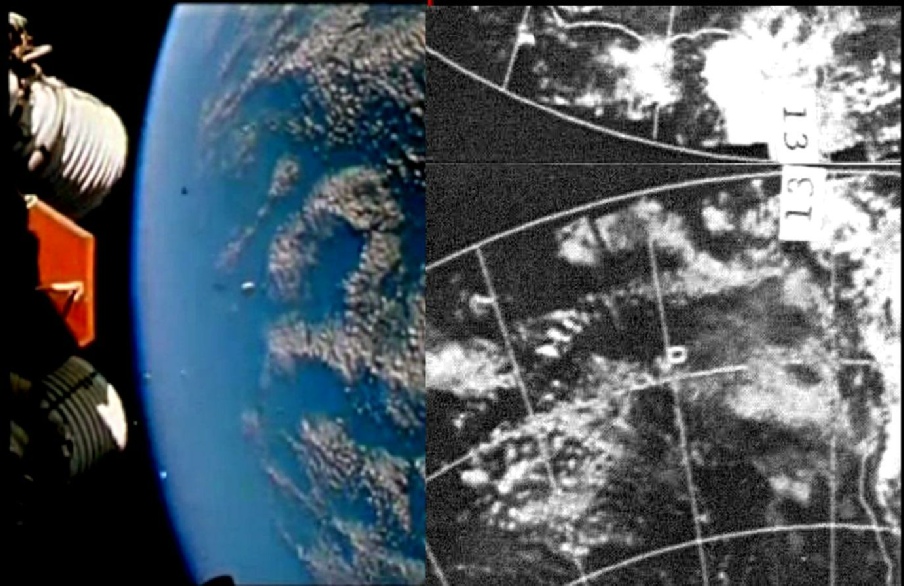
This image shows Apollo 4's famous staging footage that I matched with the weather satellite image from the same day:

wpb371f8d1_05_06.jpg


and this youtube video of mine shows all the orbital images strung together as a movie,

https://www.youtube.com/watch?v=viOTyjEdu0Y

and those images can again be matched with the weather satellite images taken on the same day as I demonstrate here:

http://onebigmonkey.com/apollo/CATM/ch4/leo/c4_10_1.html

So if Apollo 4 launched and orbited but then burned up, how did we get those photos?
 

ISF - Join now!

Every member here is approved by hand. No bots, no spam, just people who care about evidence and honest debate.

Membership is free!

Create your free account

Back
Top Bottom