My apologies for a drive-by provocative post followed by a month of being elsewhere. (New job and all that.)
Get a life dude, just look at the stats of fatal accidents with and without seatbelts.
I'm well aware of those statistics.
I'm sorry but this kind of woo is dangerous and frankly angers me having lost a loved one who wasn't wearing his seatbelt.
I'm sorry for your loss. It is unfortunately common. In fact I can come up with people I personally know who have died due to not using seatbelts (girl in my TA in highschool), are only alive because they wore seatbelts (my brother), killed a passenger who wasn't using a seatbelt (my father-in-law), survived a serious accident when not wearing a seatbelt (my mother while 8 months pregnant), and a pedestrian who was hit by a car (my sister's best friend). Please believe me when I say that we're in agreement that cars are dangerous, and seatbelts offer significant protection.
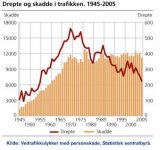
But that does not affect the validity of the paper's reasoning or make its conclusion woo. The paper claims that people have a fixed risk tolerance. If you make them feel safer, they'll become more aggressive. The question of whether the outcome of a safety measure results in fewer, more, or the same number of fatalities becomes an empirical question. The evidence summarized in that paper is that for safety measures where people's judgement is unimpaired, the result is that fatalities stay the same.
Anecdotally, were seatbelts less widely used, my brother probably would have died and my sister's best friend likely would still be alive.
I'm not sure I accept the data in this paper at face value but even if true it merely says So whether their figures are actual or the 1,000 was an estimate and the 200 the actual measurement, they still credit the seatbelts for saving 200 lives. And why were the back seat passengers still dying? Didn't they have seatbelts on? And we aren't told how many fatalities were passengers and how many were pedestrians. It could be the 1,000 was an estimate that would have been accurate if only back seat passengers had belts on too or had shoulder straps.
Apparently you didn't read the paper very closely.
1000 was the initial official estimate of lives saved in the UK. After an ongoing trend towards lower fatalities was factored in, the official estimate was revised downwards to 200. However the authors of the official estimate later acknowledged that they had failed to take into account the effects of a drunk driving campaign that was coincident with the seatbest law. When you look at the fatalities by hour of the day, the entire reduction over the general trend happened from 10 PM to 4 AM. Which is easily explainable by the drunk driving campaign, and is not explainable by general seatbelt legislation.
It is worth re-emphasizing a point that the paper had already made, which is that the UK is the
only jurisdiction in which seatbelt use gave any evidence of reduction in overall fatalities. In 80 other jurisdictions no correlation was found. So the UK data should be viewed as an anomaly, and the existence of an alternate explanation for that data leaves
no jurisdictions where fatality rates suggest that seatbelt laws save lives.
The author simply puts forth an hypothesis about increased high risk driving but the evidence doesn't address the details of the accidents that would actually test the hypothesis.
The example of seatbelt use is actually tangential to the point of that paper. If you're really interested in the research on seatbelt use, I would suggest following up the references in that paper.
And how about pedestrians like my sister's friend Pat? There is simply no way that seatbelts could have saved her, and there is a very real possibility that seatbelt use by a reckless driver contributed to her death.