
Houla Massacre, Syria: What If?

Nice additions on the Scene page. We've been really slacking a bit with video allocation ... found another version of that video of Rasha and her mother ... with French instead of Spanish subtitles and a bit longer, with an older woman and a little girl in the end. Haven't dissected the content - do we know for sure that those are the "Abdul Razak's" from the BBC article or did we deduce it from their testimonies?

And I found Alex Thomson reporting for Channel 4 - we only went by his articles so far. Nothing really new, but some interesting shots from the town - clock tower and roundabout with dead horse n stuff ... interviews a guy who speaks broken English, but that can't be the "guide" as Thomson writes that they didn't film him to protect his identity.

Added the vids and a screen of Alex (and the nun).


I'll check the extra footage. Just found a version in Arabic, likely the original. Took a few minutes. The match between video and accounts is not 100% but pretty sure. Video shows girl, older woman, and infant. Reuters describes a video like that, no names. BBC interviews Rasha, unnamed mother, infant, and a sister (not shown). Details added there now to help clarify.

Saving new footage from Taldou for reference. Will examine soon.

On the Thomson imagery, just from the still, that looks like a pretty small horse. Maybe a goat? Was dragged across the street, leaving a blood smear, poor beast. And the blasted buildings just northeast of the roundabout - those didn't likely look that way before the 25th, walls knocked out, a skeleton. Something right in there is given around as the home of the family Abbara, lost two members IIRC due to a rebel rocket misfire (no mention in the rebel version).
 
I've been digesting and improving the scene page, street level views. Fascinating. The horse is definitely a Goat, not sliced open down the side like I thought, but with something red tied to its back, apparently, with black strings. A prayer rug? Part of the Syrian flag? There's a crude painting, in the same prolific black spray paint, of a goat - about 50 meters ahead between the abandoned APCs. See both in this composite.

Perhaps most interesting is the arches, Qaws. As I just brushed-it up to say there:
The arches were reported as the general base area of the mobile Qaws security post, which supposedly made main street impregnable to rebel outsiders. As the UNHRC inquiry decided, from its August report, "The commission has since determined that the checkpoint at Al-Qaws, which is closest to the Al-Sayed house on Main Street, remained in Government control on the day of the incident. The front line between the opposition and Government forces was north of the checkpoint." (paragraph 45, p. 11) [6] Yet the arches there are evidently shot to hell in that later video, and also apparently on the day after the massacre (if to a lesser extent).

That can be seen as the UNSMIS observers filmed their entry through the arches the 26th, stitched into the view below (seen through the windshield). [3]. Bullet holes are present, although the lighting isn't terribly clear. Interestingly, the angle of sunlight suggests this is not their first entry at 11am, when they were reportedly fired on. Rather, this seems to be a late afternoon drive, but by the editing, arranged first.

In both views, something is missing, apparently torn down, from the upper center of the arches structure. It may have been some sort of crest, presumably sporting the Syrian national colors, red, white, and black. Also visible is some kind of black graffiti applied to the pillars at some point, then most of it scribbled out again in black before the observers arrived. One small word at the top of the east column seems readable. Note at least one bit of post-May 26 damage, visible in the upper image but not present in the lower one. On the right column, a chunk of concrete is missing right at the top of the black-painted spot. But some of the fighting and apparent changing-of-hands at this spot occurred, apparently, at about the time of the massacres on Main Street, despite what the UN inquiry decided.

Oh, and for those following, after watching the video more, I'm less than 50% sure now the angle I was on with Major Raslan is worth anything. More likely, just two kind of similar guys.
 
Last edited:
What the heck, people like pictures.

Arches as seen recently, on or before Sept. 13.
450px-Houla_Arches_2.png


As seen on May 26:
350px-Houla_Arches_1.png
 
CL, the reference mentioning shooting on the UN observers (saw your edit comment) comes from Marat Musin in his summary.

Marat Musin said:
[...] As of today, there are no troops within the city of Al Hula, but there are regularly heard bursts of automatic fire, nonetheless. Moreover, it is unclear whether the militants are fighting with each other, or whether supporters Bashar al-Assad are being cleaned out.
Militants opened fire on virtually everyone who tries to get closer to the border town. Before us a UN convoy was fired upon and two armored jeeps of the UN observers were damaged, when they tried to drive up to an army checkpoint in Tal Dow.

In the attack on the convoy a twenty-year-old terrorist was spotted. The fire was directed on the unprotected slopes of the first jeep, the back door of the second armored car was hooked by a fragment. There are wounded among those accompanying. A wounded soldier: “The next day, UN observers came to us at the checkpoint and as soon as they arrived, gunmen opened fire on them. And three of us were injured. One was wounded in the leg, the second – in the back, and I was hit in the hip. [...]


I so want to read the UNSMIS report. Was on the blog which translated Musin's report into German today, because they also translated the Russian TV report I posted in the general thread. Reviewed the Houla articles and found this shot of Mood's original statement. "[we] counted more than 32 children under the age of 10 and over 60 adults killed."

In the same article is this video: http://www.youtube.com/watch?v=O--fhcZqXhQ

It shows a collection of scenes allegedly from Houla while it happened, apparently shown on Addounia TV. Seen some snippets before, but most not. We see how people film detonations in a building, we see dead people on the sidewalk, we see a killer (who doesn't wear Shi'a slogans on his forehead), more dead people in a dusty spot which could be the Al-Sayed crime scene (gut feeling), more dead people including a child with a syrian flag sweat band. German subtitles aren't very informative, you get the gist from watching. Authenticity can't be verified, of course.
 
Last edited:
CL, the reference mentioning shooting on the UN observers (saw your edit comment) comes from Marat Musin in his summary.

Ah... I didn't look hard. I caught in a T. West Afri-Synergy video, thought he got mixed up with Qubeir where they were shot at a week later. Will re-add if warranted and if it might explain the afternoon re-take of their entry.

I so want to read the UNSMIS report. Was on the blog which translated Musin's report into German today, because they also translated the Russian TV report I posted in the general thread. Reviewed the Houla articles and found this shot of Mood's original statement. "[we] counted more than 32 children under the age of 10 and over 60 adults killed."

In the same article is this video: http://www.youtube.com/watch?v=O--fhcZqXhQ

It shows a collection of scenes allegedly from Houla while it happened, apparently shown on Addounia TV. Seen some snippets before, but most not. We see how people film detonations in a building, we see dead people on the sidewalk, we see a killer (who doesn't wear Shi'a slogans on his forehead), more dead people in a dusty spot which could be the Al-Sayed crime scene (gut feeling), more dead people including a child with a syrian flag sweat band. German subtitles aren't very informative, you get the gist from watching. Authenticity can't be verified, of course.

I've heard the number 92 cited, but it was an at least, at the time, okay. I'll have to check the video, esp. the 'killer.' The sweat band, if on the wrist, is from Houla but as I've said, prior to the big one, posted by late April anyway. That's all I've been meaning to post on the previous Houla massacres page.

I've been slow here and even now at the wiki, finishing, sending, and side-promoting an open letter to the OHCHR. It's up here, big ol thing, informing on Daraya and, in more detail, Houla and its witnesses. A sample:
“Bearing witness” in the Syrian conflict, as in the Libyan one before it, usually starts with quietly assessing the alleged witnesses. When there are two competing sets, it ends with bearing one set across the river of doubt, while leaving the other stranded on the far shore. The side blaming the government is almost universally selectedfor the crossing, and so is “acountability” directed.
And damn, another missing space I missed. Too late now, stupid keyboard.
 
I did get receipts for several recipients of it. One named person there, and preidency 3, 4, and 6, whatever that means. So it must also have gotten to at least one of the three I actually sent it to. I'm also getting unusual spam all of a sudden. ??

As CE noted, I made at least one error in the letter, naming Manaf Tlass instead of his cousin (?) Abdulrazaq Tlass.

But one thing I added there for the first time was this interesting point: The mobile post at Al-Qaws, was not attacked, the CoI felt, because "the front line between the opposition and Government forces was north of the checkpoint," at the overrun clocktower post, apparently. So if it did come under attack, it'd be from the north.

But the bullet holes and such we see, suggesting the post was attacked, are on the south face of the arches.

Recall the CoI conceded, despite what the rebels said, they clearly overran at least one checkpoint, and in fact "probably" "one OR two" of them. Implied is possibly a minimum three out of four, as the non-rebel witnesses said.

There's only one post north of the Qaws, and that's the clocktower. IF there were two overrun instead of one, the other would have to be south of the Qaws - either the post near the water works, or the one at the hospital.

So quite likely, all investigations agree, that post was well positioned to be attacked from either side, or from both. We can see evidence that they were hit from the south. It was a mobile post. It might have just driven away to safety, or it was destroyed (There's also at least one burned-out APC. I need to figure out where it was. I don't see it here on Main Street anyway).

Anyway, the CoI decided this post nearest two of the massacre sites "remained in Government control on the day of the incident." I guess they didn't specify "throughout the day," just at one point or another on the day. :rolleyes:

I'll even venture a guess when Al-Qaws was hit/chased away: around 10:30-11:00 pm.
 
I say earlier. Look at the timeline - 3:30pm the southern "rebel" group takes the checkpoint at the waterworks according to "Arifah" and marches up town. According to Chulov "shabiha" gather there at 4 pm, and around 4:30 pm the "soldiers" knock on Maryam's door just at the Qaws, coming back in the evening to do the killing. IIRC other witnesses of both sides report a group coming from the Dam in the afternoon. I suspect after that the whole area was under "rebel" control at least for the day. The UN investigators seem to have "decided" that that group was "shabiha/army" and nothing else, so they can't attack their own checkpoint.
 
Last edited:
Yeah, maybe earlier... I didn't think that part through. The main points there however ... this deserves a good graphic and maybe a whole page on "front lines." In the accepted version, there are none. The little FSA force ran away and the controlling army let the child-killers in.
 
French TV documentary from September 20, "Houla, autopsie d'un massacre". Blurb looks like no on-the-ground investigation, but talk with UN observers could be interesting.

C’était le 25 mai 2012. Un peu après l’heure de la prière et la fin des manifestations qui ont lieu chaque vendredi en Syrie.

A Houla, une ville à quelques kilomètres au nord ouest de Homs, les familles étaient rentrées chez elles. Brusquement des hommes armés, des miliciens du régime, selon plusieurs témoins ont envahi les rues. Dans le quartier de Taldou, ils ont défoncé les portes et massacré à l’arme blanche plus de 100 personnes. 49 enfants, au moins autant d’adultes dont 34 femmes. Certains enfants avaient les mains attachées dans le dos. Plusieurs corps de femmes ont été brûlés. Pour tenter de raconter ce qu’il s’est vraiment passé à Houla, Manon Loizeau a recueilli des témoignages directs par Skype, notamment celui d’un enfant survivant du massacre. Elle a suivi le travail d’expertises de l’O.N.G. Human Rights Watch, leur authentification des témoignages, le recoupage des informations, les vérifications à travers des images satellites. Elle a aussi rencontré des membres de la mission de l’ONU qui se sont rendus sur place dans les heures qui ont suivi les faits. Une longue enquête minutieuse, l’autopsie d’une tuerie à huis clos, celle qui se joue en ce moment en Syrie et depuis mars 2011.


Just got it running, the (a?) Skype interview at the very beginning is with our boy Ali, with headphones and a big smile on... will watch and dig for interesting scenes ... why did I forget so much French?
 
Some interesting stuff in there. Ali got himself a do-gooder french journalist "mother" who didn't talk with him for the first time. She really loves him and his courage. Another Skype talk with an activist called Abu Hassan who funnels them some videos ... in part those are the ones filmed on Sept 12, and the guy seems to be the same seen in them. They also show parts of the scenes I posted in #774, among them the one with the "killer" - but they pay no attention to him, cutting him more or less out...

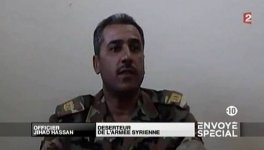
Major Jihad Raslan makes an appearance - here called Jihad Hassan. Later they do some on-the-ground investigation, but don't make it to Taldou. Instead they find a veiled woman in a refugee camp on the Turkish border, claiming to be from Houla, and a cousin of a victim in some unnamed village.

In Beirut they visit the HRW office where they are shown some maps and graphics wondering how the Shabiha could have made it to the Abdul Razzak crime scene from the Alawite villages. Short interview with the woman leading the UNHRC investigation, snippets from a press conference of the Syrian investigation, other minor stuff.

Most interesting was an interview done in Beirut with a Columbian journalist named Catalina Gomez. She also visited Taldou together with the UN observers immediately after the events, apparently the day before Thomson. She has some original footage including from inside the (one) Al-Sayed home, which she was able to enter, and some unseen scenes of a checkpoint, militants on the way to and from the place, etc. If I understood it right (she speaks English and I shouted at the French dub to shut up ;)) she was told by Army guys that terrorists did it, which she suspects to be propaganda, and saw some bearded militants, "Shabiha" she thinks, who looked so mean that she was very scared and absolutely convinced that those were the perpetrators. Didn't understand where exactly she saw them. Will look for her own reports and take some screens of her footage on occasion.
Conclusion - as to be expected from French state TV -: Bashar is responsible.

If a French speaker reads this - a transcript/translation of the interview with Ali (the first three minutes of the film) would be much appreciated.
 
Last edited:
Catalina Gomez, "Cadáveres y justificaciones en primera línea de fuego en la ciudad siria de Hula", La Vanguardia (Barcelona), May 29, reports from the scene and her interactions with the army while fighting is going on, including visiting the house with the bloodstain on the bed seen in the french video.

Auto-translated snippet:

According to the commander, the slaughter was the work of the Free Syrian Army with the support of "international terrorists". They killed, they said, the people who had refused to leave the village. "They wanted to attack and so asked to evacuate their homes, to dig there," continued the commander, ensuring that "terrorists" were acting under orders from rebel commanders and Ahmad Addulah Abdulrazaq Tlass. The people who stayed, say, paid the consequences. "They entered the town at night and we could not stop because we were not enough."


Six min audio interview in Spanish here.

Articles for El Tiempo (Columbia) May 27 and May 31.

Auto-translate from the first one:

But it's been a few seconds of our arrival when the convoy he was traveling in the UN mission and the crescent of Syria, with which we intend to go to the center of town, where there would still be thousands of civilians and combatants on both fronts, is detained by Syrian army soldiers suddenly start appearing in the houses that are on the avenue.

Respond, say, to fire them shoot from the other side. "F16, are American," they shout to hear the precise and clean shots of weapons. The shots that leave their worn Kalashnikov, however, are very strong. They say it is dangerous to enter the city, that "terrorists" are skyrocketing.

Let in the UN, then to the Red Cross ambulances and trucks with humanitarian aid, but not both journalists carts we hide in a house


Not let into the city center. And from there they visit the Al-Sayed house, so they were stopped on main street in the south. The second article clears that up, it was Sunday as well:

That day, when was the first time that journalists got to the area, the only two cars that accompanied the mission, the journalist Alex Thomson, British Channel Channel 4, and ours, were detained at the checkpoint Army Syria, at the entrance of the village, which at that time was facing opposition snipers hidden in different buildings.


Seen in the shorter Thomson video aired by CNN. She mentions another shooting event, apparently causing her team to lose the convoy, so that Channel 4 finally made it to the city center but they didn't. If I understand that terrible auto-translate correctly, because later she writes:

This last version is the witnesses would tell the British journalist who could get to the heart of town next Wednesday, when us and we had to prepare to leave the country.

"I'll finish it over," he said in the afternoon before traveling, so it was almost a feeling of triumph see days after his report, which collected the testimonies of the inhabitants, who would not stop thanking his presence.


Thomson took the interviews on the following Wednesday? Huh? Will have to revisit that later.
 
Last edited:
Just look at Ali ... my knowledge of body language tells me that he's totally making it up and is embarrassed by how serious la mère is taking him. His poor bottom lip. :D
 
Okay, I finally tried to watch the video, but cannot. So I appreciate the notes.

"Major Jihad Raslan makes an appearance - here called Jihad Hassan."
... Hassan Abdul Razaq/Hassan Abu Firas ... ? No pictures of the guy... don't suppose the video somehow proves he's the same guy the UNSMIS talked to after all? Could use any interesting things he says, or image if interesting.

Ali - a couple things would be helpful, but I see you aren't able to just decipher it. I have a French-speaking contact, but it's the same as my Arabic one, and he's been pretty busy. I don't suppose there's a transcript about?

I'm curious how they knew which house was his. I can place the one shown as just north of the Qaws, across the road and about 400 feet south of the military intel HQ even the CoI felt was "likely overrun" by armed rebels the day of the massacre.

Clearly, any new account details from Ali are always welcome, always amusing.
 
The information that it is an Al-Sayed house comes from Catalina Gomez, and the documentary comment adds that it is the house of "petit Ali". Don't know if they checked back with him or just assumed it, maybe not knowing that there was more than one Al-Sayed house. It is definitely the house also shown from the inside, entered by Gomez.

No, my French is not good enough to quote anyone, just to get the very general gist of what's been said. No transcript, and it's not on youtube. I installed this Microsoft Silverlight nonsense especially for them ... maybe that's why it had only 44 views when I found it and 50 views now, after I took a shot of Jihad for you ... forgot that one. Shaved, mustached, but clearly the SPIEGEL Raslan:
 

Attachments

  • france2_jihad.jpg
    france2_jihad.jpg
    14.1 KB · Views: 3
Last edited:
The above event was later specified by SANA to have taken place in a small village south-east of Taldou:

Authorities confronted an armed terrorist groups which were intimidating the civilians and attacking the law-enforcement members in al-Samalil village in al-Houleh area in Homs countryside.

SANA reporter quoted a source in the province as saying that the clashes resulted in the killing of scores of terrorists and the injury of others.


But yesterday:

documents.sy said:
Armed conflicts take place in the western area of the National Hospital, in Taldo town of Homs countryside, which resulted in the death of several militants and the wreckage of their mortar gun


By now we have established that Thomson was indeed twice in Taldou - Sunday and Wednesday. And a lot of other interesting details. See wiki.
 
What timing. Samalil = Shomaliya = Shumariyeh ??

Nope.

However, the other two equate and suggest strongly a segment of victims that the rebels have never told us about - men, women, and children from an Aalawite village nestled in somehow with Taldou. Even some rebel supporting sites acknowledge that rebels attacked Shumariyeh, only it was after the massacre, in retaliation (since Alawite villages (other ones, this one doesn't get named ever again) were supposedly responsible) and involved no family killings. It couldn't be much after by the way, hours at most, not days. It was reported alongside with the massacres in Taldou on the 26th.

Anyone else find that interesting?
 
Yes indeed, alleged Alawite victims of the Houla massacre, not mentioned by rebel/activist sources or their lists. Rebels acknowledge an attack there, by mortars. SANA said there were ten victims from two families. "the terrorists brutally killed Mohammad Abdul-Nabi Abdullah, his wife and six sons in addition to the citizen Rateb al-Oulo along with his son." We've probably seen them, called more among the huge pool of 62 Abdul Razaqs.

Further Houla research on Houla, May 25: Who Was in Control?:
A rebel brigade putting up images of three of the five Taldou security posts on Facebook, May 16. Nine days later, those three plus two others are allegedly overrun. UN investigators acknowledge two of those, one taken for sure, one "likely," considering the building was gutted and burnt and the two APCs outside burned up and the place deserted. The other three, including the army post at the "Water Company," protecting the Alawite village, and the national hospital, remained in gov. hands throughout.
The CoI determined that the clocktower checkpoint was overrun at some point, but there was no indication or evidence that the elevated post, the Water Company, was ever overrun, nor was the National Hospital...

According to a video filmed around 6:30 pm on the 25th, the soldiers at the hospital decided to burn the place, sending out huge plumes of smoke. Some witnesses thought it was conquering rebels doing that, after they took it around 4 pm. Those silly billies.
 

ISF - Join now!

Every member here is approved by hand. No bots, no spam, just people who care about evidence and honest debate.

Membership is free!

Create your free account

Back
Top Bottom