gold bull/bear survey

Where do you think the gold price is going?


  • Total voters
    138
:jaw-dropp Wow... No, "nice call"? No, "you were right... silver went to $28 range as you projected and then saw a bounce"?

Or "Gold is $250 lower than where you sold it short and has fallen 20% (high to recent low)"??

Just "I'm going to be right in the end more so than I was two months ago" and "here's my justification and explanation"???

Too funny.


.

I don't recall that you were going to short gold. If you made money on silver, congratulations! You don't need any encouragement, your brokerage account should be encouragement enough.
 
I'm not a goldbug, but a practical investor, which requires metals or instruments of them. We are in the "bad money driving out good" phase of an economic problem. It's worth considering that in such events it is almost always the people - not the governments - who initiate and substain the 2nd phase - "good money driving out bad".

One exception to that was the Weimer Republic, where the government made the "rye money" actually work.

But government efforts to introduce a new improved currency or substitute usually fail, although they may serve what might arguably be the real purpose of allowing the stealing to continue for a little while longer, and the bleeding of the people to continue.

This time around, it is in my opinion inevitable that the "good money that drives out the bad" will be an internet based item of value that is not a national monetary unit, and not a European or IMF monetary unit, and which is not gold based.

If this is understandable, discuss it.
 
Simon Erlich bet was just a bump on the road or what?

Erlich got the key commodity wrong. We are indeed seeing supply problems and high prices for various metals, with more problems in store, but it was never going to be metals that tipped the balance. The human race is running into resource depletion and pollution overload problems of all sorts (including climate change, ocean acidification and extreme salination in places, fresh water supplies (especially from aquifers and glaciers), wild fish stocks, phosphorous for fertilisers, deforestation and soil erosion, plus various metals and other minerals, but the one which matters most of all in terms of what is going to happen to the human population level is crude oil.

Malthus' general theory has never been proven wrong, even if his specific timings were hopelessly out. His observations about the nature of human societies and psychology, and of the way humans interact with their food supply, were all spot on. What he failed to take into account was the full power of first a coal-based industrial revolution and then an oil-based technological revolution, ending up in the full industrialisation of farming which only really happened in the second half of the 20th century. He predicted that there would always be booms and busts, and that there would be overshoot before the busts. What he got completely wrong was the potential size of the boom that could be created by a civilisation which fully utilised the world's reserves of fossil fuels. We as a species and a civilisation have been "cheating" the Malthusian controls for the last two centuries, and that is how we've ended up with over seven billion humans on this planet with predictions that it will rise to ten billion. But we cannot cheat them forever and the end of cheap oil means we cannot cheat them for very much longer. There is a direct connection between the availability of cheap oil and the unbridled rise in the human population.
 
Last edited:
Erlich got the key commodity wrong....There is a direct connection between the availability of cheap oil and the unbridled rise in the human population.
And we are seeing shale oil ramp up in production, oil sands in Canada, 400K barrels a day of oil substitute in ethanol, and talk of large scale natural gas to methanol conversion for use in vehicles.

Just like Julian Simon said occurs, over and over, in every field of industry and production. Erlich wasn't the first one to make these mistakes of believing Malthius.

George Maynard Keynes: The Economic Consequences of the Peace, published just after World War I:


y 1914 the domestic requirements of the United States for wheat were approaching their production, and the date was evidently near when there would be an exportable surplus only in years of exceptionally favorable harvest...
Europe's claim on the resources of the New World was becoming precarious; the law of diminishing returns was at last reasserting itself, and was making it necessary year by year for Europe to offer a greater
quantity of other commodities to obtain the same amount of bread...
If France and Italy are to make good their own deficiencies in coal from the output of Germany, then Northern Europe, Switzerland, and Austria...must be starved of their supplies.
​
 
Last edited:
And we are seeing shale oil ramp up in production, oil sands in Canada, 400K barrels a day of oil substitute in ethanol, and talk of large scale natural gas to methanol conversion for use in vehicles.

Just like Julian Simon said occurs, over and over, in every field of industry and production. Erlich wasn't the first one to make these mistakes of believing Malthius.

This time it really is different. Global oil production has only just peaked, and at the moment a combination of demand destruction (largely because of unrelated economic problems) and the adoption of creative ways to make up the initial shortfall has managed to delay the point where we really start to feel the crunch. There is a limit to how long these processes can put off what is inevitably coming. Using ethanol from crops is a textbook example of why these solutions to the problem won't work very well or for very long. This policy just makes inefficient use of the available oil (because it takes almost as much oil to produce the ethanol as you get energy from burning that ethanol) and diverts food away from humans and livestock, which just fuels the looming food crisis. This food crisis is already hitting the US economy in other ways, causing livestock farmers to sell liquidate their herds because they can no longer economically feed them. Likewise, diverting gas to oil, or coal to oil, just brings forward the day when we start running out of those things too.

The non-believers will never accept this until they can see it happening. I'll make a clear prediction: the human population will peak no later 2025, and maybe as early 2015.

No, it doesn't look to be shaping up that way.

http://www.npr.org/2011/09/25/140784004/new-boom-reshapes-oil-world-rocks-north-dakota

Amy Myers Jaffe of Rice University says in the next decade, new oil in the US, Canada and South America could change the center of gravity of the entire global energy supply.

"Some are now saying, in five or 10 years' time, we're a major oil-producing region, where our production is going up," she says.

The US, Jaffe says, could have 2 trillion barrels of oil waiting to be drilled. South America could hold another 2 trillion. And Canada? 2.4 trillion. That's compared to just 1.2 trillion in the Middle East and north Africa.


The Peak Oil argument has pretty much been demolished, it would seem. And Julian Simons is right once more. Which is good, not bad. (leaving your green arguments aside for the moment).

Mhaze,

So you think they've found three new Gharwar's in the Americas? :D

I stand by my prediction about the population, and I'll add that global production of conventional crude oil peaked in the period of 2005-2008. I can't really be bothered to debate this. Five years ago I would have. I don't agree that the "peak oil argument has been demolished." On the contrary, I think it is becoming more mainstream with each passing month. Ten years ago it was an obscure theory that was easily dismissed as internet conspiracy-theory nonsense. It is not any more.
 
Last edited:
Mhaze,

So you think they've found three new Gharwar's in the Americas? :....
Found? No they've known the stuff was there. It's just that recently it's became, with new technology, easily accessible. So functionally, yep, three biggies.
 
A week later and still no 'recovery'. I'm calling the last 2 months a bubble.

Right. So you're calling it a bubble even though the price is still higher than it was on the day the thread was started?

I'd call that a "bobble." :D

Nothing goes up or down in a straight line.
 
All I can say to that is "we'll see." :)
What "we'll see" is the extent to which some segments of the left succeed in slowing down or obstructing development of these resources. What we won't see is (A) that the deposits are not there (B) that they cannot be economically developed at current prices (C) that with unhindered commercial development the US would not exceed Saudi Arabia in oil production within 20 years.

A great deal of the deposits are on federal land, and these would need to be released for development.

So here is where the differences between the future drift of the "Peak Oil" theory and that of oil shale development intersects: "Peak Oil" is helped along and encouraged by both greens, Arab governments, and other factions which want to keep oil prices high.

Peak Oil, thus, is a political fiction.

500 years of oil, on the other hand, is a market reality.

Cheers!

We'll see.... :)
 
myopic much?

Originally Posted by MarkyX
No bubble burst. In fact, if anything, I suspect some major inside trading.
A week later and still no 'recovery'. I'm calling the last 2 months a bubble.


__________

lol. it has zero characteristics of a bubble yet, we need a mania first.

the only people I know outside of the internet that own metals are people I persuaded into it, and all of their friends think they are crazy.

coming back to the OP and the point of this survey, when a solid majority of the intellectuals here have finally grasped this and are touting gold on this site..

.. we will have gotten out just a little bit before that, hopefully somewhere near the bottom of the housing : gold & dow : gold cycles, and we're nowhere near that yet.

maybe 2-5 years, depends how fast everything unravels.
 
Last edited:
lol. it has zero characteristics of a bubble yet, we need a mania first.

the only people I know outside of the internet that own metals are people I persuaded into it, and all of their friends think they are crazy.

coming back to the OP and the point of this survey, when a solid majority of the intellectuals here have finally grasped this and are touting gold on this site..

.. we will have gotten out just a little bit before that, hopefully somewhere near the bottom of the housing : gold & dow : gold cycles, and we're nowhere near that yet.

maybe 2-5 years, depends how fast everything unravels.
I DO come here to check the status of the popular delusions.
 
A week later and still no 'recovery'. I'm calling the last 2 months a bubble.

You expect Gold to jump up by 300 dollars in a week?

Only way that will happen is if margin rates were 100% and leverage was no longer allowed. Only way to do transactions would be via cash, not credit, and physical only.
 
You expect Gold to jump up by 300 dollars in a week?
I never expected it to. But did you expect Gold to go down 300 dollars in a week? Or did you think it would just keep going up?

Only way that will happen is if margin rates were 100% and leverage was no longer allowed. Only way to do transactions would be via cash, not credit, and physical only.
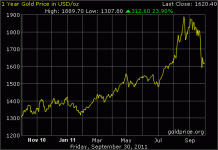
I must be thick, because I can't see why that unrealistic scenario is the only way that Gold would go up by $300. In fact Gold did go up by nearly $300 in the space of a few weeks, but everybody assured me that this was a 'normal' exponential rise. Then a few weeks later it dropped back. Was that not a bubble?

Nobody knows exactly what's going to happen next - but If it continues to slide, when will you decide that the peak has passed?

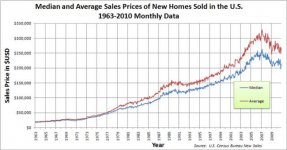
Compare these two graphs. One shows a bubble, the other one doesn't?
 

Attachments

  • US Housing Bubble.jpg
    US Housing Bubble.jpg
    33.4 KB · Views: 4
  • Gold 1 Year.gif
    Gold 1 Year.gif
    10.8 KB · Views: 2
I never expected it to. But did you expect Gold to go down 300 dollars in a week? Or did you think it would just keep going up?

I must be thick, because I can't see why that unrealistic scenario is the only way that Gold would go up by $300. In fact Gold did go up by nearly $300 in the space of a few weeks, but everybody assured me that this was a 'normal' exponential rise. Then a few weeks later it dropped back. Was that not a bubble?

Nobody knows exactly what's going to happen next - but If it continues to slide, when will you decide that the peak has passed?

Compare these two graphs. One shows a bubble, the other one doesn't?

Correct. The fundamentals in the gold market right now are completely different to those you would expect in a normal investment bubble in shares or property. There is also a massive effort going on behind the scenes by powerful players who are desperate to keep the gold price under control - the market is rigged.

I can't speak for anybody else, but I will personally not be convinced that gold prices are nearing their top until there is some sort of end in sight for the global, systemic economic/monetary/fiscal problem. At the moment there is no light whatsoever at the end of that particular tunnel - in fact the powers that be are not even addressing the systemic problems. Instead, they are just "kicking the can down the road". This latest plan to save Greece is not an attempt to solve the problems either - it is just giving the can a particularly large kick.

The reason that was not a bubble, and that gold is not in a bubble now, is that this supposed bubble is not being inflated by greed. If it was a bubble then it would be being inflated by people piling into gold for no reason other than that they think lots of other people are going to pile into gold because all of them want a bit of the action. The classic example of this sort of bubble was the dotcom share boom/bust. What is driving the price of gold right now is not greed of this sort, but fear about the very real economic/monetary/fiscal problems getting very much worse in the forseeable future. People are buying gold because they see it as the least bad option - the safe haven of last resort. They are worried that paper assets like cash and bonds are going to be devalued and are buying gold because they don't believe they have any other sensible option for protecting their wealth. In other words, I think the term "bubble" should be used when the price inflation is a self-contained cause rather than being driven higher by factors external to the bubble itself. The people who invested stupid amounts of money in shares of dotcom companies which were destined to go nowhere had plenty of other options at the time. Nothing was pushing them towards dotcom shares in the way that people are currently being pushed into gold.
 

ISF - Join now!

Every member here is approved by hand. No bots, no spam, just people who care about evidence and honest debate.

Membership is free!

Create your free account

Back
Top Bottom