Ed Forum birdwatching 2008

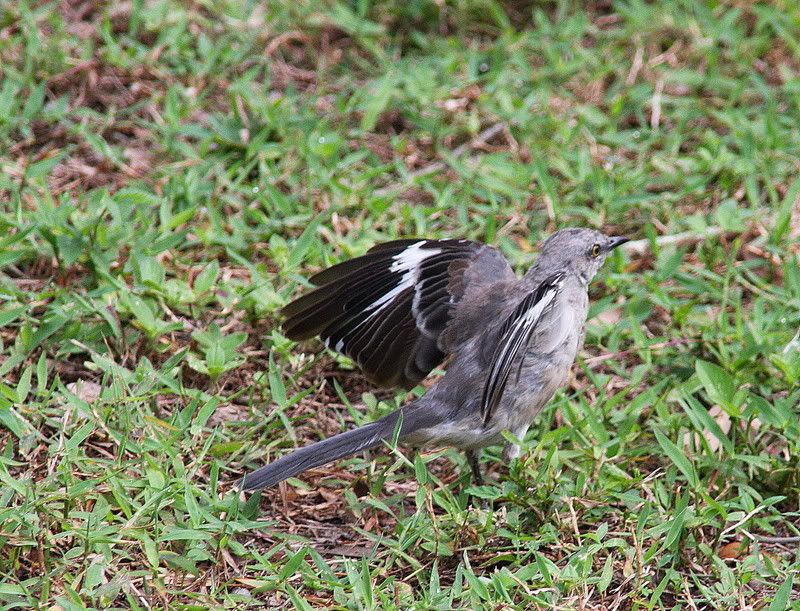
Northern Mockingbird. This is one of the most common birds in the area. I still find them very fascinating. They have the largest song vocabulary of any bird in North America. And their varied songs are like a soundtrack for the South. They do this funny thing where they flex their wings. I'm not sure what this signifies, but I snapped this pic while s/he was doing it.

NorthernMocker.jpg
 
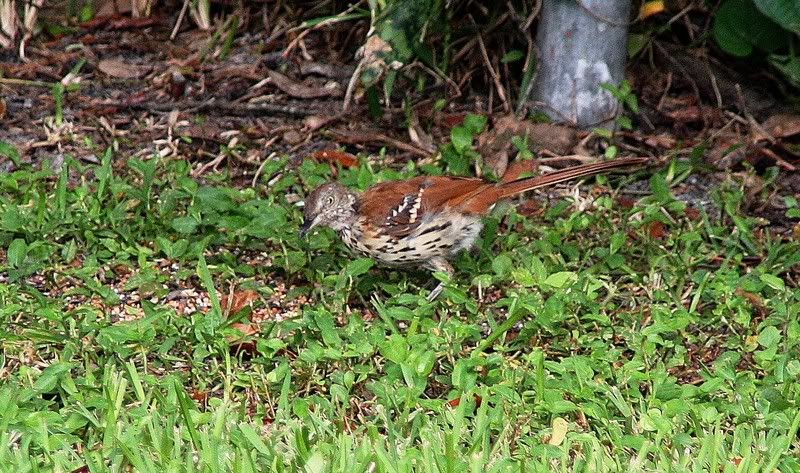
Brown Thrasher. This is a relative of the Mockingbird and the BlueJay. These birds literally thrash around on the ground looking for nesting materials.

NorthernMocker-1.jpg
 
Last edited:

Sibley shows a year-round distribution for Carolina up to and including coastal Maine, with "Rare occurrence" up to Prince Edward Island and the western coast of Quebec. It could be a straggler. There is certainly not much else to chose from. Sibley has the Winter Wren Troglodytes troglodytes, House Wren Troglodytes aedon, and Marsh Wren Cistothorus palustris in the area. None of these seem to fit the picture better than Carolina Wren.
 
I thought I had already confirmed Carolina, due to the song (I love the fact that there are song soundfiles googleable). I know I wrote the post; perhaps it was just before the forum outage.

I now have one birding book, having looked through several at the bookstore and not finding the bird I was looking for. Maybe I am focusing too much on a detail that is irrelevant, but it seemed so clear and I don't see it in any books. I'll post a few pics--the bird was (to the best of my view) all dark gray, with perhaps some variability at the head. I thought "catbird", mostly because of the call, but the beak appears to have a hook at the tip that I cannot find in any book.
2759838715_0296331e04.jpg

(other sizes)

2760682364_e8c8a497a6.jpg

(other sizes)

2759839359_090fd00538.jpg

(other sizes)

You can see from the green leaves that this is not just a bird in silhouette, but is a dark bird--I saw no flashes of white, for instance, nor of any color. On the other hand, I was not able to get terribly close, so who knows?
 
sphenisc, I was thinking the same thing whilst looking at Mercutio's pics.
The hook doesn't look deliberate enough, if that makes sense.
 
If the only reason to exclude catbird was the bill tip then I'd suggest it was one, with a slight bill deformity. Mimids, (the catbird is a member of the Mimidae), seem to be prone to this kind of thing.

http://www.umd.umich.edu/dept/rouge_river/bills.html

Wow--excellent resource! Catbird it is, and more importantly, I learn a lesson about individual variability in morphology. (Of all people, I should learn this lesson--if it were up to me as a specimen, biologists would be asking which species has eleven fingers...)
 
eleven fingers?

Reminds me of a story I heard once of a mother who took her infant to her doctor for a six week check who pointed out that the infant had six toes on each foot. She had often thought there was something odd about its feet but hadn't quite figured out what!
 
Wow--excellent resource! Catbird it is, and more importantly, I learn a lesson about individual variability in morphology. (Of all people, I should learn this lesson--if it were up to me as a specimen, biologists would be asking which species has eleven fingers...)

I've made a small essay-ish thing earlier in this thread, where I highlight exactly this. I think it is the most important thing for anyone who is going to be any kind of biologist --- even an amateur one, as a bird-watcher --- to learn: the birds in the field guide don't exist, and all real birds vary. I have a few friends who are very keen on finding rare birds, and they always try to see if any even slightly aberrant bird is something rare, while I usually assume it is just a variation in a common bird unless there are several characters pointing in another direction. I frankly find it silly sometimes when people try so very hard to make that Random Sandpiper into a Rare Sandpiper just because the leg colour is a bit off, or the wing coverlets are not quite reddish enough or so, all the while overlooking the fact that it lacks the drooping bill end and white eye-band before the eye (or something similar).

The second most important thing to learn is that it is not possible to determine to what species every individual you see or hear belongs. Sometimes, you just have to give up, and hope that you'll see it better later. If you stare too long at something too far away, or under too bad light conditions, it's all too easy to start believing that just maybe it is a bit larger than the common species usually are, or just maybe there's a hint of something dark around the uppertail coverts, and then suddenly you are convinced --- especially afterwards --- that it was a Rare Sandpiper rather than a more common species.

The third thing to learn is that all birds are interesting. If you go out somewhere and only see the same birds as the last 50 times you were there, that's okay. You don't need to find something new every time, as some of my friends think. In many ways, it's much more rewarding to see the same kinds of birds over and over again, in different seasons, with different plumages, and so on. Hear the same sounds over and over again, until you get a feeling for what is normal. This, of course, ties in much with the first issue above: the more certain you are of how much the every-day birds may vary, the more certain you will be when you really find something strange that it will actually be something new.

If you learn these three things early on, the rest will be much easier, and, at least in my eyes, you will be a much better birdwatcher. I have friends who have seen lots of rare birds, but who have never seen many of the birds that can be seen everywhere. For instance, and old classmate of mine had seen the only albatross observed in Sweden at the time, but had never seen Crested Tit, which can be found more or less in every suitable forest in all of Sweden. I think that's just silly.

 
Kotatsu,

Now I don't feel so bad about seeing only magpies, kookaburras, sulpur-crested cocatoos, and crimson rosellas when I go for a walk in the hills.

(I have seen lyrebirds but only about twice in twenty years)
 
eleven fingers?

Reminds me of a story I heard once of a mother who took her infant to her doctor for a six week check who pointed out that the infant had six toes on each foot. She had often thought there was something odd about its feet but hadn't quite figured out what!
Eight fingers, three thumbs.

They figured out I was odd (numbered) at birth, and lopped off the offending digit within a week or so. I have no memory of it at all, but do occasionally sense a thumb where there is no thumb. Great for phantom limb discussions.
 
[snip]
If you learn these three things early on, the rest will be much easier, and, at least in my eyes, you will be a much better birdwatcher. I have friends who have seen lots of rare birds, but who have never seen many of the birds that can be seen everywhere. For instance, and old classmate of mine had seen the only albatross observed in Sweden at the time, but had never seen Crested Tit, which can be found more or less in every suitable forest in all of Sweden. I think that's just silly.

Excellent advice, and I shall try to heed it.

On the other hand, if this thread is to hit the hoped-for numbers, and the easy birds are already on the list, I may find myself making a few trips to the seashore during migration season... which starts soon, and lasts pretty much into snowfall.
 
I've made a small essay-ish thing earlier in this thread, where I highlight exactly this. I think it is the most important thing for anyone who is going to be any kind of biologist --- even an amateur one, as a bird-watcher --- to learn: the birds in the field guide don't exist, and all real birds vary. I have a few friends who are very keen on finding rare birds, and they always try to see if any even slightly aberrant bird is something rare, while I usually assume it is just a variation in a common bird unless there are several characters pointing in another direction. I frankly find it silly sometimes when people try so very hard to make that Random Sandpiper into a Rare Sandpiper just because the leg colour is a bit off, or the wing coverlets are not quite reddish enough or so, all the while overlooking the fact that it lacks the drooping bill end and white eye-band before the eye (or something similar).

The second most important thing to learn is that it is not possible to determine to what species every individual you see or hear belongs. Sometimes, you just have to give up, and hope that you'll see it better later. If you stare too long at something too far away, or under too bad light conditions, it's all too easy to start believing that just maybe it is a bit larger than the common species usually are, or just maybe there's a hint of something dark around the uppertail coverts, and then suddenly you are convinced --- especially afterwards --- that it was a Rare Sandpiper rather than a more common species.

The third thing to learn is that all birds are interesting. If you go out somewhere and only see the same birds as the last 50 times you were there, that's okay. You don't need to find something new every time, as some of my friends think. In many ways, it's much more rewarding to see the same kinds of birds over and over again, in different seasons, with different plumages, and so on. Hear the same sounds over and over again, until you get a feeling for what is normal. This, of course, ties in much with the first issue above: the more certain you are of how much the every-day birds may vary, the more certain you will be when you really find something strange that it will actually be something new.

If you learn these three things early on, the rest will be much easier, and, at least in my eyes, you will be a much better birdwatcher. I have friends who have seen lots of rare birds, but who have never seen many of the birds that can be seen everywhere. For instance, and old classmate of mine had seen the only albatross observed in Sweden at the time, but had never seen Crested Tit, which can be found more or less in every suitable forest in all of Sweden. I think that's just silly.
Great post. As a novice I've fallen into the trap of assuming I was observing a rare species instead of a common morph. I also appreciate your comments about observing common birds, as suggested by my pic of the Mockingbird. They are ubiquitous and still fascinating.
 
Now I don't feel so bad about seeing only magpies, kookaburras, sulpur-crested cocatoos, and crimson rosellas when I go for a walk in the hills.

I hate you for living in a place with exciting birds^^.

Excellent advice, and I shall try to heed it.

Thank you!

I was "raised"in bird-watching in a different place from all the people I go bird-watching with. Here in Gothenburg, they are very much for races, rarities, and travelling far just to see something new. In Jönköping, the basis for bird-watching was always making inventories, surveying for nests, counting migrating birds, and banding. I spent more time just counting Mallards, Coots, and Mute Swans during my first years than I spent watching even locally uncommon birds. Of course it was exciting if the usual lake had a semi-rare bird in it one day, but that wasn't the point. The point was to get data for when the first Marsh Warbler started singing in May, or the number of Canada Geese during stop-over, or the banding of Chaffinches and Siskins at some feeding station.

So when I came here, I was very surprised that there's not even any banding activities going on in the near area. I have plans for starting something up, but I seem to have trouble getting a licence, as the licensing people are reluctant to hand out more licences to anyone. Fortunately, I will need one for my Ph.D. project (or, at least, I can credibly say that I do^^), so maybe that'll work out somehow.

On the other hand, if this thread is to hit the hoped-for numbers, and the easy birds are already on the list, I may find myself making a few trips to the seashore during migration season... which starts soon, and lasts pretty much into snowfall.

Well, what we really need are people going to Africa, Asia, and South America^^.

I'll do my part by going to Japan (I hope for 200 species there!) and Thailand, as well as a few weeks' stop in Australia. But we have no reports from South America yet, not even for common birds, and only a few from Africa (Morocco, South Africa) and Asia (South Korea).

Great post. As a novice I've fallen into the trap of assuming I was observing a rare species instead of a common morph. I also appreciate your comments about observing common birds, as suggested by my pic of the Mockingbird. They are ubiquitous and still fascinating.

Thank you! I always find it is better to "default twitch" if you're unsure. If a bird looks like a mixture between a common bird and a rare bird, it's always safer to assume that it's just an aberrant common one. Or that it just can't be determined to species level.
 
Northern Mockingbird. This is one of the most common birds in the area. I still find them very fascinating. They have the largest song vocabulary of any bird in North America. And their varied songs are like a soundtrack for the South. They do this funny thing where they flex their wings. I'm not sure what this signifies, but I snapped this pic while s/he was doing it.

Yeah, we get a buttload of Mockers here in Houston, and yes, their song is incredibly varied. I joke with Ms. Tricky that you can tell a Mockingbird song because they sound like one of those car alarms that keeps changing it's pattern.

But they're one of the birds that, no matter how common, I never get tired of them. I wish I could say the same for Grackles. Perhaps my antipathy toward the black bastards has resulted from the numerous times I've parked my car in the shade only to come back and find it covered with grackle spackle.
 
Kotatsu,

Now I don't feel so bad about seeing only magpies, kookaburras, sulpur-crested cocatoos, and crimson rosellas when I go for a walk in the hills.

(I have seen lyrebirds but only about twice in twenty years)

See my posts earlier in the thread complaining about grackles and starlings (and Tricky's post just before this.) At least your common-or-gardens are pretty. Our current batch are ugly, noisy and poopy.

There are the mockingbirds and the doves, but the grackles...ugh!
 
I hate you for living in a place with exciting birds^^.

See my posts earlier in the thread complaining about grackles and starlings (and Tricky's post just before this.) At least your common-or-gardens are pretty. Our current batch are ugly, noisy and poopy.


I think I'm going to be looking at these birds differently from now on. :)

We used to have cockatoos, galahs, and ducks land on our front lawn when we first moved in about five years ago, but that was before the water restrictions. The automatic watering system that the previous owners installed was timed to come on just before sunrise and we could watch the ducks paddling about from where we woke up in bed. :)

Now we don't even have a lawn. :(
 
Heh... So I'm sitting out in the back yard, listening to the various birds, seeing which I can identify, which I need to figure out, all that sort of stuff. The Olympic Games are getting in the way of early rising, but yesterday was a rainy morning, so the birds waited for the rain to stop before commencing their infernal racket. I'm on a bench near the garden, far enough away to avoid the wasps and hornets that appear to be my only pollinators this year. Or so I think, until a big-ass bumblebee flies over to inspect me. Only it was not a bumblebee; here I was, out looking for birds, and a bird comes over to look for me. Female ruby-throated hummingbird, but no pic yet (I am trying, just for fun, to get a decent photo of each bird sighting--in part because I want to be able to verify, and because I am learning so much on this thread).
 

Back
Top Bottom