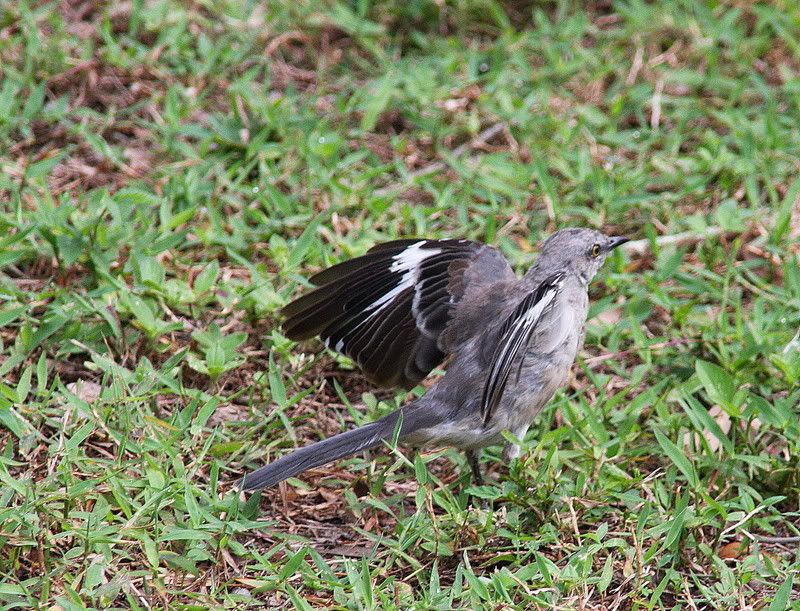
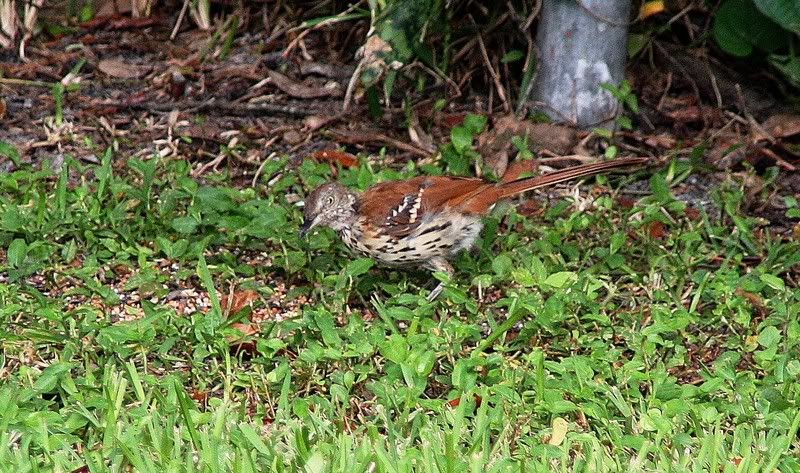
I've made a small essay-ish thing earlier in this thread, where I highlight exactly this. I think it is the most important thing for anyone who is going to be any kind of biologist --- even an amateur one, as a bird-watcher --- to learn: the birds in the field guide don't exist, and all real birds vary. I have a few friends who are very keen on finding rare birds, and they always try to see if any even slightly aberrant bird is something rare, while I usually assume it is just a variation in a common bird unless there are several characters pointing in another direction. I frankly find it silly sometimes when people try so very hard to make that Random Sandpiper into a Rare Sandpiper just because the leg colour is a bit off, or the wing coverlets are not quite reddish enough or so, all the while overlooking the fact that it lacks the drooping bill end and white eye-band before the eye (or something similar).
The second most important thing to learn is that it is not possible to determine to what species every individual you see or hear belongs. Sometimes, you just have to give up, and hope that you'll see it better later. If you stare too long at something too far away, or under too bad light conditions, it's all too easy to start believing that just maybe it is a bit larger than the common species usually are, or just maybe there's a hint of something dark around the uppertail coverts, and then suddenly you are convinced --- especially afterwards --- that it was a Rare Sandpiper rather than a more common species.
The third thing to learn is that all birds are interesting. If you go out somewhere and only see the same birds as the last 50 times you were there, that's okay. You don't need to find something new every time, as some of my friends think. In many ways, it's much more rewarding to see the same kinds of birds over and over again, in different seasons, with different plumages, and so on. Hear the same sounds over and over again, until you get a feeling for what is normal. This, of course, ties in much with the first issue above: the more certain you are of how much the every-day birds may vary, the more certain you will be when you really find something strange that it will actually be something new.
If you learn these three things early on, the rest will be much easier, and, at least in my eyes, you will be a much better birdwatcher. I have friends who have seen lots of rare birds, but who have never seen many of the birds that can be seen everywhere. For instance, and old classmate of mine had seen the only albatross observed in Sweden at the time, but had never seen Crested Tit, which can be found more or less in every suitable forest in all of Sweden. I think that's just silly.