
One thing said one way: There is no vertical release point.
This is not a rope breaking under tension or a sudden brittle fracture. The hypothesis is multi-hinge buckling of vertical columns. That phenomenon begins with primarily horizontal motion and progresses into vertical motion (going as the sine and cosine of the hinge angles, respectively), but the horizontal and vertical motion share the very same initial instant. Neither can occur without the other.
If anything could be called a release point, it's the point where the hinges of the buckle break, but that happens well after vertical drop is underway. (And most likely happens at different times for different columns in the wall.) The vertical release point is a myth of your own invention.
NIST timed the beginning of vertical motion ("the instant the roofline began to descend"), which would occur with the beginning of buckling, which also includes horizontal motion. If their vertical motion figures were inaccurate due to simultaneous horizontal motion and perspective effects, that might affect the shape of the time versus displacement curve in the earliest moments of Stage 1 (with import yet to be shown), but it does not affect the time span of the overall event.
They didn't time the collapse from "several minutes earlier" because the wall did not collapse several minutes earlier. I don't really know what else to say about that.
Respectfully,
Myriad
Columns can bend, columns can buckle. A buckle can be thought of as 2 or more bends folding in opposite directions, no?
A single bend is what we have been calling a hinge (?)
Is this a fair, simple way to see a buckle geometrically?
If so, a hinge can be seen as not shortening the effective length of a column, whereas buckling can be seen as a shortening of the effective length of a column.
Any objections to this general distinction between hinge and buckle?
This Bazant image should do:

>>>>>>>>>>>
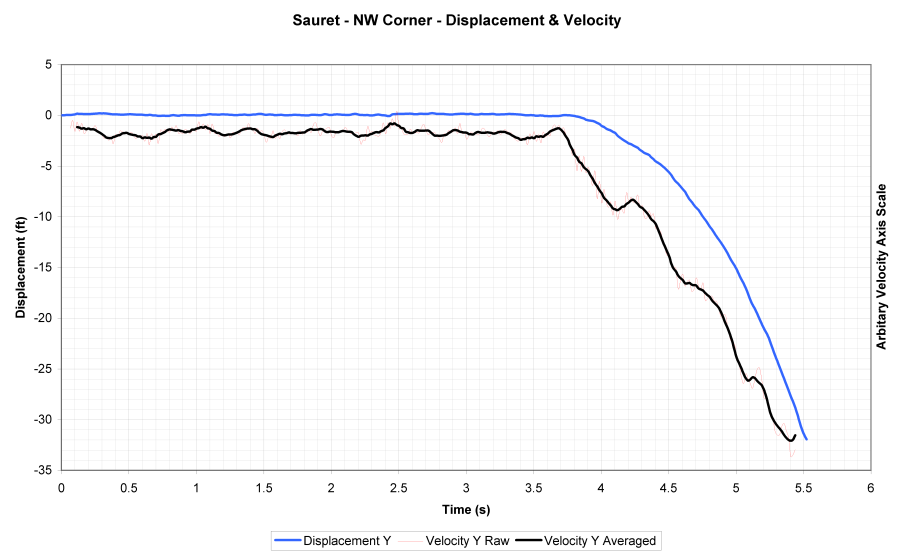
Recall that my earlier example of a "release event" was also using femr data along the NW corner of WTC1 during the (in)famous tilt and collapse initiation sequence. Femr's velocity graph:

My earlier advice was to look within the yellow region to find the release event, or corner column failure event for the NW corner.
Also recall that supposedly the WTC1 north wall experienced one of your famous "hinges" so we'd expect the velocity to not make such an extreme transition over a few frames.......but it does.
I was posting this about 1 year ago...being ignored as usual.
Last edited:


 It's clear early motion of the NW corner has a significant northward component. The NE corner is similar, but t'other way...that's south btw.


