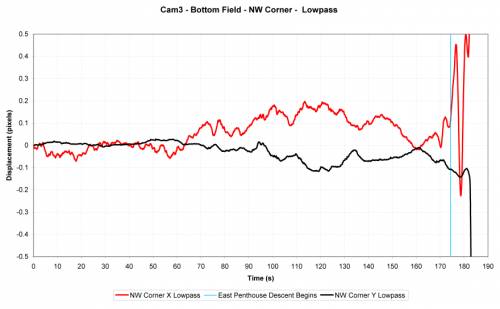
You've also been claiming that NIST's average acceleration figure for the entire north upper curtain wall collapse is too low because their placement of "t0" when the buckling began is too early, because they were fooled by horizontal motion.
Distorted early
vertical motion data, sure. Distorted
vertical release point, sure. Distorted
vertical descent time, sure...
Derived metrics, such as instantaneous (short timespan average) velocity and acceleration are of course not affected by errant T
0 if that short timespan is after their errant early motion data. But full-cycle averages
do include that period of time.
If the horizontal motion that "fooled them" into thinking buckling was underway actually is part of the buckling then that chain of inference falls apart.
No. The problem is that the early motion was interpreted as vertical (in full) not slightly vertical, mostly North-South. Put it into perspective...(pun intended

)...
The early motion from the NIST T
0 pixel location and frame has a significant North-South component. This *fools* them into producing a displacement graph which suggests, say, 3ft of vertical motion, when it may only actually be a few inches...that the motion captured is not purely vertical distorts the early displacement data. Minimising this distortion is obviously desirable. The Dan Rather viewpoint is therefore a much better choice.
If they were after the average acceleration from ANY motion, they could have started it a few minutes earlier, but they were trying to time the
vertical motion, and doing so requires definition of the vertical release point T
0. Their T
0 is a bit before the vertical release point, which skews their average
vertical motion data from release point.
The North facade was experiencing motion a while before their T
0, and the East penthouse had already descended. Any time prior would do if you're not bothered about starting T
0 for motion primarily N-S. They intended their T
0 to be the
vertical release point. It wasn't, that was slightly later on.
Same thing said in enough different ways ?
It seems unlikely given the overall progression of the collapse from interior to exterior, and the relatively early stage.
But it is very likely due to buckling of columns somewhere.
And several minutes earlier...

...? Still buckling columns ?
Why would a cycle or two of oscillatory motion be bizarre?
As an indication of *multistory buckling of its columns at lower floors* ? I'd expect that to propogate rapidly.
If we've veered towards *a* column or two somewhere buckling, different situation.
The trace above is the previous 4.5 minutes. Are you suggesting column buckling propogation began that early ?
What do you think that would do to the Column 79 theory ?
If the structural condition of the building is no longer stable, but not yet compromised enough for runaway collapse, oscillation is where the energy would go.
Again, how does this fit with the single instigating column 79 event ? Or do you not see it that way ?
Ever heard the phrase "teetering on the brink of collapse?" Teetering = oscillation.
I have indeed, Jenga being the first thing to come to mind, and not a buckle in sight. You seem to be painting a picture of gradual column buckling reaching a point of runaway propogation. Where does column 79 fit into your described behaviour ?
Critical in that it is an abrupt directional change from a low frequency oscillation to a much more rapid one followed fairly immediately by release. I'd suggest it indicates, using your analogy, the final teeter.
Do you know how dynamic systems that oscillate work? Typically, the points of "inflection" (min velocity, max acceleration) are convenient time markers but the dynamics of that point are the same as at any other.
To a certain extent. The behaviour after that point is significantly different to that beforehand.
The early motion, probably true. But during NIST's stage 1 of facade collapse, the motion was likely both: multi-story buckling of facade columns caused by interaction with the core.
Stage 1(ish) has the building undergoing global vertical descent, so of course there is going to be buckling during that time.
Amplification by what mechanism? Or alternatively: how can amplification be taken into account or even assumed to exist, without an established mechanism?
It's a tall structure. The
simplest analogy that comes to mind...wobble an upright ruler at its base...a little bit...top end motion is rather amplified. Simplified, yeah. I suggest the roofline motion has very little to do with events anywhere near the roofline during the early motion in the minutes leading to release. Clear ?
PYou are interpreting certain pixel movements in videos as N-S flexure; of course that is a different and perhaps mutually exclusive interpretation from vertical compression. They're both interpretations and I haven't seen a very strong case for either; yours might be a little stronger but both interpretations so far have been a matter of "what it looks like to me."
I've repeatedly highlighted comparison between Cam#3 viewpoint motion and Dan Rather viewpoint motion. Dan Rather viewpoint motion would be rather different if that early motion was indeed vertical...the kink does not form in that viewpoint. If there were additional viewpoints it may be possible to determine the actual N-S component but there is a distinct lack of footage. Expressing the information gleaned from comparison between the viewpoints is rather awkward to put into words. Suggest you do it. I can always provide a synchronised Cam#3 Dan Rather view. Scrubbing back and forth through both is very insightful in terms of building visual cue information to interpret the motion correctly.
As for actual compression of storeys, come on. The side effects would be more than visible. Other footage is available, which although no good for tracing, does show this suggestion to be, er, how should I say...physically unreasonable ?



 Now then, another aspect to femr2's video data analysis. Best be having a look at your videos. Your recent one supporting the NIST T0 by replicating their inept mistakes is first in line there. Ho hum...busy, busy.