• Security incident: ISF was recently accessed by intruders. Please change your password, and change it anywhere else you used it. Read more

Didja Hear About Iran?

If the government had any lick of sense it would support these mourning observations and show sorrow of it's own at the sad violence. It has, thus far, seemed to do the opposite, even denying Neda a funeral. This will backfire.

It already has backfired. Without even intending to, they have turned Neda and the others who've died into martyrs for the revolution.
 
If the government had any lick of sense it would support these mourning observations and show sorrow of it's own at the sad violence. It has, thus far, seemed to do the opposite, even denying Neda a funeral. This will backfire.

If they had any sense, they would have at least pretended to recount the votes.
 
If they had any sense, they would have at least pretended to recount the votes.
If they had any sense, when they first rigged the vote they would have made it appear that Ahmadinejad won by a narrow margin but not so narrow that there would have been a call for a recount.

But then, since when has Ahmadinejad ever shown any sense? :oldroll:
 
Description of the Major Players & Forces

The Major Players and Forces in Iran

| Government |
| Supreme Leader |
| Assembly of Experts |
Executive | Legislative | Judicial President | Guardian Council | Head of Judiciary
Vice-Presidents | Majiles | Judicial Courts
Council of Ministers | Expediency Council | Clerical Court

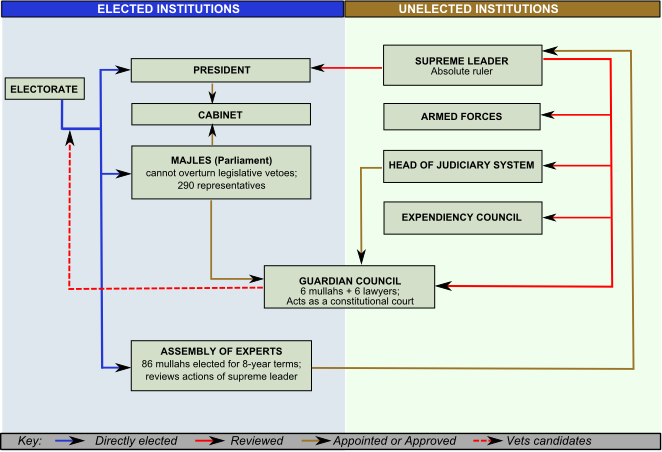
Of those positions listed above, the President, the Majiles (also called the Parliament), and the Assembly of Experts are positions that are voted into office. Each of the others is appointed by someone else, usually either the Supreme Leader or the head (or heads) of the respective branch. Also, it should be noted that the Vice-Presidents are not like the US version of a vice-president, and along with the Council of Ministers are more like what can be called a Cabinet (though there are separate cabinet appointments), or maybe like the VP of a division in a company. In case it doesn't seem apparent from the above (admittedly simplified) breakdown, the power structure here is very top-heavy and distributed to fall in favor of the Supreme Leader in almost every case.

The positions in this power structure that I know about coming into play are the following: The Supreme Leader, the Assembly of Experts, the President, the Guardian Council, the Expediency Council, and (not mentioned above) the different armed forces and police.

The Supreme Leader - (currently) Ali Hoseyni Khamenei - This is the position that holds the most undisputed power and has the most control in the Iranian government, though this position extends beyond just political power. It is a seat of religious significance, given to what should be an utmost authority on (Shia) Islam, as well as a seat of direct influence over the citizens, not only through religious edicts but as the directorship of all state-controlled media. This position exists as the personification of the Islamic Revolution in Iran from the late 1970's, and as such it sets the direction of politics, the tone of the discourse in the media, and the execution of military, judicial, and civil commands and laws for the entire nation.

Khamenei's time as Supreme Leader has been fraught with questioning and opposition for many years. Since he's more political than he is a cleric, some question his piety in religious-based decisions, which can sometimes put him close to being at odds with the Guardian Council and the many clerics throughout Iran. On the political side his decisions have come under question in the past from political rivals who have expressed concerns about oppression. Much of these tiny cracks in Khamenei's (extensive) power base haven't caused him much trouble, and his ability to appeal to the previous Supreme Leader (Ruhollah Khomeini) led to his being chosen as the successor to the position. The latter part is significant right now because, prior to Khamenei's succession to Ruhollah Khomeini, Grand Ayatollah Montazeri was in line to be the next Supreme Leader. The fact that Montazeri was censured (for criticizing Khomeini's torture of political prisoners) and lost his position (and thus the chance to succeed Khomeini) is definitely playing a role in the power struggle here on the political sphere, and is why Grand Ayatollah Montazeri is opposing Khamenei's legitimacy. This has been mentioned before, though, so if there's any interest in the power struggle between the two I suggest reading the linked Wiki pages to start you off (and read the citations and related links for deeper info).

The President - (currently) Mahmoud Ahmadinejad - The presidency is both the highest elected office in the political system and a primarily minor decision-making position. The laws a president is allowed to sign into power are subject to review by the Guardian Council, as well as review or discretion of the Supreme Leader himself. However, this position is one that faces outward to the world, and plays a large role in diplomatic relations with other nations, which can affect the nation economically as well as politically. On top of this, the presidency has no (direct) control over the military, which is under the direction (or, in the case of the IRG, the direct control) of the Supreme Leader.

Ahmadinejad has been... well, most people reading already know their feelings about him, and a large number of Iranian people aren't thrilled with him either. He came into power claiming to fix the ailing economy and to deal from a position of more strength with the West, and so far he's disappointed or embarrassed many people of Iran, even some of those who supported him initially. In fact, since the current problems with the elections, Ahmadinejad has lost even more support from Iranians who had otherwise supported him before.

On the other hand, Mir-Hossein Mousavi has enjoyed a growing increase in support even before the elections. Before the elections, the predecessor president to Ahmadinejad, Mohammad Khatami, was going to run for office and then decided not to in support of Mousavi. Since Mousavi had experience as Prime Minister during the 1980's, as well as having been supported by the first Supreme Leader (Khomeini), his credentials as a candidate were pretty highly regarded by the population and among other politicians (despite Ahmadinejad's attacks). Another former Iranian president, Ayatollah Rafsanjani, was also supportive of Mousavi in his campaign against Ahmadinejad, further adding to Mousavi's credibility, but also playing a somewhat greater role as the head of the Assembly of Experts, which we'll get to in a moment.

The Guardian Council - This what can be rightly called "the other power behind the government of Iran," in that similar to how the Supreme Leader has over-riding power above pretty much anything else, the Guardian Council has broad legislative and judicial over-riding powers, as well as a great deal of religious influence. The Council is made up of six clerics selected directly by the Supreme Leader, and six other judicial appointments that are indirectly controlled by the Supreme Leader. The main purpose of the Guardian Council is to maintain the power base for the Supreme Leader, a sort of committee-based redundancy that vets all legislation, judicial decisions, and even election candidates for the Council's approval before any of them pass. They have the power to challenge the Supreme Leader, but not to unseat him without help (that requires the Assembly of Experts, which I'm getting to). The amazing thing here is that the Guardian Council, which is comprised of appointees by the Supreme Leader, have actually issued a judgment about the election results that was contrary to what the Supreme Leader originally claimed. This doesn't sound like a big deal, except that the two parts of government (the GC and the Supreme Leader) are normally so in line with each other that there's pretty much zero disagreement, as the Council has often worked to support clamping down on dissent politically and judicially in favor of the Supreme Leader. This is the kind of crack in the armor that may not make much of a difference in the long run, but no matter how things go from here on out there's now a precedent for the Guardian Council to make a declaration at least correcting the Supreme Leader, if not actually disagreeing outright. It remains to be seen how the Council is going to react to any further pressure about the election results, but they may try to save their own skins and cut allegiance with Khamenei in order to maintain some of their positions.

The Assembly of Experts - This is the group that directly appoints the Supreme Leader and keeps him in power. They also are the only group in the entire Iranian government with the authority to remove a Supreme Leader from power. The significance of the Assembly is a two-fold power struggle. The longer-standing issue is an older power struggle between Grand Ayatollah Montazeri and Supreme Leader Khamenei-- Montazeri was once in line to succeed the original Supreme Leader Khomeini in the 1980's, but after a disagreement with Khomeini was replaced by then-president Ali Khamenei, who took Khomeini's place in 1989. In the subsequent two decades, Montazeri has been at odds often with Khamenei, which is now coming to bear again as Khamenei's political power and standing as religious authority are coming into question. The other struggle is with the seat of the Supreme Leader and the head of the Assembly of Experts, who happens to be former Iranian president Ayatollah Rafsanjani (who supports Mousavi). It's already been reported that Khamenei's forces arrested Rafsanjani's daughter (who also supports Mousavi) once, though they let her go, and the tension between Rafsanjani and Khamenei was already at a low boil by the middle of last week. There's no indication that the Assembly is making any moves to oust Khamenei yet, but if the Guardian Council wavers any more than it has so far regarding the election results, the chances are very high that Khamenei might be removed from the office and replaced, and replaced quite possibly by Montazeri.

So...

Of the individuals listed above, Montazeri and Rafsanjani are two of the more moderate, Western-friendly (well, non-hostile), and Khatami may even be possibly open to a dialogue about recognizing Israel in some official capacity (contingent on a two-state solution). These men play huge roles in the public and political support for Mousavi, and it's very likely that if he were to be appointed president of Iran, these men would ostensibly find their way into political roles in the government (and, optimally, in positions of authority). If this were the case, then Iran's whole system of government, while staying foundationally the same, will have changed dramatically in favor of improved relations with the West and possibly diplomatic relations between the US and Iran again. The hope here is that this type of event would also introduce greater civil liberties for the Iranian people, and hopefully more stake in the political elections and appointments that make up the government. Whether something like this can take place or not would only be speculation, but with so many forces at play here beyond just the protesters on the street and the popularity of their standing up to the current regime, this is the most likely time since the 1979 Revolution that some really strong reform could take place, and this is a source for much of the optimism from the Iranian side of things-- many people would love for this to happen. It's not a Western-style democracy and it wouldn't necessarily mean that Iran can suddenly be friends with everyone-- particularly problematic will still be the relationship with Israel-- but it would still be such a vast improvement that it couldn't be considered anything but a good thing.

 
10962464c89629bdc2.png

Another way of depicting Iranian government.

I am going to ask again, as I did over in politics:

Where is the evidence that Mousavi got more votes?

Another question: is it possible that Mousavi, a political veteran and sharp enough by half, had the protests pre planned, or the agitators for them, when he realized he probably wasn't going to get enough votes, fair or foul?

That the voting process smells is now open knowledge, in Iran, if it wasn't before. This may, in the long run, allow them to reform the process. Depends on who cares enough to do so.

DR
 
[qimg]http://www.internationalskeptics.com/forums/imagehosting/10962464c89629bdc2.png[/qimg]
Another way of depicting Iranian government.

Yepper. There's another one on WP, but I figured a textual explanation may help some (thanks for the image).

I am going to ask again, as I did over in politics:

Where is the evidence that Mousavi got more votes?

The original protestations weren't necessarily that Mousavi got more votes. The original contention was that the race between Mousavi and Ahmadinejad should have been closer given what-was-known prior to the election. The protestations were that the differences in the votes claimed were not representative for any of those running. I think one of the lower candidates had like 400,000 followers yet only received 300,000 votes. Generally, what the people want now is a re-vote, not a re-count. The problem with a re-vote is that it will surely be a win for Mousavi now, as these events have garnered him even more support, even from Ahmadinejad supporters.

Another question: is it possible that Mousavi, a political veteran and sharp enough by half, had the protests pre planned, or the agitators for them, when he realized he probably wasn't going to get enough votes, fair or foul?

It's possible (in that there would be some slight chance that it might work), but its probability is not known. Considering the consequences were he to be found out, I'd say it isn't likely. He wouldn't have had the media control to get a lather up about it in the weeks prior-- remember, they only get a few weeks where they can say the really hot stuff-- and the number of people he'd have needed on the ground to foment things would have been very leak-prone. But yeah, not knowing enough about his possible 'unofficial' (i.e.- personal, subversive) connections, I'd say it falls within the realm of possible. It would be quite a feat, but Mousavi was one of the guys around since the Revolution in `79 (all of these players are), so it's not impossible.

That the voting process smells is now open knowledge, in Iran, if it wasn't before. This may, in the long run, allow them to reform the process. Depends on who cares enough to do so.

There have been people who cared for a while now. They've been consistently cut off by the bottlenecks of power in the government. That's why, as I describe above, the power base is threatened from more than one side at this point, and it's Khamenei who likely stands to lose the most here even if the election results stand. There are people who are out of even Khamenei's power to safely get rid of at this point.
 
The latest is that Rafsanjani may have enough of a majority to oust Khamenei, but while there has been a few reports of this nature there hasn't been any movement toward it actually happening. It is known that Rafsanjani called a meeting of the Assembly of Experts to try and get a majority, but since the meetings are classified and essentially closed to the public this is mostly speculation.

There were more protests today, and the reaction from riot police and Basij was brutal. By "brutal" I mean beating the hell out of people, possibly attacking with axes, and reports of throwing people off a pedestrian bridge. Since the mainstream news has begun to catch up, here is a video of a phone interview with someone:


The rest of the information is a bit too painful for me to parse at the moment. Here are some of the individual tweets:
thank you ppls 4 supporting Sea of Green - pls remember always
our martyrs - Allah Akbar - Allah Akbar - Allah Akbar

we must go - dont know when we can get internet - they take 1 of
us, they will torture and get names - now we must move fast

Everybody is under arrest & cant move - Mousavi - Karroubi even
rumour Khatami is in house guard

they pull away the dead into trucks - like factory - no human
can do this - we beg Allah for save us

Lalezar Sq is same as Baharestan - unbelevable - ppls murdered
everywhere

they catch ppl with mobile - so many killed today - so many
injured - Allah Akbar - they take one of us

in Baharestan we saw militia with axe choping ppl like meat -
blood everywhere - like butcher - Allah Akbar

reports of street fighting in Vanak Sq, Tajrish sq, Azadi Sq -
now

rumour they are tracking high use of phone lines to find
internet users - must move from here now

phone line was cut and we lost internet
getting more difficult to log into net

all shops was closed - nowhere to go - they follow ppls with
helicopters - smoke and fire is everywhere

ppl run into alleys and militia standing there waiting - from 2
sides they attack ppl in middle of alleys

so many ppl arrested - young & old - they take ppl away - we lose our group

saw 7/8 militia beating one woman with baton on ground - she had
no defense nothing - sure that she is dead

they were waiting for us - they all have guns and riot uniforms
- it was like a mouse trap - ppl being shot like animals

I see many ppl with broken arms/legs/heads - blood everywhere -
pepper gas like war -

just in from Baharestan Sq - situation today is terrible - they
beat the ppls like animals

And that girl who was killed, Neda Soltan? The Iranian government is blaming her death on the MEK terrorist group inside Iran, whom nearly all of the Iranians hate equally (who are said to be connected with the CIA in some fashion, but that's a separate topic). The Iranian government and police are also not allowing Neda's family to mourn her death, which seems rather cruel and odd since the government is saying she was killed by terrorists.

Suffice to say, despite things still looking bad (possibly worse) for Khamenei and the current regime, it's been a harrowing day for the protesters and those who want some level of justice.
 
As far as I can tell the "offer" to recount is unprecedented reversal for the leaders.
An offer to recount a few votes but not change anything else? Seems pretty disingenuous from where I stand. What would be the point?
 
I read in a time article that since many of the people in rural areas are illiterate the ballots have to be read to them. They are instructed on where to mark their vote and have no way of knowing if it's actualy going to who they say they want to vote for.
Combine that with independant observers being banned from watching and it makes a recount irrelevant. The fix could well have been put in.
Sounds far fetched.

The winner was announced before there was time to count all the votes. Ahmadinejad won huge percentages in areas he should have done poorly in. The evidence seems pretty overwhelming the actual vote count was irrelevant.
 
My best understanding is that there is no smoking gun, ...
Are you serious? They counted millions of votes just a few hours after the polls closed? We aren't able to do that here and I doubt they have better technology.

And then there was specific cases where Ahmadinejad won by landslides where he should have done poorly. No smoking gun? I think that's absurdly generous of you.
 
If they had any sense, when they first rigged the vote they would have made it appear that Ahmadinejad won by a narrow margin but not so narrow that there would have been a call for a recount....
I believe that was part of the problem the dictators faced. They had to feign a win by a margin that didn't allow for a runoff.

If that is not the reason for the blatant election fraud, then the reason had to be an attempt to fake widespread support and they were so stupid that thought the public would just drink the Koolaid.
 
GreNME, let me get your thoughts on this question...

Do you, from your analysis and sources, see a significant component in "the opposition" that is, for lack of better description, secular and/or anti-theocratic? That is, is there a component of the protest movement which could, eventually, move Iran in the direction of a more secular government where the power of the mullahs is reduced or eliminated?

I like to argue that there is such a component, even if it is implicit, simply because people are openly defying the supreme religious authorities. That is something unthinkable just a few weeks ago, from what I understand.

What are your thoughts?
 
More updates, natch.

The media is now reporting a lot more than it was initially, so there's less lag between what I hear from the tweet-and-various grapevines and what you might be able to hear on the news. I noticed yesterday shortly after my posts during the day that the news about Rafsanjani trying to get a majority vote to oust Khamenei was at least playing on NPR, and the reports about the violence yesterday was also circulating by that evening. Also on the news today is a story that Khamenei urges tolerance of the protesters less than a week after calling them criminals and threatening them with violence (and having forces beat the hell out of small groups yesterday). His treatment to the opposition is not unlike an abusive spouse who goes nuclear on their spouse, and a few minutes later is talking about kindness and empathy. It's doubtful that many who are questioning Khamenei's legitimacy are going to be swayed by this announcement (considering Rafsanjani's Assembly meeting is known about), but this does offer some argumentative basis for Khamenei if he does come under some challenge.

There were some gatherings today, but to call them "protests" or "rallies" wouldn't be accurate. The gatherings were to mourn the dead protesters killed so far. There was a request for such a public gathering by Mousavi and others to the government to allow it, but the government said 'no' and Mousavi (as far as I know) told people to not get themselves hurt on this day of mourning. There were a few clashes anyway, but the details are few and far between. The conservative candidate Moshen Rezaee dropped his claims of vote-rigging, likely due to pressure from the Ahmadinejad. Another candidate, Mehdi Karroubi removed his call for a rally meant to mourn those who were killed while protesting, also likely due to pressure from Ahmadinejad.

Many people in the Iranian Parliament decided to not attend a celebration ceremony for Ahmadinejad's election. Ahmadinejad has also been going back and forth between the US and the UK being the greater evil behind the protest, remarking that Obama is no different than Bush. Iran's Minister of Intelligence has stated that anyone collecting information in Iran will be arrested, including foreign journalists, whether they are doing it for blogging, for news articles or for their own personal purposes. Another minister has come out and said that it's nonsense to say that journalists are forbidden from covering the protests, but the ramifications of anyone caught are not yet known (though there are several foreign individuals who have been detained).

Rafsanjani is said to have met with Mousavi to determine what can be done to stop the violence and destabilization in Iran. Mousavi has also made public statements that many of his close advisers and staff have been arrested and that he's essentially under limited house arrest himself.

The Iranian Revolutionary Guard has claimed that 8 Basij members have been killed and that hundreds more were injured while "protecting" people in Tehran since the protests started.

And a video: in this video, there is a couple who are either making a sort-of prayer or, as the title indicates, reciting a poem of the events they were seeing this past Friday night (the 19th) as people stood on rooftops yelling "Allahu Ackbar" (God is Great). It's a moving video, even for the non-religious like myself.


This blog post relates a letter from someone claiming to be an Iranian doctor, who is trying to pass on what he's seeing in the hospital he works at. A rough translation (using Google Translate... I'm nowhere near good enough to parse it all) is as follows:
I am a doctor and Rasoul Akram Hospital Sattarkhan busy street to work. Yesterday 38 people shot because we accepted the hospital's emergency room and 10 people were killed and others were injured. This pattern suggests that the wounds of the shower have been closed because many Mjrvhyn eaten two or more bullets were shot and where also it was very close to, for example 68 year old man in two and left the left shoulder area abdomen had been hit or 18-year-old boy from the floor and the wrist area was targeted. Biographies obtained from Mjrvhyn also showed that the pattern of wounds from shooting, roof is done, for example, a young 32-year-old hit back from being shot but the front part of the thigh and was out.

According Mjrvhyn gun suddenly and when the flood began in the population of the passing of a mobilization base in northern Azadi Square (the first highway, Mohammad Ali Jinnah) respectively. According to the injured in a car door in front of the base to form the park was unable to someone breaking in to it, and this sign is planned for the previous shooting is. According to witnesses about 4 people from the roof of the center basiji suddenly began shooting the action in ways that even those who intend to rescue the injured had to be hit were. One says Mjrvhyn while taken refuge behind a car I was injured.

At this stage angry car parked in front of the base attack and fire it into the tide, but can not be base. More riot police along with other groups to disperse angry Bsyjyan the way to reach this stage in the street during the wing of the places (eg near the Metro) other number are killed and injured.

According to information from the doctors this morning to get to Imam Khomeini hospital, this hospital during the night that the 38 killed were killed with a direct shot has been moved.

Please note that the security police in the morning today to force them all the funeral of the hospital and delivered them to the van location uncertainty and the family has moved many of them even being killed, your children without also Khbrnd. Between number of children killed and Mjrvhyn 15 and 16 years are also seen.

Today at 9 am to 11 students and doctors on the streets adjacent Rasoul Akram Hospital, this hospital has been gathering and distributing sheet contains some information about the number killed and injured were acting. Finally, the presence of this gathering riot police ended.

There is likely to be more news tomorrow regarding Mousavi, as he seems to be working toward getting together enough political backing to more 'officially' challenge Ahmadinejad's election, while Rafsanjani still seems to be looking to oust Khamenei (though he would obviously need a successor if they do oust him).
 
GreNME, let me get your thoughts on this question...

Do you, from your analysis and sources, see a significant component in "the opposition" that is, for lack of better description, secular and/or anti-theocratic? That is, is there a component of the protest movement which could, eventually, move Iran in the direction of a more secular government where the power of the mullahs is reduced or eliminated?

I like to argue that there is such a component, even if it is implicit, simply because people are openly defying the supreme religious authorities. That is something unthinkable just a few weeks ago, from what I understand.

What are your thoughts?

I'd say that, just based on my judgment from those I've been able to get information from, there isn't a notable amount of anti-theocratic bent or advocates of a strictly secular government within the protests. It's not that there aren't plenty of Iranians who are 'cultural Muslims' that are protesting, it's that there are actually a lot of people who took part in the Islamic Revolution who are actually expressing support for Moussavi in the upper echelons, and that many of the people who aren't the college-aged crowd are people who have lived in the theocratic state since the Revolution and have flourished to some degree. These are mainly the educated middle-classes that are protesting openly, while the poorer folk tend to be less educated and more prone to toe the regime's line in rhetoric-- the Basij recruits heavily from the poorer classes as a way to move up the social ladder.

What's happening right now, though, was practically unthinkable a few weeks ago. The Supreme Leader is supposed to embody a laundry list of qualities that include pious impartiality and a discernment of deceit and wrongdoing, and obvious corruption is a cause for immediate removal from the seat of Supreme Leader (which is what the Assembly of Experts exists for). The people, for the most part, aren't questioning the religion that the Supreme Leader espouses, they're actually challenging the Supreme Leader as being unqualified to represent the religion as well as run the country. Khamenei is being viewed as non-pious and corrupted by power. Ahmadinejad, on the other hand, is viewed as a liar and a cheat outright.

But yeah, there's not really much probability in there being a non-theocratic government resulting if Mousavi and his supporters win out in this fight.
 
Edited by Cuddles: 
Edited for rules 11 and 12.


American Embassies the world over were directed by Secretary Clinton to not invite, or revoke the invite already offered, Iranian diplomats to the Fourth of July celebration traditionally hosted by American embassies in foreign lands. My good friend, who was once defense attache to India, used to go to these celebrations. They were a social occasion not to be missed, apparently. Such things matter in diplomatic circles.

That a number of American ambassadors had already been cleared to invite, and did invite, Iranian diplomats to said celebrations was part of Obama hoping to warm our relations a bit from the chill they've been in for some years.

I personally agree with the circumspect approach Obama has taken, though I found his "outraged" choice of words to be rather empty. All he did was give Mahmoud ammo, which Mahmoud promptly used.

Gee, who saw that coming. But in the main, Obama has been temperate in his rhetoric, which IMO is, in the long term, worth doing.

The disinvite is also worth doing.

It's called "sending signals" in diplomatic circles.

DR
 
Last edited by a moderator:
Thanks, DR. That pretty much sums up a fairly objective examination of what you were addressing pretty well.

At the risk of repeating myself: the United States has no official diplomatic relations with Iran. There's not much the US government can do that wouldn't be construed as an act of war. Yes, I understand that there have been various classified operations in Iran over the years-- and not just under W, but during each presidential administration since Carter-- but right now pretty much every source who has any credibility as an expert on Iran has said that it's in the best interests of the US to keep pretty much hands-off on this issue. Based on the population of Iran, the culture (or, more rightly, cultures) in Iran, and the fact that Ahmadi and Khamenei are a couple of opportunistic liars of massive proportions, I agree completely that the best we could do has pretty much been done. There's very little (if any) political partisanship in that assessment, and the stratification of experts of various political persuasions who agree on this underscores how this isn't about party or ideological leaning.
 
An example of politicizing the issue: McCain, Graham, and Lieberman are suggesting trying to provide internet for Iranians through some ridiculous means. This is unnecessary partisanship and could very well be taken as an act tantamount to war, considering our lack of diplomatic relations and already unfriendly stance. McCain surely knows this (I know Graham does, because he's way smarter than that), so I can only take it to be political posturing for the base. I'm sure this would spark many a post in the Politics subforum, but the only judgment I have on it is that this statement is for the US, not for the situation in Iran right now.

On another note, JusticeForIranianWorkers.org has popped up, calling for demonstrations all around the world from labor and trade unions at Iranian embassies in various countries. Since the US has no such embassy we don't apply, but there have been numerous rallies in the US already.

There are some rumors that the government is possibly approaching Mousavi for talks regarding putting these protests to an end. Mousavi has stated that he's not going to capitulate unless the people's demands are addressed (related link [kinda]). Perhaps we'll see what happens at tomorrow's Friday Prayers (which are a pulpit for the Supreme Leader). Reza Aslan seems to think that instead of Rafsanjani looking to completely oust Khamenei, his Assembly may instead be looking for a compromise. If the latter is true, then we'll likely see an opposite speech tomorrow to the one Khamenei gave last week.

There was little in the way of reporting of violence today, though the riot police were said to be out in full force. I don't know if this means that violence wasn't the main course of the day, but one can only hope.

At this point, several of the Iranians who are still tweeting or sending messages are hiding at night instead of staying at home, which means communications are going to be even more thin while they are staying under the radar.
 
Stick to the topic and do not engage in personal attacks and bickering.
Replying to this modbox in thread will be off topic  Posted By: Cuddles
 
Well, according to the American media, apparently nothing is happening in Iran any more. But hey, did you know Michael Jackson died?
 

ISF - Join now!

Every member here is approved by hand. No bots, no spam, just people who care about evidence and honest debate.

Membership is free!

Create your free account

Back
Top Bottom