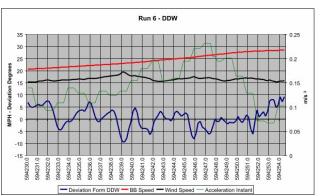
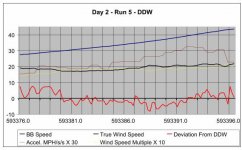
Humber-GPS expert!
Wrong way around EE windgrins: .05m/s, is less than the 0.1m/s performance. Rather like saying a voltmeter that is 10% accurate can measure to within 1% because it's "well with in 10%."
And BTW, that nominal 0.1m/s is 50% greater at 30m/s, and not at all representative of the actual performance. Waving the unit at arms length can produce errors of 0.2m/s.
Humber,
This is just a sample of why nobody believes anything you post.
Of course .05 m/s is less than 0.1 m/s. That is what the spec means. It means that the velocity error will be less than 0.1 m/s or that the GPS reading will be actual speed +- 0.1 m/s. Consequently, when the GPS is at rest, the .05 m/s worst case reading is 1/2 of the max error specified-well within the spec!
BTW, How would you know that waving the unit at arms length produces errors > .1 m/s? Do you have a way to measure your hand's velocity independently?
Do you not understand how to read specs? In fact, its nothing like saying that a voltmeter can read within 1% when its spec is 10% error. For that spec, an actual 10 Volt source could have a reading anywhere between 9 and 11 volts and be within the accuracy spec of the voltmeter.
In the case of the velocity reading of the GPS, the measured velocity should be actual velocity +- 0.1 m/s to meet its specified accuracy. And if your unproven assertion about the error being 50% worse at 30 m/s (67 mph) is correct, this would imply that the reading would be actual velocity +-0.15 m/s. (a completely negligible error for our purposes!) Please don't try my patience on this kind of garbage any more.
So your fundamental assertion of the measurement accounting for 15 mph error at a cart velocity of 35-40 mph is ludicrous and laughable.
You should go back to your "massive fraud for Spork and gross incompetence for NALSA" hypothesis. At least this is tough to disprove! NALSA and Bob Dill may differ with this assessment, however.
When you make up terms like "instantaneous accuracy" to sound knowledgeable, trust me, it doesn't work. Also, I would be very careful about slandering commercial products spec sheets in print when you make statements like:
"The GT31 is a consumer device for hand-held toys and in-car navigation. It has all sorts of proprietary gimmicks to make that workable, and not frighten or confuse the consumer."
I notice that you don't say that these "gimmicks" have any impact on the accuracy of the device! In spite of what you may think, statements like the above do not make you sound "authoritative" and as usual, you have nothing to actually back it up. Since you didn't have a clue about how GPSs work from your earlier comments in this thread, We all recognize that this posturing with your comments is completely hollow on your part.
And the following is just pure Gibberish:
To measure the claimed speed change of 2mph over 10 seconds.
dv/dt = 2mph/10s = 0.88ms/10 = 0.088ms-2. Only 10 samples. Does the idea of variance come to mind, if nothing else? Monte Carlo analysis?
And yes, I do understand variance, Monte Carlo analysis, and quite a few other statistical techniques that you have only found the names of on the internet. And the above is pure nonsense.
Feel free to rebut anything you would like. Commenting further on this subject would be a waste of time on my part as you have clearly demonstrated with these few posts that you have no idea what you are talking about.
WindGrins