I felt compelled to kill this statement of bad physics. I would like to say "once and for all" but it is clear that Humber will replay it "ad infinitum/ad nauseaum".
OK, first:
I am sure that general nausea will be a result of this post.
These are valid equations for speed and distance traveled from a fixed Inertial Reference Frame and are OK on the surface. We start to get lost from here!
I was right.
Like, you know, good enough for a pile of junk crawling its way across the deserts sands to the delight of village folk, rather than for the particles at CERN.
On the surface this looks almost OK but there is constant bickering by Humber about the variability of the winds so it is an argument that should be used carefully and he doesn't.
There is more to it than that. The cart is a joke and a
deliberate deception.
The first serious error: Luge is a timed event over a fixed track. The fixed distance over which all contestants run and is timed to compute the winner. This is equivalent to best d/t (average) or best speed over a fixed distance. Therefore lugers do want to enter the start with the fastest speed possible by accelerating before they jump on their luge. The average speed is increased by this type of start so it makes perfect sense. This has nothing to do with the BB style of run so is a complete Red Herring.
The final velocity of an object under the influence of gravity, is its initial velocity plus that gained by acceleration under g.
Vf = u + at. The cart is driven by a constant force, do is Vpush + at.
The final velocity for any object is in the simplest expression, v =at, whether a is continuously present, constant or not. You will find that all text books agree.
http://en.wikipedia.org/wiki/Velocity
True but this not what is being measured in the luge event. The time of the run is a function of initial velocity due to the luger's run, aerodynamic and ice drag due to the luger's smoothness of control and ability to minimize cross sectional area and "streamline" one's body, and the performance of the "blades" on the luge. The winner is the fastest over the fixed distance which is nothing like the contest for the BB's record. It is clear that in the luge event, the scorekeepers want to "capture" the human variability of the initial acceleration and entry onto the luge as this is what makes it more of "human" competition and not just a cart sliding down a track. The obvious difference here is that different humans, will have different starting velocities due to their differential ability to accelerate, thus affecting their overall time to cover the track.
Totally irrelevant. The luge is an example that refutes the idea that the push does not influence the outcome, and that is that. It should not be necessary to explain such simple and obvious facts. But, it is fact, so a serious threat to the cherished record, meaning you are forced to confabulate whatever you feel will quell that threat. It is obvious that is the case.
And there were no "traps". That is a word used by JB to falsely suggest a speed trap. The requirement was that the cart pass within 200 feet of a wind monitoring station, and nothing else.
The data from the cart was not available in real time, but only by later collation and calculation. All speeds and times were determined by the GPS UTC, and nothing else.
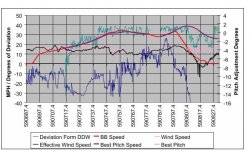
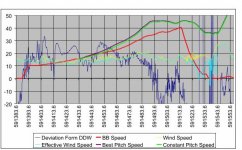
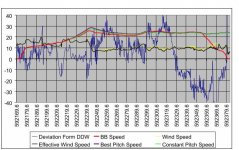
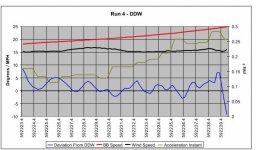
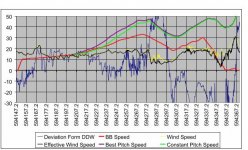
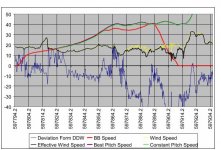
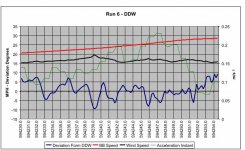
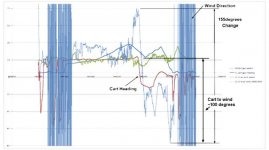
The contestant was given the data, and allowed to choose the record window and also do all the calculations and play with the data at will. The record rum was the first completed run. Subsequent runs were not able to improve upon the 1.8WS to any degree, but the first run had that magical drop in wind speed that allowed for the feeble to claim 2.8WS, so that
became the record run. Data abuse was filtered and shifted to see that it all fitted: well nearly, and there are footprints left behind. NALSA rules do not allow for rolling averages, but the average over a given window. In the case of Greenbird, 3 seconds, and in this case 10 seconds.
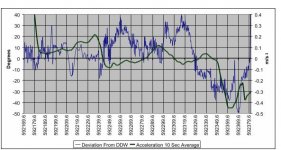
The instruments are not capable of resolving the speed to support the tiny changes in an already feeble acceleration. (0.025 to 0.1ms-2.)
The speed data is the only means by which the acceleration can be determined and that came from a consumer grade hand held ( about 150 dollars from Amazon) and will not support the result. The averaging employed in
that unit, invalidates the result. That and the pushing
alone, will see that record hit the dust.

I guess that scientists all over the world must be cheating, since repeatability is key to a successful experiment.