
You are using an out of date browser. It may not display this or other websites correctly.
You should upgrade or use an alternative browser.
You should upgrade or use an alternative browser.
Merged DDWFTTW in a “Real” Wind
- Thread starter ynot
- Start date
- Status
- Not open for further replies.
Yep
Wheels push against ground - ground pushes back
So says Newton.
I don't understand. What is this in response to?
profpangloss
Critical Thinker
- Joined
- May 1, 2011
- Messages
- 391
In a reference frame in which the top of the tread is stationary, the bottom moves forward twice as fast. But this doesn't matter, because the bottom plays no role in the cart's motion, as it is not in contact with the cart.
Or, to be more precise, there is an inertial reference frame in which the top of the tread is stationary.
The fact is, the treadmill belt is rotating and both coriolis and centrifugal forces will be present. Do you think you can isolate the top of the tread and declare it an inertial frame that is free from these forces? How about we have a rotating platform (merry-go-round), do you agree that the coriolis and centrifugal forces will be present on such a platform? Now suppose we look at just a small section of the outer circumference of that platform, say a small enough section so that the curvature is not so evident and it appears to be a moving surface only. Do you suppose looking at it in this way makes those coriolis and centrifugal forces disappear? I assure you that you cannot make those force disappear simply because you choose to look at only one section of the rotating platform, and the same applies to the rotating treadmill belt as well.
Fictitious forces are present in non-inertial reference frames. A reference frame in which the top of the tread is stationary is inertial.
What fictitious forces do you think are present?
But they are present on the treadmill, and that means it is a non-inertial FOR.
I do not understand what you mean.
Are you just saying that the tread takes a certain amount of time to go around the rollers once?
Of course it does, but what is the relevance of this fact? The tread is uniform. What difference does it make whether it has gone completely around or not? The cart can't tell.
Again, I do not understand what you mean.
The linear speed of the bottom of the cart's wheels will be the same as the linear speed of the tread, since they are in contact.
Do you mean anything more than this?
The belt has a resonant frequency that can be detected with a simple tuning fork or a strobe light. The cart is sensitive to this resonant frequency, in fact it is forced into resonance with the belt when it is held against the belt. In a forced resonance situation with positive feedback, much more energy can be transferred between the tread and the cart than a flat moving surface can transfer.
A system exhibiting positive feedback, in response to perturbation, acts to increase the magnitude of the perturbation.
http://en.wikipedia.org/wiki/Positive_feedback
Forces do not change under a Galilean transformation.
Yes but the transformation needs to be done correctly and account for all real forces. The transformation that the carteers are using, from a cart on a rotating treadmill that is held wrt the ground and the thrust latches that force, to a cart on a road in a tailwind, does not properly account for all the forces and it is invalid.
Ok. We have that. Now what? What's the problem?
That force corresponds, in the case of a cart on the ground, to the force used to push the cart up to windspeed.
No. The forces are not the same and that can easily be seen once you stop looking at the tread as if it were a flat surface moving on the surface of the earth. The top of the tread is in fact suspended above the surface of the earth and the tread moves independently of the earth ( due to the motor). When you hold the cart, you are forcing it to be stationary with the earth and the moving tread is now a source of energy to the cart. This is an undeniable and self-evident fact.
The energy available from the tread will be functionally related to the difference in velocities between the cart and the tread. And since they are moving in opposite directions, that difference is mathematically expressed as Vc – (-Vt) and this will always be a positive value. It is abundantly clear that even if the cart is going faster than the tread, there is always energy available to it from the tread.
In the case of pushing the cart and having it powered by the wind, the energy available is as before, functionally related to the difference in velocities between the cart and the wind. Since they are moving in the same direction, Vc – Vw will go towards zero as the cart velocity goes towards wind speed. At windspeed the energy available from the wind is zero. This is obviously not the same situation as on the treadmill.
profpangloss
Critical Thinker
- Joined
- May 1, 2011
- Messages
- 391
That is an absolute lie.
Your style of argument betrays you.
If I believed you, I'd do the test and post it to YouTube myself. But I can already imagine a list of excuses as long as my arm. You choose not to believe. You can do that with or without my help. So do it without.
How close would it have to be to DDW - 10 degrees, 1 degree, .0001 degree?
How would that be measured?
How steady must the wind be?
Where would that be measured?
Who would have to be in attendance to verify camera work, data collection, conditions, no motors or tow strings, etc....?
How do we know those people won't be immediately dismissed as "in our pocket" the moment it works? (obviously that would happen).
These are all your excuses for not having the test done, and none of them are mine. Don't you think that is odd, and funny?
There's nothing about your claim that's remotely believable.
Talk about IRONY!
Why would anyone do your pointless test just to hear you make more absurd excuses? I've already wasted more of my time on this reply than you're worth.
I didn't ask you to do any test at all. In fact I asked no one to do it. I was asked if I would accept the results of such a test if it were done. I said I would. I wonder why that has you so upset?

It is as if you have factophobia. You're afraid of a few simple questions because it's obvious even to you that they would expose you.
I have done better than answer a set of questions designed to mislead; I have shown you, and anyone else reading this thread, exactly why the treadmill is not equivalent to a cart on a road in a tailwind.
I have done better than answer a set of questions designed to mislead; I have shown you, and anyone else reading this thread, exactly why the treadmill is not equivalent to a cart on a road in a tailwind.
Far out, you're out of your depth aren't you?
Just a quick note, the flat part of the tread which is moving with a uniform and steady velocity, is a flat part of the treadmill belt moving with a uniform and steady velocity.
Michael C
Graduate Poster

Yep
Wheels push against ground - ground pushes back
So says Newton.
I don't understand. What is this in response to?
I'm wondering as well. Has somebody denied Newton's third law?
Subduction Zone
Muse

- Joined
- Dec 23, 2008
- Messages
- 999
It seems as if ppg will never understand what an inertial frame of reference is. But then neither could Harold, or Christoph, or schroeder, or yevgheni, or countless other adopted persona's.
One more try, I am sure he will get it this time An inertial frame of reference is not an object. It is only a speed and direction that you are observing the action from. Yes, the flat surface of the treadmill belt can be the basis of a frame of reference, it isnot the frame itself. Let's go to windgrins truck with the treadmill on it. Both the cart on the treadmill and someone standing on the ground are moving at a velocity of 0 mph in the frame of reference of the ground, which is the same as the frame of reference as the top of the treadmill. And in both cases the cart is moving at ten mph (or whatever speed he has for both the wind and the treadmill) relative to the ground. And the air in the truck is moving at ten mph (or whatever speed the outside wind is moving at). In other words you could take the cart off the treadmill on the truck and put it on the ground. There would be no difference.
One more try, I am sure he will get it this time
An inertial frame of reference is not an object. It is only a speed and direction that you are observing the action from. Yes, the flat surface of the treadmill belt can be the basis of a frame of reference, it isnot the frame itself. Let's go to windgrins truck with the treadmill on it. Both the cart on the treadmill and someone standing on the ground are moving at a velocity of 0 mph in the frame of reference of the ground, which is the same as the frame of reference as the top of the treadmill. And in both cases the cart is moving at ten mph (or whatever speed he has for both the wind and the treadmill) relative to the ground. And the air in the truck is moving at ten mph (or whatever speed the outside wind is moving at). In other words you could take the cart off the treadmill on the truck and put it on the ground. There would be no difference.Subduction Zone
Muse
- Joined
- Dec 23, 2008
- Messages
- 999
I'm wondering as well. Has somebody denied Newton's third law?
Probably humber, possibly Harold. The results of most of their claims results in the violation of at lest of one of Newton's laws.
Modified
Philosopher

- Joined
- Sep 13, 2006
- Messages
- 6,985
The fact is, the treadmill belt is rotating and both coriolis and centrifugal forces will be present. Do you think you can isolate the top of the tread and declare it an inertial frame that is free from these forces?
The cart is interacting with the flat part of tread, where there are no such forces.
No matter how small a section you choose, looking at the motion of a point on that section in any inertial reference frame will show you the same curved motion. You should rather compare the treadmill to a chain between two horizontal gears, and consider the straight part of the chain.How about we have a rotating platform (merry-go-round), do you agree that the coriolis and centrifugal forces will be present on such a platform? Now suppose we look at just a small section of the outer circumference of that platform, say a small enough section so that the curvature is not so evident and it appears to be a moving surface only. Do you suppose looking at it in this way makes those coriolis and centrifugal forces disappear? I assure you that you cannot make those force disappear simply because you choose to look at only one section of the rotating platform, and the same applies to the rotating treadmill belt as well.
There will be cyclic variations in the belt speed due to imperfections of the motor and rollers, but these will be very minor. Also, they are equally likely to cause the cart to lose speed on the belt as to gain it. To get a benefit at one particular treadmill speed would require precise tuning, and it would then not work at other speeds. Maybe it would be possible for a very tiny and light cart on a very bad treadmill at one fixed speed.The belt has a resonant frequency that can be detected with a simple tuning fork or a strobe light. The cart is sensitive to this resonant frequency, in fact it is forced into resonance with the belt when it is held against the belt. In a forced resonance situation with positive feedback, much more energy can be transferred between the tread and the cart than a flat moving surface can transfer.
PPG and reference Frames
PPG,
You should really pay attention to the independent posters in regards to the TM.
Your statements are partially correct for IFORs. That is if false forces are present or F does not = MA in the FOR, then it is not an IFOR. This was pointed out earlier to Humber in trying to explain to him what an IFOR was by me and other posters.
Your comment about rotation is obviously nonsense. The Merry-Go-Round considered as a surface, is indeed, in a central rotation around a point so false forces are in fact, present.
The rotation of the TM belt around its rollers have absolutely nothing to do with creating false forces on the linearly translating flat top surface. At the point where the belt turns around the roller, there are indeed forces but this is purposely excluded from consideration and the cart never operates there.
The IFOR itself for the TM belt is a coordinate system that is moving wrt to the earth (linearly translating not rotating) at the speed of the upper surface of the belt. No false forces exist since it is translating wrt to the earths surface. (That is, no false forces exist that don't exist for a earth fixed IFOR). And if you want to get extremely picky, this is not quite correct as the earth's rotation does create false forces so the proposed IFOR for the TM belt will have extremely minute differences which will vary with latitude, TM orientation (compass direction), and belt speed. For the purpose of this experiment, these can all be ignored as their magnitudes are below threshold of any relevant forces. This is not ad-hoc, as it is done in all Wind tunnel experiments with no noticeable effects. The IFOR is applicable for only one belt speed at a time, if the belt speed changes, it deviates from the IFOR that was initially defined by the experiment. One can define an IFOR for any arbitrary belt speed but then it is pegged to that speed. Once you define the IFOR, you can make measurements of the earth's surface speed, the cart speed, the TM frame speed, the WS wrt this IFOR and any of these measurements can be translated to any other IFOR through a simple linear translation of the coordinate systems of one IFOR to another. Your understanding is wrong, in contrast to your protestations, towards the other posters. There is nothing naive about the understanding of the posters wrt to these IFORs.
Now about your vibration theory. First of all, as stated earlier by me, you chose a comment about "latching" out of context that pertained to digital circuits and it was completely valid as it was used in the article but had no relevance whatsoever to do with our analog system in question, i.e. the cart.
Your remaining "vibration hypothesis" is a straw-clutching attempt at best. If one were to perform a Fourier analysis of vibration modes of the belt and one cart, one might find a resonance that aligned. If the TM speed is changed or different carts substituted, these resonances in general would not align and would not work in any consistent way and would not have a tendency to move the carts up the belt consistently. This variable can be eliminated by the videos of multiple carts on multiple TMs with substantially different masses from small to large. Belt speeds have been varied statically and dynamically and no vibrational modes are observed. Clearly, the only real mechanism for moving the carts up the belt are propeller forces producing thrust. So this hypothesis strains credulity to begin with and has easily been shown by the multiple experiments to not be a factor.
If you don't want to believe any of this, consult any real physicist or mechanical engineer and feel free to quote this.
PS, you really aren't doing yourself any favors about constantly harping on how naive the other posters are when you back your assertion up with incorrect and out of context information. The fact that 4 independent posters here, without consultation, are giving you the exact same information and they have been proven to be reasonably knowledgeable about physics in previous posts, should give you pause to wonder if you are, in fact, in error.
I will post a copy of the TM in a truck for convenience below for this group's discussion. In the following diagram, WS is chosen as 10mph for concreteness. One can substitute any arbitrary WS as long as all "10mph"s are changed for this variable. What one must do, however, is maintain any speed listed as a constant for the IFORs to be considered inertial. (i.e. that of the truck body and that of the earth which in this case happens to be that of the TM belt.) (Makes it kind of hard to argue your way out of this one since the TM IFOR is the same as one indexed to the earth since any point on the TM upper surface is not moving wrt the earth.)
WindGrins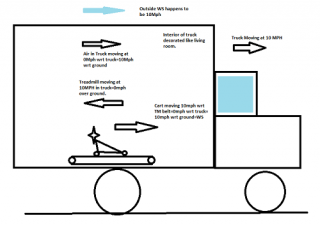
PPG,
You should really pay attention to the independent posters in regards to the TM.
Your statements are partially correct for IFORs. That is if false forces are present or F does not = MA in the FOR, then it is not an IFOR. This was pointed out earlier to Humber in trying to explain to him what an IFOR was by me and other posters.
Your comment about rotation is obviously nonsense. The Merry-Go-Round considered as a surface, is indeed, in a central rotation around a point so false forces are in fact, present.
The rotation of the TM belt around its rollers have absolutely nothing to do with creating false forces on the linearly translating flat top surface. At the point where the belt turns around the roller, there are indeed forces but this is purposely excluded from consideration and the cart never operates there.
The IFOR itself for the TM belt is a coordinate system that is moving wrt to the earth (linearly translating not rotating) at the speed of the upper surface of the belt. No false forces exist since it is translating wrt to the earths surface. (That is, no false forces exist that don't exist for a earth fixed IFOR). And if you want to get extremely picky, this is not quite correct as the earth's rotation does create false forces so the proposed IFOR for the TM belt will have extremely minute differences which will vary with latitude, TM orientation (compass direction), and belt speed. For the purpose of this experiment, these can all be ignored as their magnitudes are below threshold of any relevant forces. This is not ad-hoc, as it is done in all Wind tunnel experiments with no noticeable effects. The IFOR is applicable for only one belt speed at a time, if the belt speed changes, it deviates from the IFOR that was initially defined by the experiment. One can define an IFOR for any arbitrary belt speed but then it is pegged to that speed. Once you define the IFOR, you can make measurements of the earth's surface speed, the cart speed, the TM frame speed, the WS wrt this IFOR and any of these measurements can be translated to any other IFOR through a simple linear translation of the coordinate systems of one IFOR to another. Your understanding is wrong, in contrast to your protestations, towards the other posters. There is nothing naive about the understanding of the posters wrt to these IFORs.
Now about your vibration theory. First of all, as stated earlier by me, you chose a comment about "latching" out of context that pertained to digital circuits and it was completely valid as it was used in the article but had no relevance whatsoever to do with our analog system in question, i.e. the cart.
Your remaining "vibration hypothesis" is a straw-clutching attempt at best. If one were to perform a Fourier analysis of vibration modes of the belt and one cart, one might find a resonance that aligned. If the TM speed is changed or different carts substituted, these resonances in general would not align and would not work in any consistent way and would not have a tendency to move the carts up the belt consistently. This variable can be eliminated by the videos of multiple carts on multiple TMs with substantially different masses from small to large. Belt speeds have been varied statically and dynamically and no vibrational modes are observed. Clearly, the only real mechanism for moving the carts up the belt are propeller forces producing thrust. So this hypothesis strains credulity to begin with and has easily been shown by the multiple experiments to not be a factor.
If you don't want to believe any of this, consult any real physicist or mechanical engineer and feel free to quote this.
PS, you really aren't doing yourself any favors about constantly harping on how naive the other posters are when you back your assertion up with incorrect and out of context information. The fact that 4 independent posters here, without consultation, are giving you the exact same information and they have been proven to be reasonably knowledgeable about physics in previous posts, should give you pause to wonder if you are, in fact, in error.
I will post a copy of the TM in a truck for convenience below for this group's discussion. In the following diagram, WS is chosen as 10mph for concreteness. One can substitute any arbitrary WS as long as all "10mph"s are changed for this variable. What one must do, however, is maintain any speed listed as a constant for the IFORs to be considered inertial. (i.e. that of the truck body and that of the earth which in this case happens to be that of the TM belt.) (Makes it kind of hard to argue your way out of this one since the TM IFOR is the same as one indexed to the earth since any point on the TM upper surface is not moving wrt the earth.)
WindGrins
Last edited:
The fact is, the treadmill belt is rotating and both coriolis and centrifugal forces will be present.
The treadmill belt as a whole is not rotating. The top of the belt is moving in a straight line, and so is the bottom of the belt. The part that curves around the rollers could be said to be rotating.
So, neither coriolis force nor centrifugal force is present in a reference frame moving backward with the top of the belt.
Do you think you can isolate the top of the tread and declare it an inertial frame that is free from these forces?
Yes.
How about we have a rotating platform (merry-go-round), do you agree that the coriolis and centrifugal forces will be present on such a platform?
Yes.
Or, more precisely, in a reference frame rotating with the platform.
Now suppose we look at just a small section of the outer circumference of that platform, say a small enough section so that the curvature is not so evident and it appears to be a moving surface only. Do you suppose looking at it in this way makes those coriolis and centrifugal forces disappear?
No.
But the platform is rigid, and the whole thing rotates. Looking at one small bit of it doesn't change that.
I assure you that you cannot make those force disappear simply because you choose to look at only one section of the rotating platform, and the same applies to the rotating treadmill belt as well.
The top of the treadmill belt is moving at constant speed in a straight line; it isn't moving in a circle, as every section of the rotating platform is.
But they are present on the treadmill, and that means it is a non-inertial FOR.
Huh?
Which way are you arguing? The treadmill belt is a rotating reference frame; therefore, fictitious forces are present? Or, fictitious forces are present on the treadmill belt; therefore, it's a non-inertial reference frame?
If the former: no, the top of the belt is not rotating; it's moving in a straight line at constant speed.
If the latter: how do you know fictitious forces are present? Did you measure them or something?
The belt has a resonant frequency that can be detected with a simple tuning fork or a strobe light. The cart is sensitive to this resonant frequency, in fact it is forced into resonance with the belt when it is held against the belt. In a forced resonance situation with positive feedback, much more energy can be transferred between the tread and the cart than a flat moving surface can transfer.
A system exhibiting positive feedback, in response to perturbation, acts to increase the magnitude of the perturbation.
http://en.wikipedia.org/wiki/Positive_feedback
I'm not following you at all here.
How can I detect this "resonant frequency" of the belt with a tuning fork or strobe light?
Yes but the transformation needs to be done correctly and account for all real forces. The transformation that the carteers are using, from a cart on a rotating treadmill that is held wrt the ground and the thrust latches that force, to a cart on a road in a tailwind, does not properly account for all the forces and it is invalid.
You're just asserting that it doesn't account for all the forces. I already explained what corresponds to the force holding the cart on the treadmill. What other forces aren't accounted for?
No. The forces are not the same and that can easily be seen once you stop looking at the tread as if it were a flat surface moving on the surface of the earth. The top of the tread is in fact suspended above the surface of the earth and the tread moves independently of the earth ( due to the motor).
Why the belt moves is irrelevant. Its velocity is what's relevant.
When you hold the cart, you are forcing it to be stationary with the earth and the moving tread is now a source of energy to the cart. This is an undeniable and self-evident fact.
Certainly. And I haven't denied it.
It is equally undeniable that, in a reference frame in which the ground is moving, the ground has loads of kinetic energy. You have denied this, though.
But aren't we switching reference frames now? I thought we were talking about a reference frame in which the top of the treadmill belt is stationary. In that reference frame, the belt can't do work on the cart because it's not moving. And the person holding the cart forces it forward relative to the belt, in just the same way that the person pushing the cart on the ground up to windspeed forces it forward relative to the ground.
The energy available from the tread will be functionally related to the difference in velocities between the cart and the tread. And since they are moving in opposite directions, that difference is mathematically expressed as Vc – (-Vt) and this will always be a positive value. It is abundantly clear that even if the cart is going faster than the tread, there is always energy available to it from the tread.
In the case of pushing the cart and having it powered by the wind, the energy available is as before, functionally related to the difference in velocities between the cart and the wind. Since they are moving in the same direction, Vc – Vw will go towards zero as the cart velocity goes towards wind speed. At windspeed the energy available from the wind is zero. This is obviously not the same situation as on the treadmill.
I thought we were talking about Galilean transformations and such. Now you're back to analyzing both the treadmill cart and the ground cart from a reference frame in which the ground is stationary. How about analyzing the treadmill cart from a reference frame in which the belt is stationary?
Remember that, in such a reference frame, the belt can't provide power to the cart because it's not moving; the only thing that's moving is the air.
Suddenly, the treadmill cart looks awfully similar to the ground cart. Yet, it works.
A simple observation!
PPG,
A suggestion. You certainly are under no obligation to take.
The team of JB and Spork as well as other people have done an enormous amount of work to attempt to satisfy all reasonable challenges while others have nit-picked and consistently demanded additional tests after the previous test did not pan out as they wished. This endless stream of demands by those unwilling to do any work whatsoever is, to say the least, vexatious.
A bit of empathy for those doing all the "heavy lifting" would hurt no one here. Their patience has been tried repeatedly.
My second suggestion is that in appreciation of all the experimental work performed in good faith by these teams and individuals, we owe them an honest discourse with regards to our posts and their questions of us on our protestations. Your last post seemed to be in that spirit and I applaud your more civil efforts. It wouldn't hurt to drop the accusations of naivety and malfeasance, and treat the others with a bit more respect as everyone is doing for you. No one remaining on the thread is attempting to mislead you or anyone else. This is evidenced by multiple independent posts with the same information.
Again, no need to reply or take this advice. It is simply a friendly suggestion. Since the thread has become quieter, It would be nice to take it to a much more civil tone on everyone's part where intelligent discourse can occur.
Regards,
WindGrins
I didn't ask you to do any test at all. In fact I asked no one to do it. I was asked if I would accept the results of such a test if it were done. I said I would. I wonder why that has you so upset?
I have done better than answer a set of questions designed to mislead; I have shown you, and anyone else reading this thread, exactly why the treadmill is not equivalent to a cart on a road in a tailwind.
PPG,
A suggestion. You certainly are under no obligation to take.
The team of JB and Spork as well as other people have done an enormous amount of work to attempt to satisfy all reasonable challenges while others have nit-picked and consistently demanded additional tests after the previous test did not pan out as they wished. This endless stream of demands by those unwilling to do any work whatsoever is, to say the least, vexatious.
A bit of empathy for those doing all the "heavy lifting" would hurt no one here. Their patience has been tried repeatedly.
My second suggestion is that in appreciation of all the experimental work performed in good faith by these teams and individuals, we owe them an honest discourse with regards to our posts and their questions of us on our protestations. Your last post seemed to be in that spirit and I applaud your more civil efforts. It wouldn't hurt to drop the accusations of naivety and malfeasance, and treat the others with a bit more respect as everyone is doing for you. No one remaining on the thread is attempting to mislead you or anyone else. This is evidenced by multiple independent posts with the same information.
Again, no need to reply or take this advice. It is simply a friendly suggestion. Since the thread has become quieter, It would be nice to take it to a much more civil tone on everyone's part where intelligent discourse can occur.
Regards,
WindGrins
Last edited:
Of course we won't see a test in the "right conditions". You are the only one saying that the prior tests were the wrong conditions. You will not say what the right conditions are. Convenient. Do you really think anyone could possibly fall for your nonsense? You should try getting people do guess what number you are thinking for money, but don't let them insist on your writing it down first!I predict we will never see this though, as the cartheads can never seem to find the "right conditions" for any testing in an actual wind.
Your style of argument betrays you.
These are all your excuses for not having the test done, and none of them are mine. Don't you think that is odd, and funny?
No I think it is odd, and sad. Your style style of argument betrays you. Hundreds of test have been done, none have convinced you because you say there was something wrong with all of them. But you still think you can define what should have been done to make them acceptable after the fact. Are you serious?
Now about your vibration theory. First of all, as stated earlier by me, you chose a comment about "latching" out of context that pertained to digital circuits and it was completely valid as it was used in the article but had no relevance whatsoever to do with our analog system in question, i.e. the cart.
Of course his telltale latching is complete nonsense. I also think a test could be devised (I actually think it was done) which would see the cart transferred to the belt already at belt speed. PPG will not say if this would convince him.
Your remaining "vibration hypothesis" is a straw-clutching attempt at best. If one were to perform a Fourier analysis of vibration modes of the belt and one cart, one might find a resonance that aligned. If the TM speed is changed or different carts substituted, these resonances in general would not align and would not work in any consistent way and would not have a tendency to move the carts up the belt consistently. This variable can be eliminated by the videos of multiple carts on multiple TMs with substantially different masses from small to large. Belt speeds have been varied statically and dynamically and no vibrational modes are observed. Clearly, the only real mechanism for moving the carts up the belt are propeller forces producing thrust. So this hypothesis strains credulity to begin with and has easily been shown by the multiple experiments to not be a factor.
It strains my credulity without considering multiple treadmills or carts. Are you saying that you believe, using an unmodified commercial TM, a cart could be built using the same components as the working test carts (with the prop disconnected of course) which would accelerate forcefully up the belt and off the front of the TM using vibration as a power source?
sol invictus
Philosopher

- Joined
- Oct 21, 2007
- Messages
- 8,613
I suggest you follow your own advice and open a Physics book and study up on just what a Galilean transformation is and what an inertial frame of reference is.
In practical terms, the equivalence of inertial reference frames means that scientists within a box moving uniformly cannot determine their absolute velocity by any experiment (otherwise the differences would set up an absolute standard reference frame). In Newtonian mechanics, which can be viewed as a limiting case of special relativity in which the speed of light is infinite, inertial frames of reference are related by the Galilean group of symmetries.
Quite correct.
Do you realize that when you perform your Galilean transformation on the treadmill, you are considering the tread as a moving surface when in fact it is just part of a tread that is rotating? Can the top section of a tread that is rotating be considered an inertial reference frame? In short, there is what are called “fictitious forces” present on the rotating treadmill belt, that are not present on any flat moving surface.
Complete gibberish.
At first I thought that was odd, but after googling I see you've simply plagiarized the first part.
Consistent Correct Physics
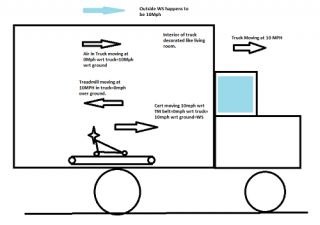
PPG is going to have a difficult time explaining the TM in a truck example. There the IRF for the TM is the same as for the earth indexed frame. He will have to explain how physics is different in the moving truck since everything else is the exact same! Humber actually attempted this since he started talking about "magic forces" moving through the van!
You are the fifth poster to assert the same! Amazing how consistent correct physics is.
Regards,
WindGrins
At first I thought that was odd, but after googling I see you've simply plagiarized the first part.
PPG is going to have a difficult time explaining the TM in a truck example. There the IRF for the TM is the same as for the earth indexed frame. He will have to explain how physics is different in the moving truck since everything else is the exact same! Humber actually attempted this since he started talking about "magic forces" moving through the van!
You are the fifth poster to assert the same! Amazing how consistent correct physics is.
Regards,
WindGrins
Last edited:
PPG is going to have a difficult time explaining the TM in a truck example. There the IRF for the TM is the same as for the earth indexed frame. He will have to explain how physics is different in the moving truck since everything else is the exact same! Humber actually attempted this since he started talking about "magic forces" moving through the van!
You are the fifth poster to assert the same! Amazing how consistent correct physics is.
Regards,
WindGrins
If we place the truck inside a larger truck, then place our entire universe inside a very large child's (relative to us) snow globe do you think we can make ppg's head explode?
Michael C
Graduate Poster
PPG is going to have a difficult time explaining the TM in a truck example. There the IRF for the TM is the same as for the earth indexed frame. He will have to explain how physics is different in the moving truck since everything else is the exact same! Humber actually attempted this since he started talking about "magic forces" moving through the van!
You are the fifth poster to assert the same! Amazing how consistent correct physics is.
Regards,
WindGrins
[qimg]http://www.internationalskeptics.com/forums/imagehosting/thum_488654de2503962698.png[/qimg]
We did the "Treadmill in a van" explanation back in 2008. Here's my post on the subject, complete with a diagram very much like yours.
Michael C-all credit goes to you!
Michael C,
That was an excellent post in your standard manner. Actually I had not seen that post before I made mine or I would not have bothered to create my diagram. It's amusing that we even chose the same speed. As I was putting mine together, I realized that having the truck travel at exactly WS had the merit of being able to remove the van container and nothing would change so I added it as an afterthought.
I give you full credit for having the idea! My total contribution was the little post about decorating the interior of the van like Spork's TM room. Sorry I did not credit you appropriately. I thought it was original!
It's a very compelling diagram and I look forward to PPGs explanation of how the physics changes in the truck or gravity doesn't work the same. He did trot out the "vibration hypothesis" as predicted.
ETA: I see that Sol Invictus added the next relevant comment:
"The laws of physics tell us that the speed of the van is totally irrelevant so long as its windows are closed and it's traveling at a steady rate on a smooth road (no bumps). It makes no difference what the wind speed outside is, let alone whether the van moves at that speed.
If the cart on the treadmill in the van behaved differently (e.g. it moved up the treadmill belt in one case and down it in the other) when the van was moving at different speeds, Newton's laws, Einstein's relativity, and most of the other laws of physics would be falsified (again, assuming the ride is smooth and the van's speed is constant during each test)."
This is a sterling example of how the arguments get reset back to "ground zero" and "folk physics by intuition" starts poor and remains bad!
Regards,
WindGrins
We did the "Treadmill in a van" explanation back in 2008. Here's my post on the subject, complete with a diagram very much like yours.
Michael C,
That was an excellent post in your standard manner. Actually I had not seen that post before I made mine or I would not have bothered to create my diagram. It's amusing that we even chose the same speed. As I was putting mine together, I realized that having the truck travel at exactly WS had the merit of being able to remove the van container and nothing would change so I added it as an afterthought.
I give you full credit for having the idea! My total contribution was the little post about decorating the interior of the van like Spork's TM room.
Sorry I did not credit you appropriately. I thought it was original!It's a very compelling diagram and I look forward to PPGs explanation of how the physics changes in the truck or gravity doesn't work the same. He did trot out the "vibration hypothesis" as predicted.
ETA: I see that Sol Invictus added the next relevant comment:
"The laws of physics tell us that the speed of the van is totally irrelevant so long as its windows are closed and it's traveling at a steady rate on a smooth road (no bumps). It makes no difference what the wind speed outside is, let alone whether the van moves at that speed.
If the cart on the treadmill in the van behaved differently (e.g. it moved up the treadmill belt in one case and down it in the other) when the van was moving at different speeds, Newton's laws, Einstein's relativity, and most of the other laws of physics would be falsified (again, assuming the ride is smooth and the van's speed is constant during each test)."
This is a sterling example of how the arguments get reset back to "ground zero" and "folk physics by intuition" starts poor and remains bad!
Regards,
WindGrins
Last edited:
- Status
- Not open for further replies.