Merged DDWFTTW in a “Real” Wind

Status
Not open for further replies.
Humber is just a few days away from showing off his cart which advances up the belt. He knows it will work because Harold said it would. Just a little more tweaking...

Nope - any tweaks or adjustments invalidate it completely. At least that's how it works when others perform tests or demonstrations.

Or did you mean getting high on meth? Because that would explain a lot.
 
What do you mean the belt "as a whole" is not rotating?

The immediately following sentences explain what I mean: "The top of the belt is moving in a straight line, and so is the bottom of the belt. The part that curves around the rollers could be said to be rotating."

The entire belt is going round and round, it is an example of rotatry machinery, and just because you choose to focus your attention on the top surface does not change that.

You said that, since the belt is "rotating", coriolis and centrifugal forces are present in a reference frame in which the top of the belt is stationary. This is false.

Exactly the same as the treadmill belt!

The treadmill belt is not rigid.

It doesn't matter. The entire belt is rotating and as such it will have a resonant frequency.

Why? The wine glass in the video wasn't rotating. What does the movement of the belt have to do with its "resonant frequency"?

It doesn't really matter if the fictitious forces are present in any significant amount on the top portion of the tread, only that they are present on any part of the tread, to establish that a rotaing tread is unlike a flat moving surface. I don't expect the fictitious forces to play a mjor role in the cart's behaviour, I mention them only to establish that the tread is a rotating structure with a resonant frequency.

Oh, ok. Let's forget about fictitious forces then, and talk about resonance.

It is the resonance and positive feedback that I say plays a major role in the cart's behaviour on the treadmill, that cannot be duplicated by a cart on a road in a tailwind.

In what way is the belt resonating? How is its motion different from straight-line motion at constant speed?

It is actually the difference in velocities that is relevant. Neither yourself or any of the carteers has supplied a satisfactory response to this:

The energy available from the tread will be functionally related to the difference in velocities between the cart and the tread. And since they are moving in opposite directions, that difference is mathematically expressed as Vc – (-Vt) and this will always be a positive value. It is abundantly clear that even if the cart is going faster than the tread, there is always energy available to it from the tread.
In the case of pushing the cart and having it powered by the wind, the energy available is as before, functionally related to the difference in velocities between the cart and the wind. Since they are moving in the same direction, Vc – Vw will go towards zero as the cart velocity goes towards wind speed. At windspeed the energy available from the wind is zero. This is obviously not the same situation as on the treadmill.

We've gone over this many times. The air does not act on the cart. It acts on the propeller. The propeller is spinning, and its blades are twisted. Therefore, it presents to the air a surface that is moving slower than the cart. When the cart is at windspeed, the propeller is effectively at less than windspeed. Therefore, the wind can still push it forward.

The ground is not a source of energy for the cart, that is nonsense! The wind is powering the cart and should the cart approach wind speed, the wind energy approaches zero. That is a fact!

No.

What's a fact is that energy and power are frame-dependent.

Suppose the cart is at windspeed. In a reference frame in which the ground is stationary, the cart (and air) are moving, and the air transfers power to the cart. In a reference frame in which the cart (and air far from the propeller) are stationary, the ground is moving, and the ground transfers power to the air (near the propeller), via the cart's wheels and propeller.

Do you really believe that if an observer changes his FOR that he changes the physical laws that govern the operation of a machine?

I really believe that velocity, and therefore kinetic energy and power, are all frame-dependent.

Do you agree that in the FOR where the ground is stationary, and the air is stationary, the belt is moving, and the cart is moving because it is powered by the belt?

Yes.

Do you then believe that if you start to move at the speed of the belt and observe the same cart moving on the same treadmill, that now the belt is no longer powering the cart?

Yes.

How can the top of the belt transfer power to anything if it's not moving? Power = (force)(distance)/time, and the distance is zero.

You honestly believ that the way you look at things affects the way they work?

The answer to this depends on careful definitions of "the way you look at things" and "the way they work". But, basically, yes. If you look at things from a different inertial reference frame, then the velocities of those things change, and so does the power flow between them.

What would happen if you closed your eyes, would everything stop working?

No.
 
Nope - any tweaks or adjustments invalidate it completely. At least that's how it works when others perform tests or demonstrations.

Or did you mean getting high on meth? Because that would explain a lot.

And anything that actually fails when tested to failure, is a sign of bad engineering.
 
And anything that actually fails when tested to failure, is a sign of bad engineering.

Which takes us back to the very beginning of the humber saga... we're cranks that are attempting the impossible, and going about it all wrong!
 
Vibration carts.

You think resoanant frequencies are nonsense? How quaint! The resonance would not depend on the speed of the treadmill as the cart is held in place and it is forced into resonance with the treadmill, regardless of the speed. Because of the forced resonance, the positive feedback path is enabled. There are countless sources on the Internet with examples of mechanical resonance. I suggest you stop denying it and do a bit of research.
That is a straw man argument and not what I said. Your attempted use of resonant frequencies to explain how the cart moves are nonsense.

And I would love to see an example of a resonant frequency that does not depend on the motion of the item resonating. Your claim does not match reality. Also you have proposed a resonant frequency, but you have never shown why or how that frequency always drives the cart forward relative to the belt, regardless of belt, if the cart is built correctly. For example spork's carts have been seen to advance on several different belts. I Ratant's have not. Neither have any other failed carts since the makers know that there is no point in testing a failed cart on a belt, it would only fall off of the end.

PPG,

Your assertion is, in essence, that carefully aerodynamically engineered devices happen to have all lucked into a treadmill resonance mechanism as a repeatable, demonstrable, mechanism to explain their a-priory predicted function from conventional aerodynamics and mechanics. This mechanism you are proposing works on carts of different configurations, size, and masses and TM speeds. And that from a perspective of vibration, replacing their props by one the exact same size with the opposite pitch, fails to work. And further, those that that look like them but are predicted not to work, don't happen to benefit from this resonance hypothesis. And to top it off, multiple large scale aerodynamic demonstrators work as predicted in the environment without a TM and without the benefit of resonant vibrations from the TM.

If this is valid, someone should be able to make radically different carts to utilize this mechanism to go up the treadmill but all the independent carteers just happened to stumble into this mechanism with a different array of commercial treadmills with different resonances and different carts and these work just fine.

Please demonstrate this with one working example of a "by design" cart that will vibrate up the TM. Good luck selling this idea as it is complete moonshine! When you turn this around, one can see how ludicrous the idea actually is!

If Spork had proposed this initially as the mechanism by which DDWFTTW carts would function, we would have laughed him off the planet. The fact that we are addressing such a silly idea in any serious manner strikes me as comical. On the other hand, if this works, we have found a new mechanism to go DDWFTTW with a vibrator.

WindGrins,:)

PS, On a serious note, I do appreciate your new style!
 
Last edited:
You think resoanant frequencies are nonsense? How quaint! The resonance would not depend on the speed of the treadmill as the cart is held in place and it is forced into resonance with the treadmill, regardless of the speed. Because of the forced resonance, the positive feedback path is enabled. There are countless sources on the Internet with examples of mechanical resonance. I suggest you stop denying it and do a bit of research.

It's rather amusing how many impossible mechanisms the deniers can come up with in their futile efforts to prove the impossibility of ddwfttw. This one is even sillier than humber's stored kinetic energy hypothesis.
 
Humber's response!

It's rather amusing how many impossible mechanisms the deniers can come up with in their futile efforts to prove the impossibility of ddwfttw. This one is even sillier than humber's stored kinetic energy hypothesis.

Since Humber shared my post on the other site, I thought you would be interested in his response to mine:

So, let me make sure I have this right.

All the working DDWFTTW carts of different size and configuration just all happen to be able to vibrate up treadmills and the non-working DDWFTTW carts can't somehow use these vibrations. The vibratory conveyor manufacturer has to carefully design their non-moving conveyors to the intended bulk materials but multiple exercise TMs just happen to be perfect for moving (carts) with the various vibrations and speeds that these TMs operate. The exact same carts that can go up a TM just happen to be able to go DDWFTTW outdoors without TM in sight but that's due to tacking of their prop or some other unknown mechanism. (since there isn't a whole lot of mechanism to begin with!)

So the real magic of the functioning of the DDWFTTW carts is they just happen to pass the vibrating treadmill test and they just happen to have some non-understood method for prop tacking all while going DDWFTTW. And you and PPG would like us to believe the above story that Spork and all the other independent testers just happen to have lucked into a design that can accomplish all these when they were trying to build a DDWFTTW cart in the first place.

This is a little like a designer who wanted to build an airplane and accidentally built a helicopter which flies by completely different principles.

So this is your best hypothesis?

Regards,

WindGrins:)

Humber:

"No, the vibration can be the controlling mechanism for another force, or driving the force itself.
As, I am sure you will know, Carl Popper talked of falsifiability. That has been abused a bit, and expressed as "a scientist should not try to prove that his experiment works, but that it doesn't". But, if even if the experiment is only moderately well constructed, that will happen as a matter of course. The opportunity for failure will be present, as a normal course of trying to demonstrate the desired outcome.

That differs from taking an initially failed device, and then trimming away all the failure modes, until there is only one possible outcome that has nothing to do with windspeed travel.
Perhaps you will object the the device is being refined. But it's not the wind device that has been changed, and then re-tested in the same environment, but the conditions that have been changed. It was fitted, but without any concerns for a cart in the wind, but just that it stayed there.

Not perfect, but can be a suitable environment for adapting a cart to suit it.
The power difference says that a different problem has been solved.

1.8W can hold the cart in place, and will work as Newton says, but not represent a 5W cart in the wind. The problem with directly adopting Drela's calculation to show that the cart can stay in place, is that the machine must be 100% efficient. That can't be, but the principle is still there. Zero net force keeps the cart in place.
The actual force is much less, and the latch mechanism explains why, and does not need to be 100% efficient to work. There are many machines that exploit naturally regulating phenomenon, when direct control is impractical, expensive, or just can't be done.

They did not arrive at the TM by luck, but by copying Spork.

Prop tacking is ************.

It is a common experience when traveling on a train, or airplane, to find that partially full coffee cups will wander across the fold-up table. That does no mean that fold-up tables are a model if such a cup on the road, or that the cup is in a tailwind, or demonstration of a viable means of locomotion. It is no more correct to assume that a belt does, vibrating or not.
"

That's a wrap for tonight!

WindGrins:D


__________________
 
Last edited:
It's rather amusing how many impossible mechanisms the deniers can come up with in their futile efforts to prove the impossibility of ddwfttw. This one is even sillier than humber's stored kinetic energy hypothesis.

PPG,

Your assertion is, in essence, that carefully aerodynamically engineered devices happen to have all lucked into a treadmill resonance mechanism as a repeatable, demonstrable, mechanism to explain their a-priory predicted function from conventional aerodynamics and mechanics. This mechanism you are proposing works on carts of different configurations, size, and masses and TM speeds. And that from a perspective of vibration, replacing their props by one the exact same size with the opposite pitch, fails to work. And further, those that that look like them but are predicted not to work, don't happen to benefit from this resonance hypothesis. And to top it off, multiple large scale aerodynamic demonstrators work as predicted in the environment without a TM and without the benefit of resonant vibrations from the TM.

If this is valid, someone should be able to make radically different carts to utilize this mechanism to go up the treadmill but all the independent carteers just happened to stumble into this mechanism with a different array of commercial treadmills with different resonances and different carts and these work just fine.

Please demonstrate this with one working example of a "by design" cart that will vibrate up the TM. Good luck selling this idea as it is complete moonshine! When you turn this around, one can see how ludicrous the idea actually is!

Another great synopsis. I think most people who have been reading the H's for a while rather quickly get to the point where expressing the true level of incredulity experienced while reading their nonsense becomes difficult. They come up with such incredible explanations to explain something which is really quite simple.
 
So, a question. I notice Goodman's cart has a rather unusual propellor, with a lot of surface area. Obviously this is probably down to it's home made nature, but could it have advantages in a dwfttw situation?
 
So, a question. I notice Goodman's cart has a rather unusual propellor, with a lot of surface area. Obviously this is probably down to it's home made nature, but could it have advantages in a dwfttw situation?
For the acceleration below WS and just above WS the large surface area helps. So it allows you to prove the concept with less space and/or more resistance. But the faster you go, the more turbulence the wide tips will produce which lowers the efficiency and thus the top speed.
 
An unqualified Success

Another great synopsis. I think most people who have been reading the H's for a while rather quickly get to the point where expressing the true level of incredulity experienced while reading their nonsense becomes difficult. They come up with such incredible explanations to explain something which is really quite simple.

Thanks,

I don't see it as intrinsically bad that these alternative modes of potential propulsion are brought up and discarded via a reasoned argument. The volume of skepticism is such that now there is a large data set to be able to quickly dismiss most alternative claims such as the vibration hypothesis. The plethora of evidence against allows us to dismiss this one effectively as evidenced by the post. I would submit that any future challenges pass this gauntlet of explaining the current data set before being taken up for serious consideration as any alternative explanation of the systems presented. My final suggestion is that for any serious alternative explanation to be seriously considered, that the presenter of this explanation provide experimental evidence that the alternative explains, that the current working explanation cannot. It is reasonable to propose such mechanisms for discussion, but to not devote serious time to exploring them without said evidence.

It is actually good that any new proposed mechanism can be compared to the range of experiments that we have already seen and see if they could be consistent with all the data. The vibration hypothesis is a good test case of this.

At this point, there just doesn't seem to be a lot of hypotheses that work other than the original:

The DDWFTTW carts are purpose built for traveling DDWFTTW using sound aerodynamic and mechanical principles in the design. The achieve the goal well within theoretical predictions. Further, the correctly designed vehicles work through a range of scales in both a highly controlled environment (i.e. the TM) and the natural environment with an on-board pilot with the range instrumented to a reasonable degree by a major appropriate sanctioning body (NALSA) to eliminate reasonable variability in natural conditions as a major concern.

Even though there are some remaining die-hard critics of the concept, the remaining objections appear to be baseless and unsubstantiated.

From this observer's perspective with the data presented I am willing to call the principle thouroughly proven and an unqualified success having successfully withstood all cogent challenges from knowledgeable critics.

Rick and John have indeed constructed multiple vehicles which can successfully go directly down wind greater than windspeed powered by nothing more than the wind in which it operates.

Again, Congratulations.

WindGrins
 
Last edited:
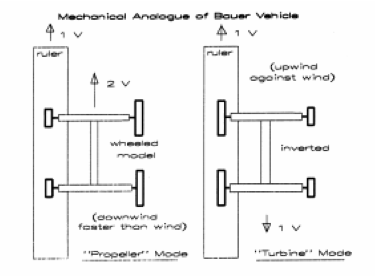
Here's something I just chanced on: an article by Peter A. Sharp that talks about both upwind and downwind crafts. It's called "Power Alternating Sailing" and it's to be found in the January 2001 edition of Catalyst, the journal of AYRS. The main point of the article is something outside this discussion, but there's a section on ddwfttw which explains Bauer's technique. Sharp considers that ddwfttw is well-accepted:

"Research papers on windmill ships and boats now take for granted the possibility of sailing downwind faster than the wind using the Bauer technique. But since the Bauer technique is difficult for most people to understand and accept (AeroVironment, Inc. has received many letters from people still insisting that it is impossible), an explanation using a simple analogue model may be helpful."​

Does anyone know anything about the interest of AeroVironment, Inc. in ddwfttw?

Sharp goes on to describe a mechanical model (created by Theo Schmidt), another variation on the many we have already seen here:

"The analogue model has two pairs of wheels which are fixed to their axles, and the axles rotate. But the wheels on one side are only half the diameter of the wheels on the other side. The small wheels are placed along a board or plank, such as a ruler, which is itself lying on a smooth surface, such as a table, and the large wheels rest on the table."​

Here's the diagram:

166124de38c13d0280.png


It's quite similar to Llyricist's idea:

attachment.php
 
Aerovironment obviously interested in everything Aero!

Here's something I just chanced on: an article by Peter A. Sharp that talks about both upwind and downwind crafts. It's called "Power Alternating Sailing" and it's to be found in the January 2001 edition of Catalyst, the journal of AYRS.

Does anyone know anything about the interest of AeroVironment, Inc. in ddwfttw?

Michael,

Given that physicist and engineer Dr. Paul MacCready is their founder and he is responsible for crafts such as the Gossamer Condor, etc. It would seem a natural outcome that they would be interested. The article you cite quotes that Bauer did an equivalent TM test in MacCready's office in Dec 1995 in a "windless room" to illustrate the idea and notes how the TM belt is equivalent as has been stated here so many times.

Great Reference.

Regards,

WindGrins
 
Bye Bye, Treadmill Equivalency!

It's rather amusing how many impossible mechanisms the deniers can come up with in their futile efforts to prove the impossibility of ddwfttw. This one is even sillier than humber's stored kinetic energy hypothesis.

What is really amusing is how the carteers claim treadmill equivalency to a cart on the road, when the cart on the treadmill is held so it is free of inertia!

Missing Inertial Force

Running on a treadmill requires much less energy than running on the ground.
- 35% less energy when replaying 100y dash.
- The body is stationary w.r.t. the ground.
- Modulating treadmill belt speed can only partially compensate.
Active mechanical tether can supply missing inertial force.
​

http://www.ima.umn.edu/talks/workshops/6-14-15.2001/hollerbach/part2/Hollerbach2.ppt


The forces on the treadmill are not the same as the force for a cart on a road in a tailwind. End of the claim of treadmill equivalency, once and for all!
 
I figured I'd better report in. First let's establish the test conditions; spork provided a reasonable checklist:
How close would it have to be to DDW - 10 degrees, 1 degree, .0001 degree?
Least deviation was about 10-15 degrees wind direction off the road that I was attempting to use, since the wind was about 40 degrees off the runway when I checked at the airport. I'm assuming that the wind direction was still off by about that much when it was at or close to WS by the way the cart kept trying to align itself. Hard to say; I was pretty busy at the time.
How would that be measured?
Wind sock at the airport, streamer on the road, and the local weather station average over the last ten minutes. Mostly guessing.
How steady must the wind be?
Again, weather station average over ten minutes. While sitting on my bike waiting for a clear stretch of road with no traffic, the wind speed varied from zero to about 15 mph; couldn't find my handheld anemometer so I guessed at the WS based on part experience. During the few times I got the cart up to WS and on the verge of FTTW, twice the wind was steady enough to say that it was "reasonably steady" and the cart was holding its own.
Where would that be measured?
It was measured from beside the cart, by me guessing when the wind seemed to disappear; a range of 3-4 mph I'd say. There were several times when the wind died, or at least that's what I interpreted it to mean when I had to apply my brakes to stay close to WS. The best run was maybe a ten second period when all seemed to be in equilibrium at WS on the road and no dogs were trying to attack the propeller.
Who would have to be in attendance to verify camera work, data collection, conditions, no motors or tow strings, etc..
Several people, including a reputable old guy :D on an electric scooter with his dog, drove and walked by as I was riding my bike and using two 1/4" dowels taped together with fishing line attaching it to the cart to tow a contraption with bright orange wheels and whirling prop down the middle of the road without allowing it to tip over in the slight crosswind and not allowing the fishing line to get tangled in the prop and not running over the cart when it bounced off small pebbles and abruptly changed course. Nobody had cameras, thank goodness.
How do we know those people won't be immediately dismissed as "in our pocket" the moment it works? (obviously that would happen).
They're still reputable witnesses, as the test failed to prove much of anything other than how difficult it still is to arrange for the right conditions to test a cart on the road.

However, once popcorn is sighted being passed by the cart, those witnesses will immediately be dismissed as idiots and charlatans for many various and sundry reasons, so to protect the innocent I didn't bother getting their names. Next time I'll invite the H's to be witnesses instead.;)

While I was riding alongside the cart, in those few seconds when at WS and with the cart pulling along the road with slack in the line while I pedaled to maintain my speed, I thought to myself, "there must be an easier way to have a surface traveling at X mph (who knows - no GPS, no speedometer, nothing to measure my actual speed on the bike) beneath the cart while the cart is not traveling relative to the air around it, in a steady state mode so that a person could observe and measure the relevant speeds and know that the conditions can be repeated anywhere anytime without all the hassle and possible incarceration for staging an exhibition without a permit."

So I went home and placed my cart on the treadmill, held the rod at the same angle as when on my bike, scrolled up the belt speed until the line again went slack and checked the treadmill belt speed; 7.2 road mph when the cart is perfectly matching the direction and the speed of the air around it.
 
Last edited:
Sorry, The message you are looking for isn't here.

Bye Bye, Treadmill Equivalency!

What is really amusing is how the carteers claim treadmill equivalency to a cart on the road, when the cart on the treadmill is held so it is free of inertia!

Missing Inertial Force

Running on a treadmill requires much less energy than running on the ground.
- 35% less energy when replaying 100y dash.
- The body is stationary w.r.t. the ground.
- Modulating treadmill belt speed can only partially compensate.
Active mechanical tether can supply missing inertial force.
​

http://www.ima.umn.edu/talks/workshops/6-14-15.2001/hollerbach/part2/Hollerbach2.ppt


The forces on the treadmill are not the same as the force for a cart on a road in a tailwind. End of the claim of treadmill equivalency, once and for all!

Hello Again Treadmill equivalence. (It seems you never even left!)

You are really good at picking websites that have nothing to do with your claim.

Did you notice it said:

- 35% less energy when replaying 100y dash.

This by definition is a sprint race and acceleration is the primary issue in sprints. When this is coupled with 0 wind for the TM vs a headwind for an actual sprinter, it is no surprise that 35% less energy is needed. In the presentation offered, the point was to keep the runner stationary against the ground. So by definition, the forces that a sprinter experiences from their acceleration could not be duplicated by the TM without running off the TM. This is why the author of the presentation was talking about "missing inertial forces".

I'm very sorry that you don't understand the physics of the websites you reference but this has no bearing on the current situation of un-accelerated motion (constant speed) and a following tailwind at TM speed.

Please think about what you read before posting it as a definitive contradiction to what is being stated here.

ETA: If you doubt this explanation please contact the author and ask him about the energy requirements of a constant speed runner on a TM in a wind Tunnel to produce a headwind at the speed he is running.

We've been over this before with the NASCAR race cars on a TM in a wind tunnel so this isn't new news.

Regards,

WindGrins
 
Last edited:
What is really amusing is how the carteers claim treadmill equivalency to a cart on the road, when the cart on the treadmill is held so it is free of inertia!

Missing Inertial Force

Running on a treadmill requires much less energy than running on the ground.
- 35% less energy when replaying 100y dash.
- The body is stationary w.r.t. the ground.
- Modulating treadmill belt speed can only partially compensate.
Active mechanical tether can supply missing inertial force.
​

http://www.ima.umn.edu/talks/workshops/6-14-15.2001/hollerbach/part2/Hollerbach2.ppt


The forces on the treadmill are not the same as the force for a cart on a road in a tailwind. End of the claim of treadmill equivalency, once and for all!
Yes; I forgot to mention, I didn't get the anti-inertial force field option on my treadmill, as they were sold out at the time, but I did manage to get a portable one that I used during my tests.

The tension in the line when towing the cart to speed on the road and also when holding the cart in place on the treadmill as the belt was coming up to speed was measured and compared using my carefully calibrated towing rig (dowels with known bending characteristics in response to tension in the line) and conclusively proved that the forces acting on the cart when on the road were exactly the same as when on the treadmill. The presence or absence of "latching forces" is therefore confirmed as being exactly the same for both cases, so any concern over such can be dismissed as irrelevant if anyone was still wondering.

Absolute proof of the treadmill equivalency. Until other actual tests and experiments provide additional and/or contradictory results, this subject is closed. Please submit any proposed tests for peer review before attempting as unauthorized testing will not be acknowledged without prior approval.
 
Last edited:
Hello Again Treadmill equivalence. (It seems you never even left!)

You are really good at picking websites that have nothing to do with your claim.

Did you notice it said:

- 35% less energy when replaying 100y dash.

This by definition is a sprint race and acceleration is the primary issue in sprints. When this is coupled with 0 wind for the TM vs a headwind for an actual sprinter, it is no surprise that 35% less energy is needed. In the presentation offered, the point was to keep the runner stationary against the ground. So by definition, the forces that a sprinter experiences from their acceleration could not be duplicated by the TM without running off the TM. This is why the author of the presentation was talking about "missing inertial forces".

I'm very sorry that you don't understand the physics of the websites you reference but this has no bearing on the current situation of un-accelerated motion (constant speed) and a following tailwind at TM speed.

Please think about what you read before posting it as a definitive contradiction to what is being stated here.

ETA: If you doubt this explanation please contact the author and ask him about the energy requirements of a constant speed runner on a TM in a wind Tunnel to produce a headwind at the speed he is running.

We've been over this before with the NASCAR race cars on a TM in a wind tunnel so this isn't new news.

Regards,

WindGrins

Are you claiming the cart on the treadmill is not accelerating?
 
I figured I'd better report in. First let's establish the test conditions; spork provided a reasonable checklist:

Least deviation was about 10-15 degrees wind direction off the road that I was attempting to use, since the wind was about 40 degrees off the runway when I checked at the airport. I'm assuming that the wind direction was still off by about that much when it was at or close to WS by the way the cart kept trying to align itself. Hard to say; I was pretty busy at the time.

Wind sock at the airport, streamer on the road, and the local weather station average over the last ten minutes. Mostly guessing.

Again, weather station average over ten minutes. While sitting on my bike waiting for a clear stretch of road with no traffic, the wind speed varied from zero to about 15 mph; couldn't find my handheld anemometer so I guessed at the WS based on part experience. During the few times I got the cart up to WS and on the verge of FTTW, twice the wind was steady enough to say that it was "reasonably steady" and the cart was holding its own.

It was measured from beside the cart, by me guessing when the wind seemed to disappear; a range of 3-4 mph I'd say. There were several times when the wind died, or at least that's what I interpreted it to mean when I had to apply my brakes to stay close to WS. The best run was maybe a ten second period when all seemed to be in equilibrium at WS on the road and no dogs were trying to attack the propeller.

Several people, including a reputable old guy :D on an electric scooter with his dog, drove and walked by as I was riding my bike and using two 1/4" dowels taped together with fishing line attaching it to the cart to tow a contraption with bright orange wheels and whirling prop down the middle of the road without allowing it to tip over in the slight crosswind and not allowing the fishing line to get tangled in the prop and not running over the cart when it bounced off small pebbles and abruptly changed course. Nobody had cameras, thank goodness.

They're still reputable witnesses, as the test failed to prove much of anything other than how difficult it still is to arrange for the right conditions to test a cart on the road.

However, once popcorn is sighted being passed by the cart, those witnesses will immediately be dismissed as idiots and charlatans for many various and sundry reasons, so to protect the innocent I didn't bother getting their names. Next time I'll invite the H's to be witnesses instead.;)

While I was riding alongside the cart, in those few seconds when at WS and with the cart pulling along the road with slack in the line while I pedaled to maintain my speed, I thought to myself, "there must be an easier way to have a surface traveling at X mph (who knows - no GPS, no speedometer, nothing to measure my actual speed on the bike) beneath the cart while not traveling relative to the air around it, in a steady state mode so that a person could observe and measure the relevant speeds and know that the conditions can be repeated anywhere anytime without all the hassle and possible incarceration for staging an exhibition without a permit."

So I went home and placed my cart on the treadmill, held the rod at the same angle as when on my bike, scrolled up the belt speed until the line again went slack and checked the treadmill belt speed; 7.2 road mph when the cart is perfectly matching the direction and the speed of the air around it.

Did you release any popcorn?
 
Status
Not open for further replies.

ISF - Join now!

Every member here is approved by hand. No bots, no spam, just people who care about evidence and honest debate.

Membership is free!

Create your free account

Back
Top Bottom