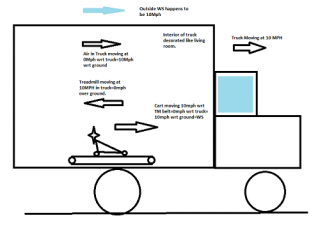
Do you realize that when you perform your Galilean transformation on the treadmill, you are considering the tread as a moving surface when in fact it is just part of a tread that is rotating?
Yes.
In a reference frame in which the top of the tread is stationary, the bottom moves forward twice as fast. But this doesn't matter, because the bottom plays no role in the cart's motion, as it is not in contact with the cart.
Can the top section of a tread that is rotating be considered an inertial reference frame?
Yes.
Or, to be more precise, there is an inertial reference frame in which the top of the tread is stationary.
A reference frame is not a physical object. It's a set of axes relative to which the positions of physical objects are measured.
In short, there is what are called “fictitious forces” present on the rotating treadmill belt, that are not present on any flat moving surface.
No.
Fictitious forces are present in non-inertial reference frames. A reference frame in which the top of the tread is stationary is inertial.
What fictitious forces do you think are present?
Since the tread is rotating, it is an example of simple harmonic motion and it will exhibit a definite resonant frequency.
I do not understand what you mean.
Are you just saying that the tread takes a certain amount of time to go around the rollers once?
Of course it does, but what is the relevance of this fact? The tread is uniform. What difference does it make whether it has gone completely around or not? The cart can't tell.
The cart that is held on this rotating tread will be forced into resonance with the rotational frequency of the belt; the wheel rotational frequency and propeller rotational frequency will both be some harmonic of the belt frequency.
Again, I do not understand what you mean.
The linear speed of the bottom of the cart's wheels will be the same as the linear speed of the tread, since they are in contact.
Do you mean anything more than this?
In fact, your transformation is so naïve, it does not even take into consideration the force you apply to the cart when holding it on the treadmill.
Forces do not change under a Galilean transformation.
What do you think needs to be done in order to "take into consideration" this force?
In the initial, untransformed situation, you have a moving belt, still air and a force applied from the stationary ground. To transform that correctly you need to have air moving over a still surface while a force is applied from the ground moving under that surface.
Ok. We have that. Now what? What's the problem?
That force corresponds, in the case of a cart on the ground, to the force used to push the cart up to windspeed.