
• Security incident: ISF was recently accessed by intruders. Please change your password, and change it anywhere else you used it. Read more

Merged DDWFTTW in a “Real” Wind

Status
Not open for further replies.
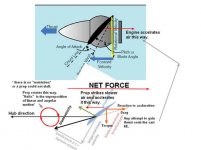
I think that the folks having a hard time with this device (e.g. RCP and friends), would benefit greatly by studying (and truly understanding) these vectors, which clearly describe exactly how this thing really works. (If you can't grok how a regular sail craft can beat the wind, you'll never grasp how the BB does it.)

Cheating, and a cover story.
attachment.php
 

Attachments

  • at_1.jpg
    at_1.jpg
    30.7 KB · Views: 83
The simple answer to that question is "that's the way BB is designed to work": it's built so that it reaches maximum velocity when running directly downwind.

I could gave a more complete answer, but in order for that to be useful we would first need to enter into a discussion about some basic physical principles.
This is why I wish ynot’s Dummies thread hadn’t been merged with this one. I mentioned in my post that BB had been designed to maximize the tacking so it worked best when going ddw. What I’m asking is how this works and was accomplished. Perhaps a little too basic for this thread, but maybe I’m not the only dummy that doesn’t get it.

In defense of humber:

He keeps the thread alive. His objections must have a touch of diabolic clout, or he wouldn't have this staying power.
I'm not saying he's correct, but he does irk the right spot.
Well said quarky. This is a point I have often tried to drive home. It’s also worth noting he can be quite funny with his retorts and pictures. For those not following the parallel discussion on TR, here’s a recent post of his there that cracked me up.


As with all models, it's not perfect.
:eek: Does this mean BB’s chick isn’t an instance of ddwfttw?

And like some boat makers they assume they know what makes their vehicles work.
Yes, and I understand this is a fairly common phenomenon. :cool:
 
A.T. These are excellent diagrams. I have a couple comments:
[*]In both diagrams, the angle of attack is nearly zero. Thus, they do not clearly show that the lift and drag components of the sail force are oriented with the direction of the apparent wind, (and not the sail surface).
That left bottom picture is not really important for the explanation (originally it wasn't there). It could just as well show the normal/axial/components of the aerodynamic force. The relevant point is that the aerodynamic force can be approx. perpendicular to the relative airflow, which is an empirically well established fact and not affected buy how you decompose that force.

[*]In the propellor blade diagram, the last figure in the lower right is not very helpful. It would be FAR better (IMHO) to break down and show the blade force components in the directions of A.) cart motion (straight up - which is the "money shot" force, pushing the cart forward), and B.) the direction of the blade motion (sideways - which is equal to the force required to be applied by the torque of the drive system.)
If you do this decomposition, then you have to show that the tangential (sideways) force component will require less counter force at the wheel than the thrust (DDW) force component. I did this in my other diagrams.

However, the point of this diagram is to show the analogy to broad reach, where the sail is constrained by the keel/wheels/skids to move sideways (off-DDW). Equally we can treat the coupling via wheels as a constraint of the blade to a certain path off-DDW, and show that the unconstrained force component will propel the blade in the desired direction along that permissible path.

This second point needs to be emphasized. Of particular note is that, compared with the sailboat (whose net sail force in the direction of travel is small compared to its normal keel force), the propellor blade force component in the direction of travel for the cart is significantly larger.
But the DDW propellor blade force component is reduced by the directly opposed wheel drag . The DDW force component on a sail in broad reach is also larger than the propulsive component, but gets partially opposed by the keel force.

(In fact, most of the propellor blade force is going precisely in the direction of travel.) Thus, one must surmise that the inherent better efficiency of this device should allow an optimized Blackbird-like propellor design to easily beat an optimized Greenbird-like fixed sail design in an out-and-out absolute speed race. In theory that is. :)
No, I think there is no such advantage. You are looking only at the aerodynamic forces here and ignoring the forces at the surface.

Once again, very nice diagrams.
Thanks.
 
This is the ddwfttw for dummies thread. The eternal-dummy here makes sure that people will keep explaining ddwfttw on dummy level.
Speaking for the dummies, I'd hardly call most of Humber's replies or your graph and reply to RR above on the dummy level, AT. My point was that questions like I posed to Michael are relatively basic physics-I'm told-and pertain to how BB works, not if. hth :)
 
Since the prop is tacking, there will be an ideal angle to the relative wind that maximizes the speed of the cart, just like there is an ideal setting for the sail of an iceboat. Any deviation from that will decrease the performance; less angle is bad and more angle is bad. Got it so far?

When the cart is traveling directly downwind, the prop blades are at the same angle to the wind at all times. When the cart is say 10 degrees off DDW, as the prop goes through the vertical position either at the top or the bottom, that 10 degrees is added to or subtracted from the ideal angle. The prop is now spending an appreciable amount of time at less than the ideal angle, and the performance suffers as a result. Draw a picture if you're unsure of how that works.

The farther the cart deviates from DDW, the worse the cart performs because the prop is getting farther away from the ideal angle. When running at high multiples of the wind speed, high efficiency is crucial, so running even a few degrees off can drop the top speed noticably. That makes the BB's 2.85x WS while running off DDW even more remarkable.
 
Last edited:
Okay, part two:
"As the wheels are turning the prop anyway, why would ddw allow optimum performance, is my question."

This one is actually fairly simple: if the prop is not aligned with the wind, it is wasting energy. The idea is to slow the speed of the wind wrt the ground, and the most efficient way to do that is by having the prop aligned with the wind. If it isn't, the wind isn't just slowed, it is propelled to the side, and that is what wastes the ground power and lowers the performance.

When the cart is at 90 degrees to the wind, it behaves as if there is no wind at all, because any movement of the prop is 100% wasted.
 
Last edited:
AT - Thanks for the detailed reply. Yes, you are certainly correct that I wasn't taking into account the wheel force when I erroneously said that the BB design has a large advantage due to its more favorable orientation of the blade force with regard to the vehicle path. After careful study of your "all-regimes" diagram, I think I can now see the meaning and significance of the "unconstrained force" in the blade diagram and how it is analogous to the net thrust of a sailboat on a broad reach. (I never really took a close look at that diagram before because the details were too small - my eyesight isn't so good. I had to bring it into an image editing program to blow it up to read it.)

That said, it still seems to me that there are some significant advantages to the BB design over a conventional sail craft. (Although its extra mechanical complexity is certainly a disadvantage.) It is traveling at a more advantageous angle with respect to the wind. And an optimized symmetrical dual prop configuration would allow the wheels to evenly dig in (with no side loads) to achieve max traction and minimal skidding.

I wouldn't bet against it! Thanks again for the great visual aids.
 
In my opinion the best moments in this thread are when everyone is discussing the physics and simply ignoring humbers. Humber, even as a troll, appears to be a pale shadow of his former self and has for weeks been reduced to an endless loop of elementary school insults. In contrast, even the incorrect explanations by other posters are at least honest, informative, and add to the discussion.
 
As the sail of an iceboat points to the tailwind. It still goes faster when the wind is at a broad reach than directly behind it. As the wheels are turning the prop anyway, why would ddw allow optimum performance, is my question.

First point to ponder: the sail of an iceboat does not point to the tailwind. It is at an angle to the wind.

And now here's a question for you: what is the direction of the thrust force of a propeller, in relation to the plane of rotation of the blades?
 
Since the prop is tacking, there will be an ideal angle to the relative wind that maximizes the speed of the cart, just like there is an ideal setting for the sail of an iceboat. Any deviation from that will decrease the performance; less angle is bad and more angle is bad. Got it so far?
A tautology of the question.

When the cart is traveling directly downwind, the prop blades are at the same angle to the wind at all times. When the cart is say 10 degrees off DDW, as the prop goes through the vertical position either at the top or the bottom, that 10 degrees is added to or subtracted from the ideal angle. The prop is now spending an appreciable amount of time at less than the ideal angle, and the performance suffers as a result. Draw a picture if you're unsure of how that works.
A self-contradictory tautology of the question. Just like Spork's explanation made in the submission.

The farther the cart deviates from DDW, the worse the cart performs because the prop is getting farther away from the ideal angle. When running at high multiples of the wind speed, high efficiency is crucial, so running even a few degrees off can drop the top speed noticably. That makes the BB's 2.85x WS while running off DDW even more remarkable.

Again, a repetition of the question.

However, it is a physical fact - and proof that rotor blades cannot tack the wind because the airfoil is at a fixed angle to the hub - is that the power generated by a turbine falls as the cube of the cosine of the angle of the incident wind.
That is why all wind turbines directly face the wind, because power is then a maximum.
On the BB, the turbine force opposes the cart, so it is worst ddw. Unlike claims of tacking props, that is supported both by text book references and the trial data.

<balloon-in-car>
 
In my opinion the best moments in this thread are when everyone is discussing the physics and simply ignoring humbers. Humber, even as a troll, appears to be a pale shadow of his former self and has for weeks been reduced to an endless loop of elementary school insults. In contrast, even the incorrect explanations by other posters are at least honest, informative, and add to the discussion.

And your pal Spork. He is a veritable Churchill. Ballsy and rapier wit, coupled with an impressive and encyclopedic knowledge.
 
First point to ponder: the sail of an iceboat does not point to the tailwind. It is at an angle to the wind.

And now here's a question for you: what is the direction of the thrust force of a propeller, in relation to the plane of rotation of the blades?

In line with the axle in both planes, which is why is can be said with assurance, that a rotor will not tack the wind.

Spork is talking about mathematical models. The little cart isn't a mathematical model, it's an actual cart that actually goes ddwfttw.

Like in the street video, where the prop turns one way, then another and finally stalls? All three possibilities in the space of a few tantrum-inducing meters.
The TM is not a correct model. The increasing difference between the relative motion of a cart and road, reflecting the speed of the cart, remains constant with increasing speed on the TM.
 
The TM is not a correct model. The increasing difference between the relative motion of a cart and road, reflecting the speed of the cart, remains constant with increasing speed on the TM.

It's this level of clarity of language which makes this thread so concise and easy to follow.

I think what humber's attempting to say is that the cart will run off the end of the treadmill.

But if you speed up the treadmill that would be equivalent to increasing the windspeed, and would be futile as the cart will just accelerate and run off the end of the treadmill anyway.

Or it may be that the "increasing difference between the relative motion... remains constant with increasing speed" is about something else entirely. We may never know.
 
Status
Not open for further replies.

ISF - Join now!

Every member here is approved by hand. No bots, no spam, just people who care about evidence and honest debate.

Membership is free!

Create your free account

Back
Top Bottom