• Security incident: ISF was recently accessed by intruders. Please change your password, and change it anywhere else you used it. Read more

Merged DDWFTTW in a “Real” Wind

Status
Not open for further replies.
Affect of Wind on Runups

There could be. Keep in mind that much of the prop is stalled when running in static conditions. When running in reversed flow (something our cart never does after it passes wind speed), even more of the prop will be stalled.

We're talking here about a prop that's operating in a local headwind - just like the prop on a plane in flight - whether that plane is flying into a headwind or with a tailwind.

Mender,

Tricky question. For runups we set the RPM to a fixed RPM typically for small general aviation aircraft. However as gusts and windshifts occur, I will verify that the RPM does indeed vary for a fixed throttle (power) setting for a conventional prop (non-constant speed).

WindGrins:D
 
I do give ynot credit for both keeping an open mind and making his own models. But like many early boat builders, they know how to make their boats or ynot his cart, but they don't understand the reason it works. And like some boat makers they assume they know what makes their vehicles work.
 
Frr= m*g*Crr.
Power = force*velocity, so the power to maintain a cart at a speed is linearly proportional to velocity, for Frr alone. Where does the power come from when there is no tailwind to provide it, Spork?

Once again, I'm describing the amount of energy that would be expended in any given period of time. Thus pushing the car at 10 mph for 10 seconds would take 10 times the energy as pushing it at 1 mph for 10 seconds. So yes, by definition, the power required would be 10 times as great as well.

It's the velocity that makes the difference, but for a constant velocity.
From a standstill, the acceleration of the first case is 10 times the second.

So for the limited case, you are right.
Let Frr = 1N
v = 10 m/s, 1m/s

First case v=10m/s, t= 10s
distance = Velocity*time = 10m/s*10m = 100m
Work = force*distance = 1N*100m = 100J
Power = work/time = 100J/10s = 10W

Second case v=1m/s, t= 10s
distance = Velocity*time = 1m/s*10s = 10m
Work = force*distance = 1N*10m = 10J
Power = work/time = 10J/10s = 1W
 
Will there be a difference in engine rpm when doing a static run-up in a private plane with no-wind conditions vs a tailwind? Not usually done, but I suspect there will be a difference, right?

ETA: it's been a while but I seem to remember the engine rpm being pretty static during the actual take-off run, so that would indicate that I'm wrong and you're right - again.

Pilot's anecdotal impressions are not physics. The engine's power characteristic will change that impression. It is common in cars. If you drive a big one, change to a smaller may feel "nippy", even though the lager revs differently or is more powerful.
 
There could be. Keep in mind that much of the prop is stalled when running in static conditions.
On the contrary. The prop is not stalled, the air is.

When running in reversed flow (something our cart never does after it passes wind speed), even more of the prop will be stalled.
We're talking here about a prop that's operating in a local headwind - just like the prop on a plane in flight - whether that plane is flying into a headwind or with a tailwind.

And so needs a power source. Tripped yourself up, again, Spork.
 
The whole point of what I was explaining about the air immediately in front of the blade is that it is not struck by the blade.
And how is that magic achieved? A vacuum between the blade an the air ahead?
As I have now said many times JBTH, if the prop "moves away" and "pushes the air backwards", there is not even the possibility of power from the wind. That leaves the wheel alone as the entire source, so PM.

Why only then? If you insist, you can analyse the blade's motion aggregated over time in terms of its angle of attack against the apparent wind. You'll get the same effect, though: the prop blade will accelerate the air backwards and the reaction force pushes the prop forwards.
Props are not an airfoil for some random reason. They are that way so the air DOES remain in contact with the surface for as long as is possible.

I can't picture whatever you mean by that. Can you explain it any more clearly?
Which explains why the blade behaves like a wing. Or a sail. Agreed.
The propeller blades are always in contact with the air. Larger blades or extra blades would transfer energy from more of the air, agreed.

All blades do the same. Prop or turbine.
There are many complications, conflicting requirements and other phenomenon such as eddies, pressure and so forth, but the aim is to keep the air in contact with the blade, so that energy is efficiently transferred either way. No-slip is physically unavoidable, but would be needed anyway.

attachment.php
 

Attachments

  • jbth.jpg
    jbth.jpg
    27.7 KB · Views: 53
Spork's and JB's new fame!

You claim the prop "harvests" energy from the wind. That is a forced position in avoidance of the stigma of perpetual motion, implied by your wheel-driving-the-prop-driving-the-wheel Harrypothesis.

It is neither.

Spork,

Since Humber says it has to be Perpetual Motion for this to work and there's just no way convential physics will let this, I think you might as well accept the Humber award for the first person to achieve PM!;)

A much greater achievement than a DDWFTTW cart!

Congratulations!

PS It looks like Newbie on Talk Rational is doing a pretty good job of surpassing Yev and Humber. Keeping them on the same page with themselves is tough! He must be one of the many minions of Spork and JB's sock puppets like me that just can't make common sense of this like Humber, Harold, and Yev!:dewink:

WindGrins:D
 
Last edited:
Spork,

Since Humber says it has to be Perpetual Motion for this to work and there's just no way convential physics will let this, I think you might as well accept the Humber award for the first person to achieve PM!;)

A much greater achievement than a DDWFTTW cart!

Congratulations!

WindGrins:D

The correct conclusion is that the cart is not as claimed. What one Earth would lend the impression that TAD are honest?

It was never, for even one second of the trial, ddw. The result is entirely explicable from the provided data.
The TM has nothing to do with WS travel, if only because the transform is wrong. It is a machine in its own right, and operates as a Atwood's machine with feedback.
The math and theory are unsupportable bunk, which employs magical rotors and notions that appear in no text book, anywhere.
 
In the interest of Time Saving

I think that in the interest of time saving, each time we post a comment with any lucidity whatsoever, we could all save some by adding the tag at the end:

"Humb Op"

which is short for Humber's Opinion which is short for:


The correct conclusion is that the cart is not as claimed.
It was never, for even one second of the trial, ddw.
The result is entirely explicable from the provided data.
The TM has nothing to do with WS travel, if only because the transform is wrong.
It is a machine in its own right, and operates as a Atwood's machine with feedback.
Your mistake is to think that the TM has anything to do with a cart in the wind.
The ddw cart is a fraud. Simple at that.
Your cart is a fraud, Spork.
The balloon in a car shows how little you understand.
The cart is a sham.
The BB is explained by changing wind patterns, and the data confirms that.
There is no ddw record.
The math and theory are unsupportable bunk, which employs magical rotors and notions that appear in no text book, anywhere.
Give it up Spork, your silly ideas have been exposed, and you don't have the skill that a hoaxer would in defense.
Nothing will save your TM, nor the trial result.

This will allow Humber to get some rest and us some sanity in not having to reply to it!:)

Regards,

WindGrins:D
 
You forgot to add a few classic Humberisms:


Neutral density balloons can travel at less than wind speed
If you put two tension springs in series, the same load will result in each spring having half the extension of one spring
The cart's symmetrical airfoil section pylons give forward thrust in sidewinds
The cart accelerates quickest when there is a sidewind
 
Last edited:
This will allow Humber to get some rest and us some sanity in not having to reply to it!:)
WindGrins:D

I don't need the rest.

The correct conclusion is that the cart is not as claimed.
It was never, for even one second of the trial, ddw.
Demonstrably so.

The result is entirely explicable from the provided data.
RMS wind averaging blows the claim away.

The TM has nothing to do with WS travel, if only because the transform is wrong.
It's a simple trick. Call the motion "velocity", then subtract the transform
so that the "speeds" that were actually transformed, can be seen as vectors the other way.
For example 5hrs - 3hrs = 2hrs
For example 3hrs - 5hrs = -2hrs
Don't build a clock on that basis.

The TM had been "bagged" by Dr Camp, saying that the transform was of something else. There are many clues to why that is, but one is easy to see.
If the real cart is traveling at 4m/s, then road moves "backwards" at -4m/s.
Then for 4.1m/s, the road moves at -4.1m/s and so on.
But on the TM, the road remains at 4m/s, as the cart travels "faster".

It is a machine in its own right, and operates as a Atwood's machine with feedback.
It is.

The balloon in a car shows how little you understand.
That one is hilarious. A the balloon moves in a "parcel of air" that is some how accelerated by the car. Well, what if the braking is 1g?
9.8m/s-2. How far should the balloon travel if that where the case?

The cart is a sham.
The BB is explained by changing wind patterns, and the data confirms that.
There is no ddw record.
Each prop blade spends 50% of its time above the hub. The wind above the hub is not measured. So what wind speed record is claimed?
Selective outcome. Drop all failures, and keep the good ones, where chance and wind pattern worked to give a transient WS claim.

The math and theory are unsupportable bunk, which employs magical rotors and notions that appear in no text book, anywhere.
Correct. No tacking props, no "air levers" etc.
But, much about no-slip and molecular acceleration. That's the current state of development.

Give it up Spork, your silly ideas have been exposed, and you don't have the skill that a hoaxer would in defense.
Nothing will save your TM, nor the trial result.
Yep. All replies contain error, and are generally math free.
A hoaxer would have anticipated the criticisms and prepared rebuttals that were at least sophisticated to pass casual inspection..
 
You forgot to add a few classic Humberisms:

Propellor blades are not airfoils (I think even the Wright brothers realised they were, Humber)
You made that up.

Neutral density balloons can travel at less than wind speed
A certainty.

If you put two tension springs in series, the same load will result in each spring having half the extension of one spring
They can if you have more than cartoon ideas of springs.

The cart's symmetrical airfoil section pylons give forward thrust in sidewinds

Ask Jenkins. His is a symmetrical solid-sail cart.
 
Last edited:
humber, it does not really matter where they put the anemometer. Even at if they measured the speed of the wind at the Blackbird's highest point it was still over twice the speed of the wind there. And poor humber still doesn't know how springs work.
 
You won't believe this!

You forgot to add a few classic Humberisms:


Neutral density balloons can travel at less than wind speed
If you put two tension springs in series, the same load will result in each spring having half the extension of one spring
The cart's symmetrical airfoil section pylons give forward thrust in sidewinds
The cart accelerates quickest when there is a sidewind

You won't believe this!

The ones in my post were just collected in the last five pages!:)

WindGrins:D
 
In defense of humber:

He keeps the thread alive. His objections must have a touch of diabolic clout, or he wouldn't have this staying power.
I'm not saying he's correct, but he does irk the right spot.
 
A new Insight!-Sort of.

The TM had been "bagged" by Dr Camp, saying that the transform was of something else. There are many clues to why that is, but one is easy to see.
If the real cart is traveling at 4m/s, then road moves "backwards" at -4m/s.
Then for 4.1m/s, the road moves at -4.1m/s and so on.
But on the TM, the road remains at 4m/s, as the cart travels "faster".

If "faster" was say 0.1 m/s could the difference between the the treadmill tread surface and the cart possibly be 4.1 m/s???

Hmmmm, I wonder!!!!

However, Humber, I am impressed. A few hundred posts backs, we would never have caught you saying 'the road moves "backwards" at 4.1 m/s.'

Is there really a chance that you may have a glimmer of what relative motion means?

Regards,

WindGrins:D
 
You won't believe this!

The ones in my post were just collected in the last five pages!:)

WindGrins:D

It's a big joke at your expense.

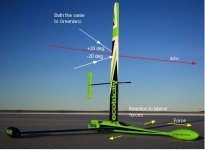
The wind readings are averaged. That is like allowing a cart to tack 20 degrees SE, and then 20 degrees SW, and say there is no tacking because +20 + (-20) = 0.
The pylons do act as sails, and so does the prop. The cart stays to one fixed heading ( it does not follow the wind), so the wind changes about it, and that is the "Galilean Equivalent" of tacking.

The lateral forces can be dealt with by steering, while keeping a constant heading. The heading is averaged too, so like the wind changes, when averaged, the small deviations one way or the other cancel out.
Any residual will not be discernible from the usual limits of GPS.

attachment.php
 

Attachments

  • greenbird.jpg
    greenbird.jpg
    17.2 KB · Views: 55
However, Humber, I am impressed. A few hundred posts backs, we would never have caught you saying 'the road moves "backwards" at 4.1 m/s.'
Note the quotation marks. I am breaking your argument, with your argument.

The asymmetry is an error that tells the TM is a phony.
 
Status
Not open for further replies.

ISF - Join now!

Every member here is approved by hand. No bots, no spam, just people who care about evidence and honest debate.

Membership is free!

Create your free account

Back
Top Bottom