
-
Security incident: ISF was recently accessed by intruders. Please change your password, and change it anywhere else you used it. Read more
You are using an out of date browser. It may not display this or other websites correctly.
You should upgrade or use an alternative browser.
You should upgrade or use an alternative browser.
Merged DDWFTTW in a “Real” Wind
- Thread starter ynot
- Start date
- Status
- Not open for further replies.
If you insist, you can analyse the blade's motion aggregated over time in terms of its angle of attack against the apparent wind.
Yep, just show humber this diagram:

and he will start hand waving like crazy and spewing unrelated nonsense about airplanes. But of course he cannot point out any specific error in the diagram.
Asymmetric Symmetry
Humber:
The cart's symmetrical airfoil section pylons give forward thrust in sidewinds (BlackBird-that is)
Writing about the Greenbird:
That's about the most asymmetrical "symmetrical solid-sail" cart I can imagine!
That's not in any way a criticism of Greenbird, the asymmetry is why it works so well.
Regards,
WindGrins
Humber:
The cart's symmetrical airfoil section pylons give forward thrust in sidewinds (BlackBird-that is)
Writing about the Greenbird:
Ask Jenkins. His is a symmetrical solid-sail cart.
That's about the most asymmetrical "symmetrical solid-sail" cart I can imagine!
That's not in any way a criticism of Greenbird, the asymmetry is why it works so well.
Regards,
WindGrins
BlackBird's tacking
This particular criticism by Humber is that the pylons holding up the prop and the prop itself form a sail surface that allows the BB to cheat by using them as tacking sails when the wind is not directly on the nose. His contention is that the BB is using these like an iceboat uses its sails or the Greenbird uses its wing.
This "cheat" works when it is not going directly downwind according to Humber. He has absolutely no data or analysis to back this but it is another "arrow in his quiver" of why it doesn't work.
His argument seems to oscillate that the data is wrong and its never going faster than the wind and when he agrees it is going faster than the wind, its a cheat because its not going directly down wind and thats why its so much faster than the wind. The posts will posit one and then 3 posts later, he will posit the latter. Then (you guessed it) three posts later, he's back to the former.
Regards,
WindGrins
It was always about tacking.
A sophisticated version of tacking,
So, what's the damn problem here?
This particular criticism by Humber is that the pylons holding up the prop and the prop itself form a sail surface that allows the BB to cheat by using them as tacking sails when the wind is not directly on the nose. His contention is that the BB is using these like an iceboat uses its sails or the Greenbird uses its wing.
This "cheat" works when it is not going directly downwind according to Humber. He has absolutely no data or analysis to back this but it is another "arrow in his quiver" of why it doesn't work.
His argument seems to oscillate that the data is wrong and its never going faster than the wind and when he agrees it is going faster than the wind, its a cheat because its not going directly down wind and thats why its so much faster than the wind. The posts will posit one and then 3 posts later, he will posit the latter. Then (you guessed it) three posts later, he's back to the former.
Regards,
WindGrins
Last edited:
Yep, just show humber this diagram:
[qimg]http://img811.imageshack.us/img811/4922/propellervectors.png[/qimg]
and he will start hand waving like crazy and spewing unrelated nonsense about airplanes. But of course he cannot point out any specific error in the diagram.
So wrong. A repeat post that is. and was, no challenge at all.
A very cartoon like world that takes no notice of the difference between drag and lift products due to viscosity, and those of momentum transfer, nor the shift in behavior for long narrow airfoils or surfaces.
When you can solve the problem of the Taylor power series below 20 degrees incidence, then you may speak.
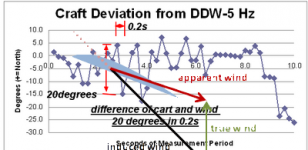
Other than that, you will be able to tell me how far the cart can move from its path in 0.2 seconds, when it weighs 650lb, and then when the wind changes the other way within 0.4s?
This is the already available NALSA data for the last 10 seconds.
Very busy propeller. Deciding which way it should turn, or to set up pressure, or wonder if it's a prop or a turbine.
http://www.internationalskeptics.com/forums/attachment.php?attachmentid=21968&stc=1&d=1303852212
Attachments

Last edited:
Jack by the hedge
Safely Ignored

The whole point of what I was explaining about the air immediately in front of the blade is that it is not struck by the blade.
If you could conceive of the very simple mechanics of the system you would know the answer is trivial. The blade moves out of the way.And how is that magic achieved? A vacuum between the blade an the air ahead?
"Moves away" from where, exactly? I really don't think you are able to envisage what is actually being described and your vague use of language merely reflects your confusion rather than any problem with the science. As if to illustrate the point, the prop does not "push the air backwards" in the sense that you usually mean it - i.e. backwards with respect to the ground. Rather the prop slows the advance of the wind. The air continues to move forward as it interacts with the propeller blade. Each point on the blade upon which it impinges is retreating with respect to the cart and with respect to the wind, but with respect to the ground it is advancing at less than windspeed.As I have now said many times JBTH, if the prop "moves away" and "pushes the air backwards", there is not even the possibility of power from the wind.
I really don't think you're ever going to grasp this.
Jack by the hedge
Safely Ignored
And right on cue, he does. It's almost as if you could read his mind.Yep, just show humber this diagram:
<big image snipped>
and he will start hand waving like crazy and spewing unrelated nonsense about airplanes. But of course he cannot point out any specific error in the diagram.
Any time, including a direct tailwind.This particular criticism by Humber is that the pylons holding up the prop and the prop itself form a sail surface that allows the BB to cheat by using them as tacking sails when the wind is not directly on the nose. His contention is that the BB is using these like an iceboat uses its sails or the Greenbird uses its wing.
Got lot's that says this cart is nowhere near a ddw cart.This "cheat" works when it is not going directly downwind according to Humber. He has absolutely no data or analysis to back this but it is another "arrow in his quiver" of why it doesn't work.
On the contrary. The data suggest the BB is a slug.His argument seems to oscillate that the data is wrong and its never going faster than the wind and when he agrees it is going faster than the wind,
That's right. It tacks the wind and the constantly changing direction adds (the equivalent of) jibing to that. The prop which you say powers the cart, spends as much time in the measured wind as in the unmeasured wind.its a cheat because its not going directly down wind and thats why its so much faster than the wind.
Show me one post that supports that direct lie.The posts will posit one and then 3 posts later, he will posit the latter. Then (you guessed it) three posts later, he's back to the former.
Regards,
WindGrins
Last edited:
And right on cue, he does. It's almost as if you could read his mind.
Show that. That is A.T's nonsense diagram. Not mine.
Yep, just show humber this diagram:
and he will start hand waving like crazy and spewing unrelated nonsense about airplanes. But of course he cannot point out any specific error in the diagram.
http://www.internationalskeptics.com/forums/attachment.php?attachmentid=21972&stc=1&d=1303854355
Prop turns less than 90 degrees before the wind changes direction.
Stream tube without an engine to produce it?
Attachments
Last edited:
I'll give this to Humber!
Windgrins:
His argument seems to oscillate that the data is wrong and its never going faster than the wind and when he agrees it is going faster than the wind, its a cheat because its not going directly down wind and thats why its so much faster than the wind. The posts will posit one and then 3 posts later, he will posit the latter. Then (you guessed it) three posts later, he's back to the former.
You are correct Humber. It was hyperbole, you did not oscillate between the two mutally contradictory statements as quickly as I said.
Ps, I would have to show you at least three posts to validate that claim.
You have me!
Regards,
WindGrins
Windgrins:
His argument seems to oscillate that the data is wrong and its never going faster than the wind and when he agrees it is going faster than the wind, its a cheat because its not going directly down wind and thats why its so much faster than the wind. The posts will posit one and then 3 posts later, he will posit the latter. Then (you guessed it) three posts later, he's back to the former.
Show me one post that supports that direct lie.
You are correct Humber. It was hyperbole, you did not oscillate between the two mutally contradictory statements as quickly as I said.
Ps, I would have to show you at least three posts to validate that claim.
You have me!
Regards,
WindGrins
Last edited:
You are correct Humber. It was hyperbole, you did not oscillate between the two mutally contradictory statements as quickly as I said.
You have me!
Regards,
WindGrins
That dog collar suits your sermons to a T.
It's all done and dusted really. The cart is a sham.
Last edited:
Yep, just show humber this diagram:
and he will start hand waving like crazy and spewing unrelated nonsense about airplanes. But of course he cannot point out any specific error in the diagram.
And right on cue, he does. It's almost as if you could read his mind.
He so predictable.
Of course he cannot point out any specific thing in the diagram that is wrong, and is forced to spew some blather about irrelevant stuff. His problem is: It's the same vectors as for sail boats with downwind VMG > windspeed, something that humber doesn't dispute. 
Humber doesn't understand vector diagrams. They are alike abstract art to him. Last time he posted a vector diagram it proved the opposite of what he was claiming. Since then he hates vectors.
Too bad a propeller is not in the least like a tacking sail. That is pure fantasy, and supported by no known text book, anywhere.He so predictable.
(Deleted telly tubby drawing)
On the other hand, standard airfoil theory including the no-slip condition, guarantee force from both prop and towers, while denying all Carteer's claims of a rotor that is both a prop and a "harvester" at the same time: total office guru fantasy.
Shall I post a picture of my Agilent vector-scope? Electronics is vectors from one end to the other, so don't bluff me with that claim. RMS is a mystery to you, and so are vectors.Humber doesn't understand vector diagrams.
They are alike abstract art to him. Last time he posted a vector diagram it proved the opposite of what he was claiming. Since then he hates vectors.
The Taylor series, if you please. That is all vectorial, so should be easy for you. Perhaps you may not find an easy wiki for that one.
Last edited:
A.T. said:
"harvester" ... vector-scope ... RMS ... Taylor series
And he still cannot point out any specific thing in the diagram that is wrong, and is forced to spew blather about irrelevant stuff.
And he still cannot point out any specific thing in the diagram that is wrong, and is forced to spew blather about irrelevant stuff.
All of it. Propellers do not have "true" and "apparent" "winds", nor do turbines.
And no torque. A torque-free, prop-turbine combo, and the best damn BBQ money can buy.
Does the boat rotate, BTW?
The BB is a bloated sail cart, that was allowed stay on a fixed heading, that did not follow the wind changes, on the premise that would be worst case for the cart. Guess who suggested to NALSA that was the case?
In fact, it does worst ddw, as every video shows. In the Jenkin's video, it crawls along at 2m/s for ~ 1:30min, until the wind changes. The posted trial chart shows the same. If it were not for the pushing that masks that, the cart would probably do less than 1m/s until the wind shift sharply South.
Last edited:
ridgerunner
New Blood
- Joined
- Feb 6, 2009
- Messages
- 11
A.T. These are excellent diagrams. I have a couple comments:
This second point needs to be emphasized. Of particular note is that, compared with the sailboat (whose net sail force in the direction of travel is small compared to its normal keel force), the propellor blade force component in the direction of travel for the cart is significantly larger. (In fact, most of the propellor blade force is going precisely in the direction of travel.) Thus, one must surmise that the inherent better efficiency of this device should allow an optimized Blackbird-like propellor design to easily beat an optimized Greenbird-like fixed sail design in an out-and-out absolute speed race. In theory that is.
I think that the folks having a hard time with this device (e.g. RCP and friends), would benefit greatly by studying (and truly understanding) these vectors, which clearly describe exactly how this thing really works. (If you can't grok how a regular sail craft can beat the wind, you'll never grasp how the BB does it.)
Once again, very nice diagrams.
- In both diagrams, the angle of attack is nearly zero. Thus, they do not clearly show that the lift and drag components of the sail force are oriented with the direction of the apparent wind, (and not the sail surface). I think the message of these illustrations would be clearer if you made the AOA something like 10-15 degrees.
- In the propellor blade diagram, the last figure in the lower right is not very helpful. It would be FAR better (IMHO) to break down and show the blade force components in the directions of A.) cart motion (straight up - which is the "money shot" force, pushing the cart forward), and B.) the direction of the blade motion (sideways - which is equal to the force required to be applied by the torque of the drive system.)
This second point needs to be emphasized. Of particular note is that, compared with the sailboat (whose net sail force in the direction of travel is small compared to its normal keel force), the propellor blade force component in the direction of travel for the cart is significantly larger. (In fact, most of the propellor blade force is going precisely in the direction of travel.) Thus, one must surmise that the inherent better efficiency of this device should allow an optimized Blackbird-like propellor design to easily beat an optimized Greenbird-like fixed sail design in an out-and-out absolute speed race. In theory that is.
I think that the folks having a hard time with this device (e.g. RCP and friends), would benefit greatly by studying (and truly understanding) these vectors, which clearly describe exactly how this thing really works. (If you can't grok how a regular sail craft can beat the wind, you'll never grasp how the BB does it.)
Once again, very nice diagrams.
Last edited:
Bruce Voigt
Critical Thinker
- Joined
- Jun 22, 2009
- Messages
- 405
Allow me to add a little science here (might help)
The cell, molecule, quark, atom, higs particle, neutrino, radiation, gravity, centrifugal force, magnetism and yes now the "CHIP" on their own are insignificant. Have a group of any of these then watch out. The power is unlimited.
Sir Isac Newton mentioned that for every reaction there is an equal and opposite reaction. Well he didn't quite get it right. Create a reaction to any of these individually and the power is transmitted not to one contact point like Newton describes but this power radiates out in a 360 degree conglomerate of chips having the same energy individually as the initial one contact point.
Its not that we don't see this its that we don't understand it.
As an example' Standing on shore with the wind coming down the lake the created swells like cracking the whip when every one holds hands at skating have the swell turning 90 degrees as it comes to shore. WOW that takes a lot of energy to do that!
ThinAirDesigns
Graduate Poster
- Joined
- Nov 10, 2008
- Messages
- 1,058
No.
- Status
- Not open for further replies.