• Quick note - the problem with Youtube videos not embedding on the forum appears to have been fixed, thanks to ZiprHead. If you do still see problems let me know.

Split Thread David Gilroy: murder conviction goes to Scottish Review Commission

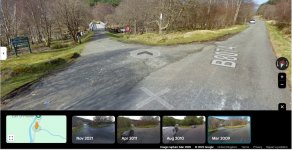
Oh, nice find! He goes further than the one you found earlier with the car driver who got cold feet and reversed out. That ends any speculation that there was a gate on the far side of the river back then. (I wish the motorcyclists had gone on!)

I could see the presence of the storage shed on the left maybe giving Gilroy a nasty moment if he didn't realise it was probably deserted, but other than that, what's not to like?

This is Google Streetview from August 2010. I don't know if we looked at that one earlier.

1760796662787.png
 
A recent death, then. When they were saying "remains" rather than "a body" I thought maybe it was something more historic. It sounds very much as if the body has been in the loch and been washed up on the shore there. I wouldn't be surprised if this turns in to another murder inquiry.

I really wish Suzanne could be found by chance like this, so we could at last figure out what he did with her.

I see this has indeed become a murder investigation.


McColl should have consulted Gilroy about methods of getting rid of bodies in the Highlands.
 
The route DG took from the Esso, Queensferry Road, Edinburgh to Lochgilphead Joint Campus is 135 miles.

The route DG took from Lochgilphead Joint Campus to the Tesco at Corstorphine Police Station, 28 Meadowplace Road, Edinburgh is 152 miles.

Total round trip of 287 miles, however the police think he drove another 124 miles - a total of 411 miles.

If the police based his cars mpg on the official mpg figure of 49mpg, his Vectra used 26.625 litres to drive 287 miles and 11.504 litres to drive an additional 124 miles.

Therefore his car used 38.129 litres to drive 411 miles at 49mpg.

But what if the average mpg was lower than 49mpg?

If the mpg was 37, DG diverted for 23.356 miles, and interestingly, when 23.356 is divided by 4 = 5.839 miles (the distance from the junction of the A85/B8074 to the picnic bench at the Allt Broighleachan.)

If the mpg was 34.22, DG did not divert anywhere for the disposal.

MPG database.jpg
 
Last edited:
When I spoke to Stuart Houston the SIO he was very certain about the extra miles driven, based on the fuel consumption figures, but to my mind that can't be right. Here's what I wrote about it in my report.

1762449401238.png

There is simply not enough time Gilroy him to have driven that distance in the time available - I don't see how he could have maintained an average of even 40 mph unless he stuck to the A roads, and what would have been the point of that?

The police seem to have assumed that he brimmed his tank at Queensferry Road, but did he? I've not seen any evidence of that. You have introduced the question of what the police's assumed mpg figure was. I haven't seen that discussed anywhere, nor I believe have I seen any report of the actual fuel volume they believe was missing from the tank. Surely they wouldn't have assumed the Vectra's WLTP figure, would they? These figures are known to be wildly optimistic.

If he was going very slowly then his mpg, with an ICE, would have got worse. So that's one way the distance covered would come out less. Cruising at 40 on an A road is actually pretty close to optimum for an ICE.

I honestly don't know. The figure of 124 miles is very precise, but it really defies credulity. What assumptions did they use? We don't know. Certainly I would imagine that fuel consumption would be poorer on the track from the B8074 to the picnic place and back. But the biggest detour we're imagining is 24 miles (it's about six miles to the deer fence, though I don't really think he went that far) and that's a fair bit less than 124 miles. That other 100 miles? I don't believe in it. There has to be some other explanation, but I couldn't get Stuart Houston to contemplate the possibility.
 
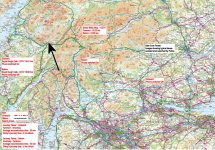
The Green Welly, Tyndrum to The Royal Burgh Cafe Inveraray is 27.6 miles and takes 40 minutes according to Google maps giving an average speed of 41.4 mph

According to the average reconstruction time on the map this took 36 minutes giving an average speed of 46 mph.

Map and times.jpg

About 40 mph seems reasonable on A roads taking into account the state of his car and possible traffic delays.

However on B roads the mph drops drastically.

For example, the 4.4 mile stretch of road from the junction of the A85/B8074 to the bridge at Eas Urchaidh takes 12 minutes according to Google maps giving an average speed of just 22 mph.
 
I'd concur with that. The only way he could have kept up 40 mph for the "missing miles" would have been if he'd been driving on unobstructed A roads. Without stopping to scope anything out. Why would he have done that? Where did he go, on these A roads, driving steadily without stopping, and not be caught by any cameras? What was he trying to achieve? One could imagine him driving, slowing down, looking at possible side roads, maybe getting out to check if a gate is locked. But not 124 miles at an average of 40 mph, along main roads.
 
“The figure of 124 miles is very precise “- Post 1124

The simplest explanation is that the police checked the Vectra’s onboard computer which showed 31mpg and there were 4 gallons missing from the fuel tank.

The police assumed the fuel tank was filled to the maximum of 61 litres/13.4181 gallons and they would have been able to verify how many litres were put into the Vectra by checking the sales receipt at the Esso on Queensferry Road.

However, he did not park on the correct side of the fuel pump and he would have to stretch the fuel hose to pump fuel into the tank. (the Vectra’s fuel cap is situated on the driver’s side) This could mean he was unable to fill the tank to its full capacity of 13.4181 gallons/61 litres.

Fuel cap.jpg
Esso.jpg


DG had driven 135 miles on his journey from the Esso, Queensferry Road, Edinburgh to Lochgilphead Joint Campus and 152 miles from Lochgilphead Joint Campus to the Tesco at Corstorphine Police Station, 28 Meadowplace Road, Edinburgh. Subsequently, there should be 4.1601 gallons left in the fuel tank but if the police found 0.1601 gallons in the fuel tank there were 4 gallons missing. At 31mpg this equates to the 124 missing miles.

If the fuel tank was filled to

13.4181 gallons/61 litres then DG has driven an extra 124 miles.

12.4181 gallons/56.45 litres then DG has driven an extra 93 miles.

11.4181 gallons/51.91 litres then DG has driven an extra 62 miles.

10.4181 gallons/47.36 litres then DG has driven an extra 31 miles.

If DG's car did get 31mpg and there were 4 gallons missing it means that DG parked his car at the Tesco at Corstorphine Police Station with 0.1601 gallons/0.7278 litres of diesel in the fuel tank (which equates to 4.963 miles at 31mpg)
 
Last edited:
I don't know how they did the sums. I thought I read somewhere that they drove a similar Vectra around on these roads and looked at its fuel consumption. All I know is there's something wrong somewhere because he can't have driven 124 miles more than we know about. Even if he doubled back to Coilessan - which is nuts but they did search there - that would only have been a little over 80 miles extra in total, still more than 40 miles short of their estimate. Other long detours such as the B840 or the B8000 weren't searched at all and don't seem to be in the picture.

The police scenario seems to be that all this 124 miles was done on the A83 between Inverararay and Ardgartan, the A815 between its junctions with the A83 and the B839, the B839 as far as Lochgoilhead and the B828 between the R&BT and the B839, plus various tracks leading off these roads. These tracks seem to be the Glen Shira road, the track down the west side of the River Goil, and the tracks on the SW side of Glen Croe right as far as Coilessan. That's it.

The snag with this is that while you could average 40 mph on the A roads, as soon as you move on to the B roads (which are all single-track) you virtually halve that, and once you're off the metalled roads you can halve it again. There simply isn't time for the exercise as described. Even driving on the main roads exclusively and only allowing a short foray along a track to dump the body, you're pushing it. As soon as the "driving around looking for a suitable disposal site" involves the B roads or the tracks, all the missing time is swallowed up and more.

I don't believe for one second that he dumped Suzanne by the side of a public metalled road. It would have been insanely risky, and besides, if he did that how did he bork his suspension. So if we go for the tracks the police think are in the frame, it's only the River Goil track, the Glen Shira track or Glen Croe. Their theory assumes he drove around on the A roads for most of the missing time, then just ducked along one track. This isn't the behaviour of someone who is "driving around looking for a suitable disposal site" at all. None of it makes a blind bit of sense.
 
That's just about the timing of the drive though. I don't know if they did look at fuel economy.

Given that the state of the car suggested it had been driven off-road, why was about 50% of the search area at the sides of public tarmaced roads?
 
From 37 minutes in the Critical Evidence video Gary Flannigan says "The last action when he left Thistle Street was to go and purchase fuel. We were able to work on the assumption that he would have a full tank of fuel. Working with the experts from traffic management we were able to recreate the journey. We were able to establish that he had 124 miles missing from his journey"

In the Scotsman article "PC Alastair Bain borrowed a similar model of vehicle from a member of the public then re-staged the journey between Edinburgh and Argyll on three different occasions between June 23 and June 24, 2010."

Maybe the police based the mpg on the borrowed Vectra'a mpg which would be higher than the mpg of DG's Vectra. (which did not have an MOT and had damaged/broken suspension coils)

The map shows that the police searched along the B8074.

B8074 search map.jpg

I wonder if any of the search party thought to say "look at that - there's a bridge that leads into the forest that a car could go over - maybe we should search over there"

Bridge at B8074.jpg
 
Last edited:
I've thought that multiple times over the past few years. The times I have looked at that map, and at the location of the picnic place, and thought, why isn't that shaded purple. It's absolutely bizarre. Before I met with Stuart Houston he said something about having to go away and check something, and I thought maybe he was going to go and find out whether they had actually gone up that track despite its not being indicated on the map, but he didn't say anything about it.

To be honest I got the impression that maybe he just fancied a quiet afternoon buying a lady a coffee in a Costa and chatting about the case. He didn't seem to have any curiosity about whether I might possibly be on to something. I would dearly love to be in a position of influence and be able to ask the investigators some searching questions. Not necessarily about why they did or didn't do something, at first, but even just what the evidence is about the R&BT, to get some idea of how strong it is. They seem very much wedded to it and I have no real idea why.
 
The Old military road access point at the R&BT has been gated since May 2009 as has this track off the B828 as can be seen here

The Old military road ends here on the A83 and has also been gated since May 2009

Therefore, the only access to the tracks in Glen Croe which were searched on Saturday 14th and Sunday 15th August 2010 is via the bridge at the Ardgartan Visitor Centre.

Once over the bridge he has to turn right to access the forestry road (which is now gated but I assume it was not gated on 5th May 2010)

When he is driving on the track he has to pass an entrance to a building

He risks bumping into forestry workers on the established forestry tracks.

He risks bumping into tourists walking/cycling from here to the Ardgartan Visitor Centre.

If he drove this route then did a 3 point turn here then drove back to the Ardgartan Visitor Centre then he wanted to get spotted in Glen Croe.
 
Last edited:
Now I remember we discussed this some time ago. I think you pointed out the same thing. If he drove that track there's no way he could have clocked up 124 extra miles in the time available, because it would have taken too long. Also, if he had wanted to get spotted in Glen Croe there was an easy way to do it. Drive straight there through Tarbet and Ardgartan. Not drive round by Tyndrum.

I can't make any sense of the police theory, in the context of an intelligent man who was good at problem-solving and who successfully got Suzanne's body out of Thistle Street the previous day. At least, not if I have to account for an extra 124 miles in the scenario. I don't think he was any nearer to Glen Croe than Tarbet, at (approximately) 18 minutes to ten in the evening.
 
There are 148 minutes between 1323 when he passes Tyndrum until 1551 when he passes Inveraray.

This route normally takes 36 minutes which means he was off piste for 112 minutes.

According to the police theory he had diverted from Inveraray to Glen Croe which is a 45 minute drive each way.

I agree that it is unlikely that he used 90 minutes of the 112 minutes available just driving to misdirect the police when there is the more pressing task of disposing of the body and ensuring that it is never found.

According to the police theory, he used 90 minutes from the 112 extra minutes he has available to travel to and from Glen Croe leaving just 22 minutes to find a disposal site in Glen Croe and complete the disposal.

That's not enough time to dig a shallow grave so he only has time to hide the body among the trees.

The search party and the dogs would have found the body in August 2010 if the body was just hidden among the trees - but they didn't.

The police may have been convinced that the sighting in the area (by the guy who thought he saw DG in the area because he looked like his brother in law) was compelling enough to justify the search of Glen Croe and they must have considered the 90 minute drive but still went ahead with the search anyway.

Until I see further evidence (if it exists), then the search of Glen Croe was a waste of time, money and resources.
 
Last edited:
Stuart Houston told me that the police believe Gilroy didn't dispose of the body in the afternoon at all. That he spent the afternoon driving round to find a suitable disposal site (and to misdirect the police I suppose, if he did that bizarre double-back from Inveraray) but then didn't unload the body and drove to Lochgilphead with Suzanne still in the boot. The theory is that he went back to the previously-identified spot on the way back and disposed of the body at that point. I think he even postulated some more driving around at that stage, though what would have been the point if Gilroy had identified his preferred location in the afternoon? Anyway, he seemed certain that Gilroy hadn't buried the body or even attempted to, and that she had just been dumped.

What was frustrating was that he was telling me all this implausible stuff but not explaining why he thought this was what Gilroy had done. I really wish I'd been in a position to ask him about that.

As we know in relation to the murder of Louise Tiffney, the finding of the body - in that case 15 years after the murder - in the place that is consistent with the accused being the murderer, can be the tipping point for conviction. There were similarities in the evidence against Flynn compared to this case, but the CCTV evidence was less compelling. Flynn got off mainly because it couldn't be proved for certain that he had driven to Longniddry at the time in question, and Louise's body wasn't found despite an intensive search (mainly inside Gosford Estate, whereas the body was dumped just outside the estate). He'd have been free and clear if it hadn't been for the abolition of the prohibition on double jeopardy. But as it was the finding of the body exactly where the police theory predicted it would be was enough to tip the scales and he was convicted at his second trial.

Admittedly all this happened after Suzanne's death and Gilroy's journey (indeed after this thread started I think), but it's an obvious consideration. Gilroy could have expected to live another 40 or even 50 years when he did all this. We've all seen reports of elderly men being jailed for long stretches because e.g. DNA evidence that wasn't available at the time subsequently proved their guilt. Would he have wanted to end his days like that? If he could get Suzanne underground and ride out that first summer's searching then the likelihood of her being stumbled on by sheer chance would have been minimal. On the other hand, if she was dumped above ground, then he'd have been looking at a life of constant worry that someone would just happen on the body. As that cyclist did, who went into the undergrowth beside the A198 for a pee. Eight metres from the side of the road!

That it took 15 years before Louise was found by chance, so close to a main road near Edinburgh in a generally civilised and non-wild part of the country, is certainly testament to how possible it is to get away with this, especially in the Highlands, but would he have been prepared to take that risk? I doubt it.

The other consideration is that if he did take the decision that he wasn't going to try to bury her, I would have expected his behaviour to be very different. The incriminating feature of his drive was the missing time. It would barely take 15 minutes to get that car off the road somewhere out of sight and off-load the body. That's within the tolerance of a journey of that length, and if that's all the time he'd lost it would have been much more plausible for him to have claimed not to have stopped. He bought a sandwich. The police recommend a 15-minute break in a journey of that length, so he did that, ate the sandwich, stretched his legs, all very normal. In that situation, even with the CCTV time stamps, they couldn't even be sure which leg of the journey he'd dumped her on.

It may be that this was the logic for the searches beside the public roads, as detailed above. Maybe he only drove a few yards off the road and borked his suspension and got mud on his undertray in the process. It's possible. But it's not consistent with all that missing time. If he'd dumped her with no missing time to narrow down the search area they'd have been looking at an absolutely impossible area. You don't need that long simply to find a dumping place if you're not intending to bury the body. Gilroy is not an idiot. He would have thought of all that.

Is it possible that he set off intending to bury her, but simply couldn't find a suitable place, driving around in an ever-mounting panic until he realised he had to press on to Lochgilphead regardless? Then did the same thing on the way back, eventually dumping her somewhere as dusk was beginning to fall? I might give this more credence with a different murderer, but Gilroy's organisational capabilities are undoubted. Getting Suzanne out of Thistle Street was the harder task, but he managed that - and at the same time, surely, realised that being bold and decisive paid off, while hesitating, waiting for a perfect moment that would never come, would be fatal. To me, all that missing time, together with Gilroy's character, points to something constructive being done, not to someone paralysed by indecision.

Stuart Houston doesn't even seem to think that Gilroy was carrying tools etc. to bury the body, so presumably he thinks Gilroy's intention all along was simply to find a dumping place. If he was prepared to settle for that, and a lifetime of wondering when someone might stumble over the remains, he could have found any number of places between Callander and Lochgilphead, without introducing the hours of missing time that were what surely sealed his fate with the jury.

I think he buried her, maybe not six feet under, or at least got her into some sort of crevice and covered her over. I don't think he went far from his core route, both in order not to waste working time, and to avoid his car being seen on a road he shouldn't have been on given his destination. And I think there's something fundamentally wrong with this 124 extra miles calculation, although I don't know what. I think expending the resources on a close search of the Allt Broighleachan picnic area, the tracks leading to Succoth Lodge and the forestry tracks around the Duncan Bàn memorial might have been a better plan.
 
“Stuart Houston told me that the police believe Gilroy didn't dispose of the body in the afternoon at all .... and drove to Lochgilphead with Suzanne still in the boot.”

I disagree.

This is the route he could have taken if he was unconcerned about taking a dead body in the boot of his car to a school

Leave Esso, Queensferry Road at 11.22
Drive to Lochgilphead Joint Campus on normal route
Arrive Lochgilphead Joint Campus 14.10
Spend 90 minutes there
Leave Lochgilphead Joint Campus 15.40
Arrive Inveraray 16.13
Spend the rest of the night driving to the disposal point and completing the disposal.

He would have been aware that it was likely that at some point that day the police would phone him to question him about Suzanne and his journey to Lochgilphead. The fact that he waited until after passing Tyndrum at 13.23 to get to a disposal site shows that he is an organised killer who does not panic and is determined to get to the perfect disposal spot. However, leaving the disposal until after visiting Lochgilphead makes no sense given his diversion from his normal route and is just too risky.

Prior to 4 pm the police left voicemails on his DG's phone asking him to contact them and he could have listened to these voicemails when he turned his phone on after passing Inveraray at 1551 on the way to Lochgilphead. DG now knows the police have joined the dots and if the body was still in the car boot at this point then he is playing with fire. Yet he continues to drive to the school without stopping. At about 4 pm the police spoke to him on the phone (see paragraph 8 here) This was probably when DG arrived at the school from 1624 and if the body was still in the boot at this point DG would be desperate to get back on the road. Yet he stayed at the school until 1758.
 
Last edited:
I'm with you. Stuart Houston's theory seems to rely on Gilroy driving around aimlessly, or at best paralysed by indecision. If he didn't take any tools with him to accomplish some sort of burial then he was planning on just dumping her all along. This would have been very unwise for the reasons stated - as graphically demonstrated by the later conviction of Flynn in very similar circumstances. I do not think Gilroy was unwise in that respect. However, if he did intend to dump the body with minimal concealment, the sensible plan would be to drive as quickly as he reasonably could and spend as little time as possible offloading the body, so as to leave no opening for the police to say, this is suspicious, what were you doing all this time? It's a very long way from Edinburgh to Lochgilphead and there are actually three reasonable routes (including the M8 one). If he left no clue which way he'd gone (just don't turn the phone on at all, or even better, accidentally leave it behind) or at what point he'd stopped, it would have been a hopeless search. The missing hours, to me, point inexorably to an intent, and an attempt, to conceal the body.

The misdirection could well have been part of such a plan - drive the northern route, leave phone clues to suggest he drove the southern route, but dump her somewhere on the northern route. But the huge amount of missing time still argues against this.

Also, as you say, if he only thought to dump the body somewhere, he'd have done it much sooner. I've driven up Strathyre and Glen Ogle. It's crawling with promising places. If he was disorganised and panicking a bit, he'd have spent a lot longer on that leg as he investigated one possibility after another, maybe driving up to Balquhidder, or the south Loch Earn road, or up towards Loch Tay. But he drove without significant delay all the way to Tyndrum. At least.

So we have someone who has decided to dump the body, not bury it (by the police theory). He isn't equipped to bury a body, and he isn't going to try. But he has decided on (say) Glen Croe as the dumping place. So he drives this insane detour through Tyndrum to sneak up on Glen Croe from behind - even though driving the straight road through Glen Croe was his usual route and the route police would probably assume he would take anyway. Once there he becomes so paralysed by indecision that he drives around at speed for over an hour, clocking up the miles in a way that could only be done on the A roads, but somehow identifies a dumping spot in the course of this - but then doesn't dump the body but goes on to Lochgilphead with it. He realises then that the cops want to talk to him ASAP, but he still doesn't hurry, wasting another half hour before he sets off back, then goes back to his chosen spot - but again he drives around at speed clocking up more unnecessary miles on the A roads before (or after) just offloading the body. Then instead of going straight back via Tarbet he sets off again on that mad pointless northern loop, only to turn south in Crianlarich and go through Tarbet anyway.

I know the cops brought in a psychologist to try to figure out what he would have done, but I'm buggered if I know how any psychologist would have come up with that one.

You are absolutely right about the logic of taking the body to the school in his car - and why wouldn't he, he took it to the Chinese restaurant the previous evening with the wife and kids in the car. He's nothing if not bold. The best plan would have been to drive straight to Lochgilphead, and leave no missing time during which he could possibly have got rid of a body. Then on the way back go to his chosen disposal site, and he has a substantial chunk of time to play with. It's going to be a lot easier to dream up a reason for a delay on the way back only, and especially as he doesn't have any special reason that he knows about to get back in a hurry. He could have gone into the R&BT area, spent as much as four hours there, then maybe done the misdirection thing up through Tyndrum with his phone on to mislead the cops into thinking the body was up in Glen Orchy or thereabouts too. But he didn't do that either.

I think the missing time in the afternoon suggests incontrovertibly that he meant to get rid of the body on the outward journey. Why he chose to do that rather than go directly and do the disposal on the way back I don't know, but that's what he decided. I think he knew when he set off where he was going, otherwise he wouldn't have driven straight to Tyndrum. Organised killer, as you say. I think the job took longer than he anticipated (I don't seriously think he would have gone back to the same place only to dispose of other things from his car if he was satisfied he'd concealed the body) and had to leave it and go on to Lochgilphead. I do not think that the time was lost in searching for a disposal site, he already knew where he was going, but getting a body out of a car and buried or very well concealed is not a quick job, especially if you're getting changed to ensure that you're forensically clean.

The call to his office might have been mistake no 2. However I imagine he wanted to make contact with them while he was at the school to establish that he was indeed in Lochgilphead and there was nothing furtive about his journey. Had he even seen that there were voicemail messages on his phone that had been sent during the time it was off? He probably got a bit of a fright when he found himself talking to a cop, but he kept his head and at that point nobody really suspected anything. But that call meant that he didn't have an open-ended window on the way back, as he'd promised to go straight to Corstorphine. (It did, however, mean that he had a heads-up that he needed to get that car and himself as forensically clean as possible before he got to Edinburgh, so that was a plus.)

I think he went back to finish the job, and dispose of anything incriminating in his car at the same time. I don't think the disposal site was far from his core route, because he couldn't afford for his car to be seen in a place incompatible with a blameless drive to Lochgilphead and back. I don't think he drove around for an extra couple of hours just to waste time and burn diesel either. I think he did drive around to try to mislead the police, but that exercise is part of his known journey - taking the Tyndrum route instead of the R&BT, then ducking down through Ardlui to make it look as if he'd taken the R&BT route all along, and leaving strategic phone traces.

I can't see any other explanation for all of this other than that he knew of somewhere between Tyndrum and Inveraray where he intended to conceal the body. He turned his phone off at Nyadd and back on in Inveraray so that the police couldn't tell which of the two routes he'd taken. He went to his chosen spot but he but underestimated the time necessary to complete the job. He got dressed again leaving the job unfinished and went to the school - still later than he'd have liked to have been there. (I now seriously think that was his first serious mistake, he should have gone straight there, but I can see why he might not have thought that one through.) While there he discovers that the police want to talk to him, and he has to go to Corstorphine. As a witness there's no reason he should have imagined they might want to look at his car, but he told Darell Brown that he wanted the bin bags to tidy his car because he didn't want the police to see it untidy. Go figure! (I have been to police stations to talk to the police as a witness and it never occurred to me that they'd want to inspect my messy car!) He now has more to do than he perhaps anticipated, because he and the car have to be forensically clean that night. So back to the disposal site, finish the job, and get rid of everything in the car used to transport the body, dig or otherwise conceal it, and any protective clothing.

I think it's possible that his original intention might have been to drive straight back over the R&BT without stopping, leaving a trace, and let the cops imagine he'd gone that way both ways. But he can't do that, he has to go back up to the disposal site around Dalmally/Tyndrum. So at some time during his journey (he had a lot of driving time to think) he hatches the plan to duck down the A82 at Crianlarich to make it look as if he'd come over the R&BT, by means of phone manipulation. And this I think was mistake number 3, he turned the phone on about five minutes too early. (Calling it #3 is probably being over-critical; the phone call to the office was arguably not a mistake, or if it was, it's not something he could reasonably have anticipated.)

Nothing else makes a blind bit of sense. I wish so much I knew what other evidence the police are relying on that makes them reject this. I wish I knew what they imagined he was thinking when he did all the bizarre and pointless driving they believe he did. And I wish I knew why they don't think these very precise (with one slip-up on the last one, when he was tired and perhaps disoriented) phone on/off switches were supposed to achieve.

Also, why, if his plan was to drive the Tyndrum route to draw the investigation up that way and away from the R&BT, did he so carefully manipulate the phone pings so as to leave no trace at all that he went that way? There's no way he knew he was going to get caught by that camera at the Green Welly.

I've said all this a dozen times. I just keep hoping I'll think of something else that points in a different direction we can explore as something new. I keep hoping I'll think of a way that the police theory makes sense. But I can't. I'm going to bed.

 
Last edited:
Have we any idea at all why there wasn't any odometer data to give a clue as to how far he'd driven? Maybe no odometer check at the petrol station, and no other one recent enough to be of any use?
 
The charges are listed on the Scotsman website but are behind a paywall, however there is a list here.

One charge states that "Gilroy is accused of travelling to an area near Glen Croe Forest, Argyll, or elsewhere in Argyll, after telling colleagues he was travelling to Lochgilphead High School."

The police think he arrived in the Glen Croe area at 14.20 and stayed in the area for an hour and 10 minutes until 15.30 but did not dispose of the body instead returning to Inveraray and on to Lochgilphead with the body still in the boot.

Another charge states "Gilroy allegedly went to an area near to Ben Donich, Argyll, on May 5 when he had been asked to come immediately to Corstorphine police station."

The police think he arrived in the Ben Donich area at 19.20 where he disposed of the body.

This means that it is now over 34 hours since Suzanne was murdered.

The police think he stayed in the Ben Donich area for 50 minutes where he completed the disposal and at 20.10 he drove to Tarbet.

He could have driven 8 miles east to Tarbet (which takes 13 minutes) but the police think he drove west to Inveraray driving through Tyndrum and Crianlarich to get to Tarbet which is 64 miles. (which takes 90 minutes)

While the police theory is physically possible it is also ludicrous.
 
Last edited:

Back
Top Bottom