Kitakaze:
"OK, now we're talking about ankles. Are we talking about human body equations or something less specific? Just want make sure I'm following."
I just used the ankles as an example of the concept, because it's a relatively easy one for most people to grasp. It's also the example I learned allometric scaling with, from a great book on nature called "The Grand Design"
I'm not looking at Patty's ankles, in case you are wondering.
My Quote:
"Any given anatomical proportions have a range of effective functionality over a certain size. exceeding the size range requires a change of proportion."
"So if I follow correctly, where you are going so far is that Patty may exceed a size range typical of normal human like Heironimus and that the proportions fit well in the range for effective functionality of that size. If the size is scaled back to normal human range ie BH, then the effective functionailty is eliminated or greatly impaired?"
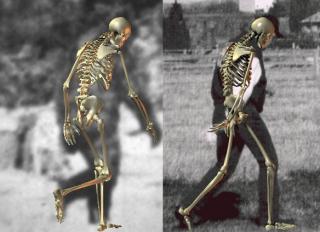
If you look at people (and this is a generalization, as an example) the average human man is I believe about 5' 9" or so. A shorter man may have shorter legs in proportion to his torso, and a much taller man might have much longer legs in proportion to his torso. My earlier study of anatomical proportions found an unusually short lower leg, a curious trait. I would expect to see that on a short man, but not a tall man.
In this case, there's no argument that functionality is impaired, but there is consideration for the likelyhood a human of a given height might have short lower legs.
So there would be a probability of what percentage of the human population has a specified height, and then what percentage of that group has the short lower legs. As you add conditions, the probability of how many people fit the description diminishes.
An obvious line of criticism would be that A) The height is wrong, and B) the short lower leg proportion is wrong, or C) the statistical data on percentages of population with the specification is incorrect.
Any argument for percentages of people who "fit" must address these anticipated criticisms.
My Quote:
"A determination of height, if it can be accomplished (and I acknowledge here many forum contributors have gone on record saying it cannot, so this is a hypothetical remark, emphasis on the "IF"), must then look at proportions of humans of similar size to consider if Patty's proportions are "normal" for a human of that size."
"If I follow this correctly, it is reiterating what I just deduced from the prior statement. So then it must follow by this that you are looking to establish a significant height for Patty in order to realize your predictions. Like something 7 ft or above?"
I am looking to establish her height, yes. I have doubts that she's 4' 3" and so, as Longtabber noted earlier in this thread, there must be something wrong with one of three numbers (the size of patty in the frame, the distance she is from camera, or the lens focal length). That optical formula has no agenda and it isn't biased. You just plug in three numbers and get a fourth (in this case, the subject's height). If I can determine with some confidence what the three numbers are, I'll let the formula determine the height.
"How am I doing so far? Please correct me if I have misunderstood."
You seem to be doing okay so far.
Bill





 Here you can see, Bill: