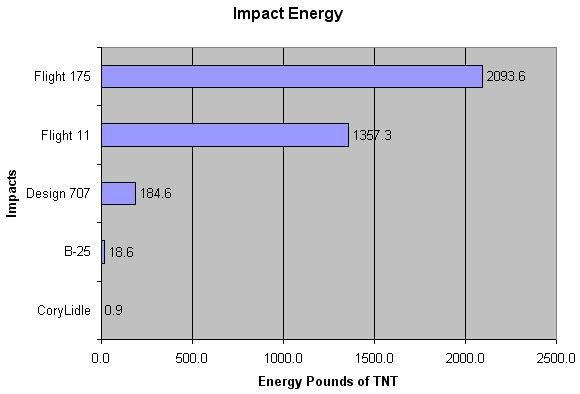
A 600 mph 707 would kill people inside the WTC, and thus the study based on shearing/topple the WTC is worthless, and meaningless. The white paper was BS, and ignored the physics of what would be a massive kinetic energy impact and massive jet fuel fireball if the plane was loaded...
An engineer would want to stop an accident like the ESB B-25 killing and ripping through office space, even at 18 pounds of TNT in kinetic energy.
The goal is to stop damage to the interior, save people... With the WTC this became easy to design since the interior columns are moved to the shell.
Moving interior columns to the exterior shell, the WTC tower would stop aircraft impacts from doing interior damage for an accident aircraft. (at 180 mph)
https://www.nae.edu/Publications/Br...ecurity/ReflectionsontheWorldTradeCenter.aspx
https://www.nae.edu/File.aspx?id=7345
Robertson planned on stopping an aircraft lost at 180 mph at the shell. The following study found it takes a speed of 130 m/s to enter the WTC shell. Thus the 80 m/s impact Robertson planned on would be stopped outside the WTC.
130 m/s impact has the kinetic energy of 500 pounds of TNT
Robertson's design was for 184 pounds of TNT at 80 m/s.
The impacts of 11 and 175 were 1300 and 2000 pounds of TNT.
ftp://ftp.ecn.purdue.edu/ayhan/Korucu/Karim and Fatt_(ASCE)0733-9399(2005)131_10(1066).pdf
I think I said increasing the thickness of the steel to 1/2 inch would stop the attacks on 911... meant to say > 20 mm... oops
The 707 at 600 mph comes from the WTC white paper, not from the guys who did the WTC structural design. Who cares if a plane ripping through the towers is going to topple it, when you want the plane to stop at the shell and spare the people inside from being ripped up and smashed into the core...
Thus the 600 mph study/easy wind conversion to impact impulse survival is BS. The fireball could kill all on the floors hit.
An aircraft at 600 mph is not an accident, it is a weapon of mass destruction.
The WTC would not stop 600 mph, the plane will enter and damage parts of the core. If you want to design for a bigger impact you have to increase the thickness of the steel. If you want to know the limits of the building you ask the structural engineer, not some white paper used as a marketing tool.
I love it... With Robertson explaining he did design to resist a 707 at 180 mph, he also looks at the possible energy of faster and larger aircraft to say this... This is perfect for 911 truth dolts who can't figure out 911.
This means if you want to design to stop the larger aircraft and possible fires;;; you have to put of the $$$$$$$$$$$$...
The design of the WTC was easy for stopping a 707 at 180 mph; if you could have the WTC stand with thinner steel as built... and it would not stop a 707; then you add thickness to match your design point of stopping the 707 at 180 mph. As the paper above found, increasing the thickness of the WTC to over 20 mm would stop the 911 attacks. Have to check the speeds they used...
I keep seeing BS about how in the "old" days it was impossible to design for this or that because there were no supercomputers. What a load of BS.