• Security incident: ISF was recently accessed by intruders. Please change your password, and change it anywhere else you used it. Read more

WTC7 and the girder walk-off between column 79 and 44

Status
Not open for further replies.
Tony,

there you go again, making a global claim of "impossibility". You think you have proven it, but most disagree. More importantly, the reverse positive claim of CD hasn't been proven positively, and you don't even claim it has - do I read you correctly on that count?


I am curious. I think you are genuinely convinced of your claims.

In june 2007, you were roughly the 100th signer of the AE911Truth petition. At the time, the NIST-report on WTC7 wasn't out yet, and no one had written a paper on "active thermitic material found in the WTC dust". Yet, at the time (this is june 7th, 2007), ae911Truth.org already had the following claims about WTC7 on their front page:
As your own eyes witness - WTC Building #7 (a 47 story high-rise not hit by an airplane) exhibits all the characteristics of a classic controlled demolition with explosives:
1. Rapid onset of “collapse”
2. Sounds of explosions at ground floor - a full second prior to collapse (heard by hundreds of firemen and media reporters)
3. Symmetrical “collapse” – through the path of greatest resistance – at free-fall speed — the columns gave no resistance
4. Squibs, or “mistimed” explosions, at the upper 7 floors seen in the network videos
5. “Collapses” into its own footprint – with the steel skeleton broken up for shipment
6. Massive volume of expanding pyroclastic dust clouds
7. Tons of molten Metal found by CDI (Demolition Contractor) in basement (no other possible source than an incendiary cutting charge such as Thermate)
8. Chemical signature of Thermate (high tech incendiary) found in slag, solidified molten metal, and dust samples by Physics professor Steven Jones, PhD.
9. FEMA finds rapid oxidation and intergranular melting on structural steel samples
10. Expert corroboration from the top European Controlled Demolition professional
11. Fore-knowledge of “collapse” by media, NYPD, FDNY​

I am wondering, Tony: Did you believe back then that all these claims were true? Do you still believe they are true? Notice that these are not only 11 claimed facts about WTC7, but also 11 accompanying claims that these 11 alleged facts are "the characteristics of a classic controlled demolition with explosives", and additionally 11 implied claims that these alleged facts are not also characteristic of a natural collapse, so we actually have 33 claims here:

1a. The "onset" of WTC7's collapse was in fact "rapid".
1b. This is a characteristic of a classic controlled demolition with explosives
1c. This cannot be a characteristic of an unassisted progressive collapse.

2a. Hundreds of firemen and media reporters in fact heard sounds of explosions at ground floor - a full second (not much sooner or later!) prior to collapse
2b. This is a characteristic of a classic controlled demolition with explosives
2c. This cannot be a characteristic of an unassisted progressive collapse.

3a. Collapse was in fact "symmetrical" collapse, it was in fact "through the path of greatest resistance", it was in fact "at free-fall speed" and in fact "the columns gave no resistance"
3b. This is a characteristic of a classic controlled demolition with explosives
3c. This cannot be a characteristic of an unassisted progressive collapse.

4a. "Squibs, or mistimed explosions", at the upper 7 floors were in fact seen in the network videos
4b. This is a characteristic of a classic controlled demolition with explosives
4c. This cannot be a characteristic of an unassisted progressive collapse.

5a. WTC7 did in fact "collapse into its own footprint", and the steel skeleton was in fact "broken up for shipment"
5b. This is a characteristic of a classic controlled demolition with explosives
5c. This cannot be a characteristic of an unassisted progressive collapse.

6a. There was in fact "massive volume" of expanding "pyroclastic dust clouds"
6b. This is a characteristic of a classic controlled demolition with explosives
6c. This cannot be a characteristic of an unassisted progressive collapse.

7a. There were in fact "tons" of "molten Metal" found by CDI (Demolition Contractor) in basement, and there is in fact "no other possible source than an incendiary cutting charge such as Thermate"
7b. This is a characteristic of a classic controlled demolition with explosives
7c. This cannot be a characteristic of an unassisted progressive collapse.

8a. The "chemical signature of Thermate" (high tech incendiary) was in fact found in slag, solidified molten metal, and dust samples by Physics professor Steven Jones, PhD.
8b. This is a characteristic of a classic controlled demolition with explosives
8c. This cannot be a characteristic of an unassisted progressive collapse.

9a. FEMA did in fact "rapid" oxidation and "intergranular melting" on structural steel samples
9b. This is a characteristic of a classic controlled demolition with explosives
9c. This cannot be a characteristic of an unassisted progressive collapse.

10a. The "top European Controlled Demolition professional" did in fact give expert corroboration for all this
10b. This is a characteristic of a classic controlled demolition with explosives
10c. This cannot be a characteristic of an unassisted progressive collapse.

11a. The media, NYPD, FDNY did in fact have "fore-knowledge" of collapse
11b. This is a characteristic of a classic controlled demolition with explosives
11c. This cannot be a characteristic of an unassisted progressive collapse.


Tony, 33 claims - some of these actually multiple claims. I am wondering:
Do you agree with ALL of them? Or with how many of these 33 do you agree?
If not, how many do you disagree with - i.e. you think they are FALSE?
How many do you have no opinion on (or a "don't know" or "depends on unknowns" or "I don't understand what that's even supposed to mean")?


As for me,
  • I agree with 11 of the 33 claims
  • I disagree with 16
  • I can't decide on 6

Note that the claims I agree with are mostly the b- or c-parts of these claims; for example, I agree that explosions are typically heard by hundreds of people before an actual explosive CD, and that this is not characteristic for natural collapses; however I strongly disagree that many people heard such explosions a second prior to collapse.

Occasionally, I agree with with the a-claim - for example that there were squibs, but I disagree with the implied claim that this is not also typical for natural collapses.

In none of the 11 cases do I agree with both the a-claim and the b- or c-claim.


Tony, just your numbers. I am curious.

In general, I can tell you that I do not agree that everything pointed to as evidence by everyone who believes the towers and WTC 7 were brought down in artificial ways is fully indicative of that in and of themselves, and even think some are somewhat weak arguments. However, I do believe the cumulative case for artificially caused collapses is convincing. Part of the destruction caused in a controlled demolition is caused by natural forces.

I would compare it to a case where a man was found dead in the street with round holes in his body with powder burns around some of them and most believed he was shot at close range, although there was a long laceration which some insisted was indicative of stabbing and said the round holes could have been caused by an ice pick. Unfortunately, the body was not autopsied and the controversy continued. However, the controversy over the laceration wound and the point that an ice pick could have been used do not eradicate the evidence for shooting provided by the round holes with powder burns and that evidence does not rule out stabbing. In fact, there could have easily been a dual stabbing/shooting at close range, but the powder burns prove shooting at the very least.

One example you did not provide is that brought up by Anders Bjorkman concerning his claim that rubble can't destroy a building. What rubble actually can't do very well is to provide a dynamic load, but if there is enough of it falling onto floors below quasi-static failures will take place. Pulverization of the concrete is another point that I don't necessarily see as proving things one way or another. The dust found away from the buildings was largely gypsum and I don't believe there was more than about 15% of the concrete actually fully pulverized to a fine dust.

I am not going to discuss this at length here, as this thread is about the girder walk-off alleged by NIST in WTC 7.
 
Last edited:
Thanks for answering, Tony :)

I am not going to discuss this at length here, as this thread is about the girder walk-off alleged by NIST in WTC 7.
Oh absolutely, I wasn't going to go into much detail at all, just wanted to see if you are capable of being critical the other way, since you signed a document that was largely supported by alleged evidence about an event before the official investigation of that event was published; apparently you knew all you needed to know back then already.

In general, I can tell you that I do not agree that everything pointed to as evidence by everyone who believes the towers and WTC 7 were brought down in artificial ways is fully indicative of that in and of themselves, and even think some are somewhat weak arguments.
Are you working, behind the scene perhaps, or somewhere publicly, to have these weak arguments changed or pulled? How worried are you that the "Gage Report on WTC7" contains serious flaws?

However, I do believe the cumulative case for artificially caused collapses is convincing.
I accept that this is your belief.

Part of the destruction caused in a controlled demolition is caused by natural forces.
Got an idea how large that part it?

I would compare it to a case where a man was found dead in the street with round holes in his body with powder burns around some of them and most believed he was shot at close range, although there was a long laceration which some insisted was indicative of stabbing and said the round holes could have been caused by an ice pick. Unfortunately, the body was not autopsied and the controversy continued. However, the controversy over the laceration wound and the point that an ice pick could have been used do not eradicate the evidence for shooting provided by the round holes with powder burns and that evidence does not rule out stabbing. In fact, there could have easily been a dual stabbing/shooting at close range, but the powder burns prove shooting at the very least.
I don't really know what's the simile in WTC7 to the round holes with powder burns? Your main argument seems not to be "this man had round holes with powder burns" but "it is impossible that this man died by an accident". Specifically which of the claimed facts that Gage presents about WTC7 now or presented then is as good as round holes with powder burns on a dead man?

One example you did not provide is that brought up by Anders Bjorkman concerning his claim that rubble can't destroy a building. What rubble actually can't do very well is to provide a dynamic load, but if there is enough of it falling onto floors below quasi-static failures will take place. Pulverization of the concrete is another point that I don't necessarily see as proving things one way or another. The dust found away from the buildings was largely gypsum and I don't believe there was more than about 15% of the concrete actually fully pulverized to a fine dust.
I didn't bring those up because Gage didn't bring them up concerning WTC7 at the time you filled out his internet form. I am glad though you find the "pulverization" argument to be bogus. You really didn't have to bring up Bjorkman, too easy a strawman to burn ;)
 
This is just silly nonsense which is either what one might actually call the result of an overactive conspiracy theorist type imagination, or an attempt at trying to protect the real criminals involved in the crime by making it look like those who want a new investigation are somehow involved in a conspiracy themselves. It is rather hard to make a significant number of scientific people look like loony conspiracy theorists, so it appears the fallback approach here is to try and discredit by making it look like a money making scheme.
No, really, it's not. Every "scientific person" associated with "9/11 Truth" looks like a loony conspiracy theorist per se. No fallback approach needed. You know that scared look in the wide eyes of people you tell your conspiracy theories to? That's a sane person assessing your 'scientific person-ness.'

The reality is I haven't made a dime off of 911 and neither have the other engineers, architects, physicists, and others that I know who are demanding a new investigation into how those buildings actually came down. In fact, my involvement here has cost me money. Nobody paid me to travel to NYC several times over the last several years, including the time I went to the studio which filmed the debate between Ryan Mackey and myself. I traveled on my own dime every time except for once. That was when Fox News sent a limousine driver to pick up Bob McIlvaine and myself in South Jersey, when we appeared on the Geraldo Rivera show in Nov. 2010. That was to ensure we were there and didn't have travel problems. We were not paid for our time and the only thing we got while waiting was free coffee.
So you stated the last time I asked you. So a bunch of engineers, architects, physicists, and others are wasting their own free time doing work for the guy that is getting paid.

eta - just noticed the highlighted phrase. "Those buildings" plural? I thought it was just WTC7?


Richard Gage is paid about $75,000 per year as the spokesperson for the AE911Truth group and that represents a paycut from what he was making prior to going fulltime with the effort.
1 - He makes over $80k, and six figures with expenses.
2 - It doesn't matter if it's a pay cut. He makes money promoting lies and fleecing gullible, paranoid people. Taking less money to do so makes that OK? :boggled:

Get real. The guy looks wore out every time I see him.
[insert crybaby icon here]

He just did a 32 city tour in 50 days to present the Experts Speak Out movie. That isn't something most people want to do.
Yeah, traveling to 32 cities sounds really horrible to most people. Buy yourself a clue, Tony.

I guess the only good news is that, based on their numbers, Gage's gig is just about up. They couldn't do anything based on the TV ad, or the recent ad in Village Voice. The rate of signing / membership is slowing to the point of dead. I wonder if Tony will help with Gage's next scam; probably something with vaccines or medicine.

That means there are others at large who had a hand in the events in NYC on Sept. 11, 2001.

Who were these people? How did they cause the collapse? Where are they now?

Indeed.
 
Last edited:
I would compare it to a case where a man was found dead in the street with round holes in his body with powder burns around some of them and most believed he was shot at close range, although there was a long laceration which some insisted was indicative of stabbing and said the round holes could have been caused by an ice pick.
Bad example. There's no powder found here, only cloth dye that is claimed to be an exotic kind of powder.
 
My highlites.
In general, I can tell you that I do not agree that everything pointed to as evidence by everyone who believes the towers and WTC 7 were brought down in artificial ways is fully indicative of that in and of themselves, and even think some are somewhat weak arguments. However, I do believe the cumulative case for artificially caused collapses is convincing. Part of the destruction caused in a controlled demolition is caused by natural forces.

You can't build a convincing case from the sum of false bits.

I would compare it to a case where a man was found dead in the street with round holes in his body with powder burns around some of them and most believed he was shot at close range, although there was a long laceration which some insisted was indicative of stabbing and said the round holes could have been caused by an ice pick. Unfortunately, the body was not autopsied and the controversy continued. However, the controversy over the laceration wound and the point that an ice pick could have been used do not eradicate the evidence for shooting provided by the round holes with powder burns and that evidence does not rule out stabbing. In fact, there could have easily been a dual stabbing/shooting at close range, but the powder burns prove shooting at the very least.

From these facts, death by shooting/stabbing is NIST's conclusion. The truther conclusion is death by brain cancer from plutonium poisoning.


One example you did not provide is that brought up by Anders Bjorkman concerning his claim that rubble can't destroy a building. What rubble actually can't do very well is to provide a dynamic load, but if there is enough of it falling onto floors below quasi-static failures will take place. Pulverization of the concrete is another point that I don't necessarily see as proving things one way or another. The dust found away from the buildings was largely gypsum and I don't believe there was more than about 15% of the concrete actually fully pulverized to a fine dust.

I am not going to discuss this at length here, as this thread is about the girder walk-off alleged by NIST in WTC 7.

Enormously wrong yet again.
Here is a small rubble load producing a substantial dynamic load, proven by experiment and predictive calculation. (Dave Thomas) This reminds me of people who believe that heavier objects fall faster than lighter objects, and that a jolt is expected from columns that don't fall axially and simultaneously onto each other.
http://www.nmsr.org/nmsr911a.htm

I am not going to discuss this at length here, as this thread is about the girder walk-off proven by NIST in WTC 7.
 
Last edited:
Enormously wrong yet again.
Here is a small rubble load producing a substantial dynamic load, proven by experiment and predictive calculation. (Dave Thomas) This reminds me of people who believe that heavier objects fall faster than lighter objects, and that a jolt is expected from columns that don't fall axially and simultaneously onto each other.
http://www.nmsr.org/nmsr911a.htm

Dave Thomas' example is misleading as the rice is in a bag and that causes it to act much more in unison than if the rice was poured freely onto the scale. Pour a known weight of rice freely onto a scale yourself and you will see. I was speaking about loose rubble, not rubble in a bag.
 
Last edited:
I think you mean if the mass and acceleration of the rubble were given enough time to smooth out and be dispersed. Force is a function of mass and acceleration regardless of whether the the mass is "loose" or it's contained (you're twiddling of the semantic there is irrelevant to the actual physics you're discussing). This discussion should not need to be reiterated....
 
Last edited:
So... not only do large buildings need not fear fire. Now skiers should have no fear of avalanches. Got it.
 
I think that idea was already brought up a million times in the past... This rubble argument was had ages ago... the framing of it is - putting nicely - unrealistic. And it just wrecked the thread again from it's original discussion on the girder failure in the building. Seriously... force, mass, acceleration, and surface area factors are already well enough established that this derail doesn't even need to continue. :\

I know... I know... I'm guilty too this time....

Although I think the derail is still sort of useful for pointing out that the dissenting argument that the beam should not have failed is based on similar simple and easily correctable errors. Not that such a point hasn't already been made
 
Last edited:
I think that idea was already brought up a million times in the past... This rubble argument was had ages ago... the framing of it is - putting nicely - unrealistic. And it just wrecked the thread again from it's original discussion on the girder failure in the building. Seriously... force, mass, acceleration, and surface area factors were already well enough known that this derail doesn't even need to happen :\

I know... I know... I'm guilty too this time....

I think he forgets that in order to deflect, the rice would have to impact something first...
 
Enormously wrong yet again.
Here is a small rubble load producing a substantial dynamic load, proven by experiment and predictive calculation. (Dave Thomas)
Some months ago I gave quite some thought to the problem of dynamic vs. static load, and loose rubble vs. solid blocks, and unless someone proves me wrong in the explanation that follows I have to partially agree with Szamboti here, and to apologize to him for some previous mistakes on the subject I've made.

For simplicity, let's model a column as a spring attached to a platform, on which you drop an object from a certain height. Depending on the height and the mass, the spring will contract more or less. Since we're using a spring as a simplified model for a column, we'll consider that beyond a certain length of contraction the column will be considered to buckle. But if it doesn't go beyond that length, the spring will recover and oscillate up and down. Let's consider pure plastic impacts only (the falling object becomes one with the platform attached to the spring on which it falls, i.e. it doesn't bounce).

If you drop a second object in the same conditions as the first one (meaning same mass and height) while the first is still oscillating, depending on the point of the period you drop it at, you can get something from an amplified effect (i.e. the spring contracts up to twice what it was contracting before) to a reduced effect (i.e. the spring contracts less). If the spring had already stopped oscillating due to friction, what you have as a result is the sum of a static load plus a dynamic one. If the second object comes early in the beginning of the period, chances are the effect will be amplified, if it comes at half the period (while the first object is ascending), it will be reduced. Resonance can be a factor too: if the new object hits at a time that is a multiple of the period, the effect will also be greater than 1 static object resting on the spring plus 1 dynamic impact.

Therefore, the period of the spring plus object system is a factor when the second object arrives.

Now, "loose rubble" can be seen a succession of objects falling.

What happens in the case of the scale and rice? We have a relatively slow oscillating system (I bet it won't go past 5 Hz without any mass on it and the frequency will decrease as mass is added) and a succession of rice grains impacting it. The interval between each rice grain adding its contribution to the dynamic effect is probably in the order of microseconds or nanoseconds, therefore it's expectable that every next object that reaches the system does so very early in the period, thus being basically indistinguishable from a single object falling on the spring. It would be interesting to see how that varies quantitatively as rice is poured more slowly.

After looking for information, I estimated that the spring constant for a more or less typical column to which an 1 ton object is dropped makes its oscillating period be in the order of milliseconds (specifically, I calculated that a 12 m steel column with Young's modulus 200*109 N/m2 with 0.05 m2 surface attached to a 1000 Kg mass had a period of about 14 ms).

Therefore, depending on the looseness of the rubble (or, more formally, on the frequency at which objects in the rubble hit the column), it's possible that the column recovers without suffering a dynamic effect similar to what it would suffer if instead of loose rubble it was a single object. You'd need more than about 150 objects of 1000kg each hitting per second (or a resonance effect) for the dynamic load to accumulate.

The numbers may differ wildly from a proper analysis and I expect errors by a factor of 3 or more to be expectable. But the bottom line is that I am now convinced that the answer is not so simple as "being loose makes no difference vs. a single object".

That said, the volume and density of rubble in the WTC towers probably was more than enough to contribute most of its load as dynamic.
 
Last edited:
You're on the right track, but it's actually simpler than that. Think of each individual impact contributing to displacement rather than try to reconcile with the concept of static load.

At a certain maximum displacement, i.e. strain, the lower structure will fracture. If you trickle out pieces slowly enough that you're just randomly striking an overdamped spring, then you're not likely to do much damage. But if they hit fast enough that the structure doesn't spring back in time, it's going to buckle.

This is also an optimistic viewpoint as there are other factors caused by impact -- fracture, high strain rate effects, abrasion, stress waves. Not likely to be much of a factor at such low speeds, mind you, but always be careful of oversimplifying the problem.

In this case, however, there is no problem at all. Once the load isn't carried by the columns but is primarily dumped on the floors, it's all over. Doesn't have to move, doesn't have to be intact, doesn't have to dynamically load anything. It simply will not hold. That's what breaking up the descending portions does: It guarantees that it can't all be gracefully balanced on the structure.

You'll note that nobody gives this crackpot idea a second thought in the actual engineering community.
 
At a certain maximum displacement, i.e. strain, the lower structure will fracture. If you trickle out pieces slowly enough that you're just randomly striking an overdamped spring, then you're not likely to do much damage. But if they hit fast enough that the structure doesn't spring back in time, it's going to buckle.
Thanks. That's the idea that I was trying to convey, but I was unable to summarize it so wonderfully. Well done :)


This is also an optimistic viewpoint as there are other factors caused by impact -- fracture, high strain rate effects, abrasion, stress waves. Not likely to be much of a factor at such low speeds, mind you, but always be careful of oversimplifying the problem.
Yes, thank you, though at least it served me to realize that things were not so simple as I first imagined them.


In this case, however, there is no problem at all. Once the load isn't carried by the columns but is primarily dumped on the floors, it's all over. Doesn't have to move, doesn't have to be intact, doesn't have to dynamically load anything. It simply will not hold. That's what breaking up the descending portions does: It guarantees that it can't all be gracefully balanced on the structure.
We still need a mechanism for the destruction of most of the core. Is it because it's laterally unsupported and in these conditions it will easily give way with little lateral movement induced by the falling rubble (as I assume probably happened at the base of the remaining portions of the cores too)?
 
The core remnants of WTC 1 and 2 are probably not even self-stable once the perimeter (and some of the outer core columns) are gone. Certainly not stable with the huge and eccentric load from the rubble heap at their bases. Plus they likely sustained actual damage in the first phase of collapse.

I'm sure others can add a lot more detail, but frankly, their collapse is not even slightly surprising to me.
 
...We still need a mechanism for the destruction of most of the core. Is it because it's laterally unsupported and in these conditions it will easily give way with little lateral movement induced by the falling rubble (as I assume probably happened at the base of the remaining portions of the cores too)?
If you work from the perspective of the available mechanisms:
A) There is a definable point in the transition from 'collapse initiation' to 'collapse progression'. It is this: Once the top portion of tower starts to descent two situations apply almost by definition in the core. They are:
(1) All the columns have failed or are in the process of failing with no way to stop failing; AND
(2) Each of those failed columns is already in the situation where the top portion is bypassing its lower section OR (allowing for various forms of failure) it is descending where bent and buckled ends could come into compact but will not re-establish axial end for end load carrying relationship.
THEREFORE
B) The principle method of interaction - where 'top portion of core' lands on 'bottom portion of core' will be horizontal beam on horizontal beam. And they will be overwhelmed and fail by shearing off the core columns similar to how the OOS floor joists failed by shearing off the columns.

The complications of accumulating debris and columns bent out of line will not effect the beam on beam impact as the major factor - all those other forces will be either second order or the relevant bit of debris would simply become intermediary 'padding' with the main mechanism still beam on beam.

So the core failure will be (primarily):
P) Strip down of beams;
Q) Leaving single columns to either topple or be knocked over. See the famous 'spires'.

AND
R) This will be ahead of any gross instability of the core remaining standing as an integral but unstable structure.

And none of that reasoning is significantly affected by other factors such as tilt of the top portion OR leading/lagging between different zones of the OOS OR The minor misalignment between core and OOS - such that some bits of core land on OOS floors rather than core.

So
Is it because it's laterally unsupported and in these conditions it will easily give way with little lateral movement....
... that was potentially a factor but it probably never reached the stage where it could come into effect. The stripped down core meaning no integral core left to be unstable - it was already gone.
 
...I'm sure others can add a lot more detail, but frankly, their collapse is not even slightly surprising to me.
No surprise to me either.

Try this as my long held explanation:

If we accept the 'three components' understanding of the collapse progression viz:
1) Floors fail rapidly down the outer tube of open office space;
2) Leaving the outer perimeter to fall over or be pushed by debris (matters not which); AND
3) The core also collapsed by some mechanism therefore what mechanisms are available?

I suggest there are only two plausible broad concept core collapse mechanisms - and details don't matter. Those two options for 'how the core collapsed' are either:
A) It was taken to pieces by the falling mass of top portion and debris - details don't matter - the point is it was 'taken apart' as the mass fell on it. And, it necessarily follows, at near enough the same time'; OR
B) It survived after the falling mass passed and long enough for an unstable tower to remain to fall due to its own inherent instability - possibly in (i) portions of multiple storeys height but not (ii) full tower height.

I don't think there is any evidence for "B)", either B(i) or B (ii), so I back "A)" which happens to align with my explanation in the previous post to pgimeno.

So two 'part hypotheses' on the table - with same conclusion.
 
Some months ago I gave quite some thought to the problem of dynamic vs. static load, and loose rubble vs. solid blocks, and unless someone proves me wrong in the explanation that follows I have to partially agree with Szamboti here, and to apologize to him for some previous mistakes on the subject I've made.

For simplicity, let's model a column as a spring attached to a platform, on which you drop an object from a certain height. Depending on the height and the mass, the spring will contract more or less. Since we're using a spring as a simplified model for a column, we'll consider that beyond a certain length of contraction the column will be considered to buckle. But if it doesn't go beyond that length, the spring will recover and oscillate up and down. Let's consider pure plastic impacts only (the falling object becomes one with the platform attached to the spring on which it falls, i.e. it doesn't bounce).

If you drop a second object in the same conditions as the first one (meaning same mass and height) while the first is still oscillating, depending on the point of the period you drop it at, you can get something from an amplified effect (i.e. the spring contracts up to twice what it was contracting before) to a reduced effect (i.e. the spring contracts less). If the spring had already stopped oscillating due to friction, what you have as a result is the sum of a static load plus a dynamic one. If the second object comes early in the beginning of the period, chances are the effect will be amplified, if it comes at half the period (while the first object is ascending), it will be reduced. Resonance can be a factor too: if the new object hits at a time that is a multiple of the period, the effect will also be greater than 1 static object resting on the spring plus 1 dynamic impact.

Therefore, the period of the spring plus object system is a factor when the second object arrives.

Now, "loose rubble" can be seen a succession of objects falling.

What happens in the case of the scale and rice? We have a relatively slow oscillating system (I bet it won't go past 5 Hz without any mass on it and the frequency will decrease as mass is added) and a succession of rice grains impacting it. The interval between each rice grain adding its contribution to the dynamic effect is probably in the order of microseconds or nanoseconds, therefore it's expectable that every next object that reaches the system does so very early in the period, thus being basically indistinguishable from a single object falling on the spring. It would be interesting to see how that varies quantitatively as rice is poured more slowly.

After looking for information, I estimated that the spring constant for a more or less typical column to which an 1 ton object is dropped makes its oscillating period be in the order of milliseconds (specifically, I calculated that a 12 m steel column with Young's modulus 200*109 N/m2 with 0.05 m2 surface attached to a 1000 Kg mass had a period of about 14 ms).

Therefore, depending on the looseness of the rubble (or, more formally, on the frequency at which objects in the rubble hit the column), it's possible that the column recovers without suffering a dynamic effect similar to what it would suffer if instead of loose rubble it was a single object. You'd need more than about 150 objects of 1000kg each hitting per second (or a resonance effect) for the dynamic load to accumulate.

The numbers may differ wildly from a proper analysis and I expect errors by a factor of 3 or more to be expectable. But the bottom line is that I am now convinced that the answer is not so simple as "being loose makes no difference vs. a single object".

That said, the volume and density of rubble in the WTC towers probably was more than enough to contribute most of its load as dynamic.

The successive impacts have to occur faster than the elastic wave of the recovery.

There are two problems with Dave Thomas' test with the first being what I mentioned about the rice being in a bag and the second being what you say about the simple scale being slow to recover.
 
Last edited:
The core remnants of WTC 1 and 2 are probably not even self-stable once the perimeter (and some of the outer core columns) are gone. Certainly not stable with the huge and eccentric load from the rubble heap at their bases. Plus they likely sustained actual damage in the first phase of collapse.

I'm sure others can add a lot more detail, but frankly, their collapse is not even slightly surprising to me.

You might be surprised to hear that I don't have a problem with the explanation for the core remnants falling afterward being a simple buckling scenario. The remaining assemblies were clearly in a slender condition and would have been damaged at their bases with possible eccentric loading at places as you say.
 
Last edited:
...
B) It survived after the falling mass passed and long enough for an unstable tower to remain to fall due to its own inherent instability - possibly in (i) portions of multiple storeys height but not (ii) full tower height.

I don't think there is any evidence for "B)", either B(i) or B (ii), so I back "A)" which happens to align with my explanation in the previous post to pgimeno.

So two 'part hypotheses' on the table - with same conclusion.

Aren't the spires (your "Q") a case of B(i)?
 
Aren't the spires (your "Q") a case of B(i)?

Agreed, unless I'm misunderstanding ozeco41.

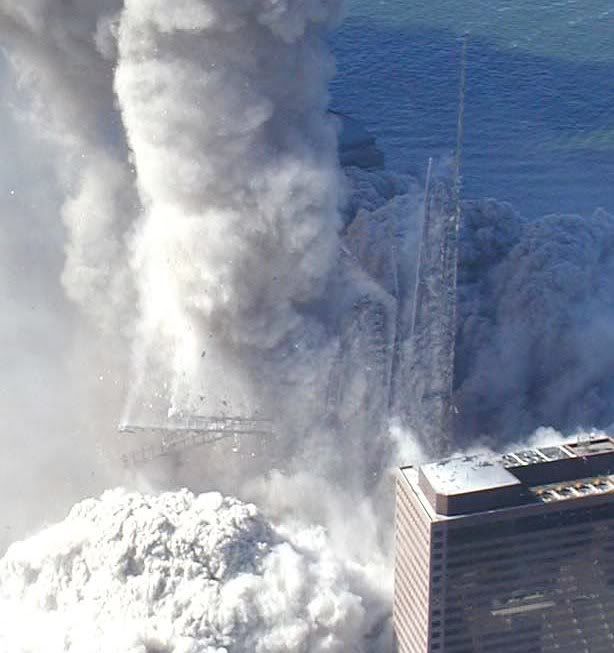
wtc1peelingcore.jpg
 
Status
Not open for further replies.

ISF - Join now!

Every member here is approved by hand. No bots, no spam, just people who care about evidence and honest debate.

Membership is free!

Create your free account

Back
Top Bottom