• Quick note - the problem with Youtube videos not embedding on the forum appears to have been fixed, thanks to ZiprHead. If you do still see problems let me know.

Origin of the paint that was found as red-gray chips - any ideas?

I'm rather excited to find out the results.

gee I wonder what would happened if Jim said it was thermite? :boxedin:
 
I'm rather excited to find out the results.

gee I wonder what would happened if Jim said it was thermite? :boxedin:
Jim and I talked about that on the phone a couple weeks ago. I asked if he was worried if he found thermitic material in the dust, what would happen? Would he get in trouble? Would it be upsetting to him? He said that in his forensic studies he finds unexpected results sometimes and he reports what he sees. That's his job. So, "If I find it I'll publish it." Then WE can deal with the data he reports. Not his problem! This is why I think we've found the right guy for the job.
 
Chris,

Could you give this reference to Jim.
DSC evaluation of binder content in latex paints, C. Pagella*, D.M. De Faveri, Progress in Organic Coatings 33 (1998) 211–217
It's in my white paper (in french) and I thing it will be usefull for him.
The figure 1(a) is very interesting.

;)
 
Last edited:
Chris,

Could you give this reference to Jim.
DSC evaluation of binder content in latex paints, C. Pagella*, D.M. De Faveri, Progress in Organic Coatings 33 (1998) 211–217
It's in my white paper (in french) and I thing it will be usefull for him.
The figure 1(a) is very interesting.

;)

Thanks, Morea, I think that this article you linked is one of not really frequent papers on the DSC measurements of the thermal degradation of polymer binders under air (here binders mostly based on vinylacetate, styrene and acrylics). Problem of DSC is that in usual open (aluminum) sample holder/pan, polymer sample always dramatically losses its mass during heating, it is therefore difficult to relate actual released/absorbed heat to some actual sample mass, and sample moreover losses heat during purely physical processes like evaporation of degradation products. This is why DSC measurements of polymer degradation should be supplemented with thermogravimetric curve (weight loss of the sample). (Btw, theoretically, thermites do not loose their mass after burning, so DSC is a comparatively good method for them).

My tentative abstract of the paper: Although DSC behavior of studied "burned" polymer binders and composites in this paper is complex and even some endothems are observed (e.g. because of evaporation of absorbed water), overall effects/the biggest peaks are generally exothermal and exotherms mostly occur in the range ca 320-480 degrees C (btw in the range of alleged "rapid" nanothermite burning in Bentham paper.) Notably, exotherms here are even broader than in Bentham paper, but also the heating rate was lower (5 degrees/min), so degradation/vaporization of polymers was naturally slower.
Authors revealed (according to expectation) that at high temperatures above ca 450 degrees C, all carbon based (polymer) material is first transformed to (dark) charred polyaromatic residue, which is eventually (at ca 600-800 degrees C) burned completely.

(sorry for rather boring contribution:confused:)
 
Last edited:
Jim and I talked about that on the phone a couple weeks ago. I asked if he was worried if he found thermitic material in the dust, what would happen? Would he get in trouble? Would it be upsetting to him? He said that in his forensic studies he finds unexpected results sometimes and he reports what he sees. That's his job. So, "If I find it I'll publish it." Then WE can deal with the data he reports. Not his problem! This is why I think we've found the right guy for the job.

All this rehashed bat crazy talk is becoming so tedious. Whilst you guys continue to pontificate the nonsense, I'm off to do a bit more skydiving and scuba diving. I'll be back on 1st March. I'm gonna get some samples from the atmosphere and from the reef bed. On my travels I will also be snatching the face masks from the Chinese, dust masks from those on building sites around the world and plan to go through my old MFO box to dig out my S10 respirator filter used in Iraq & Afganistan. Just wondering if ya dear old doc would like to test those too? Perhaps he could find what he is looking for. Just wondering....... I'll give him a fiver!

Get a life folks.
 
Last edited:
Chris,

Could you give this reference to Jim.
DSC evaluation of binder content in latex paints, C. Pagella*, D.M. De Faveri, Progress in Organic Coatings 33 (1998) 211–217
It's in my white paper (in french) and I thing it will be usefull for him.
The figure 1(a) is very interesting.

;)
He has it now
 
Ivan, Chris,

For me this article is very interesting because it demonstrates that the truthers claims about the energy released by chips during DSC (enormous, extraordinary...) are of course totaly fallacious.

Yes, dry paint can release so much energy than chips...
And certain DSC curves match perfectly with their results.
This study proves this fact... and also that truthers are very, very bad chemists!


;)
 
Ivan, Chris,

For me this article is very interesting because it demonstrates that the truthers claims about the energy released by chips during DSC (enormous, extraordinary...) are of course totaly fallacious.

Yes, dry paint can release so much energy than chips...
And certain DSC curves match perfectly with their results.
This study proves this fact... and also that truthers are very, very bad chemists!


;)

Morea, I have not read this paper thoroughly, since linear polymer binders in paints studied were chemically quite different from the cross-linkable polymer binders we expect in steel primer paints (epoxy, linseed-alkyds, polyesters etc.).
Anyway, DSC (thermal behavior) of all polymer binders would be roughly similar, so this paper is still valuable for us. And not so many papers on this topic (DSC of polymers at high/degradation temperatures) are available.

Notably, authors observed released heat/enthalpy in the range ca 3 to 8 kJ/mol, which is much lower (5x to 10x times lower) than the theoretical heat released by complete thermal oxidative degradation of these polymers, see Table 2 "Estimated enthalpies of thermal decomposition" (theoretical values are between ca 20 to 42 kJ/mol). Btw, measured released heats (overal exothermic effects) are in a good agreement with the heats reported in Bentham paper:cool:

Italian authors have not discussed in detail the reasons for these differences between theory and experiments (some of them can be connected with DSC method itself), but it is not so important. For us, they simply provided one of the indirect experimental clues that paints can show similar DSC traces under air as reported in Bentham paper for alleged "nanothermite":rolleyes:

Novadays, DSC and TGA curves can be recorded simultaneously using the same apparatus (e.g. entry Thermogravimetric analysis on Wiki), which is of course an ideal instrumentation for such measurements on thermal degradation of polymers.

(Btw, my link from yesterday to the paper does not work today, so this should be a better link (?)

 
Last edited:
All this rehashed bat crazy talk is becoming so tedious. Whilst you guys continue to pontificate the nonsense, I'm off to do a bit more skydiving and scuba diving. I'll be back on 1st March. I'm gonna get some samples from the atmosphere and from the reef bed. On my travels I will also be snatching the face masks from the Chinese, dust masks from those on building sites around the world and plan to go through my old MFO box to dig out my S10 respirator filter used in Iraq & Afganistan. Just wondering if ya dear old doc would like to test those too? Perhaps he could find what he is looking for. Just wondering....... I'll give him a fiver!

Get a life folks.

Did you here about the scuba diver that was found high up in a tree? :boxedin:
 
Another point that I would want to underline (I know that I have already said that... but it is important)

The thermXte authors have justified the use of ambiant air for their DSC because their reference for the curve comparison (Tillotson 2001 [ref 28]) was realised under air.
It's false.
As Tillotson had impurities in his sample (epoxy residues remains during fabrication process of nanothermite) he has done his test under nitrogen atmosphere. Both first author have confirmed this fact to a friend.

I hope that Jim Milette will contact Tillotson and Gash and confirm this very simple scientific fact in his future paper... And so, the lie of thermite's boys.

;)
 
Last edited:
Morea, I have not read this paper thoroughly, since linear polymer binders in paints studied were chemically quite different from the cross-linkable polymer binders we expect in steel primer paints (epoxy, linseed-alkyds, polyesters etc.).
Anyway, DSC (thermal behavior) of all polymer binders would be roughly similar, so this paper is still valuable for us. And not so many papers on this topic (DSC of polymers at high/degradation temperatures) are available.

Notably, authors observed released heat/enthalpy in the range ca 3 to 8 kJ/mol, which is much lower (5x to 10x times lower) than the theoretical heat released by complete thermal oxidative degradation of these polymers, see Table 2 "Estimated enthalpies of thermal decomposition" (theoretical values are between ca 20 to 42 kJ/mol). Btw, measured released heats (overal exothermic effects) are in a good agreement with the heats reported in Bentham paper:cool:

Italian authors have not discussed in detail the reasons for these differences between theory and experiments (some of them can be connected with DSC method itself), but it is not so important. For us, they simply provided one of the indirect experimental clues that paints can show similar DSC traces under air as reported in Bentham paper for alleged "nanothermite":rolleyes:

Novadays, DSC and TGA curves can be recorded simultaneously using the same apparatus (e.g. entry Thermogravimetric analysis on Wiki), which is of course an ideal instrumentation for such measurements on thermal degradation of polymers.

(Btw, my link from yesterday to the paper does not work today, so this should be a better link (?)

careful with the units, Ivan: It's kJ/g, not /mol ;)

The y-axis of DSC plots in this paper is captioned "heat flow (mW)" - but it should be "mW/mg", I think, which is equivalent to the W/g in Harrit e.al.
I note that the plot in Fig 1a of Pagella and De Faveri nearly reaches 300 mW - if that is indeed mW/mg and not mW/g, this power output more than 12 times higher than that of the most reactive chip in Harrit e.al. (22 W/g).

ETA: And also, Pagella and De Faveri specify competently the parameters of their DSC experiment, by provioding data such as:
A constant air flow was fed to the cell at 200 ml/min flow rate. Open-top aluminium crucibles of 100 mm3 volume were used in each test
Having read a little on DSC in recent weeks, I think I have a beginner's understanding of why the volume and material of the crucible is important (the mass and heat conductivity of the crucible are proportional to the maximum power of reaction where the device can still control temperature; this DSC is not overwhelmd by 300mW/mg, and I am sure Farrer's wasn't overwhelmed by 22mW/mg and would not have allowed temperatures to rise dramatically). Air flow is a more obviously important parameter totally ignored by Farrer and Harrit. I have pointed this out before: Farrer has admitted in an AE911T interview that he was an absolute beginner with the DSC and quickly learned the knobs and turns for just this experiment. So while he probably pushed the right buttons at the right time, he may simply be totally oblivious of what a DSC actually does, and thus how to interprete the results. Thermodynamics is not his specialization. Maybe Harrit should have known better.
 
Last edited:
careful with the units, Ivan: It's kJ/g, not /mol ;)

Sorry, Oystein, this was just "typo":cool: (I'm just finishing one of my papers which is full of units like "something/mol", you know). Thank you for your comments, but for some unknown reasons, both my links to this paper don't work for me now.

Morea, are you really sure in this matter (that Tillotson et al measured their thermites under inert)?
 
Last edited:
Sorry, Oystein, this was just "typo":cool: (I'm just finishing one of my papers which is full of units like "something/mol", you know). Thank you for your comments, but for some unknown reasons, both my links to this paper don't work for me now.

Morea, are you really sure in this matter (that Tillotson et al measured their thermites under inert)?

In the article cited by thermite boys, Tillotson and al. explain (p343 joined below) that their samples contain epoxyde or epoxyde by-products.
So, of course, they have used ultra pure nitrogen atmosphere for their DSC test.
Both first authors have confirmed this scientific fact to a friend by e-mail.

Capture.jpg


Thermite boys lie when they say that these DSC tests have been done under air by Tillotson and al.
 
Last edited:
In the article cited by thermite boys, Tillotson and al. explain (p343) that their samples contain epoxyde or epoxyde by-products.
So, of course, they have used ultra pure nitrogen atmosphere for their DSC test. Both first authors have confirmed this scientific fact to a friend by e-mail.

View attachment 24598


Thermite boys lie when they say that these DSC tests have been done under air by Tillotson and al.

"that their samples contain epoxyde or epoxyde by-products" - abd this is an explanation for why the energy output was lower than what would be expected from the thermite reaction alone, meaning that Tollotson and Gash expected the organics to not react in the DSC - a stong hint that no oxygen was present. Thanks fpr digging that up!
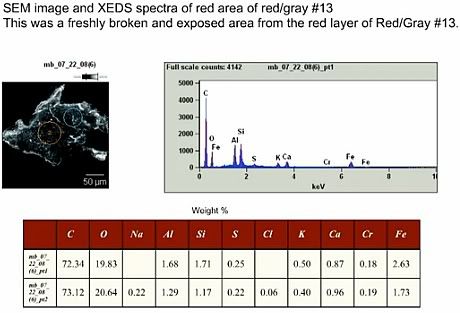
Also, their paragraph seems to imlay that the ~10% organic impurities are the only significant impurities (other than Al-oxide forming on Al), meaning that close to 90% of their sample was Fe2O3 and Al/Al-oxide. Since they intended to optimize reaction stoichiometry for the thermite reaction, and given that perfectly stoichiometric thermite contains 52% by weight iron, this means that about 45% of their 1.5kJ/g nanothermite must have consisted of just the two thermite components.

Contrast this with the quantitative findings of Mark Basile, who is generelly credited by the thermite boys as confirming their results:
Basile_39_30_Chip13_XEDS.jpg

If his 2.63% Fe and 1.68% Al are mixed, then the 2.,63% iron could provide only 1.27% Al with O, i.e. at most 5% of Basile's red layer can be stoichiometric thermite. Only one-ninth the concentration that Tillotson and Gash have. But Basile has a whopping 72% carbon alone! Epoxy may contain carbon and oxygen at a weight ration of 5:1, which means ~14% of the 19.83 O are bound to C, and the rest to the metals and Si, giving Basile a total of 86% organic "impurities". And that's ignoring H, which can't be measured by XEDS, and N, which somehow I think should be in epoxy (like 5-7% of it) but never see...


Tillotson and Gash: 9 parts thermite, 1 part epoxy
Basile; 8.5 parts organics, 1 part other stuff, 0.5 parts "thermite"

What great scientists these are! :D
 
In the article cited by thermite boys, Tillotson and al. explain (p343 joined below) that their samples contain epoxyde or epoxyde by-products.
So, of course, they have used ultra pure nitrogen atmosphere for their DSC test.
Both first authors have confirmed this scientific fact to a friend by e-mail.

View attachment 24598


Thermite boys lie when they say that these DSC tests have been done under air by Tillotson and al.

Thanks, Morea. Here, nobody has been really sure in this regard.

Oystein: up to now, my literature search on the polymer thermal(oxidative) degradation studied by DSC was mostly limited to the degradation of epoxy resins, for apparent reasons (Laclede epoxy paint as a “culprit):cool:

Thanks to your careful reading of Bentham paper we know currently that chips burned in DSC device could be different paint than chips (a) to (d) (all of them or some of them, who knows).
They can be e.g. Tnemec red primer or other paint based on alkyd resins or other curable resins with linseed oil or similar oils. So, the thermal/DSC behavior of such resins is also important for us.

I have just found this paper titled Drying and oxidative degradation of linseed oil, in which DSC behavior of films of hardened/aged linseed oil films was investigated .

Following advices of Chris7, I have made a copy of p. 308, which is here. As you can see on Fig. 7, samples show distinct (but rather broad) exotherms peaking at ca 460 degrees C (heating rate 10 degrees/min, under air). Simultaneously, samples lose mass by oxidative degradation (as is apparent from TGA curves, Fig. 8), the most rapidly at ca 410 degrees C. The overall “picture” is not so far from the behavior of burned Bentham chips:rolleyes:

I’m not saying that I “hit” something here, but it is interesting (and perhaps even important) to know more about expected thermal behavior of various binders, which were (could be) used in primer paints in WTC.

(Btw, one citation of S. Jones from the discussion below announcement of Jim Millette's study on 911Blogger: "Dr. Farrer has ignited a paint sample (what sample? I.K.) in a DSC and the paint sample showed a much broader thermal spike, indicating a relatively slow heat-release (compared to the red/gray chips)." I would like to see this DSC; but it is probably "top secret":cool:)
 
Last edited:
That argument fails.
He is lecturing a vast array of forum members who can mimic any profession they wish with impunity or professional disgrace.

Like you mimic being a television editor? I mean I suppose it's possible. For instance, an experienced television editor'd know the reason why Ace Baker's assertion of realtime simultaneous insertion of a CGI plane GFX using an Avid Media Composer to support his no-planes stance doesn't hold water.

Fitz
 
Like you mimic being a television editor? I mean I suppose it's possible. For instance, an experienced television editor'd know the reason why Ace Baker's assertion of realtime simultaneous insertion of a CGI plane GFX using an Avid Media Composer to support his no-planes stance doesn't hold water.

Fitz

I couldn't care less whether you accept my stated credentials.

You are just trolling for a response.

If you were one of the few people here I trusted and respected, it would be worth my while to provide proof.

I have never supported those absurd no-planer postulations. The idea of realtime insertion of a CGI plane using AMC is so laughable you look like a fool for just referring to it.

Meanwhile, believe what you wish, you will anyway.

MM
 
...
And what do you feel you are doing that is so different, all in the name of the unproven Official Story?

MM
19 terrorists did 911, Evidence you can't touch, it will vaporize your fantasy.
You talk of fantasy thermitic chips, as idiotic as CGI aircraft. You are part of the dumbest movement on earth, and you don't know it.

No big deal, relax, calling Harrit a dork is appropriate on the issue of the thermite scam made up by Jones out of bias, and hate. BYU fired him, and you worship him. He is a god of your religion of delusions, the mystical thermitic chips, which burn at low temperatures, and put out various amounts of heat because at best the chips are dust; plain old dust from the WTC.

You are the same as Ace Baker, you both have delusions. You offer no math, no physics, no logic, just talk. The No-plane nuts claim nothing when a plane is there, and the thermite cult members claim thermite when no thermite is there. Yin and Yang of the big tent of failure, 911 truth.

You see stuff that is not there, they don't see stuff that is there. You spread lies, you don't care, as you troll, unable to present evidence, not able to do experiments. I produced iron rich spheres in my back yard with a lighter, no thermite, and you say iron rich spheres are proof of thermite. You have faulty logic given to you by nuts.

Jones found some dust with common elements found in the earth's crust and you believe his lie of thermite. Fe and Al are common element used in many things, and you fall for the lie of thermite.

Your biggest lie, based on ignorance because you can't process EVIDENCE!
all in the name of the unproven Official Story?
Prove it! Step up to it. Here is a Pulitzer Prize winning statement if true, and all you do is post nonsense about a lie made up by an insane nice old man fired from BYU. What is stopping you from getting a Pulitzer? What? Say it!

EVIDENCE
 
"Another point that I would want to underline (I know that I have already said that... but it is important)

The thermXte authors have justified the use of ambiant air for their DSC because their reference for the curve comparison (Tillotson 2001 [ref 28]) was realised under air.
It's false.
As Tillotson had impurities in his sample (epoxy residues remains during fabrication process of nanothermite) he has done his test under nitrogen atmosphere. Both first author have confirmed this fact to a friend.

I hope that Jim Milette will contact Tillotson and Gash and confirm this very simple scientific fact in his future paper... And so, the lie of thermite's boys.;)"

I originally asked Dr. Harrit that very question at the Toronto 9/11 Hearings last September.

He stated emphatically that the Bentham Paper research team had had clear communication with Tillotson and were told that the DSC testing was conducted in open air.

I have brought your assertion and accusation of lying to their attention and received a prompt reply that they would never engage in such a charade and that their information came directly from Tillotson and Gash.

MM
 

Back
Top Bottom