• Quick note - the problem with Youtube videos not embedding on the forum appears to have been fixed, thanks to ZiprHead. If you do still see problems let me know.

Merged Discussion of femr's video data analysis

Your blindness towards all things NIST clouds your own judgement, as the written record of your posts demonstrates clearly.

It seems you will do anything not to verify claims by the NIST. It is so obvious that you do not want to examine the NIST data further.

Stop lying. I've worked very diligently to verify the claims of NIST, as many of my videos show.

But this thread is not about the NIST data, it's about Femr2's data.

If you must lie openly about me to further the discussion, you must be very desperate indeed. I note that you are simply making personal attacks, and are very far off-topic again.

Please stop doing that.
 
Readers, for a demonstration of how Femr2 is continuing to ignore the requests that he stop posting OT, simply read the OP by TFK, along with the first page of posts.
Here y'are...
I've been playing with femr's data from WTC7 for a while.

Specifically, I've been looking at the calculations of 1st & 2nd derivatives of the data.

The really interesting part (to me) has been the enormous impact on the calculated velocity & acceleration that results from the simple act of increasing the sampling rate.

People have said before that "computers are the fast way known to generate errors." This may be the purest implementation of that adage that I've ever seen.

I'd like to request that everyone (including me) keep this thread to the engineering. There are plenty of other places that we can express our dissatisfaction with each of our perceptions of the other side's politics, agendas, etc.

Here, let's stick to engineering, please.

Femr, one of the critical questions that we've argued about is your claimed "sub-pixel resolution", as produced by the SynthEyes program.

Here's a simple test.

Please pick some points on some other buildings (not WTC7) that have definable points that are comparable (in size, distance, spatial frequency & contrast) to the points on WTC7 that you've tracked, and provide tracings of those feature for several seconds. A couple of tracings of near-to-each-other features (one on WTC7 and one nearby in the frame, but on another building) would be very useful.

Please make sure that all scaling factors are set the same as in your WTC7 traces.

Presumably, that point on that building will be stationary. If there are no "sub-pixel" jumping up & down in those traces, it'll go a long way to showing that the bouncing signal are at least associated with WTC7. Perhaps schlieren effects from heat, if not actual motion of the building.

However, if the signal from a non-impacted building is bouncing just like the WTC7 signal is, then it's pretty clear that source of the trace noise is from some other source. Perhaps the software algorithms.


tom
My bolding.

Discussion of my video analysis is the thread title.

tfk has said one aspect that really interests him.
tfk has suggested ONE of the critical questionS...

That implies there are other aspects of femr2's video data analysis. Other questions.

I shall continue to discuss my video data analysis within this thread titled.... Discussion of femr's video data analysis, of course.

Perhaps the reason you have recently changed your mind from being an active discusser of femr2's video data analysis is that you repeatedly make silly mistakes, which you are not prepared to admit.

http://www.internationalskeptics.com/forums/showpost.php?p=7184413&postcount=1646
http://www.internationalskeptics.com/forums/showpost.php?p=7184420&postcount=1647
http://www.internationalskeptics.com/forums/showpost.php?p=7186181&postcount=1664
http://www.internationalskeptics.com/forums/showpost.php?p=7183931&postcount=1635
http://www.internationalskeptics.com/forums/showpost.php?p=7173046&postcount=1565
http://www.internationalskeptics.com/forums/showpost.php?p=7172318&postcount=1516
...from just recently, or from early on...
http://www.internationalskeptics.com/forums/showpost.php?p=6251220&postcount=96
http://www.internationalskeptics.com/forums/showpost.php?p=6272481&postcount=196
...etc.

You have participated in this thread for almost a year, saying much the same thing (except when you are actually discussing either my video data analysis, or application of my video data analysis to the NIST video data analysis...;) ). I suggest you stop complaining. If you are not interested, don't participate. If there is a particular technical aspect you wish to discuss, go ahead...
 
Since comparison of femr's data with NIST's findings is on topic, let's try a quick test:

My understanding of NIST's explanation for the cause of near freefall collapse of the north upper curtain wall is that it was preceded by, and resulted directly from, multistory buckling of its columns at lower floors.

Given the basic nature and geometry of buckling, multistory buckling of columns must begin with:

a) Primarily horizontal movement of the buckling columns.

b) Primarily vertical movement of the buckling columns.

c) About equal amounts of horizontal and vertical movement of the bucking columns.

d) No movement, either horizontal or vertical, of the buckling columns.

Therefore, observed early horizontal movement of the upper curtain wall just prior to its rapid collapse is:

a) Inconsistent with NIST's explanation of the collapse.

b) Consistent with NIST's explanation of the collapse.

c) Unrelated to NIST's explanation; neither tending to confirm nor refute it.

Respectfully,
Myriad
 
Last edited:
I've worked very diligently to verify the claims of NIST, as many of my videos show.
:) Now then, another aspect to femr2's video data analysis. Best be having a look at your videos. Your recent one supporting the NIST T0 by replicating their inept mistakes is first in line there. Ho hum...busy, busy.

I'll prepare some femr2 video data analysis material related to your diligent videos...
 
Nice deflection attempt, Femr2. Again readers, do try to find the acronym 'NIST' anywhere in the OP or in the thread title.

Take your time....... it isn't there. Femr2 has steadily inserted it into this thread, which means the thread is no longer discussing the OP but has wandered OT.

Time for another thread on the subject that Femr2 wants to discuss. Leave this one the way it is.
 
:) Now then, another aspect to femr2's video data analysis. Best be having a look at your videos. Your recent one supporting the NIST T0 by replicating their inept mistakes is first in line there. Ho hum...busy, busy.

I'll prepare some femr2 video data analysis material related to your diligent videos...

Nice to see you trying to back up MT's bold lie. By actually acknowledging that my videos address the topic directly.... :jaw-dropp
 
Maybe we should just change the title of this thread to 'Whatever Femr2 decides to discuss'. I think that would be more appropriate....;)
 
Since comparison of femr's data with NIST's findings is on topic
<tips hat>

a) Primarily horizontal movement of the buckling columns.
Therefore, observed early horizontal movement of the upper curtain wall just prior to its rapid collapse
Early motion was a complex twisting oscillatory motion, likely to be ahead of any large scale buckling, not simply horizontal.

Oversimplifying is the very last way to progress within this thread I suggest. I think we are all fully aware of the motion of a buckling column. Anyone not .... ?

Step one is to not state complex twisting motion as horizontal, and then suggest that uni-directional buckling behaviour explains all.

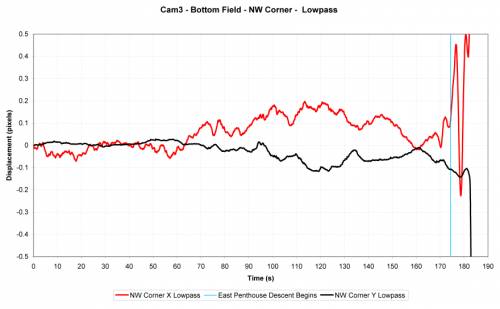
The inflexion in this trace around 160s interests me...
666377698.jpg


Not to mention motion in both horizontal and vertical direction within the image frame from over 100s in advance of release.

I would suggest such early motion has not reached buckling stage.

I think the point of inflexion is a critical point in development of subsequent descent.

If you are referring to the assertion of the NIST trace from the T0 pixel location being primarily north->south, then the immediate observation is that early motion of the NW corner was primarily south->north, opposite. The reason the direction of motion has been highlighted is that from the Cam#3 viewpoint such motion affects the data extracted and treated by NIST as solely vertical motion. Such perspective distortion effects are significantly reduced when tracing from the Dan Rather viewpoint. The NIST early motion interpretation has affected their *stage 1* timing, and so subsequently affected the vertical descent timing and derived values.
 
Last edited:
Early motion was a complex twisting oscillatory motion, likely to be ahead of any large scale buckling, not simply horizontal.

Oversimplifying is the very last way to progress within this thread I suggest. I think we are all fully aware of the motion of a buckling column. Anyone not .... ?

Step one is to not state complex twisting motion as horizontal, and then suggest that uni-directional buckling behaviour explains all.

The inflexion in this trace around 180s interests me...
[qimg]http://femr2.ucoz.com/_ph/7/2/666377698.jpg[/qimg]

Not to mention motion in both horizontal and vertical direction within the image frame from over 100s in advance of release.

I would suggest such early motion has not reached buckling stage.


I completely disagree. Unless some structural members somewhere in the fabric were deforming and causing supported loads to redistribute (that is, buckling), there would be no movement of the corner at all. The only other causes of movement I can think of are thermal expansion/contraction and creep, and those kinds of displacements would be too small to directly account for the observed deformations (including the "bulge" observed much earlier by firefighters).

So, I don't think any claim of "don't know/won't say what the cause of the early movement was, but definitely not buckling" can logically stand. A claim suggesting an alternative cause might, but I know you don't want to do that.

Respectfully,
Myriad
 
I completely disagree. Unless some structural members somewhere in the fabric were deforming and causing supported loads to redistribute (that is, buckling), there would be no movement of the corner at all. The only other causes of movement I can think of are thermal expansion/contraction and creep, and those kinds of displacements would be too small to directly account for the observed deformations (including the "bulge" observed much earlier by firefighters).

So, I don't think any claim of "don't know/won't say what the cause of the early movement was, but definitely not buckling" can logically stand. A claim suggesting an alternative cause might, but I know you don't want to do that.

Respectfully,
Myriad
The scale of motion is rather slight. Take the horizontal motion trace by NIST...
655929457.jpg

...and compare...
http://femr2.ucoz.com/_ph/7/2/666377698.jpg

We're talking about 4 inches. Not within the bounds of creep ?

I'm not saying zero buckling of any columns at all, but certainly suggesting the early motion is prior to *multistory buckling of its columns at lower floors* you were referring to. A minute earlier at least...

Are you suggesting the *multistory buckling of its columns at lower floors* was in action a minute prior to descent of the East penthouse ?
 
Are you suggesting the *multistory buckling of its columns at lower floors* was in action a minute prior to descent of the East penthouse ?


I didn't say "a minute prior," I said "just prior to its rapid collapse", which I thought was pretty clear in referring to NIST's first phase of the upper curtain wall collapse, or about the "start of main collapse" time on your graph. You brought up the prior minute, but there is no rationale for implying that the cause of that much earlier movement must be exactly the same. (Perhaps the same or a similar process, but not likely the same structural members, given the dynamic events going on.)

My point is, the very earliest stage of buckling of any given column involves primarily horizontal movement (cf the exterior column inward bowing in the towers) so it makes sense to consider that phenomenon as the prime suspect for the cause of any early primarily-horizontal movements observed. Whether that movement is overall simple or complex.

I'm pretty sure that 2+ inches displacements in a half minute or so fall outside plausible ranges for displacement directly due to creep. However, I'll readily cede that point if anyone with actual structural performance expertise wants to claim otherwise.

Respectfully,
Myriad
 
I didn't say "a minute prior," I said "just prior to its rapid collapse", which I thought was pretty clear in referring to NIST's first phase of the upper curtain wall collapse, or about the "start of main collapse" time on your graph.
Sure, and as I indicated (you might have missed it as it was an edit)...
If you are referring to the assertion of the NIST trace from the T0 pixel location being primarily north->south, then the immediate observation is that early motion of the NW corner was primarily south->north, opposite. The reason the direction of motion has been highlighted is that from the Cam#3 viewpoint such motion affects the data extracted and treated by NIST as solely vertical motion. Such perspective distortion effects are significantly reduced when tracing from the Dan Rather viewpoint. The NIST early motion interpretation has affected their *stage 1* timing, and so subsequently affected the vertical descent timing and derived values.

I'm not (and haven't been) suggesting horizontal motion as anything strange, simply that the NIST T0 trace suffers from early motion data nasties, throwing out their derived values.

You brought up the prior minute
I did, as I look much further before release when early motion is mentioned (as I have data for it up to about 6 minutes prior. Possibly longer if required at some point.).

but there is no rationale for implying that the cause of that much earlier movement must be exactly the same.
(Perhaps the same or a similar process, but not likely the same structural members, given the dynamic events going on.)
So are you suggesting the motion a minute prior to release was *multistory buckling of its columns at lower floors* or not ? It would be pretty bizarre buckling behaviour given its oscillatory motion...again I think the point of inflexion a critical point (rapid directional change in both X and Y trace direction around the 160s mark.)

My point is, the very earliest stage of buckling of any given column involves primarily horizontal movement (cf the exterior column inward bowing in the towers) so it makes sense to consider that phenomenon as the prime suspect for the cause of any early primarily-horizontal movements observed. Whether that movement is overall simple or complex.
Which is fine(ish) as I rather suspect the motion detected on the facade was not caused by buckling of any columns on the facade at all, but rather from interraction with the core.

I'm pretty sure that 2+ inches displacements in a half minute or so fall outside plausible ranges for displacement directly due to creep. However, I'll readily cede that point if anyone with actual structural performance expertise wants to claim otherwise.
I'd suggest taking into account the amplification of small deformation near the base.


ETA: Made me think of this comment from AlienEntity on his recent video for some reason, not sure why...
Alienentity@YT said:
The main reason I disagree with that POV is that the motion is continuous - it is slight at first but the deformation is both horizontal and vertical - that's very obvious from close-up viewing.

You can always quibble about how much of one thing there was versus how much of another, the very fact that the distance between the floors is even becoming compressed within the first 1 second of my clip is great evidence of the global collapse.
Interpreting the visual information correctly is very important. Interpreting the N-S flexure of the facade as vertical physical compression of the floors ? Hmm. No, don't think so.
 
Last edited:
Personally I'd be surprised if the building wasn't moving and shifting. I would be willing to bet it was shifting and moving all day.

A trace I would like to see is one before, during and after the collapse of the towers.
 
Last edited:
Personally I'd be surprised if the building wasn't moving and shifting. I would be willing to bet it was shifting and moving all day.
Do you agree the point of inflexion as a critical point ?

A trace I would like to see is one before, during and after the collapse of the towers.
I assume you mean of WTC7 during those times ?
(I have plenty traces of WTC1 motion)

Don't think there is any suitable WTC7 footage during those times. If you are aware of such, by all means let me know.
 
Do you agree the point of inflexion as a critical point ?

I'm not sure what it would be "critical" to. Any number of events could have caused it. We're not talking about a perfect rigid structure that accurately telegraphs movements to all parts of the building.
 
I'm not (and haven't been) suggesting horizontal motion as anything strange, simply that the NIST T0 trace suffers from early motion data nasties, throwing out their derived values.


You've also been claiming that NIST's average acceleration figure for the entire north upper curtain wall collapse is too low because their placement of "t0" when the buckling began is too early, because they were fooled by horizontal motion. If the horizontal motion that "fooled them" into thinking buckling was underway actually is part of the buckling then that chain of inference falls apart.

So are you suggesting the motion a minute prior to release was *multistory buckling of its columns at lower floors* or not ?


It seems unlikely given the overall progression of the collapse from interior to exterior, and the relatively early stage. But it is very likely due to buckling of columns somewhere.

It would be pretty bizarre buckling behaviour given its oscillatory motion...


Why would a cycle or two of oscillatory motion be bizarre? If the structural condition of the building is no longer stable, but not yet compromised enough for runaway collapse, oscillation is where the energy would go. Ever heard the phrase "teetering on the brink of collapse?" Teetering = oscillation. Yes that's usually used metaphorically nowadays, but where do you think the metaphor came from?

again I think the point of inflexion a critical point (rapid directional change in both X and Y trace direction around the 160s mark.)


Critical in what way? Do you know how dynamic systems that oscillate work? Typically, the points of "inflection" (min velocity, max acceleration) are convenient time markers but the dynamics of that point are the same as at any other.

Which is fine(ish) as I rather suspect the motion detected on the facade was not caused by buckling of any columns on the facade at all, but rather from interraction with the core.


The early motion, probably true. But during NIST's stage 1 of facade collapse, the motion was likely both: multi-story buckling of facade columns caused by interaction with the core.

I'd suggest taking into account the amplification of small deformation near the base.


Amplification by what mechanism? Or alternatively: how can amplification be taken into account or even assumed to exist, without an established mechanism?

ETA: Made me think of this comment from AlienEntity on his recent video for some reason, not sure why...

Interpreting the visual information correctly is very important. Interpreting the N-S flexure of the facade as vertical physical compression of the floors ? Hmm. No, don't think so.


Putting it that way is begging the question, a la "Interpreting alien spacecraft as weather balloons? Don't think so." You are interpreting certain pixel movements in videos as N-S flexure; of course that is a different and perhaps mutually exclusive interpretation from vertical compression. They're both interpretations and I haven't seen a very strong case for either; yours might be a little stronger but both interpretations so far have been a matter of "what it looks like to me."

Respectfully,
Myriad
 
You've also been claiming that NIST's average acceleration figure for the entire north upper curtain wall collapse is too low because their placement of "t0" when the buckling began is too early, because they were fooled by horizontal motion.
Distorted early vertical motion data, sure. Distorted vertical release point, sure. Distorted vertical descent time, sure...

Derived metrics, such as instantaneous (short timespan average) velocity and acceleration are of course not affected by errant T0 if that short timespan is after their errant early motion data. But full-cycle averages do include that period of time.

If the horizontal motion that "fooled them" into thinking buckling was underway actually is part of the buckling then that chain of inference falls apart.
No. The problem is that the early motion was interpreted as vertical (in full) not slightly vertical, mostly North-South. Put it into perspective...(pun intended ;) )...

The early motion from the NIST T0 pixel location and frame has a significant North-South component. This *fools* them into producing a displacement graph which suggests, say, 3ft of vertical motion, when it may only actually be a few inches...that the motion captured is not purely vertical distorts the early displacement data. Minimising this distortion is obviously desirable. The Dan Rather viewpoint is therefore a much better choice.

If they were after the average acceleration from ANY motion, they could have started it a few minutes earlier, but they were trying to time the vertical motion, and doing so requires definition of the vertical release point T0. Their T0 is a bit before the vertical release point, which skews their average vertical motion data from release point.

The North facade was experiencing motion a while before their T0, and the East penthouse had already descended. Any time prior would do if you're not bothered about starting T0 for motion primarily N-S. They intended their T0 to be the vertical release point. It wasn't, that was slightly later on.

Same thing said in enough different ways ?

It seems unlikely given the overall progression of the collapse from interior to exterior, and the relatively early stage.

But it is very likely due to buckling of columns somewhere.
And several minutes earlier...

...? Still buckling columns ?

Why would a cycle or two of oscillatory motion be bizarre?
As an indication of *multistory buckling of its columns at lower floors* ? I'd expect that to propogate rapidly.

If we've veered towards *a* column or two somewhere buckling, different situation.

The trace above is the previous 4.5 minutes. Are you suggesting column buckling propogation began that early ?

What do you think that would do to the Column 79 theory ?

If the structural condition of the building is no longer stable, but not yet compromised enough for runaway collapse, oscillation is where the energy would go.
Again, how does this fit with the single instigating column 79 event ? Or do you not see it that way ?

Ever heard the phrase "teetering on the brink of collapse?" Teetering = oscillation.
I have indeed, Jenga being the first thing to come to mind, and not a buckle in sight. You seem to be painting a picture of gradual column buckling reaching a point of runaway propogation. Where does column 79 fit into your described behaviour ?

Critical in what way?
Critical in that it is an abrupt directional change from a low frequency oscillation to a much more rapid one followed fairly immediately by release. I'd suggest it indicates, using your analogy, the final teeter.

Do you know how dynamic systems that oscillate work? Typically, the points of "inflection" (min velocity, max acceleration) are convenient time markers but the dynamics of that point are the same as at any other.
To a certain extent. The behaviour after that point is significantly different to that beforehand.

The early motion, probably true. But during NIST's stage 1 of facade collapse, the motion was likely both: multi-story buckling of facade columns caused by interaction with the core.
Stage 1(ish) has the building undergoing global vertical descent, so of course there is going to be buckling during that time.

Amplification by what mechanism? Or alternatively: how can amplification be taken into account or even assumed to exist, without an established mechanism?
It's a tall structure. The simplest analogy that comes to mind...wobble an upright ruler at its base...a little bit...top end motion is rather amplified. Simplified, yeah. I suggest the roofline motion has very little to do with events anywhere near the roofline during the early motion in the minutes leading to release. Clear ?

PYou are interpreting certain pixel movements in videos as N-S flexure; of course that is a different and perhaps mutually exclusive interpretation from vertical compression. They're both interpretations and I haven't seen a very strong case for either; yours might be a little stronger but both interpretations so far have been a matter of "what it looks like to me."
I've repeatedly highlighted comparison between Cam#3 viewpoint motion and Dan Rather viewpoint motion. Dan Rather viewpoint motion would be rather different if that early motion was indeed vertical...the kink does not form in that viewpoint. If there were additional viewpoints it may be possible to determine the actual N-S component but there is a distinct lack of footage. Expressing the information gleaned from comparison between the viewpoints is rather awkward to put into words. Suggest you do it. I can always provide a synchronised Cam#3 Dan Rather view. Scrubbing back and forth through both is very insightful in terms of building visual cue information to interpret the motion correctly.

As for actual compression of storeys, come on. The side effects would be more than visible. Other footage is available, which although no good for tracing, does show this suggestion to be, er, how should I say...physically unreasonable ?

 
Distorted early vertical motion data, sure. Distorted vertical release point, sure. Distorted vertical descent time, sure...

Derived metrics, such as instantaneous (short timespan average) velocity and acceleration are of course not affected by errant T0 if that short timespan is after their errant early motion data. But full-cycle averages do include that period of time.


No. The problem is that the early motion was interpreted as vertical (in full) not slightly vertical, mostly North-South. Put it into perspective...(pun intended ;) )...

The early motion from the NIST T0 pixel location and frame has a significant North-South component. This *fools* them into producing a displacement graph which suggests, say, 3ft of vertical motion, when it may only actually be a few inches...that the motion captured is not purely vertical distorts the early displacement data. Minimising this distortion is obviously desirable. The Dan Rather viewpoint is therefore a much better choice.

If they were after the average acceleration from ANY motion, they could have started it a few minutes earlier, but they were trying to time the vertical motion, and doing so requires definition of the vertical release point T0. Their T0 is a bit before the vertical release point, which skews their average vertical motion data from release point.

The North facade was experiencing motion a while before their T0, and the East penthouse had already descended. Any time prior would do if you're not bothered about starting T0 for motion primarily N-S. They intended their T0 to be the vertical release point. It wasn't, that was slightly later on.

Same thing said in enough different ways ?


One thing said one way: There is no vertical release point.

This is not a rope breaking under tension or a sudden brittle fracture. The hypothesis is multi-hinge buckling of vertical columns. That phenomenon begins with primarily horizontal motion and progresses into vertical motion (going as the sine and cosine of the hinge angles, respectively), but the horizontal and vertical motion share the very same initial instant. Neither can occur without the other.

If anything could be called a release point, it's the point where the hinges of the buckle break, but that happens well after vertical drop is underway. (And most likely happens at different times for different columns in the wall.) The vertical release point is a myth of your own invention.

NIST timed the beginning of vertical motion ("the instant the roofline began to descend"), which would occur with the beginning of buckling, which also includes horizontal motion. If their vertical motion figures were inaccurate due to simultaneous horizontal motion and perspective effects, that might affect the shape of the time versus displacement curve in the earliest moments of Stage 1 (with import yet to be shown), but it does not affect the time span of the overall event.

They didn't time the collapse from "several minutes earlier" because the wall did not collapse several minutes earlier. I don't really know what else to say about that.

Respectfully,
Myriad
 
One thing said one way: There is no vertical release point.
There is no vertical T0 ? Interesting. Wonder if you are going to support the NIST T=0 ? Hmm. Terms quibble, okay...

The hypothesis is multi-hinge buckling of vertical columns.
We were discussing the nature of early motion. Could you respond please.

That phenomenon begins with primarily horizontal motion and progresses into vertical motion (going as the sine and cosine of the hinge angles, respectively), but the horizontal and vertical motion share the very same initial instant. Neither can occur without the other.
Which is fine, though propogation of such movement through the large structure is subject to all manner of other behaviours I am sure you will agree. Are you suggesting all four faces entering into *multistory buckling of its columns at lower floors* sharing the very same instant ? Are you suggesting that such behaviour (of perhaps a portion of one face) will propogate to the roofline in a manner such that your assertion holds true in any measurable or meaningful manner ?

If anything could be called a release point, it's the point where the hinges of the buckle break, but that happens well after vertical drop is underway.
The term has been discussed much, with most agreeing in the current context that it's the point where unrecoverable vertical displacement begins, which is clearly not the point you suggest. Indeed, I have no issue with your phrase a little later in this post "the beginning of vertical motion ("the instant the roofline began to descend")".

The important distinction is deciding where that vertical motion begins, as I'll highlight in a moment, given your stance on this matter...

(And most likely happens at different times for different columns in the wall.)
Absolutely. Interconnected members will of course be affected by all forces, but I'm more than comfortable suggesting a different T0 for different elements.

The vertical release point is a myth of your own invention.
No, it's T=0 for vertical motion, for the purposes of producing displacement data, derived velocity data and derived acceleration data, obviously.

NIST timed the beginning of vertical motion ("the instant the roofline began to descend"), which would occur with the beginning of buckling, which also includes horizontal motion. If their vertical motion figures were inaccurate due to simultaneous horizontal motion and perspective effects, that might affect the shape of the time versus displacement curve in the earliest moments of Stage 1 (with import yet to be shown), but it does not affect the time span of the overall event.
I see your focus is actually upon supporting the NIST values. Hmmm. Well, given your (new?) stance on release point and T=0, perhaps you would like to remind yourself of what you just said...

the horizontal and vertical motion share the very same initial instant
...and...
the beginning of vertical motion ("the instant the roofline began to descend"), which would occur with the beginning of buckling

...and have a look at the motion of the NW corner...

...could you tell me why you don't think that the instant the roofline began to descend ocurred at the 170s, 174s, 179s or 181s marks please ?

Could you explain why you don't think suggesting it occurred around the ~182s mark is valid ? (Or would you put it prior to the 160s mark given there is vertical motion all the way back there?)

After all there is horizontal motion ocurring way back at the 170s mark, and earlier, and in your own words... the horizontal and vertical motion share the very same initial instant.

Please explain. (And your suggested beginning of vertical motion/the instant the roofline began to descend/release point/T=0 from the provided graph would be useful, thanks).

If their vertical motion figures were inaccurate due to simultaneous horizontal motion and perspective effects, that might affect the shape of the time versus displacement curve in the earliest moments of Stage 1
Noted. It does.

They didn't time the collapse from "several minutes earlier" because the wall did not collapse several minutes earlier. I don't really know what else to say about that.
You are discounting motion in both directions because it does not suit your subjective interpretation of when you think the *release point* is.
 

Back
Top Bottom