• Security incident: ISF was recently accessed by intruders. Please change your password, and change it anywhere else you used it. Read more

Merged Jeff Farrer Reshashes Jones's nonsense

Physicist Jeff Farrer:" There were other particles present in the red layer. There were some plate-like particles and those again, were consistent throughout the red layer, throughout all of the samples that we found. Those appeared to have higher aluminum and silicone peaks in their compositional analysis and one of the significant things that we find in the red layer is the fact that these particles that we find in the red layer are..the fact that they are consistent. The fact that they are consistent in shape, in composition, and in size, leads me to believe that these are not naturally occurring materials. The red layer is not a naturally occurring material. Sure you have iron oxide everywhere that you have iron you get an iron oxide. But you don't get them in nice little 100 nanometer rhombohedral shaped particles inside of a very small red layer. By the way, just to give you a reference on the size, these particles that are in the red layer are thousands of times smaller than the width of a human hair. So these are very sophisticated particles of very sophisticated materials. Not materials that we would expect to find in the demolition debris of a building. In order to get that kind of consistency with shape and size and to be that small, these really are sophisticated materials. And probably only developed in a laboratory. They maybe processed outside a laboratory but they are developed in a laboratory."


Physicist Jeff Farrer:"Our conclusions were that the red/gray chips are some form of thermite or nano-thermite or an energetic material which is very similar to thermite. It is a very strong conclusion given the data. Now others may say; could it be something else? Certainly. It certainly could be something else.
I am not about to say that we've completely ruled out everything. But, those conclusions we made in the paper are very strong given the data. If there is another possibility, that is something someone can come forward with using the same very stringent scientific method that we used in this paper, and publish that, and I can guarantee they will find that our work is completely reproducible. If you find other red/gray chips, they will look and have the same composition and the same behavior in the calorimeter as the red/gray chips that we found. Now if they come up with different conclusions than we do,
that is their prerogative of course, and I would like to see that. I like to see other people looking at these things because that reproduces our results and it also brings us to a discussion which needs to happen. We need to be talking about this. There needs to be another investigation of the events of that day and that is why I signed the petition at the Architects and Engineers for 9/11 Truth website."


I think Dr. Farrer makes the better case.

MM

Are these from the recent interviews? If you have a link to the transcripts, I'd be much obliged. Thanks.
 
Platelike particles, huh?
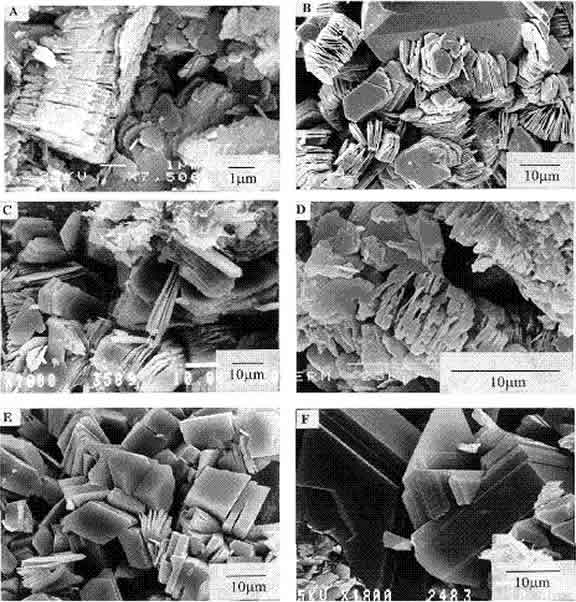
So lets take a look at the SEM photo-micrographs.
picture.php


In the middle of photo (a) we can clearly see these particles. Looking at the other photos it becomes self evident that these particles are thin sheet-like particles (platelets) and they have an hexagonal shape to them (d). There is also something else that is interesting about these platelets. Look at the arrow in photo (d). Look at the platelets. What's happened to them? They are all stacked up together. Why is that? What causes that?

So now we have established that the Aluminium and the Silicon as well as some of the Oxygen in the sample (of the red layer) is directly linked to these thin hexagonal platelets.

Has anyone ever had a grow your own crystal toy as a child? You get a tiny seed and place it in a solution and the seed grows and forms a shape. Different solutions give you different shapes. Well the exact same thing happens with platelets like these and also with the whitish grains you can see in the same SEM photos. These whitish crystals are rhomboidal (some say rhombohedral) in shape and because Fe and O are associated with them then we are sure that they are Fe2O3 - experience and reference shows us that this is correct.

Closer magnification as seen in Fig 9 - shows us to be correct.

picture.php


We also notice that there is another material present, namely a Carbon matrix. So now we know that Al cannot be free or elemental, it is bound with Si and O in the crystal. If it wasn't bound in the crystal then we would expect to see another particle that was of a different morphology (structure).

So what are these hexagonal platelets that contain Al, Si and O. These elements point us in the direction of Aluminosilicates, which are minerals or clays, but which one?

Well we could be here for days trying to find the right one. But do you remember the strange stacking? The thin hexagonal platelet. Yep, they are odd aren't they? Kind of stick in the mind as a feature that if you ever came across it again you'd think, "hey, I've seen that!".

Does this remind you of anything?
Biot226PhotoF.jpg


Or this? (Below are Scanning Electron Microscope Pictures of Kaolinite Interstratified with Illite. Note the platelets of Kaolin are easily observed. )

sem.jpg
http://www.smianalytical.com/clay-analysis.html
and how about this?

Biot226PhotoE.jpg


Remember the XEDS maps and how the Si is associated with Al, remember the identical peak ratios for the platelet

picture.php


Kaolin (Kaolinite) Al2Si2O5(OH)4 will give identical Al and Si peaks, it also has the same shape (as proven above), it also stacks just like the platelets are stacked in Jones' samples. I don't know of any other aluminosilicate material that stacks or has this shape. Does anyone else? Metamars, can you find a material that has these characteristics, but isn't kaolin? Kaolin is a natural mineral. It's morphology is thin platelets. There is no man made engineering going on, just mother nature some physics and chemistry. Wow, how cool is that, material that are nanometres thin are found naturally occurring in minerals.

Kaolin is used in thousands of materials. There is nothing odd or strange about it (except perhaps it's shape and the natural way it's platelets stack - which gave the game away). And there is no elemental aluminium in Kaoulin.

So what happens to the thermite reaction if there is no aluminium free to oxidise? Yep, that's correct, the thermite reaction cannot take place. This proves that the samples are not thermite and did not undergo a thermite reaction in the DSC. Something else reacted and because air was present then combustion most likely took place.

And that folks is how science is done.

Note that no one complains about elemental Oxygen. No one tries to say that the Oxygen isn't part of a compound with the Iron. Yet that is exactly what they do when they talk about the Aluminium. The data in the paper proves Fe2O3 crystals are present and the same data proves that Aluminium is bound up in platelets of Kaolin, so why is no one having a go at elemental O? Why just the Aluminium?

The paper also specifies an MEK test on sample to free this elemental Al, but it isn't any of the samples a,b,c,d that had the full analysis and DSC tests conducted. Infact it's another material altogether.

Yes, that looks about right. No-one ever measures particle size via their thickness. It's always across the largest diameter.

Imaginary experiment - imagine we take a whole range of diameters of hexagonal platelets, but their thickness doesn't change at 68nm. Now if we pass them through a mesh what is the determining factor for whether they are trapped in the mesh or fall through assuming the mesh hole is round?

That's right it's the platelet's diameter that determines whether it's collected or not. So we characterise materials via their diameter. In any case natural materials produced in mother nature are formed as crystals and do form at very small scales as I have shown.
"...consistent in shape, in composition, and in size leads me to believe that these are not naturally occurring materials". Huh. Imagine that. I'll just let Sunstealer address that:
Kaolin is a natural mineral. It's morphology is thin platelets. There is no man made engineering going on, just mother nature some physics and chemistry. Wow, how cool is that, material that are nanometres thin are found naturally occurring in minerals.
Shame for the thermite advocates that his statement was already refuted... back in April 2009. But it's good of them all to confirm kaolin for everyone in their work. :rolleyes:

More reading: http://www.internationalskeptics.com/forums/showthread.php?p=4607894#post4607894
 
Last edited:
I just let BYU know what he is doing. It seems likely that they may view this as likely to bring the school into disrepute.
 
If the Truthers think their pictures of "uniform structures" could only be due to some high-tech super-engineered wonder material, where do they think diamonds come from? Extraterrestrials?

Dr. Farrer's comments are laughably stupid. Which is probably why he hasn't taken his results to any legitimate analytical chemistry journals or conferences. Frankly, I don't think he believes it himself, or else he would have.
 
If the Truthers think their pictures of "uniform structures" could only be due to some high-tech super-engineered wonder material, where do they think diamonds come from? Extraterrestrials?

Or on a smaller scale, C-60, i.e. buckminsterfullerene, aka "Bucky Balls".

Ryan knows this, so I imagine he'll tune out here, but for anyone else curious: Naturally occuring regular microstructures such as those kaolin platelets are not rare. What does Farrer think crystals are?
 
"Not Rare" is an understatement. Aluminum oxide preferentially takes the form of those hexagonal plates, at about that size. Such structures make up a nontrivial fraction of the entire planet.

I'm also waiting to hear how that silicon got in there. Hmm, what to think, Inside Jerb or not? :p
 
If the Truthers think their pictures of "uniform structures" could only be due to some high-tech super-engineered wonder material, where do they think diamonds come from? Extraterrestrials?

Dr. Farrer's comments are laughably stupid. Which is probably why he hasn't taken his results to any legitimate analytical chemistry journals or conferences. Frankly, I don't think he believes it himself, or else he would have.
OMG

Ever look at 'raw' diamonds?

I think the laughably stupid comments are your own.

MM
 
OMG

Ever look at 'raw' diamonds?

I have no words for the stupidity of this...

:jaw-dropp will have to suffice.

MM, what, specifically, is the difference in crystal structure between "raw" diamond and "not raw" diamond?
 
Last edited:
I have no words for the stupidity of this...

:jaw-dropp will have to suffice.

MM, what, specifically, is the difference in crystal structure between "raw" diamond and "not raw" diamond?

You beat me to it. MM could have avoided this just by shoving diamond electron microscopy into Google images. It took me all of 30 seconds.

Again we see this Truther 'visualisation' syndrome. MM looks at a rough, shapeless uncut diamond and assumes there is no crystalline structure. Weird.
 
You beat me to it. MM could have avoided this just by shoving diamond electron microscopy into Google images. It took me all of 30 seconds.

Again we see this Truther 'visualisation' syndrome. MM looks at a rough, shapeless uncut diamond and assumes there is no crystalline structure. Weird.

Big surprise. These are the same folks that look at pictures of the WTC burning, and conclude the fires were "small."

It is a bit more pathetic when a self-proclaimed materials science expert makes such baffling claims, though.
 
So desperate for any kind of rebuttal you leap on uncut diamonds.

Go for it.

The real point is;

Physicist Jeff Farrer: "these are very sophisticated particles of very sophisticated materials. Not materials that we would expect to find in the demolition debris of a building. In order to get that kind of consistency with shape and size and to be that small, these really are sophisticated materials. And probably only developed in a laboratory. They maybe processed outside a laboratory but they are developed in a laboratory."

MM
 
So desperate for any kind of rebuttal you leap on uncut diamonds.

I didn't say uncut. I said "not-raw", which is the opposite of whatever you're defining "raw" diamond as.

And I ask again: what, specifically, is the difference in crystal structure between "raw" and "not-raw" diamond?
 
So desperate for any kind of rebuttal you leap on uncut diamonds.

You brought up that subject.


The real point is;

Physicist Jeff Farrer: "these are very sophisticated particles of very sophisticated materials. Not materials that we would expect to find in the demolition debris of a building. In order to get that kind of consistency with shape and size and to be that small, these really are sophisticated materials. And probably only developed in a laboratory. They maybe processed outside a laboratory but they are developed in a laboratory."

MM

My bolding.

Microscopic crystals are commonplace in nature. There's nothing 'sophisticated' about it.
 
So desperate for any kind of rebuttal you leap on uncut diamonds.

Go for it.

No. YOU leaped on uncut diamonds. You did not understand that crystaline structures are ubiquous in nature. Diamonds, whether cut or uncut, finished or unfinished, raw or processed, natural or artificial, will show their crystal structure under a microscope. Otherwise, they would not be diamonds. The crystal structure is what MAKES a diamond a diamond, by definition.

The real point is;

Physicist Jeff Farrer: "these are very sophisticated particles of very sophisticated materials.

No. They are naturally occurring crystals.

Not materials that we would expect to find in the demolition debris of a building.

Farrer is out of his field of expertise here. He has very likely never before or after analysed the debris of any other building.

In order to get that kind of consistency with shape and size and to be that small,

Consistency, as in "the yields are estimated to be approximately
1.5, 3, 6 and 7.5 kJ/g respectively"? With some samples, according to Niels Harrit, even not reacting at all? Let me illustrate that "consistency" for you:
  • Chip (a): |===
  • Chip (b): |======
  • Chip (c): |============
  • Chip (d): |===============
  • Chip (x): | (one of Harrits non-reacting specimen)

these really are sophisticated materials.

Not any more sophisticated than ordinary paint.

And probably only developed in a laboratory. They maybe processed outside a laboratory but they are developed in a laboratory."

No. Dug up from nature in mines.
 
Last edited:
No. YOU leaped on uncut diamonds. You did not understand that crystaline structures are ubiquous in nature. Diamonds, whether cut or uncut, finished or unfinished, raw or processed, natural or artificial, will show their crystal structure under a microscope. Otherwise, they would not be diamonds. The crystal structure is what MAKES a diamond a diamond, by definition.


No. They are naturally occurring crystals.


Farrer is out of his field of expertise here. He has very likely never before or after analysed the debris of any other building.


Consistency, as in "the yields are estimated to be approximately
1.5, 3, 6 and 7.5 kJ/g respectively"? With some samples, according to Niels Harrit, even not reacting at all? Let me illustrate that "consistency" for you:
  • Chip (a): |===
  • Chip (b): |======
  • Chip (c): |============
  • Chip (d): |===============
  • Chip (x): | (one of Harrits non-reacting specimen)


Not any more sophisticated than ordinary paint.


No. Dug up from nature in mines.

I agree with your diamond statement but the rest of your post is unsupported crap.

p.s. I don't believe any diamond dust was discovered.

MM
 
Last edited:
You've been called on your accusations of "techno-babble" and "crap" elsewhere, yet were unable to substantiate your lay meanderings. Why should we believe you this time?

Either come up with a detailed response to Oystein's post or admit that you're out of your depth.
 

ISF - Join now!

Every member here is approved by hand. No bots, no spam, just people who care about evidence and honest debate.

Membership is free!

Create your free account

Back
Top Bottom