• Security incident: ISF was recently accessed by intruders. Please change your password, and change it anywhere else you used it. Read more

How to increase your IQ level ?

In that regard I would tend not to look at the composite score but the individual cognitive area scores. If I want to hire a design engineer, I might be attracted by a high perceptual reasoning score even if, say, the mental processing speed score were lower.
In the case of children, there is an entire Child Study Team evaluating the kid (as you of course know, but being said for readers who may not), looking at all sorts of information, both broadly and with great focus.
Winkie noted, but yes there are a number of concerns about the various biases that might affect a score on one the standard tests. I tend to lump all that into the general problem of what intelligence actually might mean compared to how one proposes to measure it.
My wife administers tests on students ranging from 4 years old to 26. She believes quite firmly that the test is significantly biased. Her favorite example is when testing a 4yo and using the standardized language in questioning, the child might not know what a television is. But they know exactly what a TV is, yet she cannot adjust the question in some testing structures (in some, particularly ESL kids, she can).
 
I once had an aptitude test when looking for a career change (ca. 1985) that had a question "Do you know how to use a slide rule?".
I didn't, but they had been mostly out of style since personal calculators got cheap about 10 years earlier. I figured it was just an old test, with that question assessing your mathematical aptitude. I think it failed on that account.
 
It's a bit odd that we would be more concerned to give a 130+ IQ child extra support instead of one with a below 90 IQ.
Supposedly the smart kids will be able to figure things out for themselves.
Different kinds of support. Like, one gets placed in remedial studies, the other in advanced placement or skipping a grade.
 
Your IQ can be raised, even very high, using a relatively simple method. It allows you to raise your intelligence level to 180, 200, 400, 600, or even 1600 points. To achieve this, you need to properly prepare yourself and tune yourself to achieve a higher IQ. In the proposed method, your mind is simply transported to a higher IQ level. You can tell yourself you're going to achieve a higher IQ, for example, 180, and you shift to that level. This method allows you to achieve up to 1600 points, although not immediately. You should first try lower levels to mature towards 1600 or 1200 points.
To support this method, I suggest listening to music from the radio through large headphones. At very high levels, the music begins to sound noticeably better, and interesting sound effects appear. Similarly, analyzing the lyrics of a song you're listening to allows you to practice at higher levels.
The rule is that the maximum level, the suggested maximum, is ten times your normal IQ level. So, if you have an IQ of 100, you'll get 1,000 points; if you have an IQ of 120, you'll get 1,200 points; and if you have an IQ of 160, you'll get 1,600 points.
In practice, I recommend raising your IQ to 300 points. You should aim to reach 300 points, and only occasionally go above 1,000 points.
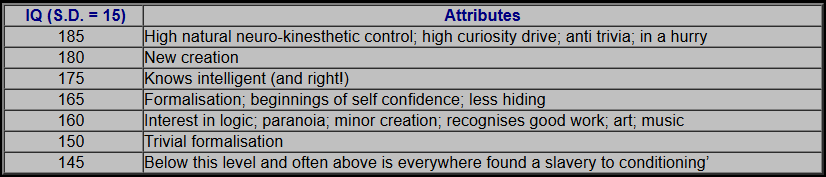
To begin, it's worth practicing with the levels presented in the table below.

p2eiGHO5_o.png


Gregory Podgorniak, Poland, 2023

about the author, My name is Gregory Podgorniak (brn. 01.1977, Szczecinek, West Pomerania, Poland). I am working on field of natural as well as social sciences. During philosophical studies at Adam Mickiewicz University in Poznan (1996-1999) I was actively act in student scientific organisation, got a scientific scholarship, and one from my articles titled Circulus vitiosus and fourfold petitio principii in the system of Descartes was published in Humanistic Drafts of Publishing House of Humaniora Foundation in Poznan, no. 6, 1998. Unfortunately certain fate events made impossible to me continuing studies to master's and later doctor's degree. Thence I was forced to be content only with a title of bachelor.
Thanks to deep and penetrating researchings I was able to establish indisputably some number of my past incarnations reaching of ancient period, these data are certain, these incarnations are: Auguste Comte (1798-1857) French philosopher and sociologist, Edme Mariotte (1620-1684) French physicist and meteorologist, Aenesidemus (1 st century BC) Greek sceptical philosopher, Arcesilaus (315-241 BC) Greek sceptical philosopher, Gorgias (485-380 BC) Greek sophist.

see also my threads on this forum:

Nuclear war and going back of Hitler
A new approach to the evolution and structure of society
Does qualitative change come down to quantitative change ?
An extended version of A. Comte's theory of science

For your fascinating theory to qualify as scientific, it needs to be:

Observable​
Measurable​
Replicable​
​
In addition, as an IQ test, it needs to be sampled widely, and validated against a Normal Distribution. It also needs to have predictive value. For example, indicating special needs, such as possible difficulty in learning to read or write and whether it can select those who can handle academia, etc.
​
​
​
 
IQ test to seem to measure something meaningful. If nothing else, they seem to strongly correlate with socioeconomic success in western societies. So, they do in fact measure something other than just the ability to take IQ tests.

That being said, the OP is nonsense.
 
It's a bit odd that we would be more concerned to give a 130+ IQ child extra support instead of one with a below 90 IQ.
Supposedly the smart kids will be able to figure things out for themselves.
That's the concern. Got to identify the potential trouble-makers before they lead the normies astray.
 
Your IQ can be raised, even very high, using a relatively simple method. It allows you to raise your intelligence level to 180, 200, 400, 600, or even 1600 points. To achieve this, you need to properly prepare yourself and tune yourself to achieve a higher IQ. In the proposed method, your mind is simply transported to a higher IQ level. You can tell yourself you're going to achieve a higher IQ, for example, 180, and you shift to that level. This method allows you to achieve up to 1600 points, although not immediately. You should first try lower levels to mature towards 1600 or 1200 points.
To support this method, I suggest listening to music from the radio through large headphones. At very high levels, the music begins to sound noticeably better, and interesting sound effects appear. Similarly, analyzing the lyrics of a song you're listening to allows you to practice at higher levels.
The rule is that the maximum level, the suggested maximum, is ten times your normal IQ level. So, if you have an IQ of 100, you'll get 1,000 points; if you have an IQ of 120, you'll get 1,200 points; and if you have an IQ of 160, you'll get 1,600 points.
In practice, I recommend raising your IQ to 300 points. You should aim to reach 300 points, and only occasionally go above 1,000 points.
To begin, it's worth practicing with the levels presented in the table below.

p2eiGHO5_o.png


Gregory Podgorniak, Poland, 2023

about the author, My name is Gregory Podgorniak (brn. 01.1977, Szczecinek, West Pomerania, Poland). I am working on field of natural as well as social sciences. During philosophical studies at Adam Mickiewicz University in Poznan (1996-1999) I was actively act in student scientific organisation, got a scientific scholarship, and one from my articles titled Circulus vitiosus and fourfold petitio principii in the system of Descartes was published in Humanistic Drafts of Publishing House of Humaniora Foundation in Poznan, no. 6, 1998. Unfortunately certain fate events made impossible to me continuing studies to master's and later doctor's degree. Thence I was forced to be content only with a title of bachelor.
Thanks to deep and penetrating researchings I was able to establish indisputably some number of my past incarnations reaching of ancient period, these data are certain, these incarnations are: Auguste Comte (1798-1857) French philosopher and sociologist, Edme Mariotte (1620-1684) French physicist and meteorologist, Aenesidemus (1 st century BC) Greek sceptical philosopher, Arcesilaus (315-241 BC) Greek sceptical philosopher, Gorgias (485-380 BC) Greek sophist.

see also my threads on this forum:

Nuclear war and going back of Hitler
A new approach to the evolution and structure of society
Does qualitative change come down to quantitative change ?
An extended version of A. Comte's theory of science
Without the baked beans
 
I tested well enough to join MENSA, just squeaking by their lower limit. I went to a couple gatherings and found them quite boring. There's no question I am quite intelligent in some areas, but admittedly quite dumb in others. I like to say that yes, I can parse complex computer code, but can't keep score at bowling.
 
I tested well enough to join MENSA, just squeaking by their lower limit. I went to a couple gatherings and found them quite boring. There's no question I am quite intelligent in some areas, but admittedly quite dumb in others. I like to say that yes, I can parse complex computer code, but can't keep score at bowling.
Just boring and not insufferable?
 
In the case of children, there is an entire Child Study Team evaluating the kid (as you of course know, but being said for readers who may not), looking at all sorts of information, both broadly and with great focus.

My wife administers tests on students ranging from 4 years old to 26. She believes quite firmly that the test is significantly biased. Her favorite example is when testing a 4yo and using the standardized language in questioning, the child might not know what a television is. But they know exactly what a TV is, yet she cannot adjust the question in some testing structures (in some, particularly ESL kids, she can).
I had a nice Hi Log/Log slide rule in the 8th grade. Never needed for shool work at that level.
 
I own three slide rules. One was my father's. The other was gifted to be because it's the miniature model the Apollo astronauts took with them to the Moon. The other...I...bought.
I have one from one of my ancestors, no idea because we had some lawyers, preachers, and semi-literates but nobody that would have needed a slide rule.
 
My paternal grandfather (whom I never knew) was a master carpenter. He owned a
peculiarly complex carpenter's square, with which and an ordinary yardstick he could calculate
footages of timber needed for building, using them "like a slide rule," as my father put it.
He could build a two-story frame house and finish with just a couple of inches of 2x4 left over.

No, not a sackett story. I've heard and seen references elsewhere to this particular skill.
 
My paternal grandfather (whom I never knew) was a master carpenter. He owned a
peculiarly complex carpenter's square, with which and an ordinary yardstick he could calculate
footages of timber needed for building, using them "like a slide rule," as my father put it.
He could build a two-story frame house and finish with just a couple of inches of 2x4 left over.

No, not a sackett story. I've heard and seen references elsewhere to this particular skill.
I have such a square. It has 'board feet' scale on it to do so, but we don't buy by board feet much nowadays.

I also have a 1940s little blue pamphlet/book distributed by the United Brotherhood of Carpenters and Joiners that shows how to make complex geometric shapes using the square and a straight edge (often a level). I'm talking from simple ploygons to freaking mandalas.
 

ISF - Join now!

Every member here is approved by hand. No bots, no spam, just people who care about evidence and honest debate.

Membership is free!

Create your free account

Back
Top Bottom