• Quick note - the problem with Youtube videos not embedding on the forum appears to have been fixed, thanks to ZiprHead. If you do still see problems let me know.

Gage and Szamboti to speak at New Jersey Institute of Technology

I seriously doubt to toll would be any different.

There's no reason the effect would have been less if they stayed standing. The significance of WTC7 is a fantasy, they even claim no one knew about it.

WTC 7 killed no one, certainly.

Not to get into a deep and ridiculous discussion of number of dead, the towers killed everyone still in the stairwells, some of whom would have lived had the collapse arrested, anyone in the lobby, and anywhere too close to the debris fall zone who wasn't under sufficient cover, also died but may have lived if the collapse arrested.
 
.. The significance of WTC7 is a fantasy, they even claim no one knew about it.
Another example of their limited comprehension - the perpetual "single issue out of context" focus.

They wouldn't even recognise let alone admit that those two are in direct conflict - self rebuttal.
 
Do you (or does anyone else) know how much orthogonal support was provided by the corners? The exterior columns were connected to the floors all the way around the building, and my guess is those connections provided the overwhelming majority of orthogonal support. Would cutting just the corners actually make that much difference?

Orethogonal support is a nonsense concept here. The slabs were what would hold the 4 sides at 90° to each other....

IF IF IF there were no floors... and there was an oblique wind load the thing could go parallelogram... bending the corner spandrel plates. Lotsa leverage I would think.
 
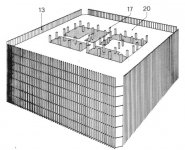
What "corner columns" are we discussing here? In looking at the drawings, there were, strictly speaking, no corner columns, but there were 69 columns on each side of the Twin Towers, arranged in 23 groups of three connected by spandrels, and the "corners" were just the end columns on each side. Which would make for 8 corner columns, connected to each other by a diagonal member, IIRC, and the whole assembly covered by an aluminum cover. Am I wrong?
 

Attachments

  • corner.jpg
    corner.jpg
    50.3 KB · Views: 1
What "corner columns" are we discussing here? In looking at the drawings, there were, strictly speaking, no corner columns, but there were 69 columns on each side of the Twin Towers, arranged in 23 groups of three connected by spandrels, and the "corners" were just the end columns on each side. Which would make for 8 corner columns, connected to each other by a diagonal member, IIRC, and the whole assembly covered by an aluminum cover. Am I wrong?

No there were actually 4 corner columns! Look at the plaza level. The wide columns are the tridents... but the diagonal corners had 2 "14x14" columns... which likely only supported their own weight and no floor loads!
 

Attachments

Do you (or does anyone else) know how much orthogonal support was provided by the corners?
Very little and of near zero relevance to the actual collapse mechanism. It is a false claim to support Tony's model of mechanism - which he has never described comprehensively because it is not a coherent model.

The exterior columns were connected to the floors all the way around the building, and my guess is those connections provided the overwhelming majority of orthogonal support.
True enough in the original undamaged situation. BUT triply irrelevant in the context of Tony's nonsense claims:

1) He shows no understanding of the three stages of the actual mechanism viz "initiation" >> "transition" >> "progression. Whether he is pretending ignorance or genuinely does not comprehend matters not.

2) He continues to confuse sequence - getting simple concepts like "BEFORE" and "AFTER" reversed.

3) By the time of the aspects he is claiming:
(a) "Initiation" had dropped the top block;
(b) "transition" had started ROOSD - those floors already removed; and
(c) "progression" was under way - three mechanisms viz "ROOSD", perimeter peel off and core strip down. AND

(d) in that sequence - look to the posting history to see how often Tony confuses the sequence order.

In that setting the corner aspects are irrelevant - second or lower order magnitude and overwhelmed by the energy of the actual collapse mechanism.

Would cutting just the corners actually make that much difference?
No - whenever it was done. Little if any effect at any stage and utterly useless at the stage of progress of collapse that Tony claims.

Remember that all of Tony's claims make the same two foundation errors:
(i) He always assumes false premises to support his pre-determined conclusion of CD; AND
(ii) He always gets the sequence of happenings wrong. Usually looking for things "AFTER" which have already happened "BEFORE" (or would have happened "BEFORE" except they were impossible - e.g. Missing Jolt and Axial Impact of "dropping" columns.)

Further explanation available if needed OR references to multiple previous explanations.

And no apology for both instances of "always" - let me know if you find any exceptions. ;)
 
Orethogonal support is a nonsense concept here. The slabs were what would hold the 4 sides at 90° to each other....
Yes

IF IF IF there were no floors... and there was an oblique wind load the thing could go parallelogram...
Yes.....but.... Reality was that at the time that Tony's claim refers to the floors were already gone. Yes the "parallelogram" is theoretically possible BUT not in the what - four or five (Maximum - probably about 1 - someone interested can do the check ??) seconds - "window of opportunity" between "floors gone" and "perimeter peeled off".

...bending the corner spandrel plates. Lotsa leverage I would think.
Yes - if that leverage in the horizontal plane ever had a chance to come into effect.

:thumbsup:
 
Last edited:
Page 1 of a reply to post # 642


Horizontal red lines indicate the matrix system of interconnection of the 3 story tall (36 feet)
by three column wide (ten foot) vertical exterior North face of the WTC1 twin tower.
The two vertical green lines indicate where the north face meets the bevel.
The violet vertical lines shows the placement of the bevel vertical columns 200 (NE bevel) and 100 (NW bevel)
The Blue vertical line indicates the exact center column of the vertical wall.
The exact same scheme ofset con nection shown is utilized on all four faces of both WTC twin towers.
Each column/spandrel assembly is connected to it's mate (horizontal and vertical) by high strength bolts
at twelve separate locations as shown by the black dots.
Every column/spandrel assembly is also married at the three intersecting floor truss assemblies
with welds and bolts for a total of twenty one different connection points.

Any disagreement so far Gamolon ?

No ? Excellent
Page 2 of reply to post # 642
Exhibit 2
WTC1 schematic of WTC1 north face bevel structure


The NW bevel has column 100 missing per design on every odd numbered floors.
The NE bevel is designed exactly the same except column 200 is missing
on every even numbered floors.
This scheme is outlined in exhibit 2
At floor 105 the NW bevel column 100 is missing rising to floor 106
At floor 104 the NW bevel column is present rising to floor 105.
This pattern is repeated at all the bevels above the 7th floor to the 110th floor as shown in the schematic.
Pay special note to column 100 in the NW bevel at floor 95 rising to floor 96. Correct - No vertical column 100.

Exhibit 3 magnification of the staggered bevel column system.


The bevel columns alternating sequence is featured at the left of image.
The average standard thirty six foot tall by ten foot wide exterior column structure is three floors tall while
the standard bevel column structure is
twenty four feel tall and rises only two stories.

Comparing exhibits one ,two,and three we see the entire vertical column structures
of the WTC1 wall are systematically staggered to ensure all bolted external
column sectors connections are distributed equally and uniformly.

Do we agree ?
 
I believe most of us have a pretty good general idea of how the towers were constructed.

Will an answer be forthcoming wrt why there are no images of any exterior columns, including those at the building corners, being explosively severed prior to the upper section beginning its downward movement?
Note: Neither are there any images illustrating perimeter columns being severed by these supposed explosives ahead of the destruction progression. If severing was required to effect said destruction then there should be images at some point at or soon after, initiation of collapse, that demonstrates it was occurring.
No ? Excellent
Page 2 of reply to post # 642
Exhibit 2
WTC1 schematic of WTC1 north face bevel structure

[qimg]http://i1083.photobucket.com/albums/j394/xfonebonex1/zzzBmp_zpsrtistef8.png[/qimg]

The NW bevel has column 100 missing per design on every odd numbered floors.
The NE bevel is designed exactly the same except column 200 is missing
on every even numbered floors.
This scheme is outlined in exhibit 2
At floor 105 the NW bevel column 100 is missing rising to floor 106
...........<snip>.......
Do we agree ?

I wait with baited breath to see whether or not this will EVER come around to answering the query posed. I have my doubts, prove them unfounded.
 
Last edited:
Except ... many of those 20 stories show the very same evidence of 'explosions' that you claimed earlier yet now deny.

My sincere advice - get your story straight in advance, otherwise you end up improvising crap as you go along and looking silly.

Do you speak English?
 
The core up at the collapse zone in 1wtc and something like 20+ columns which were not inside or adjacent to elevator shafts. It would be pretty hard to place and wires those... or impossible and not have any notice. Or a single survivor including those who were not in the towers but worked in those floors reporting work done these columns.

Any layout I have seen of the Twin Tower central cores seem to show that the vast majority of the core columns were accessible from the elevator shafts.
 
Last edited:
Any layout I have seen of the Twin Tower central cores seem to show that the vast majority of the core columns were accessible from the elevator shafts.
For his part JSandero has no need to follow whatever false premise got introduced regarding the placement of any devices, and most people don't care about means and methods of implementation. This is an unnecessary red herring which belies to address if the devices were even there to begin with, and for the last several years your argument for that has been that there was "no jolt".

The core up at the collapse zone in 1wtc and something like 20+ columns which were not inside or adjacent to elevator shafts. It would be pretty hard to place and wires those... or impossible and not have any notice. Or a single survivor including those who were not in the towers but worked in those floors reporting work done these columns.

Sandero, nothing personal, but means and methods as I explain above are only relevant if these people can make a cognoscente argument that establishes the devices already got there, because that's the point Tony's already at. There are a multitude of ways - however unlikely - that this could have, would have, or should have gotten carried out. At the end of the day, Tony already argues they got there, and if he could ever prove the devices got there, then how it was done may be relevant to figuring out how to avoid a copycat incident, but in an event being discussed in the past tense this is a matter of there is either evidence they got there already or there's not. Tony's evidence of the collapse instigator is pointing out a trait of the collapse that is common in all "post-initiation" scenarios and which has little if anything in relevance to what actually does the "instigating"

Whilst I think there are plenty of flaws in the implementation factor myself it seems a waste of time to entertain the false premise unless to kill time, in which case... you can - if you want - continue with it if you're aware of that disclaimer.
 
Last edited:
For his part JSandero has no need to follow whatever false premise got introduced regarding the placement of any devices, and most people don't care about means and methods of implementation. This is an unnecessary red herring which belies to address if the devices were even there to begin with, and for the last several years your argument for that has been that there was "no jolt".


Sandero, nothing personal, but means and methods as I explain above are only relevant if these people can make a cognoscente argument that establishes the devices already got there, because that's the point Tony's already at. There are a multitude of ways - however unlikely - that this could have, would have, or should have gotten carried out. At the end of the day, Tony already argues they got there, and if he could ever prove the devices got there, then how it was done may be relevant to figuring out how to avoid a copycat incident, but in an event being discussed in the past tense this is a matter of there is either evidence they got there already or there's not. Tony's evidence of the collapse instigator is pointing out a trait of the collapse that is common in all "post-initiation" scenarios and which has little if anything in relevance to what actually does the "instigating"

Whilst I think there are plenty of flaws in the implementation factor myself it seems a waste of time to entertain the false premise unless to kill time, in which case... you can - if you want - continue with it if you're aware of that disclaimer.

I am arguing the opportunity part of the classic means, motive, and opportunity paradigm against SanderO's claim that the core columns were not accessible from the elevator shafts. They certainly are in all layouts of the core and elevator shafts I have seen.

We also know there was an elevator modernization project going on in the Twin Towers for 9 months prior to Sept. 11, 2001.

The above two points actually provide for both means and opportunity.
 
I am arguing the opportunity part of the classic means, motive, and opportunity paradigm against SanderO's claim that the core columns were not accessible from the elevator shafts.

Before arguing means, motive and opportunity, it's a good idea to establish that the crime has actually been committed. Your eyes are the only ones round here in which you've done that.

Dave

PS: Tony will now pretend I'm suggesting the 9/11 attacks never happened...
 
I am arguing the opportunity part of the classic means, motive, and opportunity paradigm against SanderO's claim that the core columns were not accessible from the elevator shafts. They certainly are in all layouts of the core and elevator shafts I have seen.

We also know there was an elevator modernization project going on in the Twin Towers for 9 months prior to Sept. 11, 2001.

The above two points actually provide for both means and opportunity.

What type of charges could have survived,the impact, the reactions in the fires and cut the steel Tony, and how would you ignite it?
 
Before arguing means, motive and opportunity, it's a good idea to establish that the crime has actually been committed. Your eyes are the only ones round here in which you've done that.

Dave

PS: Tony will now pretend I'm suggesting the 9/11 attacks never happened...

On this forum it is probably fair to say I am talking to a fringe element.
 
What type of charges could have survived,the impact, the reactions in the fires and cut the steel Tony, and how would you ignite it?

The collapses actually started above the aircraft impact damage, or at the very top of it where damage was light.

In addition, the first floors to collapse after the initiation in the North Tower were those above the initiation floor, not below. You should mull that over a little.
 
The collapses actually started above the aircraft impact damage, or at the very top of it where damage was light.

In addition, the first floors to collapse after the initiation in the North Tower were those above the initiation floor, not below. You should mull that over a little.

Because it doesn't jibe with the normal direction that a fire propagates; in general, flames and heat travel downwards through a structure.

Oh, wait...

Dave
 

Back
Top Bottom